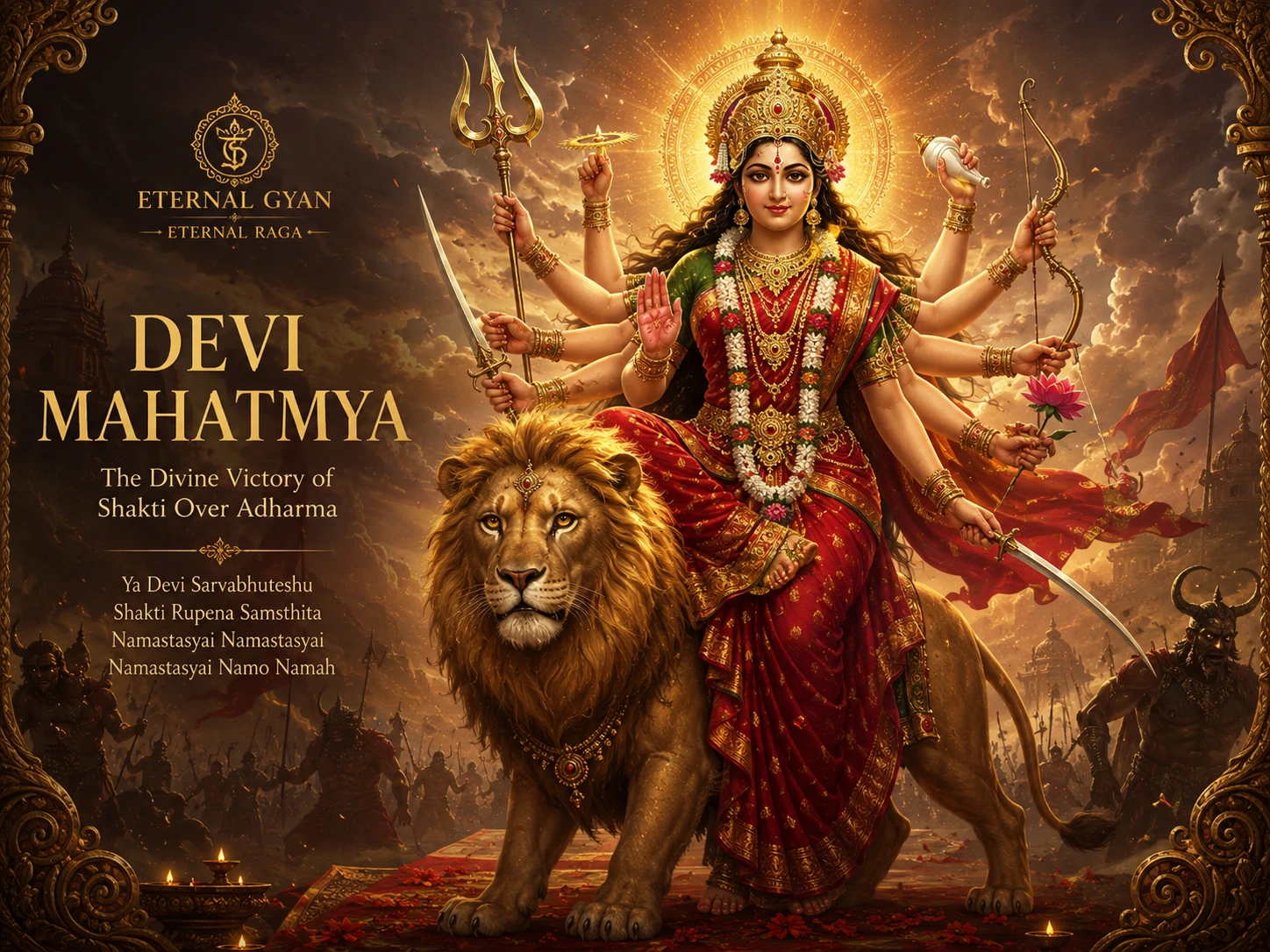
Devi Mahatmya -- The Three Charitas That Changed How India Worships the Feminine
देवी माहात्म्य -- तीन चरित्र जिन्होंने भारत की स्त्री-शक्ति उपासना बदल दी
The Devi Mahatmya opens with a devastatingly simple premise: the gods have lost.
Not a skirmish. Not a setback. A total, unambiguous, categorical defeat. The male deities of the Hindu pantheon -- Brahma, Vishnu, Shiva, Indra, Agni, Vayu, the entire divine assembly -- have been driven from heaven by forces they cannot overcome. And the reason they cannot overcome them is built into the architecture of the cosmos: the demons have obtained boons that make them immune to every male being in creation. No god can kill them. No man can touch them. The system has produced a loophole, and the only way to close it is through a power that the existing system never anticipated.
That power is the Devi -- the Goddess -- and the Devi Mahatmya (Sanskrit: devimahAtmyam, 'Glory of the Goddess') is the text that gives her theology, narrative, and worship framework its definitive form. Composed between 400 and 600 CE, embedded as chapters 81-93 of the Markandeya Purana, this 700-verse text is known by three names: Devi Mahatmya (the scholarly title), Durga Saptashati (the 700 verses, used in North India), and Chandi Path (used in Bengal and eastern India). It is recited in its entirety during every Navaratri, chanted in Durga Puja pandals from Kolkata to Kuala Lumpur, and forms the liturgical backbone of Shaktism -- the worship of the Divine Feminine as the supreme reality.
For a UPSC aspirant studying the religious movements of medieval India, for a literature student at JNU encountering feminist theology, for a startup founder in Koramangala who lights agarbatti before Durga every morning without quite knowing why -- the Devi Mahatmya is the source code.
The Devi Mahatmya has a layered narrative structure. The outermost frame is set in the Markandeya Purana, where the sage Markandeya narrates stories to his disciples. Within this, a rishi named Medhas tells two troubled men -- Suratha, a dethroned king, and Samadhi, a merchant betrayed by his own family -- about the nature of Mahamaya (the Great Illusion). Why, they ask, are we still attached to the people and situations that have caused us so much pain? Medhas answers by recounting three episodes (charitas) of the Goddess destroying demons. The message is clear: the demons outside mirror the demons inside. Liberation from external oppression and liberation from internal delusion are the same battle.
This framing device is often overlooked but is theologically crucial. The Devi Mahatmya is not merely a war narrative. It is a text about psychological liberation delivered through mythological combat. The king has lost his kingdom (external power), the merchant has lost his family's loyalty (emotional bonds), and both are trapped by their own attachment. The Goddess's battles are the cosmic-scale version of what every human being faces: the fight against inertia (tamas), unchecked ambition (rajas), and intellectual arrogance (sattva corrupted by ego).
This three-guna mapping is the structural genius of the text. Each charita corresponds to one of the three gunas of Samkhya philosophy, and each presiding goddess embodies the power needed to overcome that particular mode of ignorance.
The Prathama Charita (First Episode, Chapter 1) is the shortest and the darkest. Its presiding deity is Maha Kali, and the guna it addresses is tamas -- cosmic inertia, ignorance, the sleep of consciousness.
At the dawn of a new creation cycle, Vishnu lies asleep on the cosmic serpent Shesha in the primordial ocean. From the wax of his ears, two demons emerge: Madhu and Kaitabha. They immediately begin terrorizing Brahma, who sits on the lotus growing from Vishnu's navel. Brahma tries to wake Vishnu but cannot -- because Vishnu is held in Yoga Nidra, the cosmic sleep induced by Mahamaya herself.
Brahma's only recourse is to hymn the Goddess directly. He praises her as the power that even Vishnu cannot resist -- the force that puts the Preserver to sleep and the force that can wake him. This is a radical theological statement: the Goddess is not Vishnu's servant or accessory. She is the power without which Vishnu is literally unconscious. She is Shakti -- the activating energy without which Shiva is shava (corpse).
Moved by Brahma's hymn, the Goddess withdraws from Vishnu's body. He wakes, engages Madhu and Kaitabha in combat for five thousand years, and ultimately kills them by resting their heads on his thigh and decapitating them with the Sudarshana Chakra -- but only after the Goddess bewilders the demons into offering Vishnu a boon, and Vishnu asks to be the one who kills them.
The First Charita's message is foundational: before any action is possible, consciousness must awaken. The battle against tamas is not fought with weapons but with awareness. For a college student in Kota who can't get out of bed to study for JEE, for a professional in Pune battling burnout and inertia after a layoff, the First Charita speaks directly: your first enemy is not the world. It is the sleep inside you. And the power to wake up is feminine.
या देवी सर्वभूतेषु शक्तिरूपेण संस्थिता। नमस्तस्यै नमस्तस्यै नमस्तस्यै नमो नमः॥
yā devī sarvabhūteṣu śaktirūpeṇa saṃsthitā | namastasyai namastasyai namastasyai namo namaḥ ||
To that Goddess who abides in all beings in the form of Power -- salutations to Her, salutations to Her, salutations to Her, again and again.
— Devi Mahatmya (Markandeya Purana), Chapter 5 (Tantroktam Devi Suktam), Verse 12
The Madhyama Charita (Middle Episode, Chapters 2-4) is the most famous of the three -- the origin of the Mahishasura Mardini icon that dominates Navaratri worship across India. Its presiding deity is Maha Lakshmi (not to be confused with the Lakshmi of wealth; here she represents the totality of divine power in its active, rajasic mode), and the guna it addresses is rajas -- unchecked ambition, aggression, the drive to dominate.
Mahishasura, the buffalo demon, has obtained Brahma's boon: no god, no man, no demon can kill him. Drunk on this invincibility, he conquers heaven, displaces Indra, usurps the positions of Surya, Chandra, Vayu, Agni, Varuna, and Yama. The universe is under total demonic control.
The defeated gods assemble before Vishnu and Shiva. In their collective fury, a blazing tejas (divine energy) pours from their bodies and coalesces into a single female form. This is the birth of Durga -- not born from a womb but from the concentrated rage of every god in the cosmos. Each deity contributes: Shiva's tejas forms her face. Vishnu's energy shapes her arms. Brahma's light creates her feet. Indra gives her his vajra. Vishnu gives Sudarshana. Shiva gives the Trishula. Himavan gives the lion as her mount.
The theological implication is staggering: the Goddess is not lesser than any god. She is the unified power of all gods. She is what happens when the entire masculine divine admits its limitations and pools everything it has into a single feminine expression.
The battle with Mahishasura is prolonged and savage. His generals -- Chikshura, Chamara, Udagra, Mahahanu, Bidala, Tamra -- fall one by one. Mahishasura himself shapeshifts continuously: from buffalo to lion to human to elephant to buffalo again. Finally, the Goddess pins the buffalo with her foot, strikes him with her spear as he emerges from the buffalo's mouth in human form, and beheads him. This is the image on every Durga Puja pandal: the ten-armed Goddess, lion beneath her, foot on the buffalo's neck, trident piercing the demon -- the Mahishasura Mardini.
For modern India, the Second Charita is the story of systemic oppression overthrown by a power the system never anticipated. When a Dalit girl from Muzaffarpur cracks NEET, when a woman from Dharavi wins a national scholarship, when a female IPS officer takes charge of a district no one else wanted -- they are, in a sense, the Mahishasura Mardini narrative made real. The system said: no existing power can defeat this problem. The answer came from a direction the system had dismissed.
The Uttama Charita (Final Episode, Chapters 5-13) is the longest and most psychologically complex. Its presiding deity is Maha Sarasvati, and the guna it addresses is sattva -- not the pure, beneficial sattva, but sattva corrupted by ego, the most dangerous ignorance of all because it believes it is wisdom.
The demons Shumbha and Nishumbha have conquered heaven through a different strategy: not brute force alone but a combination of power, wealth, and arrogance. They have stolen the domains of Surya, Chandra, Kubera, Yama, and Varuna. They are, in modern terms, the oligarchs -- those who accumulate every form of power and believe their accumulation makes them invincible.
Shumbha sends an emissary to the Goddess (who has appeared as Kaushiki from Parvati's body) proposing marriage: 'You are the most beautiful woman; I am the most powerful being. We belong together.' The Goddess's response is devastating and deeply feminist: 'I have made a vow that I will marry only the one who defeats me in battle. Come and fight, or send someone who can.'
What follows is a cascading series of battles. First come generals: Dhumralochana, who is reduced to ash by a single 'humkara' (the syllable HUM) from the Goddess. Then Chanda and Munda, whom Kali -- emerging from the Goddess's forehead as a terrifying dark form -- beheads (earning the name Chamunda). Then Raktabija, the demon whose every drop of blood spawns a new clone -- a brilliant metaphor for how systemic problems multiply when attacked superficially. Kali solves this by drinking every drop of Raktabija's blood before it hits the ground, preventing regeneration.
Finally, Shumbha and Nishumbha face the Goddess directly. In a pivotal theological exchange, Shumbha taunts: 'You rely on the strength of others!' The Goddess responds: 'I am alone in this universe. These other forms are merely my projections. Watch as they merge back into me.' Every emanation -- Kali, the Saptamatrikas, the Shaktis of every god -- withdraws into the Goddess's single body. She defeats Shumbha alone, proving that she is not a committee of borrowed powers but the singular source from which all power emanates.
This is the highest theology of the Devi Mahatmya: the Goddess is not one of many deities. She is the one reality appearing as many. Advaita, applied to the Feminine Divine.
The Three Charitas -- Structure, Theology, and Meaning
| Aspect | Prathama Charita (Ch 1) | Madhyama Charita (Ch 2-4) | Uttama Charita (Ch 5-13) |
|---|---|---|---|
| Presiding Goddess | Maha Kali | Maha Lakshmi | Maha Sarasvati |
| Guna Addressed | Tamas (inertia, sleep) | Rajas (ambition, aggression) | Sattva (ego disguised as wisdom) |
| Primary Demon(s) | Madhu and Kaitabha | Mahishasura | Shumbha and Nishumbha (+ Raktabija) |
| How Demon Gained Power | Emerged from Vishnu's earwax during cosmic sleep | Boon from Brahma: no male being can kill him | Accumulated all divine positions and powers |
| Goddess's Method | Withdraws Yoga Nidra; bewilders demons | Created from combined tejas of all gods; direct combat | Absorbs all emanations back into herself; fights alone |
| Key Theological Point | Shakti is the power behind all gods -- even Vishnu | The Goddess is the unified power of the entire pantheon | The Goddess is the sole reality; all forms are her projections |
| Modern Parallel | Breaking through depression and inertia | Overcoming systemic oppression with unexpected strength | Defeating arrogance that disguises itself as competence |
| Navaratri Days | Days 1-3 (Durga/Kali worship) | Days 4-6 (Lakshmi worship) | Days 7-9 (Sarasvati worship) |
The three-guna mapping to three charitas is a traditional interpretive framework, not explicitly stated in the text itself. The Navaratri day correspondence follows the most widely observed North Indian tradition.
The Devi Mahatmya is not merely read. It is performed. The Chandi Path -- the complete recitation of all 700 verses -- is one of the most widespread liturgical practices in Hinduism. During Navaratri, millions of households and temples across India recite the full text over nine nights. The recitation is treated as a single, continuous mantra -- not a narrative to be intellectually understood but a sonic architecture that transforms consciousness through vibration.
The text has acquired six 'angas' (limbs or appendages) that frame the recitation: the Devi Kavacham (armour), Argala Stotram (bolt), Keelakam (wedge), Ratri Suktam, Devi Suktam, and Devi Atharva Sheersham. These limbs create a ritual container -- you armour yourself, unlock the text, remove obstacles, and then enter the seven hundred verses. The structure mirrors tantric sadhana: preparation, invocation, immersion, and integration.
In Bengal, the Devi Mahatmya is inseparable from Durga Puja -- the largest cultural festival in eastern India. The Kolkata Durga Puja, which received UNESCO Intangible Cultural Heritage status in 2021, is a direct artistic expression of the Madhyama Charita. The immersion (visarjan) of the Durga idol on Dashami represents the Goddess's return to Kailasha after the battle. For the Bengali diaspora -- from Silicon Valley to Singapore -- Durga Puja is not just a festival. It is an annual re-enactment of the Devi Mahatmya, a five-day lived experience of the scripture.
The economic scale is massive. The Kolkata Durga Puja alone generates an estimated Rs 40,000 crore annually, making it one of the largest religiously-driven economic events on earth -- comparable to Brazil's Carnival or China's Lunar New Year.
The Raktabija episode (Chapters 8-9) deserves separate attention because it contains what may be the most psychologically precise metaphor in all of Puranic literature. Raktabija ('blood-seed') is a demon general whose boon ensures that every drop of his blood that touches the ground spawns an identical clone. Each clone has the same strength, the same weapons, the same ferocity as the original. Wound him once and you face two. Wound them and you face four, then eight, then an army.
Think about what this represents. Raktabija is not a single problem. He is a systemic problem that multiplies when attacked superficially. Cut the symptom and the root produces ten more. In organizational theory, this is the 'whack-a-mole' dynamic -- the repeated failure of surface-level interventions against deep structural issues. In personal psychology, it is the pattern of anxiety that generates more anxiety when you fight it head-on. In Indian politics, it is the hydra-headed corruption that swells when you arrest one functionary while leaving the network intact.
The Goddess's solution through Kali is brilliant in its totality. Kali does not fight the clones. She drinks the blood before it hits the ground -- she intercepts the generative mechanism itself. She does not treat symptoms; she eliminates the process by which symptoms reproduce. This is systems thinking encoded in mythology, sixteen centuries before Donella Meadows published 'Thinking in Systems.'
For an IIT student studying feedback loops in control systems, for a management consultant at McKinsey analysing why a client's restructuring keeps failing, for a public health official in Lucknow trying to understand why disease keeps recurring in the same wards despite repeated interventions -- Raktabija is not ancient mythology. It is a diagnostic framework dressed in narrative clothing.
The Devi Mahatmya contains one of the earliest explicit statements of feminine theological supremacy in any world religion. In Chapter 11 (Verse 8), the Goddess declares that she will manifest again whenever the world is threatened -- a parallel to Krishna's promise in Bhagavad Gita 4.7-8 ('yada yada hi dharmasya'). But there is a crucial difference: Krishna promises to incarnate. The Goddess promises to manifest in infinite forms -- as warrior, as nature, as consciousness itself. The text effectively establishes a Shakta parallel to the Vaishnava avatara doctrine, but without the limitation of countable incarnations. Kolkata's iconic Durga Puja pandal competitions -- where artists create 50-foot tall installations themed around social issues like climate change, women's rights, and digital surveillance -- are direct cultural descendants of this 1,500-year-old theological assertion.
The Devi Mahatmya's influence extends far beyond ritual. It is the foundational text for understanding the theology of feminine power in Indian civilization. Before the Devi Mahatmya, goddess worship in India was fragmented -- local devis, village goddesses, fertility cults, river deities. The text crystallized these scattered traditions into a unified theology: all goddesses are one Goddess. Durga, Kali, Lakshmi, Sarasvati, the Saptamatrikas, the Nava Durgas -- they are not separate beings but manifestations of a single Shakti.
This unification had massive cultural consequences. It created a pan-Indian framework for goddess worship that transcended regional boundaries. A Bengali worshipping Durga in Kolkata, a Tamil worshipping Amman in Madurai, a Rajasthani worshipping Chamunda in Jodhpur, and a Kashmiri worshipping Sharika in Srinagar could all recognize each other's deity as a face of the same supreme Goddess. The Devi Mahatmya is the theological bridge that connects Vaishno Devi in Jammu to Meenakshi in Madurai, Kamakhya in Guwahati to Mahalakshmi in Mumbai.
For India's contemporary cultural landscape, this matters enormously. The Navaratri-Durga Puja-Dussehra complex is the largest goddess-centred religious celebration on earth. The garba and dandiya nights of Gujarat, the immersion processions of Bengal, the Mysore Dussehra palace illumination, the Kullu Dussehra rath yatra, the Vijayadashami Sarasvati Puja in schools across Kerala -- all trace their theological DNA to this single text.
The Devi Mahatmya did not invent goddess worship in India. But it gave it a scripture, a theology, and a structure that transformed scattered practices into a civilisational movement. It is, in the truest sense, the text that made the Goddess.
The name 'Mysore' (Mysuru) derives from 'Mahishasura' -- the buffalo demon of the Devi Mahatmya's second charita. According to local tradition, Mahishasura's kingdom was centred in the region of modern-day Mysore, Karnataka. The Chamundeshwari Temple atop Chamundi Hill -- one of the 18 Maha Shakti Peethas in some reckonings -- is dedicated to the Goddess who killed Mahishasura (as Chamunda, from the Third Charita) and also Mahishasura himself (from the Second). A massive statue of Mahishasura stands on Chamundi Hill, holding a sword and a cobra, visible from much of the city. The annual Mysore Dussehra, a state-sponsored ten-day celebration, is one of the oldest continuously observed festivals in India, dating back to the Wadiyar dynasty's patronage in the 15th century. The festival's torchlight procession and palace illumination with 100,000 bulbs draws over a million visitors annually.
Begin the Durga Saptashati Recitation
The Devi Mahatmya is recited as a complete sadhana. Many begin with the Devi Kavacham, the Argala Stotram (the bolt that unlocks) and the Keelaka Stotram, and then enter the 700 verses. Even a single chapter recited daily during Navaratri is held to be immensely meritorious. The full text is on Eternal Raga as chapters 81 to 93 of the Markandeya Purana, and the Argala and Keelaka stotrams have their own pages.
Tags
Eternal Raga · शाश्वत राग
Institutional voice — scholarly articles on Sanatan Dharma
Deepen Your Understanding
अपनी समझ और गहरी करें
deities avatars
Devi Swaroopa -- Forms of the Goddess
She is Durga on the battlefield and Annapurna in the kitchen. She is Kali at the cremation ground and Lakshmi in the boardroom. She is Saraswati at the university and Parvati in the family. The Hindu Goddess is not one deity with accessories -- she is the entire spectrum of feminine power, from terrifying to tender, from cosmic to domestic. Understanding her forms is understanding the universe itself.
rituals traditions
Navratri -- Nine Nights That Transform India
For nine nights, India becomes a different country. In Gujarat, millions dance garba till dawn. In Bengal, the streets turn into open-air art galleries. In Varanasi, nine temples light up in sequence. In Mysore, the palace blazes with 100,000 bulbs. Navratri is not a single festival -- it is nine nights of goddess worship that unite India's most diverse traditions into one cosmic celebration.
sacred artefacts
Samudra Manthan Treasures -- The 14 Things That Came Out When Gods and Demons Churned the Ocean Together
Poison came first. Immortality came last. In between: a goddess, a gem, a cow, a horse, a tree, a physician, a bow, a moon, and an elephant. The Samudra Manthan is not just a myth -- it is a startup pitch deck for the universe. Two rival teams. One impossible project. Fourteen deliverables. And a hostile takeover at the end.
deities avatars
Dashavatara -- Why Vishnu Comes Back Ten Times
Fish, tortoise, boar, half-lion, dwarf, axe-warrior, prince, cowherd, enlightened teacher, future horseman. The ten avatars of Vishnu are not random folklore. Read them in sequence and you get something startling -- a narrative that mirrors evolutionary biology, tracks the rise and fall of political systems, and argues that God does not sit above history but enters it, gets dirty, and does the work. The Dashavatara is Hinduism's answer to the question every civilisation asks: why does the world keep breaking, and who fixes it?
scriptural exegesis
Pitha Nirnaya -- The Text That Tried to Map Where the Goddess Fell
After Sati's body came apart over the subcontinent, someone had to write it all down: which piece fell where, which goddess now lives there, which form of Shiva guards her. The Pitha Nirnaya is that gazetteer. But ask how many Shakti Peethas exist and you get four different answers from four different texts -- 4, 18, 51, 108 -- and none of them is wrong.
tantra mantra yantra
Tantra, Mantra and Yantra -- The Three Pillars of Spiritual Practice
Tantra is the loom, Mantra is the thread, Yantra is the pattern. Together they form the complete technology of spiritual transformation that India gifted to the world -- and they are far more profound than popular culture imagines.
tantra mantra yantra
Kundalini -- The Serpent Power That Sleeps at Your Spine's Base
A coiled serpent sleeps at the base of your spine. When awakened through yoga, mantra, or guru's grace, she rises through seven energy centres, dissolving every limitation of body and mind, until she merges with pure consciousness at the crown of your head. This is not New Age fantasy. This is the central psycho-spiritual technology of Tantric Hinduism -- mapped in Sanskrit texts over 1,500 years ago and now studied by neuroscientists at institutions from Harvard to NIMHANS Bangalore.
The Devi Mahatmya contains one of the earliest explicit statements of feminine theological supremacy in any world religion. In Chapter 11 (Verse 8), the Goddess declares that she will manifest again whenever the world is…
More in Scriptural Exegesis
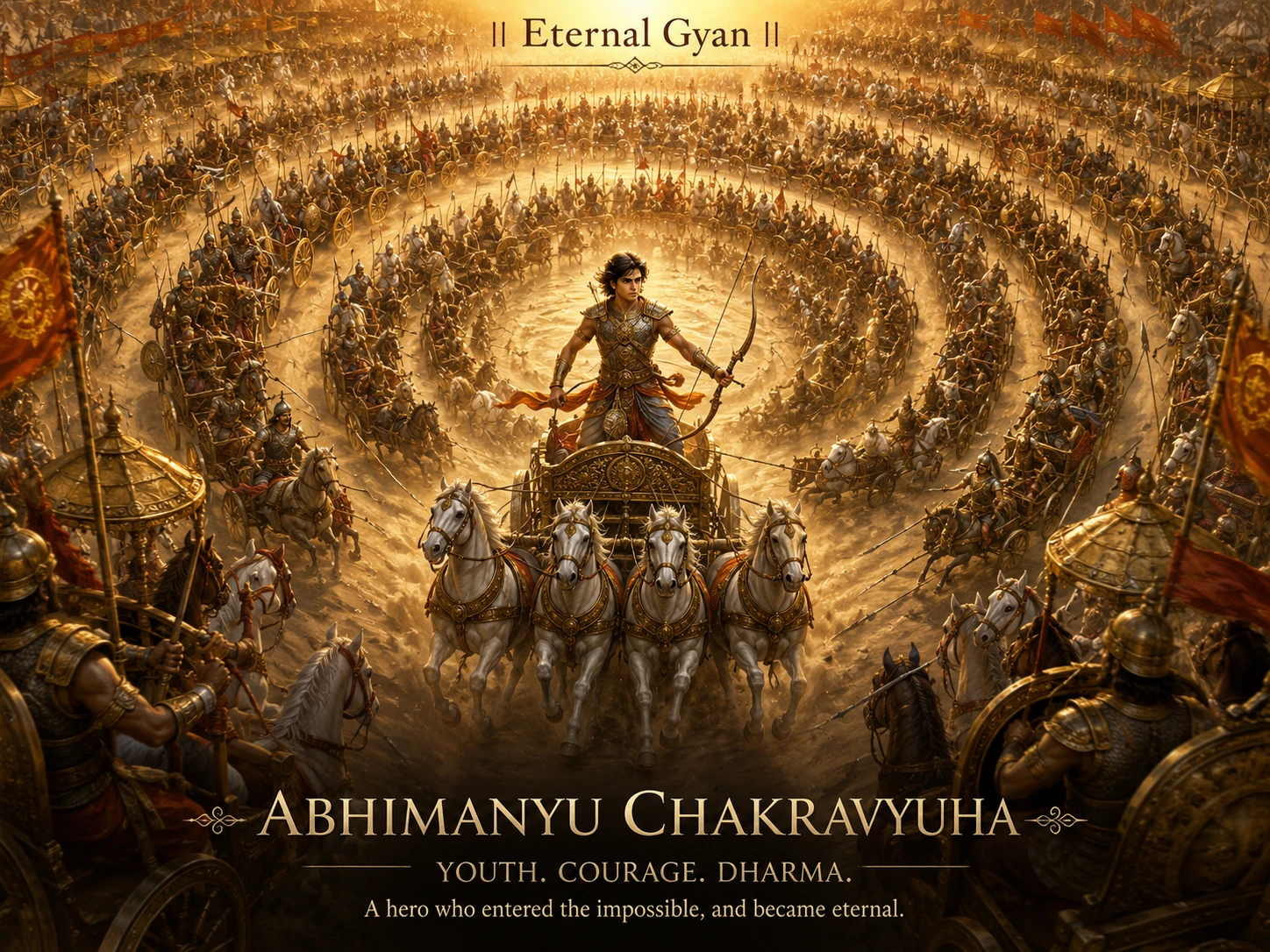
Abhimanyu and the Chakravyuha -- The Boy Who Knew How to Enter but Not How to Leave
14 min read
Adbhuta Ramayana -- The Ramayana Where Sita Becomes Kali
9 min read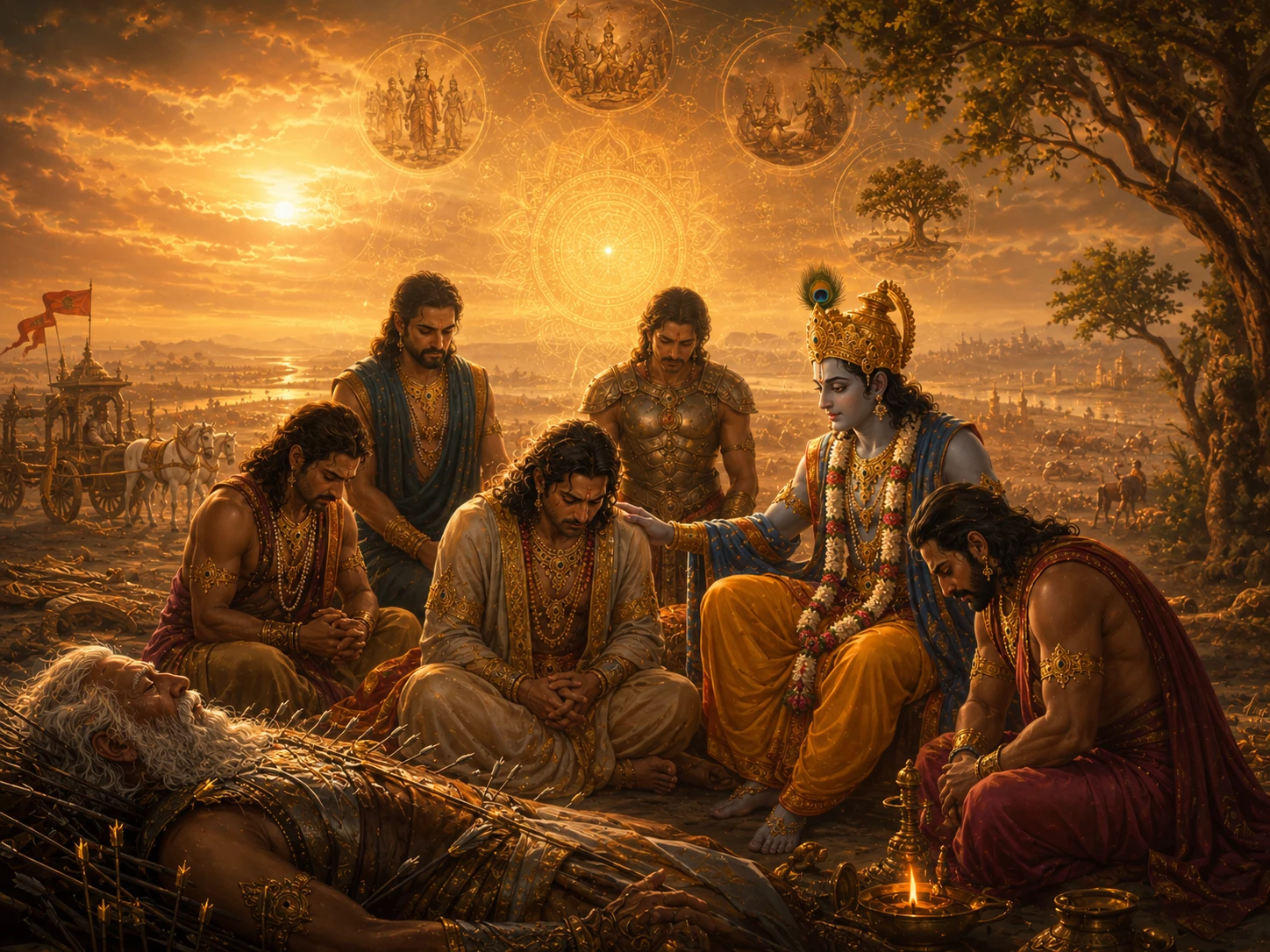
After Kurukshetra -- What Happened Next
14 min readThe same translation error that turned '33 Koti' into '33 crore' in Hinduism also happened in Buddhism. The Chinese translation of Buddhist texts rendered 'Sapta Koti Buddha' (7 Supreme Buddhas) as '7 Crore Buddhas.' The…
Deities AvatarsCommunity Reflections
🕉️
Be the first to share your reflection.
Related across Eternal Raga