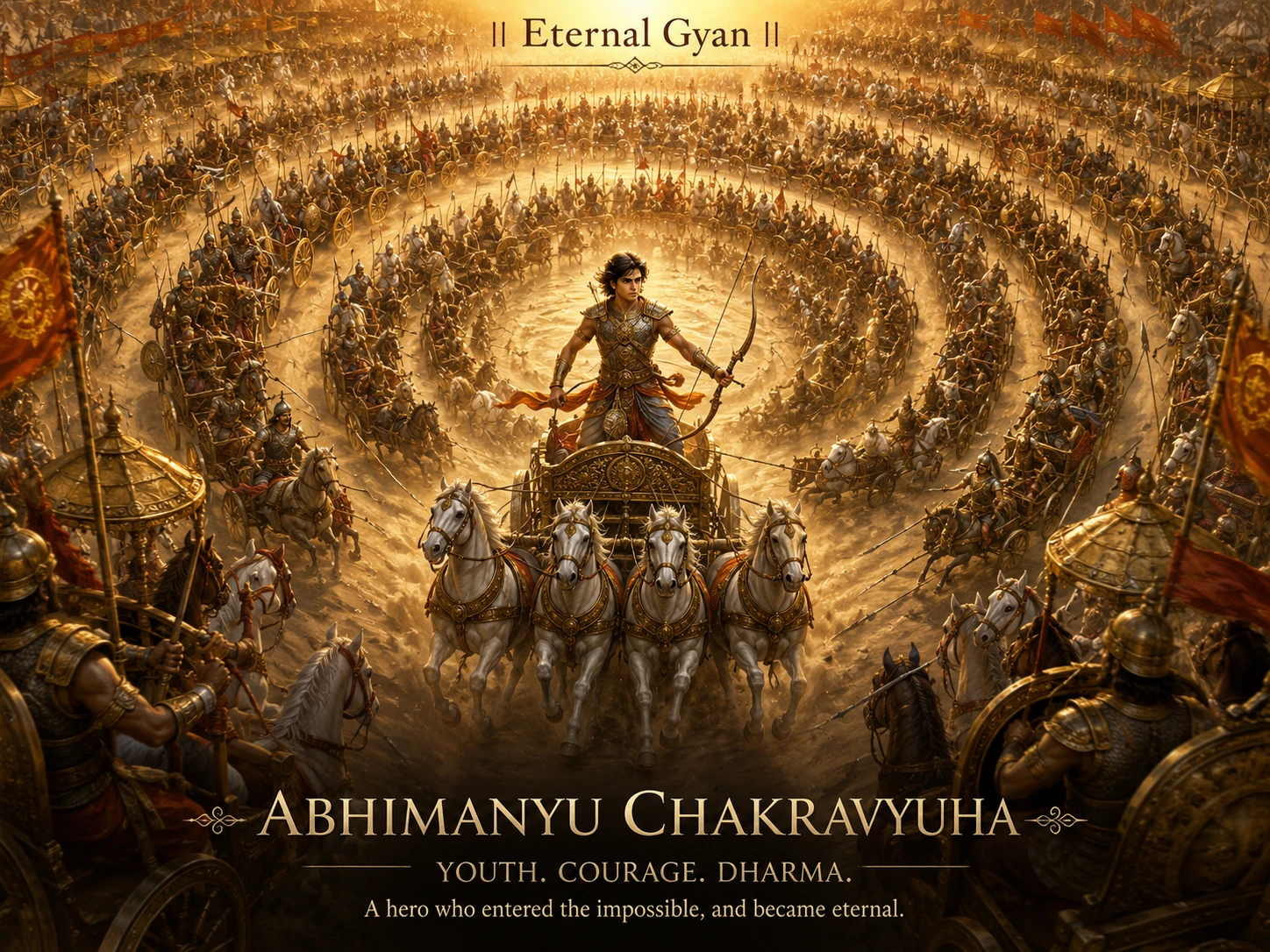
Abhimanyu and the Chakravyuha -- The Boy Who Knew How to Enter but Not How to Leave
अभिमन्यु और चक्रव्यूह -- वह बालक जो प्रवेश जानता था, निकलना नहीं
Abhimanyu's death on Day 13 of the Kurukshetra War is the Mahabharata's most emotionally devastating episode. More than the fall of Bhishma. More than the killing of Karna. More than the dice game. Because Abhimanyu is a child. He is sixteen years old, newly married to Uttara of the Matsya kingdom, and he is sent into a formation that his own father Arjuna -- the greatest warrior alive -- has not taught him to exit. He knows how to break in. He does not know how to break out. And every adult in his family knows this before they send him.
The episode occurs in the Drona Parva (Book 7 of the Mahabharata), specifically in the Abhimanyu-vadha sub-parva. In the BORI Critical Edition, the relevant chapters fall in Drona Parva adhyaya 34 onwards. In the Ganguli translation, the narrative spans Drona Parva sections XXXIII-XLVIII. The context is critical: Drona, now commander of the Kaurava forces after Bhishma's fall on Day 10, has promised Duryodhana that he will capture Yudhishthira alive. To accomplish this, he deploys the Chakravyuha (also called Padmavyuha) -- a spiralling, concentric military formation that is nearly impossible to penetrate and even harder to escape.
The problem: only four warriors on either side know the secret of the Chakravyuha -- Arjuna, Krishna, Pradyumna, and Abhimanyu. On Day 13, the Samsaptakas (a sworn brigade of Trigarta warriors) lure Arjuna and Krishna to the southern front, far from the main battlefield. This is deliberate. With Arjuna absent, the Pandavas have no one who can break the Chakravyuha -- except Abhimanyu, who knows how to enter but not how to exit.
The tradition of how Abhimanyu learned partial knowledge is one of the most haunting backstories in Indian literature. The popular version -- retold across folk traditions, television serials, and Amar Chitra Katha comics -- says that while still in Subhadra's womb, Abhimanyu overheard Arjuna describing the technique of entering the Chakravyuha to his wife. Subhadra fell asleep before Arjuna could describe the exit technique, and so the unborn child learned only half the knowledge. The BORI Critical Edition does not include this womb-learning tradition in the main text -- it appears in later interpolations and regional recensions. What the Critical Edition does confirm is that Abhimanyu himself tells Yudhishthira: 'I know how to enter the Chakravyuha but not how to come out.'
Yudhishthira's response is the moral crux of the episode. He says: enter the formation, create an opening, and we will follow you in to provide support. Bhima, Satyaki, Dhrishtadyumna, and others promise to be right behind him. Abhimanyu agrees. He commands his charioteer Sumitra to drive toward Drona's formation. Sumitra -- perhaps the most underappreciated character in this episode -- objects. He reminds the boy that Drona is invincible, that the formation is deadly, that Abhimanyu has grown up in comfort and does not fully understand what he is walking into. Abhimanyu overrules him with the confidence of youth.
What Yudhishthira does not know -- what changes everything -- is that Jayadratha, the king of Sindhu, possesses a boon from Lord Shiva. On one day, Jayadratha can single-handedly hold off all the Pandavas except Arjuna. That day is today. After Abhimanyu breaks through the first layer of the Chakravyuha, the Pandavas attempt to follow -- and Jayadratha blocks them. Every single one. Bhima, Satyaki, Yudhishthira, Dhrishtadyumna, Nakula, Sahadeva -- all stopped by one man with divine backing. Abhimanyu is alone inside.
What follows inside the Chakravyuha is one of the most extraordinary descriptions of single-handed combat in world literature. Abhimanyu does not merely survive inside the formation -- he dominates. The Drona Parva describes him defeating or driving back Drona, Karna, Ashwatthama, Shalya, Duryodhana, Dushasana, Kripa, and Kritavarma -- individually. He kills Lakshmana, Duryodhana's son and the Kaurava heir apparent. He kills Brihadbala, the king of Kosala (of the Ikshvaku dynasty -- Rama's lineage). He kills the brothers of Shalya, the son of King Asmaka, and multiple other commanders. He invokes the Gandharva Astra, creating the illusion of thousands of Abhimanyus on the battlefield. He makes Karna faint. He sends Dushasana fleeing.
The text's language during this section reaches fever pitch. Sanjaya, narrating to the blind Dhritarashtra, describes Abhimanyu as a 'lion among a herd of deer,' a 'fire in a forest of dry bamboo.' The boy is operating at a level that even senior maharathis cannot match. Drona himself says that Abhimanyu possesses the combined virtues of all five Pandavas and the martial skill equal to Arjuna's.
But the arithmetic is merciless. One boy. Thousands of soldiers. Dozens of maharathis. His arrows will eventually run out. His bowstring will eventually break. His chariot will eventually be destroyed. The Kaurava strategy shifts from trying to defeat him in combat to attrition -- multiple warriors attacking simultaneously, targeting his equipment rather than his body, wearing him down through sheer numerical superiority. This is where the dharma of war breaks. In the Mahabharata's rules of engagement, a single warrior should face a single opponent. Multiple warriors ganging up on one is adharma. But Drona orders it. And they obey.
Abhimanyu's Last Stand -- Who Did What Inside the Chakravyuha
| Warrior | Action Against Abhimanyu | Abhimanyu's Response | Dharma Violation? |
|---|---|---|---|
| Drona | Commanded the formation; ordered simultaneous attack | Abhimanyu defeated him in individual combat multiple times | Yes -- ordered group attack on a lone warrior |
| Karna | Cut Abhimanyu's bowstring from behind; attacked his flanks | Made Karna faint with arrow strikes; drove him back | Yes -- struck from behind while Abhimanyu faced another |
| Ashwatthama | Participated in the simultaneous assault | Abhimanyu defeated him in direct exchange | Yes -- group assault |
| Jayadratha | Used Shiva's boon to block all Pandavas at the entrance | N/A -- Abhimanyu was already inside | Technically no -- divine boon, not a combat violation |
| Dushasana's son | Final blow with a mace when Abhimanyu was disarmed and fighting with a chariot wheel | Abhimanyu fought with broken chariot wheel as weapon; killed in mace combat | Disputed -- some texts say fair mace duel, others say Abhimanyu was exhausted |
| Duryodhana | Ordered the killing of Abhimanyu after Lakshmana's death | Abhimanyu killed his son Lakshmana | Yes -- motivated by revenge, not dharma |
| Shalya, Kripa, Kritavarma | Attacked simultaneously from multiple directions | Abhimanyu engaged all; wounded each | Yes -- multi-warrior assault on one |
The BORI Critical Edition records Dushasana's son as the one who delivers the final fatal blow in mace combat. Some regional traditions and later texts attribute the final kill differently. The Drona Parva itself acknowledges that multiple warriors attacked simultaneously, which violated the dharma of single combat.
अभिमन्युं हि सम्प्रेक्ष्य लोकः सम्प्रत्ययन्निदम्। एकः सर्वान्समाधत्ते क्रुद्धो रणमहोत्सवे॥
abhimanyuṁ hi samprekṣya lokaḥ sampratyayan nidam | ekaḥ sarvān samādhatte kruddho raṇa-mahotsave ||
Beholding Abhimanyu, the world was forced to accept this truth: one man, when enraged, can hold off all others in the great festival of battle.
— Mahabharata, Drona Parva (Sanjaya's narration to Dhritarashtra)
Abhimanyu's death triggers the most consequential chain reaction of the war. When Arjuna returns from the southern front and learns what happened, his grief is beyond description. He takes a vow: before sunset tomorrow, he will kill Jayadratha -- the man whose boon sealed the Chakravyuha and trapped his son. If he fails, he will immolate himself. Day 14 of Kurukshetra becomes the most intense single day of the war, with the entire Kaurava army positioned between Arjuna and Jayadratha. In the final moments before sunset, with Jayadratha hidden behind layers of defenders, Krishna creates an eclipse (or an illusion of sunset -- the text varies), causing Jayadratha to emerge prematurely. Arjuna beheads him with a precision shot.
But the consequences ripple further. Abhimanyu's death hardens every Pandava. The rules of war begin to dissolve. Bhima becomes more savage. Krishna becomes more pragmatic about dharma. The restraint that characterised the first 13 days gradually erodes. By Day 18, the war has descended into a state where nearly every killing involves some element of deception or rule-breaking -- Drona, Karna, Duryodhana, all die through tactics that bend or break the dharma of combat. Abhimanyu's death is the moment the war loses its honour.
For modern India, the Abhimanyu story resonates in ways that go beyond mythology. Every parent who sends a child to Kota for JEE coaching with incomplete preparation. Every manager who assigns a junior employee to a project beyond their training. Every system that demands performance but withholds the resources needed to succeed. The Chakravyuha is not just a military formation. It is a metaphor for any structure designed so that entering is easy, exiting is impossible, and the person inside is blamed for their own destruction. Student loan systems. Toxic workplaces. Exploitative contracts. Abhimanyu walks among us every day.
The word 'Chakravyuha' has entered modern Indian business and political vocabulary as a metaphor for systems designed to trap. The phrase 'Chakravyuha challenge' was used by former RBI Governor Raghuram Rajan to describe India's economic reform paradox -- where entering liberalisation is easy but exiting legacy systems is structurally impossible. The Indian Army's actual military training still includes study of Vyuha formations described in the Mahabharata, adapted for modern warfare at the National Defence Academy (NDA) in Khadakwasla, Pune. Abhimanyu's entry into the Chakravyuha is depicted in the Hoysala temple at Halebidu, Karnataka -- a 12th-century stone relief that is one of the oldest surviving visual depictions of the episode.
Find the Drona Parva in the Mahabharata
Abhimanyu's story unfolds in the Drona Parva, the seventh of the Mahabharata's eighteen books. The Mahabharata text is not yet on Eternal Raga; the Mahabharata overview article maps all eighteen parvas so you know where to look in a full translation.
Tags
Eternal Raga · शाश्वत राग
Institutional voice — scholarly articles on Sanatan Dharma
Deepen Your Understanding
अपनी समझ और गहरी करें
scriptural exegesis
Wives of Arjuna -- Four Women Who Shaped the War
Arjuna did not marry for romance. Each of his four marriages -- to Draupadi, Subhadra, Ulupi, and Chitrangada -- was a strategic alliance that brought the Pandavas military power, divine protection, or political legitimacy they could not have won on the battlefield. A Panchala princess, a Yadava sister, a Naga queen, and a Manipuri warrior-princess: four women from four different civilisations, each changing the course of the Mahabharata.
scriptural exegesis
The Dice Game -- The Darkest Hour of the Mahabharata
A king who cannot say no to a challenge. An uncle whose dice are loaded with the bones of the dead. A court full of elders who watch injustice and say nothing. And a woman who asks one question that nobody in the room can answer: 'Did my husband lose himself first, or me?' The dice game in the Sabha Parva is not a plot device. It is the moral black hole at the centre of the Mahabharata. Everything before it is prologue. Everything after it is consequence. And the central horror is not what happens -- it is who lets it happen.
scriptural exegesis
Karna's Tragedy -- The Sun's Forgotten Son
Born with divine armor, abandoned at birth, raised by a charioteer, humiliated for his caste, cursed by his teacher, and killed while defenseless -- Karna's story is not the Mahabharata's subplot. It is the Mahabharata's conscience. Every system that failed him is a system that still fails people today.
scriptural exegesis
Kurukshetra Battle Alliances -- Which Kings Joined Which Side
Seven akshauhinis against eleven. 1.5 million warriors against 2.4 million. The Kurukshetra war was not two families fighting -- it was the entire Indian subcontinent choosing sides. From the Pandyas of Tamil Nadu to the Kambojas of Central Asia, from the Yadavas of Dwaraka to the Kekayas split down the middle -- here is the geopolitical map of who joined whom and why, sourced from Udyoga Parva.
scriptural exegesis
Ashwatthama and the Brahmashirsha -- The Night the War Refused to End
The war ended on Day 18 when Bhima shattered Duryodhana's thighs. The victory celebrations should have begun. Instead, that night, three Kaurava survivors -- Ashwatthama, Kripa, and Kritavarma -- entered the sleeping Pandava camp and slaughtered everyone inside. The five sons of Draupadi. Dhrishtadyumna. Shikhandin. Thousands of soldiers who believed the war was over. Then Ashwatthama launched the Brahmashirsha Astra at the unborn child in Uttara's womb -- Arjuna's grandson, the last heir of the Pandava line. Krishna saved the child and cursed Ashwatthama to wander the earth for 3,000 years in agony. He is still walking.
scriptural exegesis
Bhishma's Terrible Vow
A crown prince gave up the throne, love, marriage, and children -- forever -- so his father could marry a fisherwoman. That single vow made Bhishma immortal in name and set the entire Mahabharata into motion. Was it the noblest sacrifice in literature, or the most catastrophic?
scriptural exegesis
7 Chiranjeevis -- The Immortals of Hindu Tradition
Seven beings who will not die until the end of this cosmic age. One is cursed to wander in agony. One rules the underworld. One compiled every scripture you have ever read. One is the most worshipped deity in India. The Chiranjeevis are not a mythology trivia list -- they are a map of how immortality works in Hindu thought, and why it is not always a blessing.
The word 'Chakravyuha' has entered modern Indian business and political vocabulary as a metaphor for systems designed to trap. The phrase 'Chakravyuha challenge' was used by former RBI Governor Raghuram Rajan to describe…
More in Scriptural Exegesis

Adbhuta Ramayana -- The Ramayana Where Sita Becomes Kali
9 min read
After Kurukshetra -- What Happened Next
14 min read
Agni Pariksha -- Sita's Fire Ordeal and the Interpretations That Divided India
15 min readThe same translation error that turned '33 Koti' into '33 crore' in Hinduism also happened in Buddhism. The Chinese translation of Buddhist texts rendered 'Sapta Koti Buddha' (7 Supreme Buddhas) as '7 Crore Buddhas.' The…
Deities AvatarsCommunity Reflections
🕉️
Be the first to share your reflection.