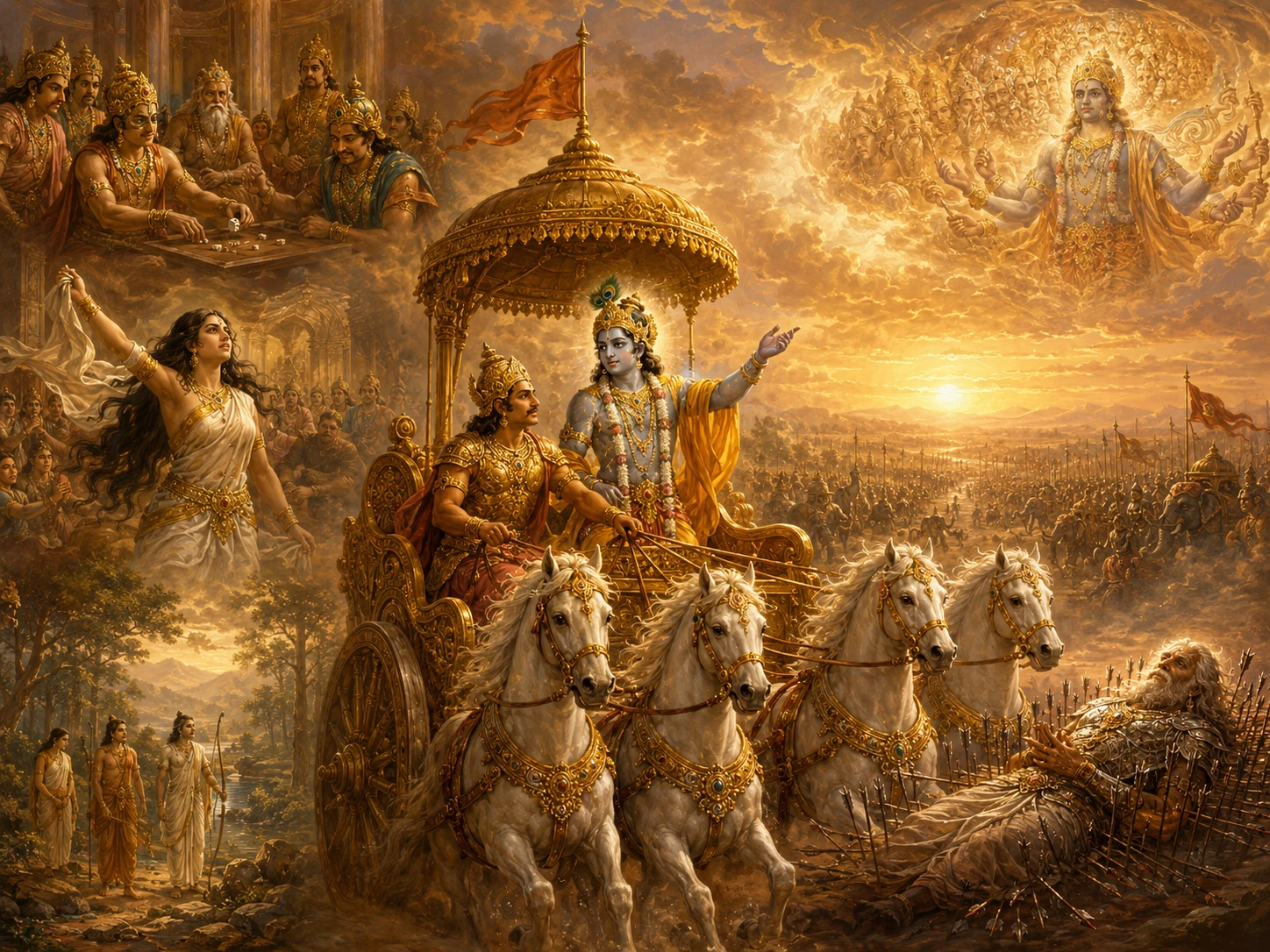
The Dice Game -- The Darkest Hour of the Mahabharata
द्यूत क्रीड़ा -- महाभारत का सबसे अँधेरा प्रहर
The dice game is the hinge on which the entire Mahabharata turns. Before it, there is rivalry, jealousy, and political tension between the Kuru cousins -- but no irreversible breach. After it, war is inevitable. The 18 days of slaughter at Kurukshetra, the deaths of Bhishma, Drona, Karna, Abhimanyu, and a million soldiers, the extinction of an entire generation -- all of it traces back to one afternoon in the assembly hall of Hastinapura where a king who could not refuse a challenge sat down to play a game he could not win against an opponent who could not lose.
The episode occurs in the Dyuta Parva and Anudyuta Parva, sub-sections of the Sabha Parva (Book 2 of the Mahabharata). In the Ganguli translation, the dice game spans chapters 58-73 of the Sabha Parva. In the BORI Critical Edition, the relevant section falls within adhyayas 45-72. There are actually two dice games -- the first one is invalidated when Dhritarashtra, horrified by the consequences, returns everything to Yudhishthira. The second game, played for a single catastrophic stake (12 years of exile plus 1 year incognito), is the one that sends the Pandavas into the forest and sets the clock ticking toward Kurukshetra.
What makes the dice game the most analysed episode in all of Indian literature is not the gambling itself. It is the behaviour of every single person in the room. The Mahabharata uses this scene to put an entire civilisation's moral architecture on trial -- and finds it wanting.
The conspiracy is laid out in plain sight. After Yudhishthira's Rajasuya Yajna establishes him as the paramount sovereign, Duryodhana is consumed by envy. He visits the Pandavas' sabha at Indraprastha -- built by the divine architect Maya Danava -- and is humiliated when he mistakes a crystal floor for water and falls in, and later mistakes water for crystal and gets drenched. Draupadi's laughter (or the laughter of attendants, depending on the version) burns in his memory. He returns to Hastinapura seething.
Shakuni, Duryodhana's maternal uncle from Gandhara (modern-day Kandahar, Afghanistan), proposes the solution: 'What you cannot win by sword, you can win by dice. Yudhishthira has a weakness for gambling. He cannot refuse a challenge -- it is against his Kshatriya dharma. Invite him to a game. I will play on your behalf. My dice obey me.' The text is explicit: Shakuni's dice are enchanted. Whether they were carved from the bones of his dead father (a tradition found in later retellings and regional versions, not in the Mahabharata's own text) or simply occult-charged, the result is the same -- every throw goes Shakuni's way.
Dhritarashtra, the blind king, knows the plan is wrong. Vidura, his half-brother and wisest adviser, explicitly warns him: 'This game will destroy your house.' Dhritarashtra agrees -- and then proceeds to send the invitation anyway. This is the first moral failure, and it sets the template for every failure that follows. Knowing the right thing and not doing it. That single pattern -- repeated by Bhishma, Drona, Kripa, and every elder in the sabha -- is what the dice game is really about.
The game itself is a masterclass in narrative escalation. Yudhishthira arrives at Hastinapura. He sees the new sabha. He is told a friendly game of dice has been arranged. He expresses reluctance -- 'Gambling is deceit. It brings destruction' -- but adds the line that seals his fate: 'If challenged, I cannot refuse. This is my eternal vow.'
The stakes begin small: jewellery, gold, chariots. Shakuni wins every throw. The text's narration is chillingly minimal -- Vyasa does not describe technique, strategy, or drama at each round. He simply records Yudhishthira announcing a stake, and Shakuni saying 'Jitam' -- 'Won.' Stake, won. Stake, won. The monotony is deliberate. It mimics the experience of addiction itself -- the gambler is not thinking, not strategising, not even hoping. He is just repeating the act.
The stakes escalate: elephants, horses, the royal treasury, the army, the kingdom of Indraprastha itself. Then Yudhishthira stakes Nakula. Won. Sahadeva. Won. Arjuna. Won. Bhima. Won. Himself. Won. At every stage, voices in the sabha murmur disapproval but do nothing. Vidura pleads. Bhishma sits in anguished silence. Drona is mute. The text makes you feel the weight of that silence -- the loudest sound in the room is what is not being said.
Then comes the moment that changes everything. Shakuni, or Duryodhana through Shakuni, asks: 'You have one stake left. Draupadi.' And Yudhishthira, the Dharmaraja, the embodiment of righteousness -- stakes his wife.
What follows is the scene that has haunted Indian civilisation for three thousand years. Draupadi is dragged into the sabha by her hair -- by Dushasana, on Duryodhana's orders. She is in a single garment. She is in her period (some versions say she was in her menstrual chamber). She is brought before the full assembly -- Bhishma, Drona, Vidura, Dhritarashtra, Kripa, Karna, and every prince and elder of the Kuru court.
And she asks one question. It is the most legally precise question in all of ancient literature: 'Did Yudhishthira lose himself first, or did he stake me while he was still a free man? Because if he had already lost himself before he staked me, he was no longer a free agent -- he was a slave. And a slave owns nothing, not even his own will. He certainly does not own his wife. Therefore, the stake is void.'
Nobody answers. The question bounces off every elder like a stone off a shield. Bhishma -- the patriarch, the man who has taken a vow to protect the Kuru throne -- says: 'The ways of dharma are subtle. I cannot answer this question.' Drona is silent. Vidura has already been shouted down by Duryodhana. Karna mocks Draupadi. Dushasana begins to pull at her garment.
The text records that Draupadi's garment became endless -- an inexhaustible length of cloth that prevented her from being disrobed. Most traditions attribute this to Krishna's intervention; others to the power of her own virtue. The theological mechanism matters less than the structural point: the only person who acts to protect Draupadi's dignity is either God himself or Draupadi's own moral force. Not one mortal man in that room of warriors, scholars, and kings lifts a finger.
Who Said What -- Responses in the Sabha During the Dice Game
| Person | Role | Response During the Dice Game | Moral Verdict |
|---|---|---|---|
| Yudhishthira | Dharmaraja, eldest Pandava | Gambled compulsively; staked brothers and wife after losing himself | Guilty -- addiction overrode dharma; the legal question of his agency after self-loss remains central |
| Shakuni | Gandhari's brother, Duryodhana's uncle | Played with loaded/enchanted dice; provoked every escalation | Guilty -- architect of the fraud; exploited Kshatriya dharma-compulsion |
| Duryodhana | Eldest Kaurava, crown prince | Ordered Draupadi to be dragged in; told Dushasana to disrobe her | Guilty -- the primary instigator and perpetrator |
| Dushasana | Duryodhana's brother | Physically dragged Draupadi by hair; attempted disrobing | Guilty -- direct perpetrator of physical violence |
| Karna | Duryodhana's ally | Mocked Draupadi publicly; called her to sit on Duryodhana's lap | Guilty -- verbal assault; crossed from enmity into cruelty |
| Dhritarashtra | Blind king, Kaurava patriarch | Knew it was wrong; sent invitation anyway; intervened only when terrified by Bhima's vows | Guilty -- willful enabler; parental bias over royal duty |
| Bhishma | Grand patriarch, bound by vow to throne | Said 'the ways of dharma are subtle'; could not answer Draupadi's question | Complicit -- silence as moral abdication; institutional loyalty over justice |
| Drona | Royal preceptor | Completely silent throughout | Complicit -- silence is consent in a position of authority |
| Vidura | King's adviser, Dharma's son | Warned Dhritarashtra repeatedly; was shouted down | Least guilty of elders -- spoke truth to power but lacked power to enforce it |
| Vikarna | Duryodhana's younger brother | Stood up and declared the game unjust; called the staking of Draupadi invalid | The sole moral voice -- a Kaurava who sided with dharma; silenced by his own side |
Vikarna's protest is one of the most overlooked moments in the Mahabharata. A Kaurava brother, surrounded by his own family, stands up to say: this is wrong. He is ignored. He later dies fighting for the Kaurava side at Kurukshetra -- a good man trapped on the wrong side of history.
अनृतं धूर्तसमितौ विजयो भवति ध्रुवम्। कितवस्य मदोन्मत्तैः धर्मो नाभिप्रवर्तते॥
anṛtaṁ dhūrta-samitau vijayo bhavati dhruvam | kitavasya madonmattaiḥ dharmo nābhipravartate ||
In an assembly of cheats, falsehood certainly wins. Among those intoxicated by the madness of gambling, dharma does not prevail.
— Mahabharata, Sabha Parva (Vidura's counsel to Dhritarashtra)
The aftermath is critical and often forgotten. After the attempted disrobing, Bhima takes five terrible vows. He vows to break Duryodhana's thigh, to kill Dushasana and drink his blood, and to wash Draupadi's hair with that blood. Every one of these vows will be fulfilled on the battlefield of Kurukshetra -- Bhima is the only character in the Mahabharata who keeps every single oath he takes.
Dhritarashtra, terrified by the vows and by ominous signs (jackals howling, donkeys braying -- signs of impending doom in the Mahabharata's symbolic vocabulary), panics and intervenes. He grants Draupadi boons. She asks for the freedom of Yudhishthira and then for the freedom of the other four Pandavas with their weapons and chariots. Dhritarashtra is so shaken that he declares the entire first game void and returns everything.
But then -- and this is where Duryodhana's genius for destruction operates -- Dhritarashtra is pressured by Duryodhana, Shakuni, and Karna to call the Pandavas back for a second game. One throw. One stake. The loser goes into exile for 12 years followed by one year of living incognito -- and if recognised during the 13th year, the exile repeats. Yudhishthira, already walking back to Indraprastha a free man, is recalled. He sits down again. He loses again.
This second game is often the more devastating one to contemplate. Yudhishthira had been given everything back. He had seen what addiction did to him. He had watched his wife humiliated. And he still sat down to play again. The Mahabharata is not moralistic enough to explain why. It simply records the fact. Every person who has watched someone relapse into addiction -- gambling, alcohol, substances, toxic relationships -- recognises this moment with sickening clarity.
The dice game's deepest teaching is about institutional failure. Modern readers often focus on Yudhishthira's addiction or Duryodhana's cruelty. But the Mahabharata's own emphasis falls elsewhere -- on the elders. Bhishma, Drona, and Kripa are the institutional pillars of the Kuru state. They have power, authority, and moral standing. They know what is happening is wrong. And they do nothing.
Bhishma's excuse -- 'the ways of dharma are subtle' -- has become one of the most debated lines in Indian philosophy. Is he genuinely unable to answer Draupadi's legal question? Or is he hiding behind philosophical complexity to avoid a political confrontation with the ruling faction? Most modern commentators lean toward the latter reading. Bhishma's vow to serve the throne of Hastinapura -- whoever sits on it -- has bound him so completely that he cannot act against Duryodhana even when Duryodhana is manifestly wrong. Institutional loyalty has overridden moral judgment.
This pattern is not ancient. It is contemporary. The senior partner at a law firm who watches a junior associate being harassed and says nothing because the harasser brings in clients. The IIT professor who witnesses plagiarism but looks away because the student has connections. The corporate board member who sees financial fraud and stays silent because confrontation would tank the stock price. The Kuru sabha is not a mythological courtroom. It is every boardroom, every faculty meeting, every parliamentary session where powerful people watch injustice unfold and choose silence over action. The Mahabharata wrote this scene not to document the past but to predict the future.
Draupadi's legal question in the sabha -- 'Did my husband lose himself first, or me?' -- has been analysed in multiple Indian law journals as a proto-feminist challenge to property law and personhood. Legal scholar Upendra Baxi has called it 'the first recorded instance of a constitutional challenge to state authority in Indian literature.' The question remains legally unresolved in the Mahabharata itself -- Bhishma never answers it. The only person who unambiguously declares the game void is Vikarna, a Kaurava prince, whose moral courage is one of the epic's most underappreciated moments. In 2019, the Supreme Court of India cited the Mahabharata's treatment of women's autonomy in a judgment expanding women's property rights, noting that Draupadi's argument anticipated modern jurisprudence on the invalidity of contracts made under coercion.
Find the Sabha Parva in the Mahabharata
The dice game is in the Sabha Parva, the second of the Mahabharata's eighteen books. The Mahabharata text is not yet on Eternal Raga; the overview article maps all eighteen parvas so you know where to look in a full translation.
Tags
Eternal Raga · शाश्वत राग
Institutional voice — scholarly articles on Sanatan Dharma
Deepen Your Understanding
अपनी समझ और गहरी करें
scriptural exegesis
Draupadi in the Sabha -- The Trial That Started the War
A queen was dragged into a court full of kings, warriors, and elders. Not one stood up. She asked a single legal question that nobody could answer. Then she swore an oath that burned a civilization to the ground. Draupadi's Sabha episode is not a story about a helpless woman. It is the most devastating indictment of institutional silence in world literature.
scriptural exegesis
100 Kauravas -- The Forgotten Brothers of the Mahabharata
Everyone knows Duryodhana and Dushasana. But what about Vikarna, who stood up for Draupadi when no one else did? Or Yuyutsu, who defected to the Pandavas because his conscience demanded it? The Mahabharata names all 100 sons of Dhritarashtra -- warriors, strategists, and dissenters -- most of whom are killed across 18 days. Their story is not just a casualty list. It is the most devastating portrait of fratricidal war ever composed.
scriptural exegesis
Bhishma's Terrible Vow
A crown prince gave up the throne, love, marriage, and children -- forever -- so his father could marry a fisherwoman. That single vow made Bhishma immortal in name and set the entire Mahabharata into motion. Was it the noblest sacrifice in literature, or the most catastrophic?
scriptural exegesis
Vidura Niti -- The Wisest Counsel That the King Heard and Still Ignored
The night before the Pandavas' exile ended, when war was one decision away, a sleepless king called his wisest adviser. For eight chapters of the Udyoga Parva, Vidura -- the bastard son who could never be king, the only man in Hastinapura who always told the truth -- delivered 593 verses of raw, unfiltered counsel on leadership, ethics, self-mastery, and statecraft. Dhritarashtra listened to every word. Agreed with every point. And then did the opposite. Vidura Niti is not just political philosophy. It is the anatomy of a man who knew the right thing, had the right adviser, and chose wrong anyway.
scriptural exegesis
Karna's Tragedy -- The Sun's Forgotten Son
Born with divine armor, abandoned at birth, raised by a charioteer, humiliated for his caste, cursed by his teacher, and killed while defenseless -- Karna's story is not the Mahabharata's subplot. It is the Mahabharata's conscience. Every system that failed him is a system that still fails people today.
scriptural exegesis
Abhimanyu and the Chakravyuha -- The Boy Who Knew How to Enter but Not How to Leave
On the 13th day of Kurukshetra, a sixteen-year-old boy broke into the deadliest military formation in the ancient world -- alone, because the adults who promised to follow him were blocked at the gate. He fought Drona, Karna, Ashwatthama, Kripa, Duryodhana, and Shalya simultaneously. He killed Duryodhana's son Lakshmana. He made Karna flee. He held an entire army at bay for hours. And then they killed him -- not in fair combat, but by surrounding him, destroying his chariot, breaking his weapons, and attacking from all sides at once. Abhimanyu's death is not a tragedy of weakness. It is a tragedy of incomplete knowledge sent to do a complete job.
scriptural exegesis
Yaksha Prashna -- Questions at the Lake
Four brothers lie dead beside an enchanted lake. One brother remains. A voice from the water asks 124 questions about dharma, death, happiness, and the self. Yudhishthira's answers in Vana Parva remain the most sophisticated ethical examination in all of Sanskrit literature.
Draupadi's legal question in the sabha -- 'Did my husband lose himself first, or me?' -- has been analysed in multiple Indian law journals as a proto-feminist challenge to property law and personhood. Legal scholar Upend…
More in Scriptural Exegesis
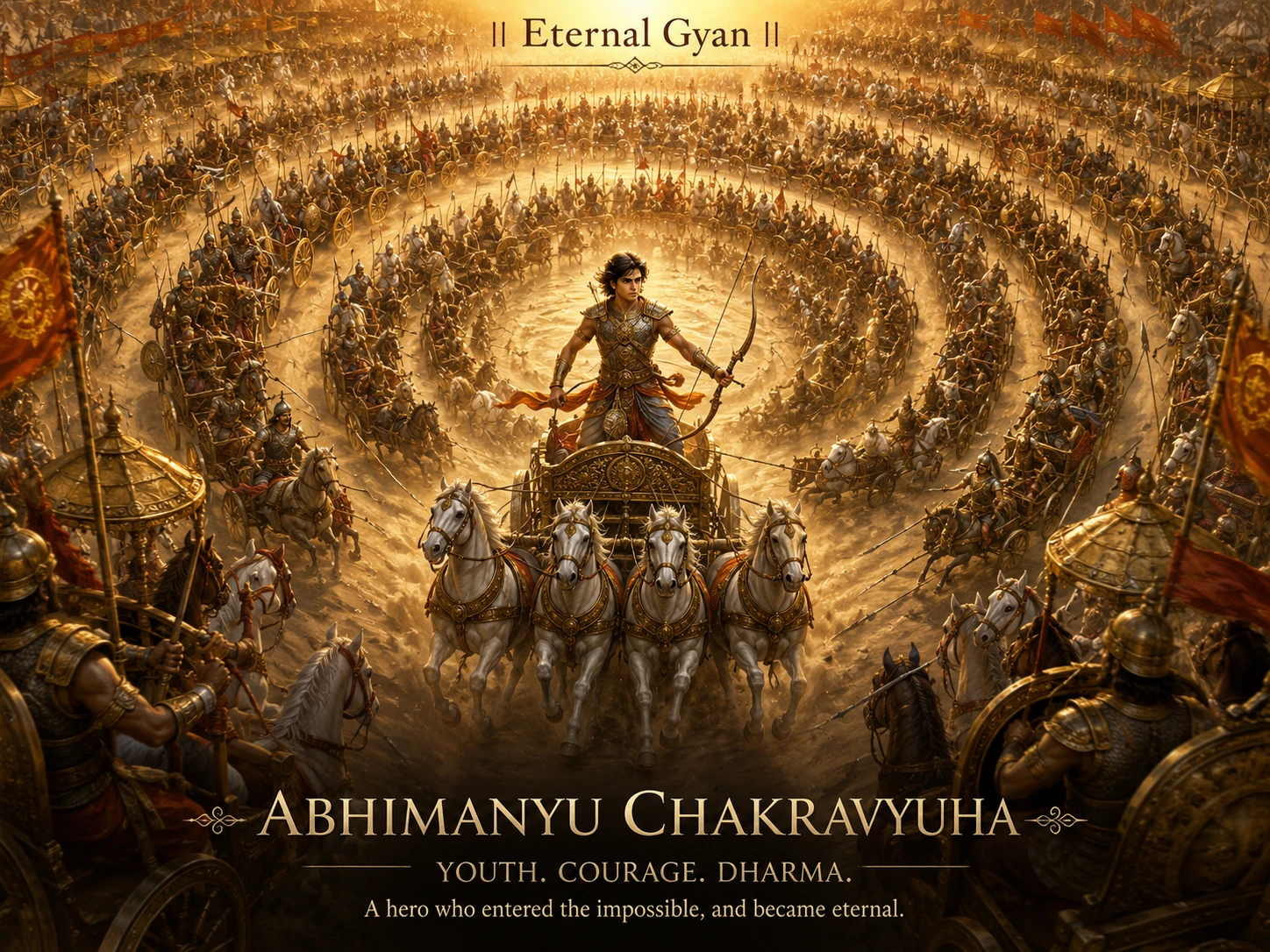
Abhimanyu and the Chakravyuha -- The Boy Who Knew How to Enter but Not How to Leave
14 min read
Adbhuta Ramayana -- The Ramayana Where Sita Becomes Kali
9 min read
After Kurukshetra -- What Happened Next
14 min readThe same translation error that turned '33 Koti' into '33 crore' in Hinduism also happened in Buddhism. The Chinese translation of Buddhist texts rendered 'Sapta Koti Buddha' (7 Supreme Buddhas) as '7 Crore Buddhas.' The…
Deities AvatarsCommunity Reflections
🕉️
Be the first to share your reflection.