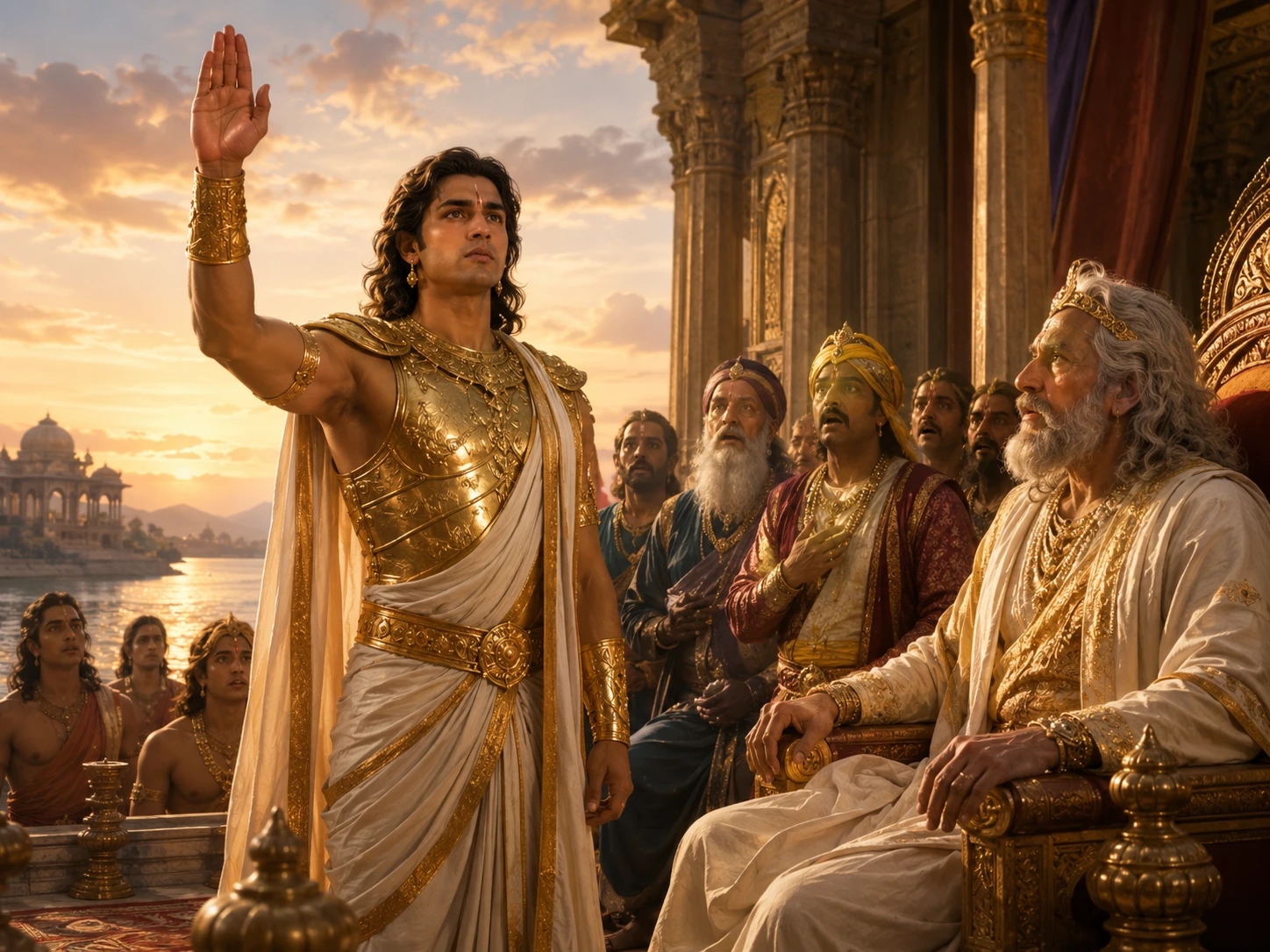
Bhishma's Terrible Vow
भीष्म की भीषण प्रतिज्ञा -- वो कसम जिसने इतिहास बदल दिया
Before he was Bhishma, he was Devavrata -- the prince of Hastinapura, son of King Shantanu and the goddess Ganga. He was everything a kingdom could want in an heir: martial prowess unmatched among his generation, trained in weapons by Parashurama himself, educated in statecraft, beloved by the people. The throne was his by right, by ability, and by popular consensus.
Then his father fell in love.
Shantanu, while walking by the Yamuna, was captivated by Satyavati -- a ferryman's daughter who smelled of musk rather than fish (thanks to a boon from the sage Parashara, who was also the father of her secret son, Vyasa). Shantanu wanted to marry her, but her father Dashraj set a condition: Satyavati's sons must inherit the throne, not Devavrata.
Shantanu returned to Hastinapura in silence. He could not bring himself to ask his firstborn to step aside. Devavrata noticed his father's depression, investigated the cause, and went to Dashraj himself. What he offered was beyond anything Dashraj had demanded.
'I renounce the throne,' Devavrata said. 'Satyavati's sons will rule.'
But Dashraj pushed further: 'What if your children challenge my daughter's children for the throne?'
And this is where the ordinary sacrifice became the terrible one. Devavrata did not just give up the throne. He gave up the possibility of ever having children. He took a vow of lifelong celibacy -- Brahmacharya for eternity. No marriage. No heirs. No dynasty. No continuity. He erased his own future to secure his father's desire.
The gods showered flowers. The heavens declared: 'From this day he shall be called Bhishma -- the one who has taken a terrible vow.' Bhishma means 'terrible' or 'fearsome' -- and the name refers not to his martial ability but to the severity of his renunciation.
Shantanu, overwhelmed with guilt and gratitude, granted Bhishma the boon of iccha mrityu -- death only when Bhishma chose it. Bhishma could not be killed until he willed his own death. This boon would keep him alive for generations, a witness to every catastrophe his vow would eventually cause.
Let that sink in. A young man in his prime, with the world at his feet, chose to give up love, sex, marriage, fatherhood, kingship, and lineage -- permanently, irrevocably -- because his father was too embarrassed to ask. And then he received a gift that ensured he would live long enough to watch every consequence unfold.
This is not a fairy tale about filial devotion. This is a tragedy built into the DNA of the Mahabharata.
For the modern Indian reader, Bhishma's vow resonates with uncomfortable familiarity. The eldest daughter who gives up her career to manage the family home after a parent's illness. The first-generation IIT graduate who sends his entire salary home and delays his own marriage for a decade. The Indian Armed Forces officer who misses his children's growing years for border postings. Sacrifice for family is culturally celebrated in India -- but the Mahabharata is honest enough to ask: what happens when the sacrifice is too extreme? When does nobility curdle into dysfunction?
Because here is the thing -- Bhishma's vow did not save Hastinapura. It destroyed it.
Without Bhishma on the throne, the kingdom passed to Satyavati's sons Chitrangada and Vichitravirya. Chitrangada died young in battle. Vichitravirya was weak and died without heirs. Satyavati, desperate for the lineage to continue, called upon her other son Vyasa to perform niyoga (a Vedic practice where a sage impregnates the queen to produce an heir). The result was Dhritarashtra (blind) and Pandu (pale, cursed). From their flawed births came the Kauravas and the Pandavas. From their rivalry came Kurukshetra. From Kurukshetra came the death of an entire generation.
Bhishma watched all of this. He had the power to intervene at multiple points -- as the strongest warrior, the most respected elder, the man with iccha mrityu. He could have stopped Duryodhana's rise, prevented Draupadi's humiliation, refused to fight for the Kauravas. But he did not. He was bound by his vow to serve the throne of Hastinapura, regardless of who sat on it.
This is the moral architecture of Bhishma: the most powerful man in the room, perpetually unable to act because his hands are tied by a promise he made fifty years ago. He is the ultimate cautionary tale about institutional loyalty without moral agency. The corporate veteran who knows the CEO is committing fraud but stays because 'I've been here thirty years.' The bureaucrat who processes an unjust order because 'I serve the institution, not the individual.' The Supreme Court judge who follows precedent that everyone knows is wrong because 'the system must be respected.'
Bhishma at the Sabha -- sitting in silence while Draupadi is dragged by her hair and Dushasana attempts to disrobe her -- is the most damning image of misplaced loyalty in world literature. He could have stopped it. One word from Bhishma and no Kaurava would have dared proceed. But he sat. He sat because he had sworn to serve the throne, and the king (Dhritarashtra) did not order him to intervene.
The Bhishma Parva in the Mahabharata is his final act -- the ten days he commanded the Kaurava army in the Kurukshetra war. Even here, his internal conflict is visible. He fights the Pandavas, his own grandnephews, because duty to the throne demands it. But he also tells the Pandavas, privately, how to defeat him. He reveals that he will not fight Shikhandi (who was born as Amba in a previous life, a woman Bhishma had wronged). On the tenth day, Arjuna places Shikhandi in front and fills Bhishma with arrows. Bhishma falls, resting on a bed of arrows (sharashayya), and waits for Uttarayana -- the winter solstice -- to choose his death.
The Shanti Parva and Anushasana Parva that follow are Bhishma's final teachings from the arrow-bed. He teaches Yudhishthira about dharma, governance, economics, ethics -- the accumulated wisdom of a man who has watched an empire self-destruct and understands exactly why. These teachings form one of the longest philosophical sections in the Mahabharata and remain studied in Indian political science and management programs to this day.
Bhishma's tragedy is that he was right about everything and acted on none of it. He knew Duryodhana was wrong. He knew Draupadi's humiliation was unforgivable. He knew the war would destroy the Kuru race. But his vow -- the terrible, beautiful, catastrophic vow -- held him in place like a pin through a butterfly.
अद्यप्रभृति मे ब्रह्मचर्यं भविष्यति। अपुत्रस्य महाराज लोकास्तेजोमयाः पराः॥
adyaprabhṛti me brahmacaryaṃ bhaviṣyati | aputrasya mahārāja lokāstejomayāḥ parāḥ ||
From this day forward, I shall observe lifelong celibacy. O great king, for one who is childless, the radiant higher worlds are assured.
— Mahabharata, Adi Parva, Shantanu-Bhishma episode (Section 100, Ganguli translation)
Bhishma's Vow -- What He Gave Up vs. What He Got
| Surrendered | Received | Unintended Consequence |
|---|---|---|
| Throne of Hastinapura | Eternal respect as patriarch | Kingdom passed to weaker heirs, leading to succession crisis |
| Marriage and children | Iccha Mrityu (death at will) | Had to watch generations of his family destroy each other |
| Personal happiness | Name 'Bhishma' -- terrifying renunciation | Became a cautionary figure for rigid vow-keeping |
| Right to intervene as king | Duty-bound institutional advisor | Could not stop Draupadi's humiliation or Duryodhana's rise |
| Romantic love (Amba, Ambika, Ambalika) | Martial immortality | Amba reborn as Shikhandi became the cause of his fall |
The Mahabharata does not celebrate Bhishma's vow uncritically. The text shows both its nobility and its catastrophic downstream effects, inviting the reader to judge.
The phrase 'Bhishma Pratigya' has entered everyday Hindi as an idiom meaning an unbreakable, iron-clad promise. When a cricketer says 'maine Bhishma pratigya li hai ki retire nahi hoonga,' or a politician declares a 'Bhishma pratigya' against corruption, they invoke the cultural weight of Devavrata's renunciation. The phrase appears in Indian courtrooms, parliamentary debates, and corporate board meetings -- a living testament to the Mahabharata's penetration of modern Indian language.
Explore Bhishma's Teachings from the Arrow-Bed
Bhishma's discourse on dharma, governance and ethics fills the Shanti and Anushasana Parvas, the longest philosophical sections of the Mahabharata. The Mahabharata text is not yet on Eternal Raga; the overview article shows where these books sit. The Vishnu Sahasranama, which Bhishma recites in the Anushasana Parva, is on the site with each name's meaning.
Tags
Eternal Raga · शाश्वत राग
Institutional voice — scholarly articles on Sanatan Dharma
Deepen Your Understanding
अपनी समझ और गहरी करें
scriptural exegesis
Karna's Tragedy -- The Sun's Forgotten Son
Born with divine armor, abandoned at birth, raised by a charioteer, humiliated for his caste, cursed by his teacher, and killed while defenseless -- Karna's story is not the Mahabharata's subplot. It is the Mahabharata's conscience. Every system that failed him is a system that still fails people today.
scriptural exegesis
Draupadi in the Sabha -- The Trial That Started the War
A queen was dragged into a court full of kings, warriors, and elders. Not one stood up. She asked a single legal question that nobody could answer. Then she swore an oath that burned a civilization to the ground. Draupadi's Sabha episode is not a story about a helpless woman. It is the most devastating indictment of institutional silence in world literature.
scriptural exegesis
Yaksha Prashna -- Questions at the Lake
Four brothers lie dead beside an enchanted lake. One brother remains. A voice from the water asks 124 questions about dharma, death, happiness, and the self. Yudhishthira's answers in Vana Parva remain the most sophisticated ethical examination in all of Sanskrit literature.
scriptural exegesis
Mahabharata -- History or Myth? What the Evidence Actually Says
Submerged cities off Gujarat. 35+ archaeological sites matching the epic's geography. 200+ astronomical events verified by planetarium software. A river that vanished exactly as the text describes. Five categories of evidence that do not 'prove' the Mahabharata -- but make dismissing it as pure fiction increasingly difficult.
scriptural exegesis
Women Power in Ancient India -- Scholars, Warriors, and Queens the Textbooks Erased
Gargi debated the greatest philosopher of her age and he could not defeat her. Maitreyi rejected a fortune for the pursuit of knowledge. Vishpala lost a leg in battle, got an iron prosthetic, and went back to fight. Kaikeyi drove Dasharatha's chariot in war and saved his life. These are not feminist reimaginings. These are the primary texts. And they tell a very different story from the one you were taught.
deities avatars
Rama -- Ideal of Dharmic Living
Why does India still name its sons after a prince who chose exile over a throne? Rama's life is not a fairy tale -- it is a manual for dharmic decision-making under impossible pressure. From boardrooms to battlefields, his choices remain the hardest moral benchmark in civilization.
The phrase 'Bhishma Pratigya' has entered everyday Hindi as an idiom meaning an unbreakable, iron-clad promise. When a cricketer says 'maine Bhishma pratigya li hai ki retire nahi hoonga,' or a politician declares a 'Bhi…
More in Scriptural Exegesis
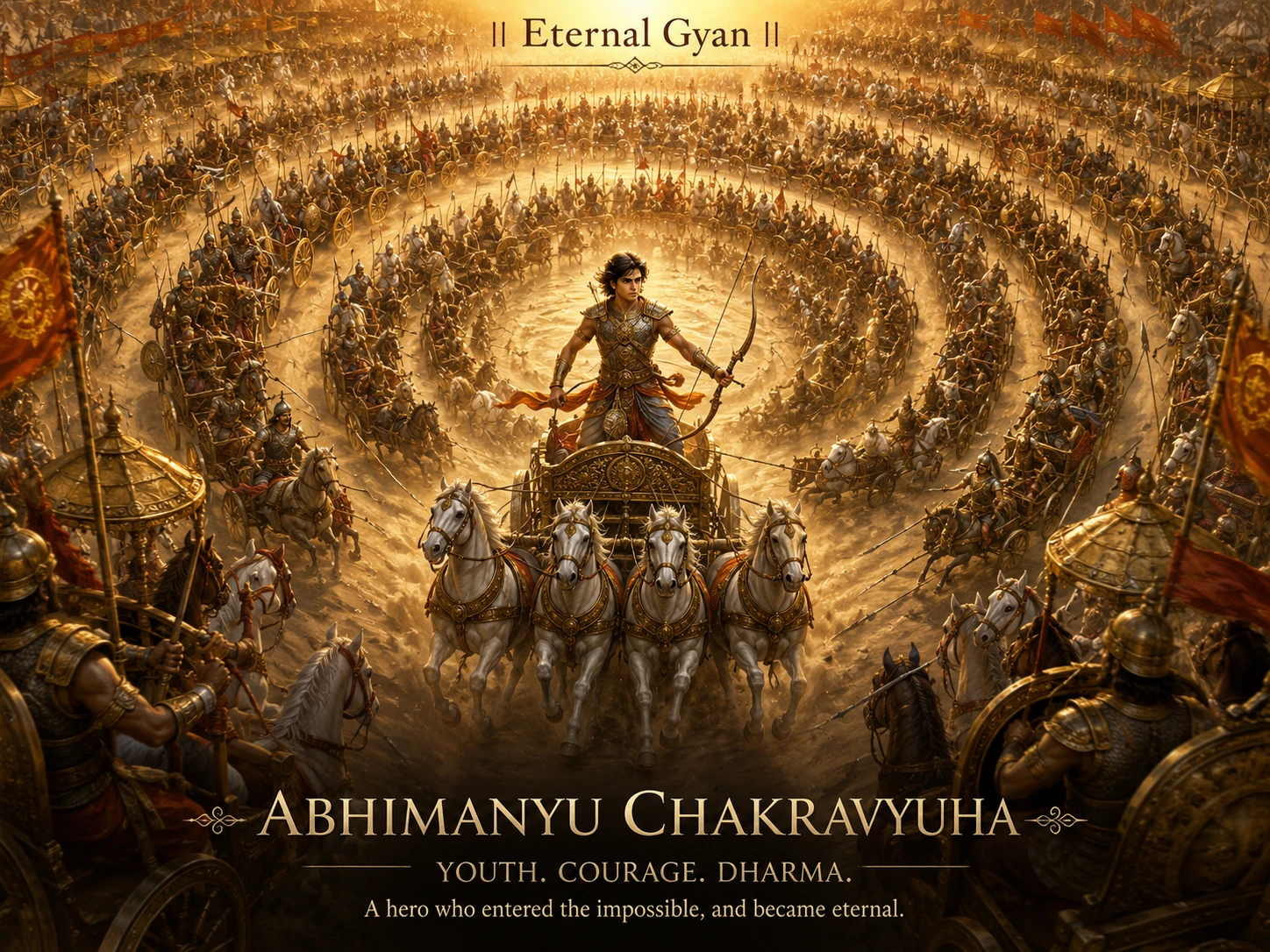
Abhimanyu and the Chakravyuha -- The Boy Who Knew How to Enter but Not How to Leave
14 min read
Adbhuta Ramayana -- The Ramayana Where Sita Becomes Kali
9 min read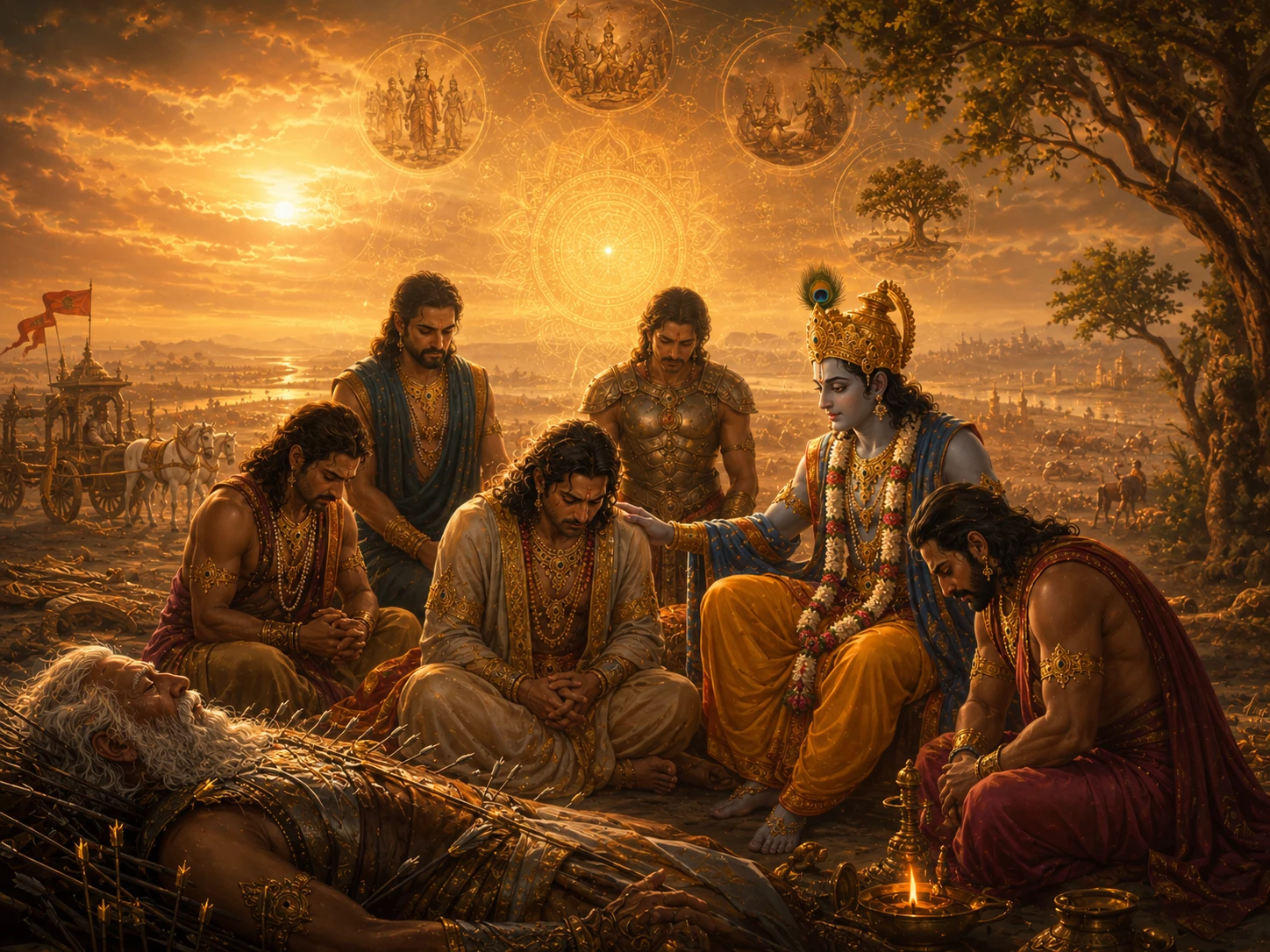
After Kurukshetra -- What Happened Next
14 min readThe same translation error that turned '33 Koti' into '33 crore' in Hinduism also happened in Buddhism. The Chinese translation of Buddhist texts rendered 'Sapta Koti Buddha' (7 Supreme Buddhas) as '7 Crore Buddhas.' The…
Deities AvatarsCommunity Reflections
🕉️
Be the first to share your reflection.