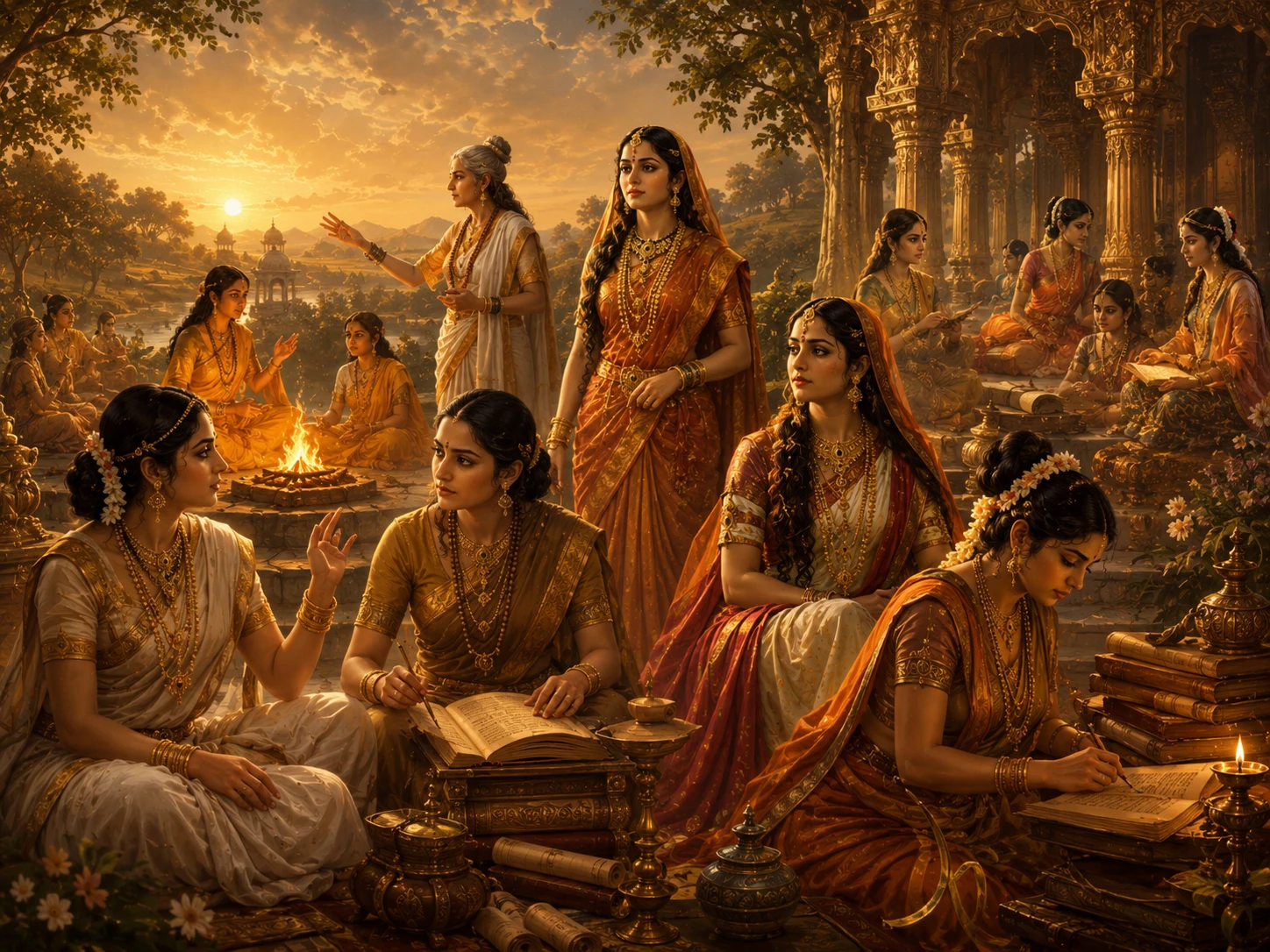
Women Power in Ancient India -- Scholars, Warriors, and Queens the Textbooks Erased
प्राचीन भारत में नारी शक्ति -- वो विद्वान, योद्धा और रानियाँ जिन्हें पाठ्यपुस्तकों ने मिटा दिया
Here is a test. Name one woman from ancient Indian scripture who was not primarily defined by her relationship to a man.
If you hesitated, it is not because such women do not exist. It is because nobody told you about them. The popular retelling of Hindu civilisation has reduced its women to wives, mothers, and victims -- Sita the faithful wife, Draupadi the wronged queen, Gandhari the blindfolded mother. These are real dimensions of real characters, but they are not the whole picture. Not even close.
The primary texts -- Vedas, Upanishads, epics, Puranas -- contain women who debated philosophers and won, composed Vedic hymns that are still chanted today, fought in battles with iron prosthetic limbs, drove war chariots, rejected wealth for knowledge, built strategic alliances that reshaped continents, and made decisions that determined the fate of civilisations.
This is not a modern feminist reimagining. This is what the texts actually say. The reimagining happened later -- when colonial scholars, Victorian morality, and centuries of selective retelling conspired to erase these women from popular memory and replace them with a narrative of eternal subjugation.
This article is Part 1 of a three-part series on women in Hindu scripture. Part 2 covers Sita and Draupadi as the catalysts who triggered two great wars. Part 3 covers the forgotten women -- Urmila, Madri, Gandhari, Mandodari -- whose sacrifices the tradition barely acknowledges.
The test exposes something important about how history is taught in India. Ask a CBSE 10th-standard student about ancient Indian women and they will name Rani Lakshmibai (19th century, Revolt of 1857) or Savitribai Phule (19th century, education reform). These are modern historical figures. The ancient women -- the ones who debated philosophy in royal courts before the Common Era began, who fought battles before iron was common, who composed Rigvedic hymns that are still chanted in temples today -- are almost entirely absent from the syllabus. This is not because the primary texts are silent. It is because the educational pipeline between the primary texts and the classroom has been culturally filtered.
This article goes to the primary sources. Not mythology books. Not popular retellings. The Rigveda. The Brihadaranyaka Upanishad. The Mahabharata. The inscriptions. What these texts actually say -- not what later centuries chose to remember -- about what women were, did, and could be.
येनाहमामृता स्यां किमहं तेन कुर्याम्॥
yenāham amṛtā syāṃ kim ahaṃ tena kuryām ||
What shall I do with that by which I do not become immortal?
— Brihadaranyaka Upanishad 2.4.3 (Maitreyi to Yajnavalkya)
The Philosophers -- Gargi, Maitreyi, Lopamudra
Around 700 BCE, King Janaka of Videha organised a Brahmayajna -- a grand philosophical debate -- in his court. The prize: a thousand cows with ten grams of gold hanging from each horn. The greatest minds in India assembled. Among them, one woman: Gargi Vachaknavi, daughter of sage Vachaknu, one of the Navaratnas (nine gems) of Janaka's court.
Sage Yajnavalkya, confident in his superiority, declared he would claim the cows. Eight scholars challenged him. All lost. Then Gargi stood up.
Her questioning is recorded in chapters 3.6 and 3.8 of the Brihadaranyaka Upanishad -- not as a footnote but as the structural centrepiece of the debate. She asked Yajnavalkya about the fundamental 'warp' of reality -- what is space woven on? What is that woven on? She pushed him layer by layer toward the Absolute until Yajnavalkya had to invoke the concept of Akshara (the Imperishable) to answer her. He warned her: 'Do not question too much, O Gargi, lest your head fall off.' This was not a threat of violence -- it was a philosophical concession that she had reached the boundary of what language can express.
After his answer, Gargi declared to the assembly: 'Distinguished Brahmins, you should consider yourselves lucky if you escape this man by merely paying respects. None of you will defeat him.' She was the only scholar with the intellectual authority to certify the winner. The debate did not end with a male sage's pronouncement. It ended with Gargi's.
Maitreyi, Yajnavalkya's own wife, appears in chapters 2.4 and 4.5 of the same Upanishad. When Yajnavalkya decided to renounce the world, he offered to divide his wealth between his two wives. Katyayani, the other wife, accepted. Maitreyi asked the question that defines her forever: 'If the entire earth, filled with wealth, belonged to me, would that make me immortal?' When he said no, she replied: 'Then what shall I do with that which does not make me immortal? Tell me instead what you know about the Self.'
This is not a wife asking her husband for spiritual advice. This is a philosopher forcing a negotiation -- I will not accept material settlement; I want the knowledge you are taking into renunciation. The dialogue that follows -- on the nature of Atman, the reason love exists, and the unity of all consciousness -- became the philosophical cornerstone of Advaita Vedanta. Adi Shankaracharya wrote a complete commentary on it.
Lopamudra, wife of sage Agastya, composed Rigveda hymn 1.179 -- one of the few hymns in the Vedas attributed to a woman. In it, she argues that asceticism without love is incomplete, and that desire and spirituality are not opposed. She persuaded Agastya to balance tapas with grihastha life. The hymn is still part of the Vedic recitation tradition.
These women were called Brahmavadinis -- 'those who speak of Brahman.' Not Brahmavadini wives. Not Brahmavadini daughters. Brahmavadinis. Their knowledge was their identity.
But Gargi is not alone. The Mahabharata's Shanti Parva records the debate between Sulabha and King Janaka -- yes, the same dynasty, perhaps a later Janaka. Sulabha was a wandering ascetic who entered the king's court and challenged his claim to spiritual liberation. The debate is remarkable because Sulabha defeats Janaka on his own philosophical ground, arguing that true liberation cannot coexist with the attachment to kingship. A woman wanderer, with no institutional backing, no title, no army, defeated a king in philosophical combat -- and the text records her victory without apology.
The Warriors -- Vishpala, Kaikeyi, Chedi Queens
The Rigveda (1.116.15) mentions Vishpala, a warrior queen who lost a leg in battle. The Ashvins -- divine physicians -- fitted her with an iron prosthetic (ayasi jangha), and she returned to fight. This is not a late mythological addition. This is the Rigveda -- the oldest Hindu text. A woman losing a limb in combat, receiving a metal prosthetic, and resuming battle is recorded in the most ancient scripture as a matter-of-fact event, not a miracle.
Kaikeyi -- universally vilified as the stepmother who exiled Rama -- was originally a warrior princess of the Kekeya kingdom (modern Punjab). The Valmiki Ramayana describes how she drove King Dasharatha's chariot in the battle against the Asuras, replacing the fallen charioteer, and saved Dasharatha's life when an axle pin broke by inserting her own finger into the wheel hub. Dasharatha, grateful, offered her two boons -- the same boons she would later use to send Rama to exile. The tragedy of Kaikeyi is not that she was evil. It is that a warrior queen's strategic mind was manipulated by Manthara and channelled toward a catastrophic demand.
The Mahabharata records multiple women warriors. Shikhandi, born female as Amba and reborn in a male body through Shiva's boon, became the strategic key to Bhishma's fall. Chitrangada of Manipur, Arjuna's wife, was a warrior princess who ruled her own kingdom. The text describes her military skills alongside her beauty -- the two are not treated as contradictory.
The key insight: these women were not warrior 'exceptions' grudgingly tolerated by a patriarchal text. They appear in the narrative without apology or special explanation. The Rigveda does not say 'even though she was a woman, Vishpala fought.' It simply says she fought, lost a leg, and was fitted with an iron one. The gender was not the point. The courage was.
The Rig Veda itself is not silent on women in public and martial spaces. Multiple hymns reference women attending sabhas (assemblies) and samitis (tribal councils). Rigveda 10.159 is a power hymn spoken by a queen who declares her supremacy over co-wives and her authority in the household -- and the language is martial, not domestic.
Chitrangada of Manipur, from the Mahabharata, offers a particularly striking case. She was a warrior princess who ruled her own kingdom because her father had no sons. When Arjuna met and married her during his years of exile, the terms of the marriage were extraordinary by any standard: Arjuna agreed that their son Babhruvahana would inherit Chitrangada's throne, not his. The matrilineal succession was explicitly negotiated. This is not a footnote in the text -- it is a plot point that later leads to one of the most dramatic encounters in the epic, when Babhruvahana fights and temporarily kills his own father.
Moving from scripture to inscriptional history, Rani Naganika of the Satavahana dynasty (1st century BCE) is documented in the Nanaghat cave inscription in the Western Ghats of Maharashtra. The inscription records that she performed Vedic yajnas including the Ashvamedha -- the horse sacrifice, the ultimate assertion of sovereign power. This was extraordinarily rare for any ruler, let alone a queen. Her coins bear her own name, not her husband's. For a history student preparing for UPSC, Naganika is the answer to the question: 'Was female sovereignty possible in ancient India?' The Nanaghat inscription is 15 km from Junnar, near Pune -- physical proof on your doorstep.
The Strategic Minds -- Kunti, Satyavati, Draupadi
Kunti is not just 'Arjuna's mother.' She is arguably the most strategic mind in the Mahabharata -- a woman who navigated exile, widowhood, five sons by different fathers (including three through divine invocation), political alliances, and eighteen years of survival in a hostile court. When the Pandavas were in exile and Arjuna won Draupadi at her Swayamvar, it was Kunti's offhand instruction -- 'share equally whatever you have won' -- that created the polyandrous marriage that bound all five brothers to one queen. Accidental or not, this single decision ensured the Pandavas could never be divided. Kunti understood alliance politics at a level that would make any Chanakya graduate pause.
Satyavati, grandmother of the Kauravas and Pandavas, engineered one of the most consequential dynastic decisions in the epic. When both her grandsons (Dhritarashtra and Pandu) proved unable to produce heirs normally, she summoned Vyasa -- her own son from a previous relationship -- to perform Niyoga (a sanctioned practice of begetting heirs through a designated male). She made this decision without male approval, exercising a matriarchal authority that the text treats as entirely legitimate.
Draupadi is reduced in popular culture to the woman whose disrobing started a war. But in the text, she is a relentless strategic voice. During the twelve years of exile, when the Pandavas wavered between forgiveness and war, it was Draupadi who consistently argued for justice. Her speech to Yudhishthira in the Vana Parva -- where she challenges his passive acceptance of injustice -- is one of the most powerful arguments for righteous anger in world literature. She did not start the war. She demanded accountability. The war was the consequence of a system that denied it.
Consider this: the startup ecosystem in Bangalore loves to celebrate 'disruptors' -- founders who broke conventions and built empires. Kunti disrupted the entire Kuru succession through a single sentence. Satyavati disrupted an entire dynasty's bloodline through a single decision. Draupadi disrupted the social contract of Kuru-Panchala diplomacy through a single speech. These women were operating at the CEO level of ancient Indian power structures -- and the texts record their agency without apology. If a B-school case study were written about any of them, it would be taught in the strategy elective alongside Chanakya's Arthashastra.
Women of Ancient India -- Beyond the Popular Image
| Woman | Popular Image | What the Primary Text Actually Says | Source Text |
|---|---|---|---|
| Gargi Vachaknavi | Barely mentioned in textbooks | One of 9 Navaratnas of Janaka's court. Only scholar who could certify Yajnavalkya's victory. Called Brahmavadini. | Brihadaranyaka Upanishad 3.6, 3.8 |
| Maitreyi | Yajnavalkya's wife | Philosopher who rejected wealth for knowledge. Her dialogue became the foundation of Advaita Vedanta. | Brihadaranyaka Upanishad 2.4, 4.5 |
| Lopamudra | Agastya's wife | Rigvedic poet. Composed hymn 1.179. Argued that desire and spirituality are complementary, not opposed. | Rigveda 1.179 |
| Vishpala | Unknown to most | Warrior queen. Lost leg in battle. Fitted with iron prosthetic by Ashvins. Returned to fight. | Rigveda 1.116.15 |
| Kaikeyi | Villain who exiled Rama | Warrior princess of Kekeya. Drove Dasharatha's chariot in war. Saved his life by inserting her finger in broken axle. | Valmiki Ramayana, Ayodhya Kanda |
| Kunti | Mother of Pandavas | Supreme political strategist. Navigated exile, Niyoga, polyandrous alliance, and 18 years in enemy court. | Mahabharata, multiple Parvas |
| Draupadi | Victim of disrobing | Relentless advocate for justice. Her Vana Parva speech is one of the strongest arguments against passive acceptance of injustice. | Mahabharata, Vana Parva |
| Satyavati | Vyasa's mother | Matriarch who made the most consequential dynastic decision in the epic without male approval. | Mahabharata, Adi Parva |
This table covers only 8 women. The texts mention dozens more: Apala, Ghosha, Vishvavara (Rigvedic poets), Sulabha (defeated King Janaka in debate in the Mahabharata), Ubhaya Bharati (defeated Mandana Mishra's debating proxy against Shankaracharya), Rani Naganika (Satavahana warrior queen with her own coins). The 'oppressed Hindu woman' narrative, while reflecting real periods of patriarchal decline, does not represent the foundational texts.
What Changed? The Decline
This article would be intellectually dishonest if it only celebrated the Vedic ideal without addressing the obvious question: if women held these positions in ancient India, what happened?
The decline was gradual and multi-causal. The Smriti literature (Manusmriti, Yajnavalkya Smriti, and later Dharmashastra texts, roughly 200 BCE - 500 CE) progressively restricted women's access to education, property, and religious authority. The Vedic right of women to study and perform yajnas was curtailed. Child marriage replaced Swayamvar. Sati, initially an extremely rare warrior-widow practice, was gradually romanticised and, in some regions, enforced. The purdah (veil/seclusion) system, intensified during centuries of Central Asian invasions, further restricted women's public participation.
Critically, the original Vedic texts became inaccessible to most women -- and most men. When Sanskrit education became the exclusive domain of a narrow priestly class, the living memory of Gargi, Maitreyi, and Sulabha faded. What remained in popular culture were simplified, domesticated versions of Sita and Savitri -- the 'pativrata' ideal stripped of the fierce independence these characters actually demonstrate in the original texts.
Acknowledging this decline is essential, not because it diminishes the foundational texts but because it clarifies what we are recovering. The women of the Vedas and epics are not a modern feminist fantasy projected onto ancient texts. They are recorded in the texts themselves. The decline happened later, through historical processes that can be named and dated. Knowing this changes the conversation from 'Hinduism oppresses women' to 'Hinduism's foundational texts record female authority that later periods suppressed.' The first framing is a weapon. The second is a map for reclamation.
This matters because it changes the political framing entirely. When a right-wing cultural nationalist says 'ancient India was perfect for women,' they are partially right about the Vedic texts but wrong about the continuity -- the decline happened and must be owned. When a left-wing academic says 'Hinduism is inherently patriarchal,' they are partially right about the Smriti-era decline but wrong about the foundational texts -- Gargi, Maitreyi, Vishpala, and Sulabha are not later insertions. They are in the oldest layers of the tradition. The intellectually honest position, the one a serious UPSC essay demands, is both: the texts preserved female authority; later periods suppressed it; recovery is possible because the source material still exists.
The Rigveda (1.116.15) records the first known prosthetic limb in human history -- an iron leg (ayasi jangha) fitted to the warrior queen Vishpala by the Ashvins after she lost her leg in battle. This predates the famous Roman general Marcus Sergius's prosthetic iron hand (c. 218 BCE) by at least several centuries. The Rigvedic account does not treat this as miraculous -- it is presented as a medical intervention by the divine physicians. India's first recorded amputee-warrior is a woman. And she went back to fight.
Read the Maitreyi-Yajnavalkya Dialogue
The conversation Advaita Vedanta returns to again and again began when a woman refused to accept wealth. Read the Brihadaranyaka Upanishad's dialogue of Maitreyi and Yajnavalkya on Eternal Raga, with Sanskrit and translation.
Tags
Eternal Raga · शाश्वत राग
Institutional voice — scholarly articles on Sanatan Dharma
Deepen Your Understanding
अपनी समझ और गहरी करें
scriptural exegesis
Sita and Draupadi -- The Two Women Who Triggered Two Great Wars
Every Indian knows that the Ramayana happened because Sita was abducted and the Mahabharata happened because Draupadi was disrobed. But here is the question nobody asks: were these women the cause of war, or the consequence of systems that had already failed? The answer reframes both epics.
scriptural exegesis
The Forgotten Women -- Urmila, Madri, Gandhari and the Sacrifices Nobody Tells
Urmila slept for 14 years so Lakshmana could stay awake guarding Rama. Madri walked into her husband's funeral pyre carrying the guilt of his death. Gandhari blindfolded herself for life -- not in submission, but in the most devastating protest a wife has ever made. These women shaped the epics. The epics barely mention them.
scriptural exegesis
Draupadi in the Sabha -- The Trial That Started the War
A queen was dragged into a court full of kings, warriors, and elders. Not one stood up. She asked a single legal question that nobody could answer. Then she swore an oath that burned a civilization to the ground. Draupadi's Sabha episode is not a story about a helpless woman. It is the most devastating indictment of institutional silence in world literature.
scriptural exegesis
Wives of Arjuna -- Four Women Who Shaped the War
Arjuna did not marry for romance. Each of his four marriages -- to Draupadi, Subhadra, Ulupi, and Chitrangada -- was a strategic alliance that brought the Pandavas military power, divine protection, or political legitimacy they could not have won on the battlefield. A Panchala princess, a Yadava sister, a Naga queen, and a Manipuri warrior-princess: four women from four different civilisations, each changing the course of the Mahabharata.
scriptural exegesis
Brihadaranyaka Upanishad -- Yajnavalkya, Maitreyi, and the Question That Defines All Love
A husband prepares to leave home forever. He calls his wife and offers to divide his property between her and his other wife. Maitreyi stops him with one question: 'If this whole earth filled with wealth were mine, would I be immortal through it?' Yajnavalkya answers: 'No. Your life would be like that of the wealthy -- comfortable but mortal. There is no hope of immortality through wealth.' And Maitreyi says: 'Then what shall I do with that by which I do not become immortal? Tell me instead, sir, what you know.' What follows is one of the most profound philosophical dialogues in human history -- the teaching that everything you love, you love for the sake of the Self.
scriptural exegesis
Savitri and Satyavan -- The Woman Who Argued With Death
She knew the day her husband would die. She walked into the forest beside him anyway. And when Yama came with his noose, she argued -- not pleaded -- her way to four boons that turned death itself into the doorway home.
philosophy darshana
Rama vs Krishna -- Two Faces of Dharma, One Question for Your Life
Rama followed every rule and lost his wife. Krishna broke every rule and won the war. Both are Vishnu. Both upheld Dharma. So who was right? The answer might be the most important thing Hindu philosophy has to say to a world that thinks morality is simple.
The Rigveda (1.116.15) records the first known prosthetic limb in human history -- an iron leg (ayasi jangha) fitted to the warrior queen Vishpala by the Ashvins after she lost her leg in battle. This predates the famous…
More in Scriptural Exegesis
Abhimanyu and the Chakravyuha -- The Boy Who Knew How to Enter but Not How to Leave
14 min read
Adbhuta Ramayana -- The Ramayana Where Sita Becomes Kali
9 min read
After Kurukshetra -- What Happened Next
14 min readThe same translation error that turned '33 Koti' into '33 crore' in Hinduism also happened in Buddhism. The Chinese translation of Buddhist texts rendered 'Sapta Koti Buddha' (7 Supreme Buddhas) as '7 Crore Buddhas.' The…
Deities AvatarsCommunity Reflections
🕉️
Be the first to share your reflection.