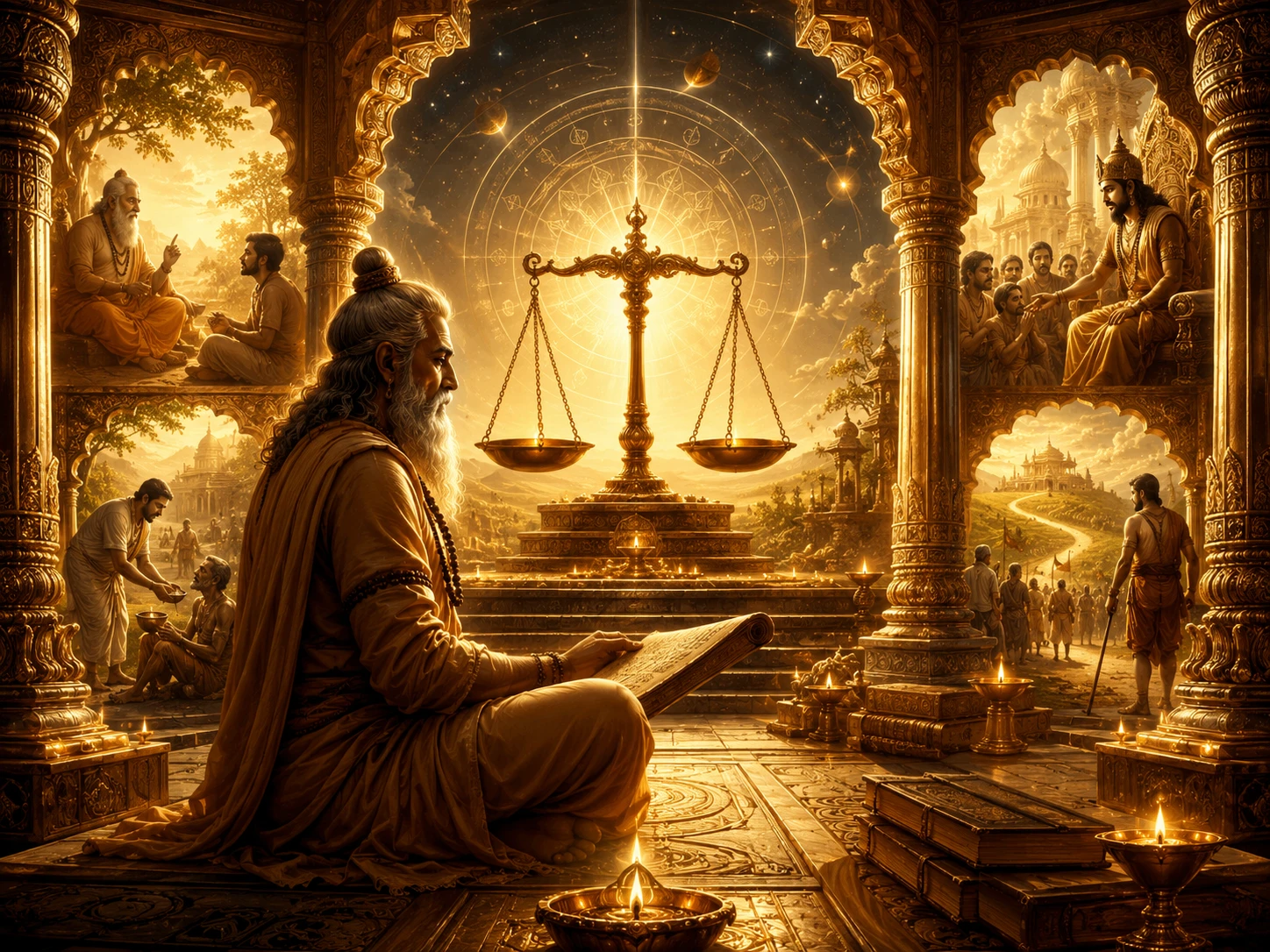
Brihadaranyaka Upanishad -- Yajnavalkya, Maitreyi, and the Question That Defines All Love
बृहदारण्यक उपनिषद् -- याज्ञवल्क्य, मैत्रेयी, और वह प्रश्न जो सब प्रेम परिभाषित करता है
The Brihadaranyaka Upanishad is the largest and arguably the oldest of the principal Upanishads. The name means 'the great forest text' (Brihad = great, Aranyaka = forest treatise), and it lives up to its name in every dimension -- it is vast in scope, dense in argument, and wild in the range of topics it covers. It forms the concluding portion of the Shatapatha Brahmana of the Shukla Yajurveda and is attributed to the sage Yajnavalkya, who is also the traditional compiler of the Shukla Yajurveda itself.
The text has six chapters (Adhyayas) and covers an extraordinary range: creation cosmology, the nature of dreams, the theory of karma and rebirth, the honey doctrine (madhu-vidya), the nature of Brahman, and multiple philosophical debates. But the most celebrated sections are the dialogues involving Yajnavalkya -- particularly his conversations with Maitreyi (his wife), Gargi Vachaknavi (a woman philosopher who challenges him in a public debate), and King Janaka (the philosopher-king of Videha).
Yajnavalkya is the most fully realised character in Upanishadic literature. He is brilliant, arrogant, tender, provocative, and unflinching. He wins debates by intellectual force. He silences challengers by threatening cosmic consequences. And then, in his most intimate moment, he sits with his wife Maitreyi and delivers the most psychologically acute teaching on love in Indian philosophy. The text contains this range because life contains this range -- the Brihadaranyaka does not separate the philosophical from the personal, the cosmic from the domestic, the metaphysical from the emotional.
This article focuses on the Yajnavalkya-Maitreyi dialogue (occurring twice -- in 2.4 and 4.5, with slight variations) because it contains the Upanishad's most concentrated and transformative teaching. It is also one of the earliest and most significant philosophical dialogues involving a woman as the primary interlocutor and driver of the inquiry.
न वा अरे पत्युः कामाय पतिः प्रियो भवति, आत्मनस्तु कामाय पतिः प्रियो भवति । न वा अरे सर्वस्य कामाय सर्वं प्रियं भवति, आत्मनस्तु कामाय सर्वं प्रियं भवति । आत्मा वा अरे द्रष्टव्यः श्रोतव्यो मन्तव्यो निदिध्यासितव्यो मैत्रेयि ॥
na vā are patyuḥ kāmāya patiḥ priyo bhavati, ātmanastu kāmāya patiḥ priyo bhavati | na vā are sarvasya kāmāya sarvaṃ priyaṃ bhavati, ātmanastu kāmāya sarvaṃ priyaṃ bhavati | ātmā vā are draṣṭavyaḥ śrotavyo mantavyo nididhyāsitavyo maitreyi ||
It is not for the sake of the husband, my dear, that the husband is loved, but for the sake of the Self. It is not for the sake of all, my dear, that all is loved, but for the sake of the Self. The Self, O Maitreyi, should be seen, heard, reflected upon, and deeply meditated upon.
— Brihadaranyaka Upanishad, Adhyaya 2, Brahmana 4, Verse 5 (Yajnavalkya-Maitreyi Dialogue); Shukla Yajurveda, Shatapatha Brahmana
This verse is the psychological atom bomb of Indian philosophy. Read it slowly. You love your husband -- but not for his sake. You love your children -- but not for their sake. You love music -- but not for music's sake. You love money -- but not for money's sake. Everything you have ever loved, you love for one reason only: for the sake of the Self.
This is not selfishness. The Upanishad is not saying you are narcissistic. It is making a structural observation about the nature of love. When you love your child, what you actually experience is a moment of self-expansion -- your boundaries dissolve, your ego relaxes, and for a brief instant you touch something infinite within yourself. The child is the occasion for this experience. But the source of the joy is not the child. The source is the Self -- the Atman -- which is infinite, unlimited, and inherently blissful. The child (or the spouse, or the sunset, or the song) is a window through which you briefly glimpse your own nature.
This explains something that every human being has noticed but few can articulate: why does the same object produce joy at one moment and indifference at another? The same chai that tasted divine on a rainy Pune evening tastes like nothing when you are anxious about a work deadline. The chai did not change. Your inner state changed. The Brihadaranyaka's conclusion is precise: the joy was never in the chai. The joy was in you. The chai was the trigger. The Self was the source.
For the UPSC aspirant studying philosophy, this teaching is foundational. It connects Vedantic metaphysics to everyday psychology. It explains why Vedanta claims that Brahman is Ananda (bliss) -- not because Brahman is an emotion, but because the experience of love, joy, and bliss in human life is always a momentary contact with the Self, which is Brahman. The logical chain is: you experience joy when ego-boundaries dissolve > the Self that is revealed is Brahman > Brahman is therefore experienced as bliss > all love is love of the Self.
Maitreyi's question is the key that unlocks everything. She does not ask 'what is Brahman?' -- that would be a metaphysical question. She asks 'would wealth make me immortal?' -- that is an existential question. It is the question of every human being who has achieved success and felt the emptiness behind it. Every Sharma uncle in Delhi who built a Kothi and still feels incomplete. Every Bangalore techie with RSUs who still dreads Monday morning. Every Bollywood actress with 10 million followers who still cannot sleep without Ambien. Maitreyi asks their question. Yajnavalkya gives the only honest answer: no. Wealth gives comfort, not immortality. Then what does? The Self.
Key Philosophical Dialogues in the Brihadaranyaka Upanishad
| Dialogue | Participants | Central Question | Key Teaching | Chapter |
|---|---|---|---|---|
| Maitreyi Dialogue | Yajnavalkya and Maitreyi (wife) | Would wealth make me immortal? | All love is love of the Self; Atman must be seen, heard, reflected upon | 2.4 and 4.5 |
| Gargi Debate | Yajnavalkya and Gargi Vachaknavi | What is everything woven upon? | Everything is woven on space (akasha); space is woven on the Imperishable (Akshara Brahman) | 3.6 and 3.8 |
| Janaka Teaching | Yajnavalkya and King Janaka | What is the light of a person? | When sun, moon, fire, and speech fail -- the Self alone is the light | 4.3 |
| Neti Neti | Yajnavalkya's method | How to describe Brahman? | Not this, not this (neti neti) -- Brahman is described only through negation | 2.3.6 |
| Madhu Vidya | Dadhyach Atharvana (via Yajnavalkya) | How is everything connected? | All elements are honey to each other -- mutual interdependence of the cosmos | 2.5 |
The Brihadaranyaka is unique among Upanishads for featuring women as primary interlocutors (Maitreyi, Gargi) and for showing the philosopher (Yajnavalkya) in both his public debating mode and his private, intimate teaching mode.
The Neti Neti (not this, not this) method, introduced in Brihadaranyaka 2.3.6, became one of the defining techniques of Vedantic philosophy. When asked to describe Brahman, Yajnavalkya refuses positive description. He says Brahman has two forms: the mortal (gross, defined) and the immortal (subtle, undefined). The gross form is everything that is other than air and space -- earth, water, fire. The subtle form is air and space. But the essence of both -- the Self of this -- is described only as 'neti neti' -- not this, not this.
This is not evasion. It is precision. Any positive description of Brahman would limit it. If you say 'Brahman is infinite,' the word 'infinite' becomes a concept in the mind -- and anything that is a concept in the mind is a mental object, not the reality itself. Neti neti strips away every concept, every image, every word, until what remains is the unnameable ground. This is the same approach that Turiya takes in the Mandukya Upanishad (described through seven negations) and that the Kena Upanishad uses ('not what people worship here').
For the modern Indian, neti neti is a practical tool for self-inquiry. Who am I? I am not my job title -- neti. I am not my bank balance -- neti. I am not my caste, my region, my language, my political opinion, my Instagram persona -- neti, neti, neti, neti, neti. What remains when every label is removed? That is what the Brihadaranyaka is pointing to. Not a blank void, but the pure awareness that was wearing all those labels without being any of them.
The Gargi debate (3.6, 3.8) deserves particular attention because it represents one of the earliest recorded philosophical debates involving a woman as a full intellectual equal. Gargi Vachaknavi challenges Yajnavalkya at the court of King Janaka in front of an assembly of Brahmins. She asks a devastating chain of questions: if everything is woven on water, what is water woven on? Space. What is space woven on? The world of Gandharvas... and so on, driving deeper and deeper until she reaches the Imperishable (Akshara). Yajnavalkya warns her: 'Do not ask too much, Gargi, or your head will fall.' This warning has been read as either intellectual intimidation or as a genuine metaphysical caution -- that pushing conceptual inquiry beyond the Imperishable leads not to deeper knowledge but to the dissolution of the questioner's conceptual framework. Gargi accepts and declares Yajnavalkya the greatest Brahmin among them.
The fact that Gargi participates as an equal in a philosophical debate in a royal court -- asking questions that no male Brahmin dared to ask, pushing the inquiry further than anyone else -- is a corrective to the narrative that ancient Indian women had no intellectual role. The Brihadaranyaka preserves Gargi's name, her questions, her intellectual courage, and her final judgment. She is not a footnote. She drives the inquiry.
The Brihadaranyaka's Madhu Vidya (Honey Doctrine, 2.5) teaches that everything in the universe is 'honey' (madhhu) to everything else -- mutually nourishing, mutually dependent. The earth is honey to all beings, and all beings are honey to the earth. The sun is honey to all beings, and all beings are honey to the sun. This is not merely ecological interconnectedness -- it is ontological. The connection is through the Self: the same Atman is the honey-essence in both the perceiver and the perceived.
Yajnavalkya's teaching to King Janaka (4.3) on the nature of dreams is another landmark. He describes the dream state as one where the individual self becomes its own creator -- it builds roads, chariots, rivers, and worlds from its own light. 'There are no chariots there, no roads, no joys, no pleasures, but he creates chariots, roads, joys, pleasures.' This is not just a phenomenological description of dreaming. It is a metaphysical argument: if you can create an entire world in a dream without external materials, then your consciousness has creative power independent of the external world. This is the same argument the Mandukya Upanishad will later use for its Taijasa (dream) state.
The Brihadaranyaka Upanishad's influence on Indian civilisation is difficult to overstate. Shankara wrote his longest and most detailed commentary on it. The Neti Neti method became the signature technique of Advaita self-inquiry. Maitreyi's dialogue is referenced in feminist scholarship on ancient India. The Madhu Vidya is cited in ecological philosophy. The Gargi debate appears in every history of Indian logic and rhetoric. And the teaching that all love is love of the Self has filtered into Indian poetry, bhakti literature, and contemporary self-help culture -- though often without attribution.
For the student who wants to understand the full architecture of Vedantic thought -- not just the conclusions but the arguments, not just the positions but the debates -- the Brihadaranyaka Upanishad is indispensable. It is the forest in which all other Upanishads are trees.
The four-fold method of Self-knowledge given in the Maitreyi dialogue -- drashtavya (to be seen), shrotavya (to be heard), mantavya (to be reflected upon), nididhyasitavya (to be deeply meditated upon) -- became the foundational pedagogy of Vedanta. Shankara formalised this as the three stages of spiritual practice: Shravana (hearing the teaching from a guru), Manana (reflecting on it through reason and inquiry), and Nididhyasana (sustained contemplative meditation until the truth becomes one's lived experience).
This three-stage model has practical applications far beyond spirituality. Any deep learning follows this pattern. A medical student first hears the diagnosis framework (Shravana), then works through case studies and differential diagnoses (Manana), then develops clinical intuition through years of practice (Nididhyasana). A musician first hears the raga (Shravana), then practices the phrases and ornaments (Manana), then internalises the raga until it flows without conscious effort (Nididhyasana). The Brihadaranyaka's insight is that Self-knowledge follows the same progression -- and that most seekers stop at Shravana. They hear the teaching, agree with it intellectually, and then wonder why nothing has changed. The Upanishad says: hearing is not enough. You must reflect until the teaching becomes your own understanding. And then you must meditate until the understanding becomes your lived reality.
The Brihadaranyaka also contains the teaching that became the Vedantic theory of error -- the rope-snake analogy. In dim light, you see a rope and mistake it for a snake. You experience genuine fear, genuine adrenaline, genuine suffering. But the snake was never there. When you bring a lamp and see the rope, the snake does not 'go away' -- it was never present. Shankara developed this into his theory of Adhyasa (superimposition): the entire phenomenal world is a superimposition on Brahman, like the snake on the rope. The world does not need to be destroyed (you do not need to kill the snake). It needs to be seen correctly (you need to bring the lamp). This is why Vedanta is called a 'knowledge path' -- liberation comes not from doing something but from seeing correctly.
The Brihadaranyaka Upanishad's treatment of Yajnavalkya as a character deserves attention because he is presented with a psychological complexity unmatched in ancient Indian literature. He is not a one-dimensional saint. He is arrogant -- he famously tells the other Brahmins at Janaka's court to drive away the thousand cows reserved as the prize for the greatest knower of Brahman, because 'I wish to have the cows' (3.1.2). He is competitive -- he defeats eight challengers in public debate. He is tender -- his dialogue with Maitreyi is one of the most intimate conversations in ancient literature. And he is honest -- when Maitreyi asks whether wealth can give immortality, he does not soften the answer.
This complexity is pedagogically important. The Upanishad is showing that spiritual knowledge does not erase personality. Yajnavalkya does not become bland or generic after realising Brahman. He remains sharp, ambitious, passionate, and fully human. The teaching is that liberation does not produce uniformity. A liberated person can be gentle like Ramana Maharshi or fierce like Yajnavalkya. The knowledge is the same; the expression varies with the temperament.
For the modern reader -- especially the Indian reader raised on hagiography, where every saint is infinitely patient and every guru is infallibly wise -- Yajnavalkya is refreshing. He quarrels with his wife about property division. He intimidates competitors. He accepts prizes. He is, in short, a real person who happens to also be the greatest philosopher of his age. The Brihadaranyaka does not sanitise him, and this is its strength: it shows that the highest knowledge is compatible with a full, messy, complicated human life.
The Brihadaranyaka's cosmological sections (Chapter 1) are also foundational. The Ashvamedha (horse sacrifice) is reinterpreted as a meditation on the cosmos itself -- the horse's head is the dawn, its eye is the sun, its breath is the wind. This is the Upanishadic revolution at work: taking a literal ritual (killing a horse to demonstrate royal power) and transforming it into a contemplative practice (seeing the entire universe as a sacrifice, with every element as an offering). This interiorisation of ritual is the bridge between Vedic religion and Vedantic philosophy, and the Brihadaranyaka is where that bridge is most explicitly built.
The Brihadaranyaka's teaching on dreams (4.3) has a sophisticated structure that modern sleep science is only beginning to appreciate. Yajnavalkya describes three states -- waking, dreaming, and the 'junction' between them (sandhya) -- and argues that in the junction, the self is simultaneously aware of both worlds. This is strikingly similar to the hypnagogic state that sleep researchers have documented: the transitional zone between waking and sleeping where hallucinatory imagery, lucid awareness, and creative insights coexist.
Yajnavalkya's description of the dreaming self as a creator is phenomenologically precise: 'There are no chariots there, no horses, no roads. He creates chariots, horses, roads. There are no joys, no pleasures, no pools. He creates joys, pleasures, pools. For he is the maker.' This is consciousness as a generative engine -- not merely a passive receiver of stimuli but an active creator of entire experiential worlds. This is the same insight that the Mandukya Upanishad develops with its Taijasa state and that modern VR designers exploit: consciousness does not need external input to produce complete, immersive experience.
The Brihadaranyaka's teaching on death (4.4) is equally profound. Yajnavalkya describes how, at the moment of death, the pranas (vital forces) gather around the Self, the Self takes its accumulated karmas as its 'light,' and travels to its next embodiment. The description is vivid: 'As a goldsmith takes a piece of gold and turns it into another, newer, more beautiful form, so does this Self, after having thrown off this body and dispelled its ignorance, make unto itself another, newer, more beautiful form.' This is not passive reincarnation. It is active re-creation -- the Self as an artist who crafts its next body from the material of its accumulated deeds.
For the modern Indian grappling with questions of death and afterlife -- the cancer patient in Tata Memorial, the elderly parent in a Tier-2 city hospital, the family gathered for the thirteenth-day shraddha ceremony -- the Brihadaranyaka offers a framework that is neither nihilistic (death is the end) nor naively comforting (you go to heaven). It says: what you become after death depends on what you were during life. Your karmas are not punishments or rewards. They are the material from which your next form is crafted. Choose your material wisely.
The Brihadaranyaka Upanishad's verse on love -- 'na va are patyuh kamaya patih priyo bhavati, atmanah tu kamaya patih priyo bhavati' -- has been called the most psychologically acute observation on human love in world literature. Modern attachment theory, developed by John Bowlby in the 1960s, argues that we love others because loving makes us feel secure -- a self-referential loop. The Brihadaranyaka said the same thing three thousand years earlier, but went further: the security you seek in love is not emotional safety. It is a momentary contact with your own infinite nature.
This teaching transforms the experience of heartbreak. When a relationship ends, the suffering is commonly attributed to the loss of the other person. The Brihadaranyaka reframes: what you lost was not the person. What you lost was the window through which you were glimpsing your own Self. The person was the occasion for self-contact. The grief is real -- but it is grief for a lost doorway, not a lost destination. The destination (the Self) is still here. You need only find another doorway -- or better, realise that you ARE the destination.
For the Indian listener -- the newly divorced professional in Mumbai, the heartbroken college student in Chandigarh, the widow performing final rites in Varanasi, the NRI whose parents arranged marriage crumbled in Chicago -- this is not philosophy. It is survival equipment. The Brihadaranyaka does not ask you to stop loving. It asks you to understand what you are actually loving. And when you do, love becomes both deeper and less desperate. Deeper because you are touching the infinite in the other person. Less desperate because the infinite cannot be lost.
The text's closing teaching (6.5) provides the Vansha Brahmana -- a guru-shishya lineage tracing the transmission of this knowledge through dozens of generations, from divine beings to human sages. This lineage is not merely historical record. It is a statement of faith: this knowledge was not invented. It was received, preserved, and transmitted by an unbroken chain of teachers, each of whom realised it before passing it on. For the student who enters this lineage today -- through any authentic teacher, in any tradition that traces back to the Upanishads -- the Brihadaranyaka says: you are inheriting something older than history, something tested by millennia, something that works.
The Brihadaranyaka Upanishad contains the first known formulation of the law of karma and rebirth in Indian literature (3.2.13): 'By good deeds one becomes good, by evil deeds one becomes evil.' This verse is the earliest textual source for the karmic theory that later became central to all Indian religions. Additionally, the dialogue between Yajnavalkya and Maitreyi was a favourite of Swami Vivekananda, who used it in his Chicago World Parliament of Religions address (1893) to demonstrate that Hinduism had a sophisticated philosophy of love 2,500 years before European Romanticism. Schopenhauer, the German philosopher who deeply influenced Nietzsche and Wagner, called the Upanishads 'the consolation of my life' -- and the Brihadaranyaka was his primary text, accessed through the Latin translation Oupnekhat made from Dara Shikoh's Persian version.
Self-Inquiry -- The Neti Neti Meditation
Sit quietly. Ask: 'Am I this body?' Feel the body -- then notice that you are aware of the body. You are not the body. Neti. 'Am I these thoughts?' Watch them -- then notice you are aware of the thoughts. You are not the thoughts. Neti. Keep going. What remains when everything is negated is what Yajnavalkya was pointing Maitreyi toward.
Tags
Eternal Raga · शाश्वत राग
Institutional voice — scholarly articles on Sanatan Dharma
Deepen Your Understanding
अपनी समझ और गहरी करें
philosophy darshana
The Four Mahavakyas -- Upanishadic Sentences That Changed Civilisation
Four sentences. Twelve words of Sanskrit. Three thousand years of commentary. The Mahavakyas are the most compressed, most powerful, and most debated statements in all of Indian philosophy. Each one claims that the individual self and the ultimate reality of the universe are not two different things. And each one has been interpreted to mean something completely different by every major school of Vedanta.
scriptural exegesis
Chandogya Upanishad -- Tat Tvam Asi
A 24-year-old returns from 12 years of Vedic study, bloated with pride and stuffed with textbook knowledge, only to have his father demolish his certainty with nine repetitions of three words: Tat Tvam Asi -- You Are That. The Chandogya Upanishad is the text that broke the wall between God and you.
scriptural exegesis
Katha Upanishad -- Nachiketa and Yama
A teenage boy walks into the house of Death, waits three days without food, and then proceeds to negotiate the universe's deepest secret out of Yama himself. The Katha Upanishad is not a dusty scripture -- it is the original startup pitch where a kid with zero leverage outplayed the CEO of the afterlife.
scriptural exegesis
Isha Upanishad -- The Complete Guide to 18 Verses That Changed Indian Philosophy
Eighteen verses. That is all. The Isha Upanishad is the shortest of the principal Upanishads -- the final chapter of the Shukla Yajurveda -- and yet it tackles more ground in fewer words than most philosophical treatises manage in hundreds of pages. Enjoy the world through renunciation. Act for a hundred years without attachment. See your Self in all beings. These are not greeting-card platitudes. They are precision-engineered instructions for living in the world without being destroyed by it. Gandhi called it the essence of Hinduism. Shankara built his Advaita commentary around it. And its opening verse remains the most quoted line in all Upanishadic literature.
philosophy darshana
Advaita Vedanta Explained -- Shankara's Radical Philosophy of Non-Duality
You are not your job title. You are not your Instagram bio. According to Adi Shankaracharya, you are not even your body or mind -- you are Brahman itself, the infinite consciousness wearing a temporary costume. Advaita Vedanta is the most radical philosophical claim in Indian history: that the entire universe is one undivided reality, and separation is the grandest illusion.
philosophy darshana
Neti Neti -- The Method of Negation That Reveals Everything
What is Brahman? Not the body. Not the mind. Not the intellect. Not the ego. Not the universe. Not even the gods. The Brihadaranyaka Upanishad's 'Neti Neti' is the most radical answer ever given to the most fundamental question -- an answer that works by refusing to answer, stripping away everything false until only truth remains.
scriptural exegesis
Women Power in Ancient India -- Scholars, Warriors, and Queens the Textbooks Erased
Gargi debated the greatest philosopher of her age and he could not defeat her. Maitreyi rejected a fortune for the pursuit of knowledge. Vishpala lost a leg in battle, got an iron prosthetic, and went back to fight. Kaikeyi drove Dasharatha's chariot in war and saved his life. These are not feminist reimaginings. These are the primary texts. And they tell a very different story from the one you were taught.
The Brihadaranyaka Upanishad contains the first known formulation of the law of karma and rebirth in Indian literature (3.2.13): 'By good deeds one becomes good, by evil deeds one becomes evil.' This verse is the earlies…
More in Scriptural Exegesis
Abhimanyu and the Chakravyuha -- The Boy Who Knew How to Enter but Not How to Leave
14 min read
Adbhuta Ramayana -- The Ramayana Where Sita Becomes Kali
9 min read
After Kurukshetra -- What Happened Next
14 min readThe same translation error that turned '33 Koti' into '33 crore' in Hinduism also happened in Buddhism. The Chinese translation of Buddhist texts rendered 'Sapta Koti Buddha' (7 Supreme Buddhas) as '7 Crore Buddhas.' The…
Deities AvatarsCommunity Reflections
🕉️
Be the first to share your reflection.