Chandogya Upanishad -- Tat Tvam Asi
छान्दोग्य उपनिषद् -- तत् त्वम् असि
The Chandogya Upanishad is one of the oldest and most voluminous Upanishads in the Vedic canon. It is embedded in the Chandogya Brahmana of the Sama Veda, listed as number nine in the Muktika canon of 108 Upanishads. It is not a short mystical poem. It is an anthology -- eight Prapathakas (chapters), each divided into multiple Khandas (sections), containing hundreds of verses. Scholars estimate its composition between the 8th and 6th century BCE, making it contemporary with or slightly older than the earliest Buddhist texts.
But if you had to boil the entire Chandogya down to its single most important contribution to human civilisation, it would be three syllables: Tat Tvam Asi. 'That Thou Art.' Or, in the blunt register that GenZ actually uses: You are literally That -- the ultimate reality that holds the universe together is the exact same thing as the consciousness reading these words right now.
This phrase appears in Chapter 6, Section 8, Verse 7 -- and then it repeats eight more times across Sections 6.8 through 6.16, like a refrain in a song. Which makes sense, because this is a Sama Veda text and the Sama Veda is the Veda of melody. The Chandogya's teaching method is musical: it builds, repeats, circles back, and drives the lesson home through rhythm, not argument.
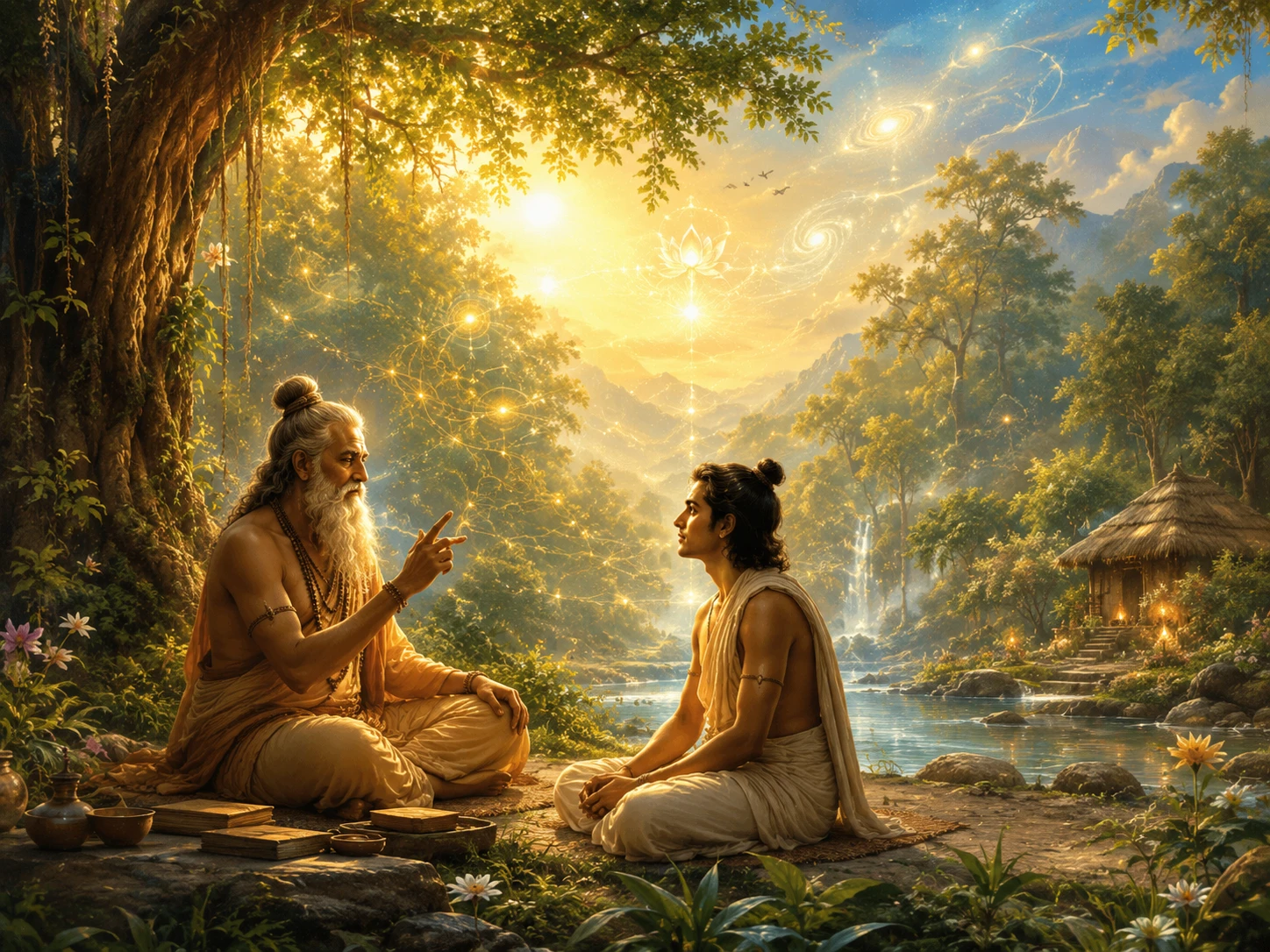
The statement emerges in a dialogue between Uddalaka Aruni, a Vedic sage, and his son Shvetaketu. It is not a cosmic revelation from a mountaintop. It is a father correcting his son over what is essentially the ancient equivalent of thinking your IIT degree makes you wise.
The setup is devastatingly relatable. Uddalaka Aruni sends his son Shvetaketu to study the Vedas at age 12, saying: 'There is no one in our family who has not studied and is a Brahmin only by birth.' Shvetaketu returns at 24, after twelve years of rigorous Vedic education. He is, in the Upanishad's words, 'swell-headed and arrogant,' thinking he knows everything.
Uddalaka asks a single question that collapses his son's confidence: 'Have you asked about that by which we perceive what cannot be perceived, know what cannot be known, hear what cannot be heard?' Shvetaketu has not. His entire education has been about memorising mantras, perfecting rituals, and mastering grammar. He knows the text of the Vedas but not the reality the Vedas point toward.
This is the Chandogya's first surgical strike against credentialism. Twelve years of formal education, and the boy has missed the point entirely. If you have ever watched an IIT graduate with a 99.9 percentile struggle to answer 'why do you want this job?' in a placement interview -- or watched a PhD scholar unable to explain their research to a ten-year-old -- you have witnessed the Shvetaketu condition. Knowledge of facts is not the same as understanding of essence.
Uddalaka then begins a teaching sequence that spans Sections 6.1 through 6.16 -- one of the most sustained philosophical demonstrations in any world scripture. He does not lecture. He uses analogies. Each analogy reveals the same truth from a different angle, and each ends with the same three words: Tat Tvam Asi, Shvetaketo.
Uddalaka's analogies are masterpieces of pedagogical design. In Chapter 6, Section 1, he begins with the clay analogy: by knowing one lump of clay, you know all objects made of clay -- pots, bricks, jars are just names and forms (nama-rupa). The underlying reality is clay. By knowing one piece of gold, you know all gold ornaments -- rings, necklaces, earrings are modifications. The essence remains gold.
In Section 6.12, the most famous analogy appears: the banyan seed. Uddalaka asks Shvetaketu to bring a fruit from the banyan tree. 'Break it open.' The boy does. 'What do you see?' 'Tiny seeds, sir.' 'Break one open.' 'What do you see now?' 'Nothing, sir.' 'My dear, that finest essence which you cannot perceive -- from that very essence this great banyan tree arises. That which is the finest essence -- this whole universe has that as its Self. That is the Truth. That is the Self. Tat Tvam Asi, Shvetaketo.'
This is not hand-waving mysticism. It is empirical demonstration. Uddalaka is saying: look, the tree exists, the seed exists, but the generative power inside the seed is invisible to your eyes. The invisible foundation of everything visible is Sat -- pure Existence. And that same Sat is your Atman.
Another analogy (Section 6.13) uses salt dissolved in water. Uddalaka asks Shvetaketu to place a lump of salt in water overnight. The next morning, the salt has dissolved -- you cannot see it. But every sip of the water tastes salty. The salt pervades the water without being visible. Just so, Brahman pervades the universe without being seen. And that Brahman -- Tat Tvam Asi.
Schopenhauer, the German philosopher who read the Upanishads via a Latin translation, was so moved by the Chandogya that he considered Tat Tvam Asi the most important utterance in all of philosophy. He rendered it in German as 'Dies bist du' and built his theory of compassion on it: if the Self in me is the same Self in you, then harming you is harming myself.
स य एषोऽणिमैतदात्म्यमिदं सर्वं तत्सत्यं स आत्मा तत्त्वमसि श्वेतकेतो इति
sa ya eṣo'ṇimaitadātmyamidaṃ sarvaṃ tatsatyaṃ sa ātmā tattvamasi śvetaketo iti
That which is the subtlest essence -- this whole universe has That as its Self. That is the Truth. That is the Self. You are That, O Shvetaketu.
— Chandogya Upanishad 6.8.7
The phrase Tat Tvam Asi is one of the four principal Mahavakyas -- great utterances -- of Vedantic philosophy. Each comes from a different Veda:
From the Sama Veda (Chandogya Upanishad): Tat Tvam Asi -- You are That. From the Shukla Yajurveda (Brihadaranyaka Upanishad): Aham Brahmasmi -- I am Brahman. From the Atharva Veda (Mandukya Upanishad): Ayam Atma Brahma -- This Self is Brahman. From the Rig Veda (Aitareya Upanishad): Prajnanam Brahma -- Consciousness is Brahman.
All four express the same truth from different grammatical perspectives. But Tat Tvam Asi holds a special place because of its pedagogical context -- it is spoken by a teacher to a student, making it the one Mahavakya designed for transmission, not just realisation.
The interpretive wars over this phrase are legendary. Shankaracharya's Advaita Vedanta reads it as absolute identity: the individual Self and Brahman are the same, without qualification. Ramanujacharya's Vishishtadvaita reads it as qualified identity: the Self is a part of Brahman, like a wave is part of the ocean. Madhvacharya's Dvaita tradition, in a bold grammatical move, reads the Sanskrit as 'Sa atma-atat tvam asi' -- meaning 'Atman, thou art NOT that,' preserving the eternal difference between God and soul. The Achintya Bheda Abheda school of Chaitanya Mahaprabhu holds both: the Self is simultaneously one with and different from Brahman, and this relationship is beyond human logic.
These are not academic quarrels. They determined the structure of temple worship, the nature of prayer, the architecture of salvation across medieval India. Mandirs built by Shankaracharya traditions emphasise meditation. Mandirs in Ramanuja's tradition emphasise devotional surrender. The same three words -- interpreted differently -- built entirely different civilisational infrastructures.
Four Mahavakyas -- The Great Utterances of Vedanta
| Mahavakya | Translation | Source | Veda | Grammatical Person | महावाक्य | अनुवाद | स्रोत | वेद | व्याकरणिक पुरुष |
|---|---|---|---|---|---|---|---|---|---|
| Tat Tvam Asi | You Are That | Chandogya Upanishad 6.8.7 | Sama Veda | Second person -- teacher to student | तत् त्वम् असि | तू वही है | छान्दोग्य उपनिषद् 6.8.7 | सामवेद | मध्यम पुरुष -- गुरु से शिष्य |
| Aham Brahmasmi | I Am Brahman | Brihadaranyaka Upanishad 1.4.10 | Shukla Yajurveda | First person -- self-realisation | अहं ब्रह्मास्मि | मैं ब्रह्म हूँ | बृहदारण्यक उपनिषद् 1.4.10 | शुक्ल यजुर्वेद | उत्तम पुरुष -- आत्मानुभूति |
| Ayam Atma Brahma | This Self Is Brahman | Mandukya Upanishad 1.2 | Atharva Veda | Third person -- objective declaration | अयम् आत्मा ब्रह्म | यह आत्मा ब्रह्म है | माण्डूक्य उपनिषद् 1.2 | अथर्ववेद | प्रथम/अन्य पुरुष -- वस्तुनिष्ठ घोषणा |
| Prajnanam Brahma | Consciousness Is Brahman | Aitareya Upanishad 3.3 | Rig Veda | Definitional -- identifying Brahman's nature | प्रज्ञानं ब्रह्म | चेतना ब्रह्म है | ऐतरेय उपनिषद् 3.3 | ऋग्वेद | परिभाषात्मक -- ब्रह्म का स्वरूप |
Together, the four Mahavakyas cover all grammatical persons and angles of approach. Initiates into Advaita sannyasa receive these as mantras to dissolve the illusion of separation between Self and Brahman.
The Chandogya Upanishad is far more than the Tat Tvam Asi passage, though that passage is its crown. Chapter 3 contains the celebrated Sandilya Vidya (3.14), which declares 'Sarvam Khalvidam Brahma' -- all this indeed is Brahman. This is another foundational statement that Shankaracharya used extensively in his commentaries.
Chapter 1 devotes considerable space to the mysticism of the Sama chant itself -- the Udgitha, the sacred syllable Om as the essence of all Saman songs. The Chandogya argues that Om is the quintessence of speech, of breath, of the earth, of the waters, of the entire cosmos. This is not merely theology. The emphasis on sound, vibration, and chanting as paths to realisation influenced the entire Bhakti movement -- from Tukaram's abhangas in Maharashtra to Annamacharya's keertanas in Tirupati.
Chapter 7 presents the dialogue between Narada and Sanatkumara, where Narada -- despite knowing the four Vedas, Itihasas, Puranas, grammar, astronomy, logic, and military science -- confesses he still does not know the Self. Sanatkumara then leads him through a hierarchy of meditations, ascending from Name to Speech to Mind to Will to Consciousness to Strength to Food to Water to Heat to Space to Memory to Hope to Prana, and finally to the Infinite (Bhuma). Each level transcends the previous one. This teaching anticipates modern cognitive science's hierarchy of abstraction and is used in Vipassana-adjacent meditation traditions even today.
Chapter 8 introduces the Dahara Vidya -- the meditation on the small space (dahara akasha) within the heart, which is as vast as the external cosmos. This concept became central to the Yoga traditions and to the Shaiva and Vaishnava meditation practices that define Hindu worship in temples from Varanasi to Thanjavur.
Arthur Schopenhauer called Tat Tvam Asi the most important statement in all of philosophy and built his ethics of compassion on it. He argued that if the Self in me is identical to the Self in every other being, then cruelty is fundamentally self-harm. In modern India, the Chandogya's 'Sarvam Khalvidam Brahma' (All this is Brahman) is inscribed on the entrance walls of several Shankaracharya Mathas. IIT Kanpur's philosophy department uses the Uddalaka-Shvetaketu dialogue as a case study in epistemology courses, exploring what counts as 'real knowledge' versus 'information.' The phrase Tat Tvam Asi is the motto of the Chinmaya Mission's educational institutions worldwide.
The Chandogya Upanishad's influence reaches far beyond philosophy departments. Every time a pandit begins a Vedic recitation with Om, every time a yoga class ends with the statement 'the light in me honours the light in you,' every time a Hindustani classical musician holds the Sa note as the foundation of a raga -- the Chandogya's vision of sound as the bridge between the individual and the cosmic is at work.
For the GenZ reader scrolling through this in a metro train between Andheri and Churchgate, the Chandogya's core message is brutally simple: the degrees, the job titles, the followers, the LinkedIn endorsements -- these are nama-rupa, name and form. They are the pot, not the clay. The ring, not the gold. The salt has dissolved into the water of your daily life, and you cannot see it, but it is there in every sip. You are not what your resume says. You are That.
Schopenhauer built Western compassion ethics on it. Shankaracharya built an empire of monasteries on it. Vivekananda took it to Chicago and changed how the world saw Hinduism. And Uddalaka -- a father sitting under a tree -- said it nine times to a 24-year-old who thought he knew everything. That is the Chandogya Upanishad.
Chant Om -- the Chandogya's Supreme Sound
The Chandogya Upanishad opens by naming Om the essence of all speech and all existence. Chant it slowly on the out-breath, let it fade, and rest in the silence after. The Three Parts of Om dharana on Eternal Raga sets out the practice, and the Chandogya Upanishad itself is on the site too.
Tags
Eternal Raga · शाश्वत राग
Institutional voice — scholarly articles on Sanatan Dharma
Deepen Your Understanding
अपनी समझ और गहरी करें
scriptural exegesis
Katha Upanishad -- Nachiketa and Yama
A teenage boy walks into the house of Death, waits three days without food, and then proceeds to negotiate the universe's deepest secret out of Yama himself. The Katha Upanishad is not a dusty scripture -- it is the original startup pitch where a kid with zero leverage outplayed the CEO of the afterlife.
scriptural exegesis
Gita Chapter 4 -- Jnana Karma Sannyasa Yoga
Chapter 4 of the Bhagavad Gita contains the most quoted verse in all of Hinduism -- 'Yada Yada Hi Dharmasya' -- and the most radical claim Krishna ever made: that He incarnates across ages whenever dharma declines. But this chapter is not just about avatars. It is a masterclass in how knowledge transforms action from bondage into liberation.
philosophy darshana
The Four Mahavakyas -- Upanishadic Sentences That Changed Civilisation
Four sentences. Twelve words of Sanskrit. Three thousand years of commentary. The Mahavakyas are the most compressed, most powerful, and most debated statements in all of Indian philosophy. Each one claims that the individual self and the ultimate reality of the universe are not two different things. And each one has been interpreted to mean something completely different by every major school of Vedanta.
philosophy darshana
The Six Darshanas -- India's Original Intellectual Operating Systems
Long before Greek philosophy had its first argument, India had six complete philosophical systems -- each with its own logic, metaphysics, epistemology, and liberation path. Nyaya built formal logic. Vaisheshika invented atomic theory. Samkhya mapped consciousness. Yoga engineered the mind. Mimamsa decoded ritual. Vedanta asked the final question. Together, they are the most comprehensive intellectual framework any civilisation has produced.
philosophy darshana
Adi Shankaracharya -- The Teacher of Advaita
Born in a Kerala village, he left home as a boy, walked the length of India, wrote the classic commentaries of Advaita Vedanta, founded four monasteries at its four corners, and -- by tradition -- died at thirty-two. Who Adi Shankaracharya was and what he taught.
scriptural exegesis
The Bhagavad Gita -- An Overview of the Song of God
Seven hundred verses spoken between two armies, in the minutes before a war. What the Bhagavad Gita is, where it sits in the Mahabharata, how its eighteen chapters are arranged, and why a dialogue about duty on a battlefield became the most read book of Hindu thought.
scriptural exegesis
Ramayana -- History or Myth? What the Evidence Actually Says
A 48-km limestone bridge between India and Sri Lanka that NASA satellites photographed. An exile route spanning 3,000 km that you can walk today -- every river, cave, and mountain matching Valmiki's descriptions. Astronomical events that planetarium software can verify. Five categories of evidence that turn a simple 'myth or fact?' into a far more interesting question.
Arthur Schopenhauer called Tat Tvam Asi the most important statement in all of philosophy and built his ethics of compassion on it. He argued that if the Self in me is identical to the Self in every other being, then cru…
More in Scriptural Exegesis
Abhimanyu and the Chakravyuha -- The Boy Who Knew How to Enter but Not How to Leave
14 min read
Adbhuta Ramayana -- The Ramayana Where Sita Becomes Kali
9 min read
After Kurukshetra -- What Happened Next
14 min readThe same translation error that turned '33 Koti' into '33 crore' in Hinduism also happened in Buddhism. The Chinese translation of Buddhist texts rendered 'Sapta Koti Buddha' (7 Supreme Buddhas) as '7 Crore Buddhas.' The…
Deities AvatarsCommunity Reflections
🕉️
Be the first to share your reflection.