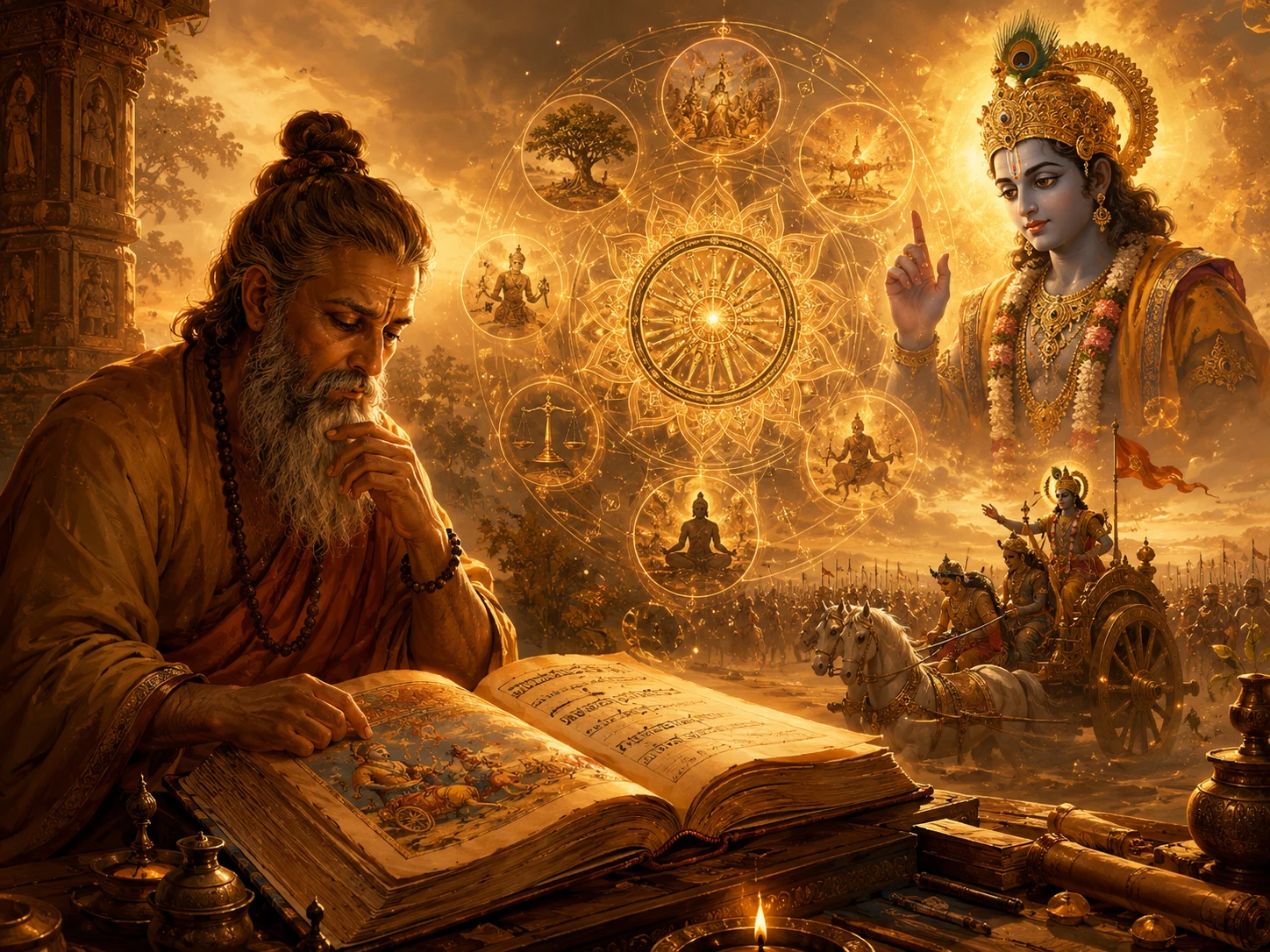
Gita Chapter 4 -- Jnana Karma Sannyasa Yoga
गीता अध्याय 4 -- ज्ञान कर्म संन्यास योग
The fourth chapter of the Bhagavad Gita has 42 verses and a name that sounds like a contradiction: Jnana Karma Sannyasa Yoga -- the Yoga of Knowledge, Action, and Renunciation. How can knowledge and action coexist with renunciation? That paradox is exactly the point. Chapter 4 is where Krishna resolves the apparent conflict between the path of the monk who renounces the world and the path of the warrior who must act in it.
The chapter opens with a stunning revelation. Krishna tells Arjuna that this yoga was not invented on the battlefield of Kurukshetra. He first taught it to Vivasvan, the Sun God, who passed it to Manu, who passed it to Ikshvaku -- the first king of the Solar Dynasty. Over vast stretches of time, the teaching was lost. Now Krishna is reviving it, speaking it to Arjuna because Arjuna is both his friend and his devotee.
Arjuna, understandably confused, asks: 'You were born in this age. Vivasvan was born long before. How could you have taught him?' This is not a rhetorical question. Arjuna is asking for a direct explanation of how a man standing in front of him can claim to have lived across cosmic ages. Krishna's answer -- verses 4.5 through 4.9 -- contains the theological foundation of the avatar doctrine that defines Vaishnavism and, more broadly, much of Hindu thought.
Krishna says: 'Many births have passed for both you and me, Arjuna. I remember them all; you do not.' He then declares that although He is unborn and imperishable, He manifests Himself through His own Yoga-Maya -- His divine creative power. This is not reincarnation in the human sense. It is conscious, willed descent.
यदा यदा हि धर्मस्य ग्लानिर्भवति भारत। अभ्युत्थानमधर्मस्य तदात्मानं सृजाम्यहम्॥ परित्राणाय साधूनां विनाशाय च दुष्कृताम्। धर्मसंस्थापनार्थाय सम्भवामि युगे युगे॥
yadā yadā hi dharmasya glānir bhavati bhārata | abhyutthānam adharmasya tadātmānaṃ sṛjāmyaham || paritrāṇāya sādhūnāṃ vināśāya ca duṣkṛtām | dharmasaṃsthāpanārthāya sambhavāmi yuge yuge ||
Whenever there is a decline of dharma and a rise of adharma, O Bharata, then I manifest Myself. For the protection of the righteous, for the destruction of the wicked, and for the establishment of dharma, I appear in every age.
— Bhagavad Gita 4.7-8
These two verses -- 4.7 and 4.8 -- are arguably the most recognised words in all of Hindu scripture. They are chanted in Dussehra processions, quoted in Supreme Court judgments on religious freedom, inscribed on military memorials, and set as ringtones on phones from Patna to Palo Alto. Swami Vivekananda cited them in his 1893 Chicago address. They appear in the opening credits of the Mahabharata television series that an entire generation of Indians grew up watching.
But the theological weight of these verses is often missed in popular culture. The word 'srijami' in verse 4.7 does not mean 'create' in the ordinary sense. Shankaracharya's commentary clarifies: Krishna's form is not newly created at each incarnation -- it is eternally existent and is simply manifested. This is why the avatar doctrine is fundamentally different from, say, the Christian incarnation, where God becomes flesh at a specific historical moment. In Hindu theology, every avatar of Vishnu is a revelation of what already exists, not a new creation.
The verse also carries a political philosophy that has shaped Indian civilisation. It says that divine intervention is triggered not by prayer but by the state of dharma in the world. When institutions fail, when justice is corrupted, when the powerful exploit the weak -- that is when the divine descends. This is not passive theology. It is a call to action disguised as mythology. Every IAS officer who quotes 'Yada Yada Hi Dharmasya' in their graduation speech is, whether they know it or not, invoking a framework where governance itself is a form of divine duty.
But Chapter 4 goes far beyond the avatar verses. From verse 4.13 onward, Krishna introduces a revolutionary idea: the four varnas were created by Him according to guna (quality) and karma (action), not by birth. This single verse has been the subject of more commentary, more debate, and more misuse than perhaps any other in the Gita. The critical point is that Krishna explicitly bases varna on guna and karma -- your nature and your work -- not on your family or jati. Whether modern caste politics honours this distinction or betrays it is one of India's oldest ongoing arguments.
The philosophical core of Chapter 4 arrives in verses 4.18-24, where Krishna introduces the concept of 'action in inaction and inaction in action.' The wise person, says Krishna, sees inaction in action and action in inaction. This is not wordplay. It means: a person who works without attachment to results, whose actions are burned by the fire of knowledge, is effectively not acting at all -- because no karma accrues. Conversely, a person who sits in a cave claiming to renounce the world but whose mind churns with desire is actually acting -- because mental activity generates karma.
This is the synthesis that gives the chapter its name. Jnana (knowledge) does not replace Karma (action). Jnana transforms Karma. When you act with full knowledge of who you really are -- the eternal Atman, not the body, not the ego, not the job title -- then action ceases to bind. This is Sannyasa -- renunciation not of action itself, but of the fruits of action.
Verses 4.25-33 then catalogue twelve types of yajna (sacrifice) that count as paths to liberation: offering breath into breath (pranayama), offering the senses into restraint, offering wealth, offering austerity, offering study, offering knowledge. Krishna's point is radical: yajna is not just the Vedic fire ritual. It is any disciplined offering of the self toward a higher purpose. A coder in Bangalore shipping clean code at 3 AM without caring about credit is performing yajna. A NEET aspirant in Kota solving biology papers not for rank but for the joy of understanding is performing yajna. A mother in Varanasi feeding her family before herself is performing yajna.
The chapter closes with verse 4.42, where Krishna commands Arjuna: 'Therefore, with the sword of knowledge, cut asunder this doubt born of ignorance that lies in your heart. Take refuge in yoga. Arise, O Bharata!' This is not gentle encouragement. It is a battle cry for intellectual clarity.
कर्मण्यकर्म यः पश्येदकर्मणि च कर्म यः। स बुद्धिमान्मनुष्येषु स युक्तः कृत्स्नकर्मकृत्॥
karmaṇyakarma yaḥ paśyedakarmaṇi ca karma yaḥ | sa buddhimānmanuṣyeṣu sa yuktaḥ kṛtsnakarmakṛt ||
One who sees inaction in action and action in inaction is wise among all people. Such a person is a yogi and has accomplished all action.
— Bhagavad Gita 4.18
Key Teachings of Gita Chapter 4 -- Verse Map
| Verses | Teaching | Core Concept | श्लोक | शिक्षा | मूल सिद्धान्त |
|---|---|---|---|---|---|
| 4.1-3 | Lineage of the teaching: Vivasvan to Manu to Ikshvaku to Arjuna | Parampara -- guru-shishya chain | 4.1-3 | शिक्षा की वंशावली: विवस्वान से मनु, इक्ष्वाकु, अर्जुन तक | परम्परा -- गुरु-शिष्य श्रृंखला |
| 4.5-9 | Avatar doctrine: Krishna manifests whenever dharma declines | Yoga-Maya and divine descent | 4.5-9 | अवतार सिद्धान्त: धर्म गिरने पर कृष्ण प्रकट होते हैं | योग-माया और दैवीय अवतरण |
| 4.13 | Four varnas based on guna and karma, not birth | Varna as function, not caste | 4.13 | चार वर्ण गुण-कर्म पर आधारित, जन्म पर नहीं | वर्ण कार्य है, जाति नहीं |
| 4.18-24 | Action in inaction, inaction in action | Jnana transforms karma -- detached action | 4.18-24 | कर्म में अकर्म, अकर्म में कर्म | ज्ञान कर्म को रूपान्तरित करता है |
| 4.25-33 | Twelve types of yajna -- breath, senses, wealth, austerity, study, knowledge | Yajna as any disciplined self-offering | 4.25-33 | बारह प्रकार के यज्ञ -- प्राण, इन्द्रिय, धन, तप, स्वाध्याय, ज्ञान | यज्ञ = कोई भी अनुशासित आत्म-अर्पण |
| 4.36-42 | Knowledge as the supreme purifier -- 'the fire of knowledge burns all karma' | Jnana as liberation | 4.36-42 | ज्ञान परम शुद्धिकर्ता -- 'ज्ञानाग्नि सब कर्मों को भस्म करती है' | ज्ञान ही मुक्ति |
Chapter 4's 42 verses cover more ground than many entire philosophical texts -- from cosmic cosmology to everyday work ethics, unified by the principle that knowledge-infused action is the path to freedom.
Gita 4.7-8 ('Yada Yada Hi Dharmasya') is inscribed on the entrance of the Indian Parliament library. The verse was also quoted in the Indian Supreme Court's landmark 1995 judgment defining Hindutva as 'a way of life.' DRDO's Agni missile programme and ISRO's Mars Orbiter Mission both featured this verse in inaugural speeches. In 2015, PM Modi gifted a Gita to US President Obama during his Washington visit. The IIT Kanpur Gita Supersite, a digital Sanskrit project, uses Chapter 4 as its most-accessed page -- with more than 2 million hits annually. Verse 4.18 ('action in inaction') is taught in IIM Ahmedabad's organisational behaviour courses as a framework for mindful leadership.
Read Gita Chapter 4 on Eternal Raga
Read all 42 verses of Chapter 4 on Eternal Raga, with Sanskrit text, transliteration, and meaning in English and Hindi.
Tags
Eternal Raga · शाश्वत राग
Institutional voice — scholarly articles on Sanatan Dharma
Deepen Your Understanding
अपनी समझ और गहरी करें
scriptural exegesis
Katha Upanishad -- Nachiketa and Yama
A teenage boy walks into the house of Death, waits three days without food, and then proceeds to negotiate the universe's deepest secret out of Yama himself. The Katha Upanishad is not a dusty scripture -- it is the original startup pitch where a kid with zero leverage outplayed the CEO of the afterlife.
scriptural exegesis
Chandogya Upanishad -- Tat Tvam Asi
A 24-year-old returns from 12 years of Vedic study, bloated with pride and stuffed with textbook knowledge, only to have his father demolish his certainty with nine repetitions of three words: Tat Tvam Asi -- You Are That. The Chandogya Upanishad is the text that broke the wall between God and you.
scriptural exegesis
7 Chiranjeevis -- The Immortals of Hindu Tradition
Seven beings who will not die until the end of this cosmic age. One is cursed to wander in agony. One rules the underworld. One compiled every scripture you have ever read. One is the most worshipped deity in India. The Chiranjeevis are not a mythology trivia list -- they are a map of how immortality works in Hindu thought, and why it is not always a blessing.
philosophy darshana
Rama vs Krishna -- Two Faces of Dharma, One Question for Your Life
Rama followed every rule and lost his wife. Krishna broke every rule and won the war. Both are Vishnu. Both upheld Dharma. So who was right? The answer might be the most important thing Hindu philosophy has to say to a world that thinks morality is simple.
scriptural exegesis
The Bhagavad Gita -- An Overview of the Song of God
Seven hundred verses spoken between two armies, in the minutes before a war. What the Bhagavad Gita is, where it sits in the Mahabharata, how its eighteen chapters are arranged, and why a dialogue about duty on a battlefield became the most read book of Hindu thought.
scriptural exegesis
Suryavanshi -- The Solar Dynasty from the First King to Rama
Rama was not the first king of Ayodhya. He was the 67th. Before him came Ikshvaku, who sneezed into existence from Manu's nostril. Then Harishchandra, who sold himself into slavery for truth. Then Sagara, whose 60,000 sons were burned to ash. Then Bhagiratha, who brought Ganga from heaven to redeem them. Then Raghu, who conquered the world. Then Dasharatha, who gave his life for a promise. This is the Solar Dynasty -- the longest unbroken royal lineage in any mythology on earth.
Gita 4.7-8 ('Yada Yada Hi Dharmasya') is inscribed on the entrance of the Indian Parliament library. The verse was also quoted in the Indian Supreme Court's landmark 1995 judgment defining Hindutva as 'a way of life.' DR…
More in Scriptural Exegesis
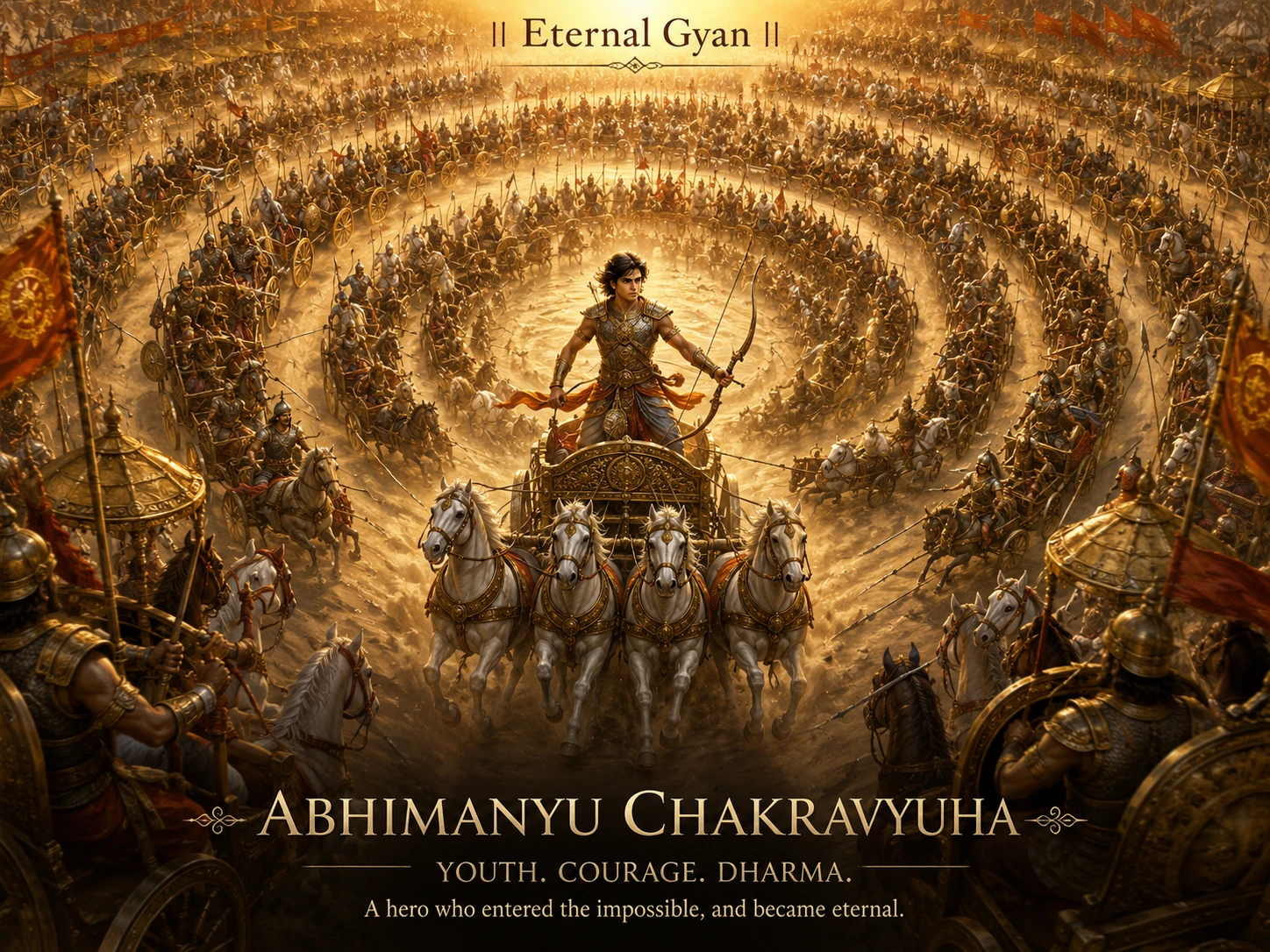
Abhimanyu and the Chakravyuha -- The Boy Who Knew How to Enter but Not How to Leave
14 min read
Adbhuta Ramayana -- The Ramayana Where Sita Becomes Kali
9 min read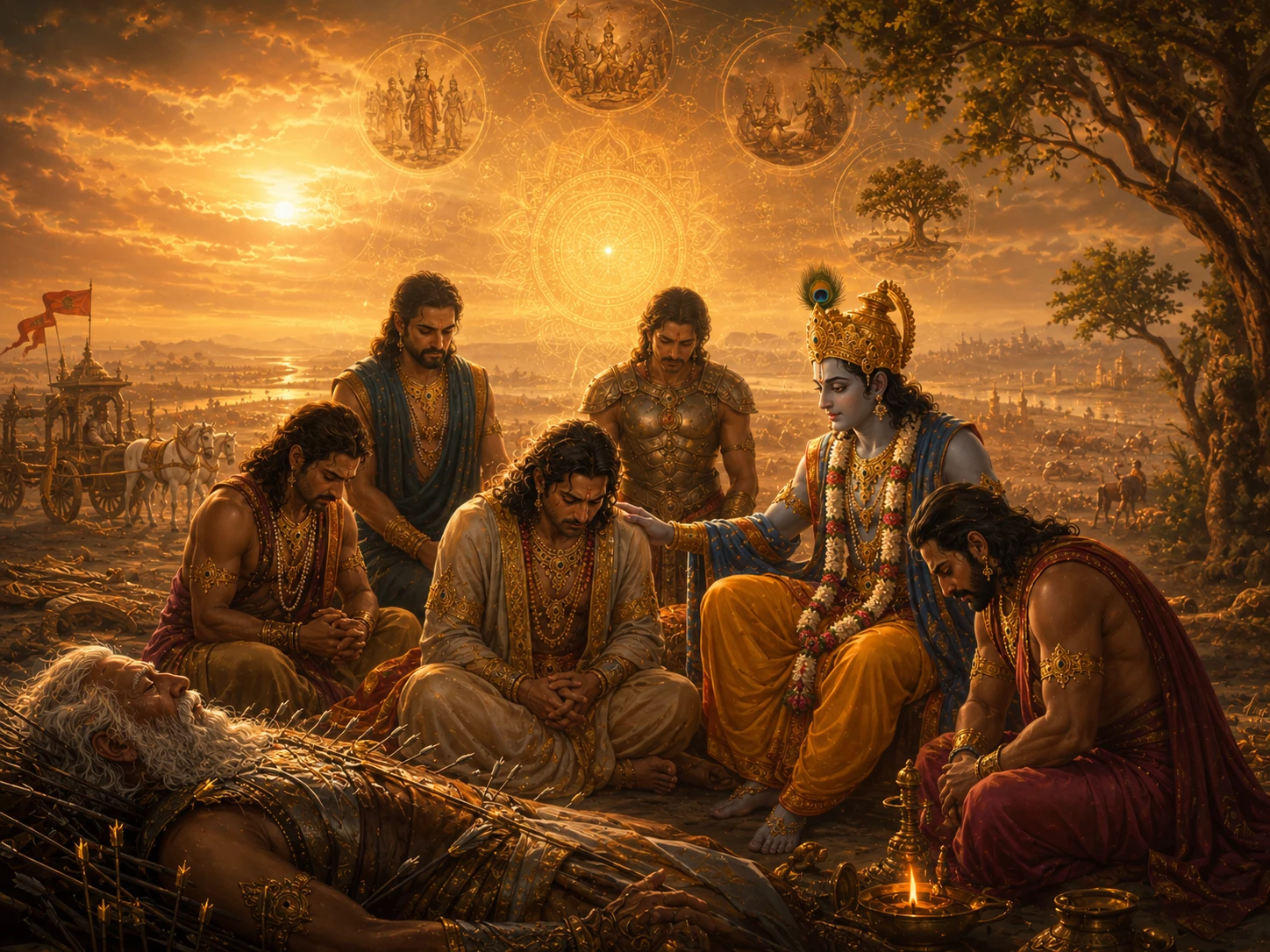
After Kurukshetra -- What Happened Next
14 min readThe same translation error that turned '33 Koti' into '33 crore' in Hinduism also happened in Buddhism. The Chinese translation of Buddhist texts rendered 'Sapta Koti Buddha' (7 Supreme Buddhas) as '7 Crore Buddhas.' The…
Deities AvatarsCommunity Reflections
🕉️
Be the first to share your reflection.