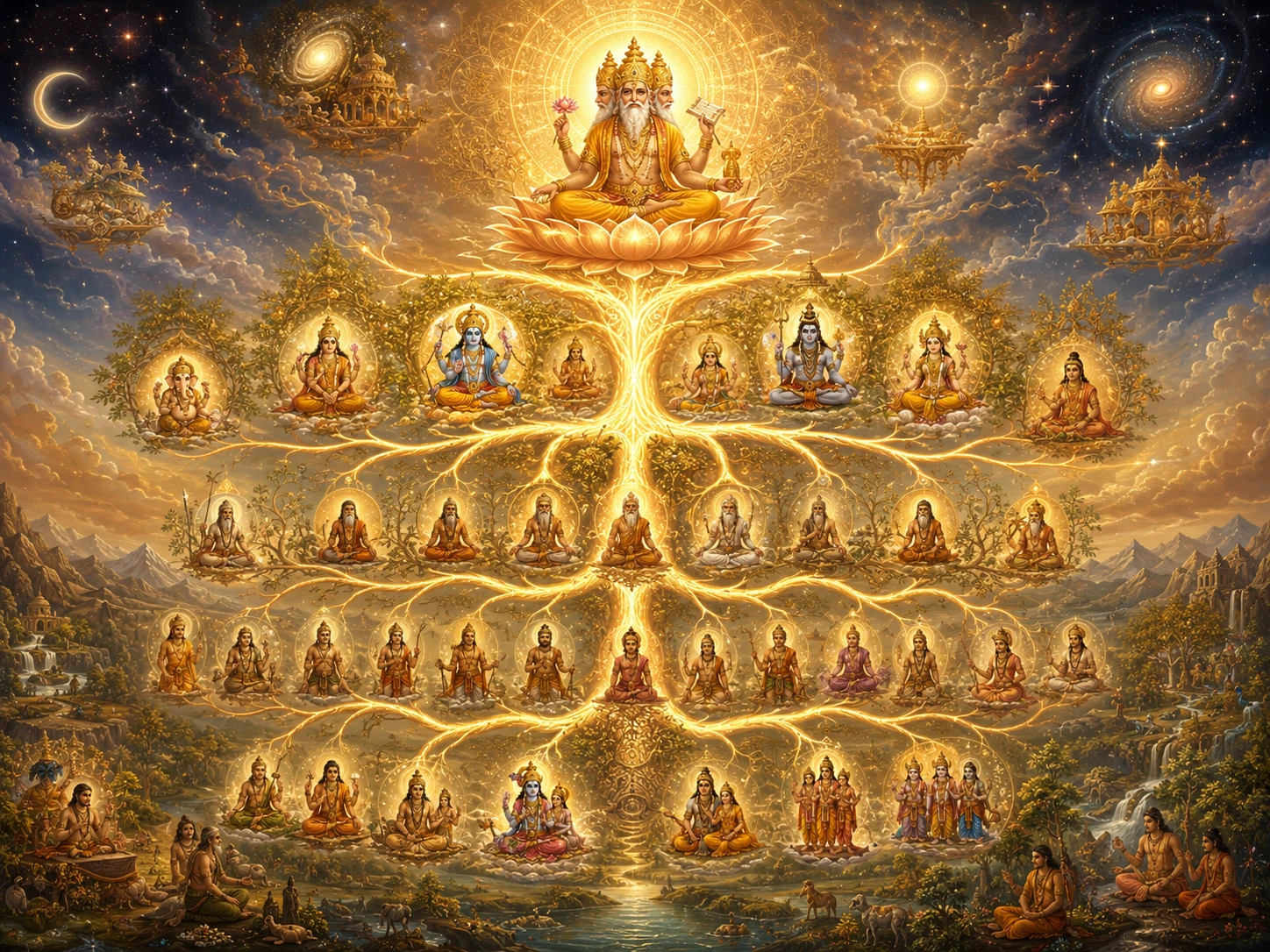
Suryavanshi -- The Solar Dynasty from the First King to Rama
सूर्यवंशी -- प्रथम राजा से राम तक सौर राजवंश
Introduction -- The Longest Lineage in Human Mythology
The Suryavanshi -- the Solar Dynasty, also called the Ikshvaku Dynasty or Raghuvansha -- is the most extensively documented royal lineage in Hindu scripture. The Vishnu Purana (Book 4), Valmiki Ramayana (Bala Kanda, Sarga 70, where Vasishtha recites the lineage at Rama's wedding), and the Bhagavata Purana (Skanda 9) together enumerate over 100 kings spanning from Vaivasvata Manu to Sumitra, the last ruler, who was defeated by Mahapadma Nanda in approximately the 4th century BCE.
The cosmic genealogy runs: Brahma > Marichi > Kashyapa > Surya (Vivasvan) > Vaivasvata Manu > Ikshvaku > ... > Rama (67th generation) > Kusha and Lava > ... > Brihadbala (killed by Abhimanyu in the Mahabharata war, 31 generations after Rama) > ... > Sumitra (the last king).
This article focuses on the key figures from Ikshvaku to Rama -- the kings whose stories are individually famous but whose connections within the dynasty are often missed. Each king's story is not just a stand-alone legend but a link in a chain that connects the Sun god's family to the epic of the Ramayana.
For a UPSC aspirant studying Ancient India, the Ikshvaku dynasty appears in both the Puranic king-lists and the archaeological record (the Ikshvaku rulers of Andhra are historically attested, though their connection to the mythological Ikshvakus is debated). For a visitor to Ayodhya -- especially after the 2024 Ram Mandir consecration -- understanding that Rama was the 67th king of a lineage that began with the Sun adds a dimension that no guidebook provides. Kalidasa's Raghuvansha, one of the finest Sanskrit mahakavyas, traces this exact lineage. The poem is studied in Sanskrit departments at BHU, JNU, and Pune University as a masterwork of literary genealogy.
इमं विवस्वते योगं प्रोक्तवानहमव्ययम्। विवस्वान्मनवे प्राह मनुरिक्ष्वाकवेऽब्रवीत्॥
imam vivasvate yogam proktavaan aham avyayam vivasvaan manave praaha manur ikshvaakave abravit
I taught this imperishable yoga to Vivasvan (Surya); Vivasvan taught it to Manu; Manu taught it to Ikshvaku.
— Bhagavad Gita, Chapter 4, Verse 1
Key Kings of the Solar Dynasty -- Ikshvaku to Rama
| King | Generation | Famous For | Key Episode | Source |
|---|---|---|---|---|
| Ikshvaku | 1st (Manu's son) | Founder of the dynasty, first king of Ayodhya | Born from Manu's sneeze; 100 sons; founded Kosala kingdom | Vishnu Purana 4.1, Ramayana 1.70 |
| Vikukshi (Shasada) | 2nd | Eldest son of Ikshvaku | Ate a hare during a sacred hunt; banished then recalled as king | Vishnu Purana 4.2 |
| Puranjaya (Kakutstha) | 3rd | Warrior who rode Indra in bull form | Defeated Daityas by fighting from the hump of Indra-as-bull; dynasty also called 'Kakutstha' | Vishnu Purana 4.2 |
| Mandhata | ~20th | Chakravartin (world emperor) | Conquered the entire earth; one of the greatest Suryavanshi kings | Vishnu Purana 4.3 |
| Harishchandra | ~30th | The truthful king | Sold himself, wife Shaivya, and son Rohitashva into slavery rather than break his promise to Vishwamitra | Markandeya Purana, Vishnu Purana 4.7 |
| Sagara | ~40th | 60,000 sons burned to ash | His sons dug the ocean (Sagara = ocean) searching for the sacrificial horse; Kapila Muni's gaze burned them | Ramayana 1.38-42, Vishnu Purana 4.4 |
| Bhagiratha | ~44th | Brought Ganga from heaven | Performed extreme tapas; Ganga descended through Shiva's locks; redeemed Sagara's 60,000 sons; Ganga called 'Bhagirathi' | Ramayana 1.43-44, Vishnu Purana 4.4 |
| Dilipa | ~60th | The devoted king | Served Nandini (Vasishtha's cow) to earn a son; model of royal dharma | Raghuvansha 1-2 (Kalidasa) |
| Raghu | ~61st | World conqueror, dynasty renamed after him | Conquered all directions; gave away all his wealth; the dynasty became 'Raghuvansha' after him | Raghuvansha 3-5 (Kalidasa) |
| Aja | ~62nd | The grief-stricken king | Married Indumati via svayamvara; she died suddenly; Aja died of heartbreak | Raghuvansha 6-8 (Kalidasa) |
| Dasharatha | ~63rd | Father of Rama, the promise-keeper | Had three wives (Kausalya, Kaikeyi, Sumitra); granted Kaikeyi two boons that led to Rama's exile; died of separation from Rama | Ramayana 2.1-63 |
| Rama | 67th | 7th avatar of Vishnu, Maryada Purushottam | Exile, Sita's abduction, Lanka war, return to Ayodhya, Rama Rajya | Valmiki Ramayana (entire epic) |
| Kusha and Lava | 68th | Rama's twin sons | Kusha ruled South Kosala; Lava ruled North Kosala; Kusha married Nag-kanya Kumudvati | Ramayana Uttara Kanda |
| Brihadbala | ~98th | Last major Suryavanshi in the Mahabharata era | Fought on Kaurava side in Kurukshetra; killed by Abhimanyu | Mahabharata, Vishnu Purana 4.22 |
Sources: Vishnu Purana Book 4, Valmiki Ramayana Bala Kanda Sargas 70-72, Bhagavata Purana Skanda 9, Raghuvansha by Kalidasa. Generation numbers are approximate as different Puranas insert or omit names. Rama is consistently placed around the 63rd-67th generation depending on the source. The dynasty continued for ~30 more generations after Rama until Brihadbala (Mahabharata era) and further ~50 until Sumitra (last king, ~4th century BCE).
The Stories That Define the Dynasty
The Solar Dynasty is defined by a single quality: Satya -- truth, kept at any cost. Every major king's story revolves around a promise, a vow, or a commitment to dharma that is tested to destruction.
Harishchandra sold his wife, his son, and himself into slavery at a cremation ground rather than break his promise to Vishwamitra. When his own son died of a snakebite and his wife brought the body for cremation, Harishchandra -- now a chandala (cremation worker) -- demanded the cremation fee because his master had ordered him to collect it from everyone. He chose his duty over his grief. The gods, watching, restored everything.
Sagara's 60,000 sons dug through the earth searching for the stolen Ashwamedha horse and disturbed Kapila Muni's meditation. Kapila's gaze reduced them all to ash. Their souls could not find moksha until Ganga's waters washed over their remains -- but Ganga was in heaven. It took four generations of Sagara's descendants performing tapas before Bhagiratha finally convinced Ganga to descend. Shiva caught her in his matted locks to soften the impact. The Ganga is called 'Bhagirathi' in her honour. The phrase 'Bhagirath prayas' (Herculean effort) in modern Hindi comes from this story -- it means an effort so colossal that it takes generations to complete. When ISRO scientists call a multi-decade space programme a 'Bhagirath prayas,' they are quoting the Solar Dynasty.
Dasharatha's tragedy is the dynasty's moral climax. He had promised Kaikeyi two boons during a war. Years later, she demanded: exile Rama for 14 years and crown Bharata. Dasharatha could have refused. He was the king. No one could compel him. But a Suryavanshi king's word, once given, cannot be retracted. He honoured the boon and died of the separation from Rama -- literally died of a broken heart. Rama, in turn, honoured his father's word even though Dasharatha was already dead. The exile proceeded. The Ramayana happened. And the principle that defined the Solar Dynasty -- your word is your life -- became the central moral architecture of Hindu civilisation.
After Rama, the dynasty continued through his sons Kusha and Lava. Thirty-one generations later, Brihadbala fought on the Kaurava side in the Mahabharata war and was killed by Abhimanyu. The dynasty eventually ended with Sumitra, defeated by Mahapadma Nanda. But the Raghuvansha's moral code outlived its kings. When Mahatma Gandhi invoked 'Ram Rajya' as his vision for independent India, he was invoking not just Rama but the entire Solar Dynasty tradition of truth-keeping, duty, and sacrifice.
The Hindi phrase 'Bhagirath Prayas' -- meaning an effort of such monumental scale that it seems impossible -- comes directly from the Solar Dynasty. King Bhagiratha performed tapas for generations to bring the river Ganga down from heaven to wash over the ashes of his ancestors (Sagara's 60,000 sons). When ISRO, DRDO, or IIT researchers describe a multi-decade engineering challenge as a 'Bhagirath Prayas,' they are unconsciously quoting the Suryavanshi king-list. The Ganga herself bears his name: 'Bhagirathi.'
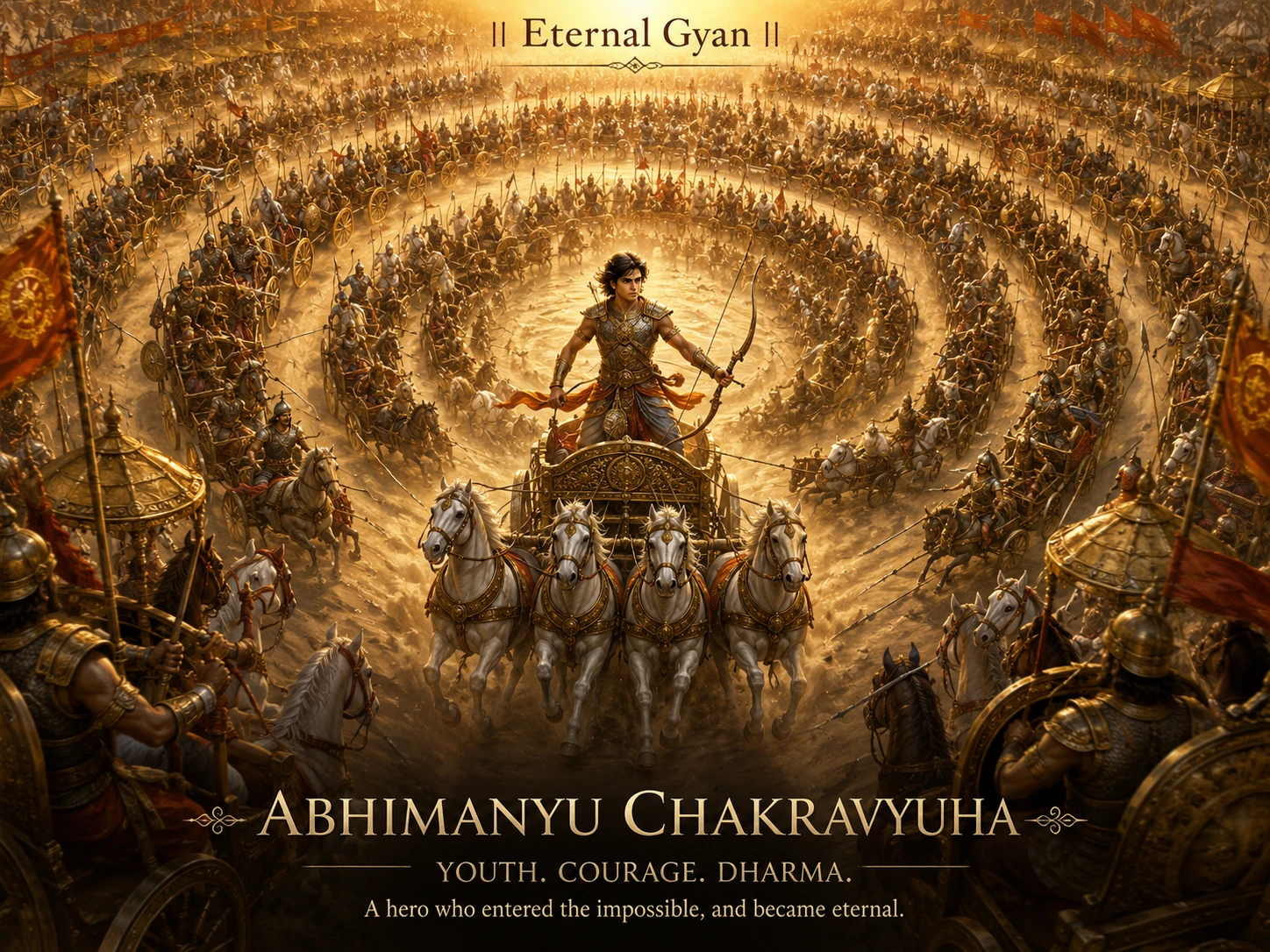
Brihadbala, the Solar Dynasty king who fought in the Mahabharata war approximately 31 generations after Rama, fought on the Kaurava side and was killed by Abhimanyu (Arjuna's teenage son) on the 13th day of the war during the Chakravyuha formation. This means the Solar Dynasty -- Rama's own lineage -- was on the opposite side from the Pandavas (who belonged to the Lunar Dynasty). The Mahabharata war was, among many other things, a Solar Dynasty vs Lunar Dynasty conflict. The two branches of Vaivasvata Manu's family tree, separated by dozens of generations, met again on a battlefield.
Read the Ramayana on Eternal Raga
The Solar Dynasty's greatest story is the Ramayana itself. Read it on Eternal Raga, all seven kandas from the Bala Kanda onward, with Sanskrit and translation in English and Hindi.
Tags
Eternal Raga · शाश्वत राग
Institutional voice — scholarly articles on Sanatan Dharma
Deepen Your Understanding
अपनी समझ और गहरी करें
deities avatars
Surya's Family -- How One God Fathered Yama, Shani, the Ashwini Kumaras, and All of Humanity
Surya had two wives: Sanjana, who could not bear his radiance, and Chhaya, the shadow she left behind. From Sanjana came Yama (death), Yamuna (the river), Manu (humanity's ancestor), and the Ashwini Kumaras (divine physicians). From Chhaya came Shani (Saturn, karma's enforcer), Tapati (the river), and Savarni Manu (the next cosmic era's ruler). Same father. Two mothers. Ten children. And the entire human race.
vedic sciences
The 14 Manus -- Cosmic Reset Buttons of Hindu Time
Hindu cosmology does not have one Adam. It has fourteen. Each Manvantara -- a cosmic era of 306.72 million years -- is governed by a different Manu who repopulates the earth, establishes dharma, and oversees a fresh team of gods, sages, and an Indra. We are currently in the 7th Manvantara, ruled by Vaivasvata Manu, son of Surya. Seven Manus have served. Seven are yet to come. And Vishnu takes a new avatar for each.
scriptural exegesis
Chandravanshi -- The Lunar Dynasty from Moon to Mahabharata
The Solar Dynasty gave India Rama. The Lunar Dynasty gave India everything else: Krishna, the Pandavas, the Kauravas, Bharata (after whom India is named), Shakuntala (Kalidasa's masterpiece), and the Mahabharata itself. It begins with a scandal -- the Moon god Soma abducting Tara, wife of Brihaspati -- and it ends with the greatest war in mythology. One lineage. Two branches. Every epic.
scriptural exegesis
Brahma's Children -- The First Generation of Creation
Brahma tried three times to populate the universe. First he created four sons who refused to reproduce and became monks. Then he got so angry that Rudra burst from his forehead. Finally he created ten Prajapatis from his mind -- and through them, every god, demon, human, animal, and plant in existence traces its origin. This is the original org chart of the cosmos.
scriptural exegesis
Ram and Sita -- The Complete Life Chronology
How old was Sita when Ram went into exile? Were they married for 12 years or just one? What does Valmiki Ramayana actually say -- and why do different manuscripts say different things? Social media is full of numbers thrown out of context. This article does what most don't: it lays out every verse, every manuscript variant, every scholarly reading, and lets you see the complete picture. From Chaitra Navami to the banks of Sarayu, this is the life chronology of Ram and Sita as the primary texts present it -- contradictions, critical editions, and all.
deities avatars
Kashyapa's Wives -- How One Sage Fathered Gods, Demons, and Everything In Between
Why are gods and demons always at war? Because they are cousins -- half-brothers sharing the same father, the sage Kashyapa. Aditi's sons became the Devas. Diti's sons became the Daityas. Vinata's sons became Garuda and Aruna. Kadru's sons became the serpents. And the family dynamics that produced them explain the entire cosmic conflict of Hindu mythology.
The Hindi phrase 'Bhagirath Prayas' -- meaning an effort of such monumental scale that it seems impossible -- comes directly from the Solar Dynasty. King Bhagiratha performed tapas for generations to bring the river Gang…
More in Scriptural Exegesis
Abhimanyu and the Chakravyuha -- The Boy Who Knew How to Enter but Not How to Leave
14 min read
Adbhuta Ramayana -- The Ramayana Where Sita Becomes Kali
9 min read
After Kurukshetra -- What Happened Next
14 min readThe same translation error that turned '33 Koti' into '33 crore' in Hinduism also happened in Buddhism. The Chinese translation of Buddhist texts rendered 'Sapta Koti Buddha' (7 Supreme Buddhas) as '7 Crore Buddhas.' The…
Deities AvatarsCommunity Reflections
🕉️
Be the first to share your reflection.