Kashyapa's Wives -- How One Sage Fathered Gods, Demons, and Everything In Between
कश्यप की पत्नियाँ -- कैसे एक ऋषि से देवता, दानव और सब कुछ उत्पन्न हुआ
Introduction -- The Sage Who Is Everyone's Father
If you have ever wondered why Indra and the Asuras are perpetually at war, or why Garuda and the serpents are mortal enemies, or why the Devas and Daityas are so evenly matched in every cosmic battle -- the answer is a single name: Kashyapa.
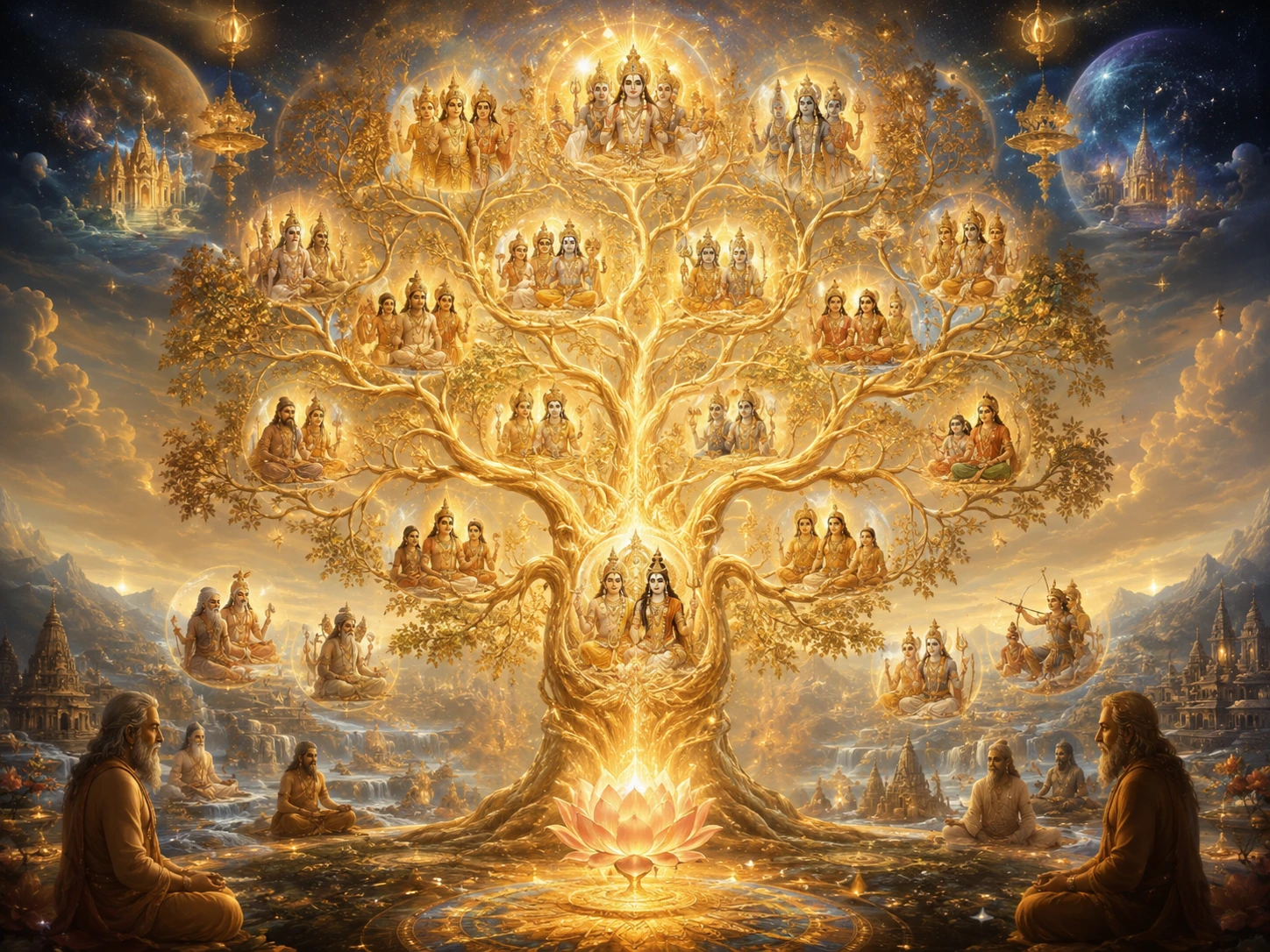
Kashyapa is the son of Marichi (the first Prajapati), grandson of Brahma, and one of the seven Saptarishis of the Rig Veda. He married thirteen daughters of Daksha Prajapati -- and through these thirteen wives, he fathered virtually every category of being in Hindu cosmology: the gods (Devas), the demons (Daityas and Danavas), the serpents (Nagas), the birds (including Garuda), the animals, the trees, the celestial dancers (Apsaras), and even the Yakshas and Rakshasas.
This makes Kashyapa the biological grandfather of the entire cosmos. And it means that the Deva-Asura wars that dominate Puranic literature are not battles between alien civilisations. They are family feuds -- half-brothers fighting over inheritance, prestige, and control of the three worlds.
The Vishnu Purana (Book 1, Chapter 15) lists the thirteen wives and their children in detail. The Shiva Purana (Rudra Samhita, Chapter 32) provides another version. The Mahabharata (Adi Parva) lists slightly different names but the same core structure. This article uses the Vishnu Purana as the primary reference and notes variations from other texts.
For anyone who has ever navigated the politics of a joint family in a three-BHK flat in Pune, or mediated between two branches of the same business family in Marwari or Chettinad tradition -- Kashyapa's family dynamics will feel uncomfortably familiar. Same father, different mothers, very different children, and a permanent fight over who gets the corner office in Swarga.
अदितिर्दितिर्दनुश्चैव अरिष्टा सुरसा तथा। सुरभिर्विनता चैव ताम्रा क्रोधवशा इरा। कद्रूश्च मुनिश्चैव कश्यपस्य त्रयोदश॥
aditir ditir danush chaiva arishtaa surasaa tathaa surabhir vinataa chaiva taamraa krodhavashaa iraa kadrush cha munish chaiva kashyapasya trayodasha
Aditi, Diti, Danu, Arishta, Surasa, Surabhi, Vinata, Tamra, Krodhavasha, Ira, Kadru, and Muni -- these thirteen were the wives of Kashyapa.
— Vishnu Purana, Book 1, Chapter 15 (Padma Purana, Srishti Khanda Ch. 6 also lists these)
The Thirteen Wives and Their Children
Each of Kashyapa's thirteen wives produced a distinct category of beings. The taxonomy is precise -- not metaphorical. The Puranas treat this as the definitive classification system of all life forms in the cosmos:
1. ADITI -- Mother of the Gods (Devas/Adityas). Her twelve sons are the Adityas: Vishnu, Indra (Shakra), Aryaman, Dhata, Vidhata, Tvashta, Pusha, Vivasvana (Surya), Savita, Mitra, Varuna, Amsha, and Bhaga. The name 'Aditya' literally means 'son of Aditi.' Vishnu's Vamana avatar (the dwarf who measured the three worlds) was born as Aditi's son. This makes Aditi the mother of the supreme God in the Vaishnava tradition -- and yet she is only one of thirteen wives.
2. DITI -- Mother of the Demons (Daityas). Her sons include Hiranyaksha (killed by Vishnu's Varaha avatar) and Hiranyakashipu (killed by Narasimha). Their descendants include Bali (the righteous demon king cheated by Vamana), Prahlada (Vishnu's greatest demon devotee), and Banasura. The Daityas are not 'evil' by birth -- they are driven by ambition, pride, and a legitimate grievance that their half-brothers (the Devas) hoard all the cosmic privileges.
3. DANU -- Mother of the Danavas (another class of Asuras). Her hundred sons include Viprachitti, Shambar, and Puloman. The distinction between Daityas and Danavas is maternal: same father (Kashyapa), different mothers (Diti vs Danu). In practice, both are grouped as 'Asuras' in most texts.
4. VINATA -- Mother of Birds. Her two sons are Aruna (the charioteer of Surya, the personification of dawn) and Garuda (king of birds, Vishnu's vehicle). The Garuda-Naga rivalry originates from a bet between Vinata and Kadru, in which Kadru cheated and enslaved Vinata. Garuda's quest to free his mother by stealing Amrita from the Devas is one of the great adventure stories in the Mahabharata (Adi Parva, Astika Parva).
5. KADRU -- Mother of Serpents (Nagas). Her sons include Shesha (Ananta, who holds the earth), Vasuki (wrapped around Shiva's neck and used as the churning rope in Samudra Manthan), and Takshaka (who killed Parikshit, triggering Janamejaya's Sarpa Satra that frames the telling of the Mahabharata itself). The enmity between Garuda's line (Vinata) and the serpents (Kadru) is literally a maternal inheritance -- two co-wives whose feud passes to their children.
6. SURASA -- Mother of the Nagas according to some accounts (Vishnu Purana), overlapping with Kadru's children. In the Ramayana (Sundara Kanda), Surasa appears as a giantess who tests Hanuman during his ocean crossing.
7. SURABHI -- Mother of cows and cattle. Kamadhenu (the wish-fulfilling cow) is her daughter. In agricultural India, this makes Surabhi's lineage arguably the most economically significant of all thirteen.
8. TAMRA -- Mother of various bird species. Her six daughters gave birth to owls, eagles, vultures, crows, waterbirds, horses, camels, and donkeys. The diversity of creation from a single maternal line is a recurring Puranic theme.
9. KRODHAVASHA -- Mother of fanged animals and predators. Lions, tigers, bears, and other carnivores descend from her lineage.
10. IRA (IDA/ILA) -- Mother of trees, creepers, shrubs, and all plant life. This is significant: the Puranas classify plant life not as a separate kingdom but as a lineage within the same cosmic family. Plants and gods share a grandfather.
11. DANU/ARISHTA -- Mother of Gandharvas (celestial musicians) in some versions.
12. KHASA -- Mother of Yakshas (nature spirits, Kubera's subjects) and Rakshasas (demons of a different category than Daityas).
13. MUNI -- Mother of Apsaras (celestial dancers: Urvashi, Menaka, Rambha, Tilottama). In the Brahma Purana, all celestial dancers are daughters of Kashyapa and Muni -- making them half-sisters to the gods and demons they often entice or distract.
Kashyapa's 13 Wives and Their Progeny
| Wife | Sanskrit | Children/Species | Famous Descendants | Cosmic Role |
|---|---|---|---|---|
| Aditi | अदिति | 12 Adityas (Devas/Gods) | Vishnu (Vamana), Indra, Surya, Varuna | Protectors of cosmic order (Rta) |
| Diti | दिति | Daityas (Demons) | Hiranyaksha, Hiranyakashipu, Prahlada, Bali | Challengers of divine authority |
| Danu | दनु | Danavas (100 sons) | Viprachitti, Shambar, Puloman | Second class of Asuras |
| Vinata | विनता | Birds | Garuda (Vishnu's vehicle), Aruna (Surya's charioteer) | Sky realm, dawn |
| Kadru | कद्रू | Nagas (Serpents) | Shesha, Vasuki, Takshaka | Underworld (Patala), cosmic support |
| Surasa | सुरसा | Nagas (variant) | Tests Hanuman in Sundara Kanda | Guardian of ocean passage |
| Surabhi | सुरभि | Cows and cattle | Kamadhenu (wish-fulfilling cow) | Agricultural abundance, Yagna |
| Tamra | ताम्रा | Various bird species | Owls, eagles, vultures, crows, waterbirds | Avian biodiversity |
| Krodhavasha | क्रोधवशा | Fanged predators | Lions, tigers, bears | Terrestrial predator ecology |
| Ira/Ila | इरा/इला | All plant life | Trees, creepers, shrubs, grasses | The botanical kingdom |
| Arishta | अरिष्टा | Gandharvas | Celestial musicians | Divine music and arts |
| Khasa | खसा | Yakshas and Rakshasas | Kubera's subjects, forest demons | Nature spirits, wilderness |
| Muni | मुनि | Apsaras | Urvashi, Menaka, Rambha, Tilottama | Celestial dance, divine distraction |
Source: Vishnu Purana, Book 1, Chapter 15. Names vary across texts -- the Mahabharata (Adi Parva) and Shiva Purana (Rudra Samhita, Ch. 32) list slightly different names but the same core structure. The key theological point is that all these categories share a common father (Kashyapa) and grandfather (Brahma).
Tap any wife to see her children, famous descendants, and Puranic citations.
Why This Matters -- The Theology of Kinship
The Kashyapa genealogy is not just a family tree. It is a theological argument: good and evil are not separate species. They are siblings.
Aditi and Diti are sisters -- both daughters of Daksha, both wives of the same husband. The Devas and Daityas they produce share identical genetics (same father, same grandfather). The difference is not DNA. It is disposition, choice, and the timing of conception. The Bhagavata Purana narrates that Diti approached Kashyapa during Sandhya Kala (twilight, an inauspicious time associated with Rudra's ganas), while Aditi approached during auspicious hours. The offspring reflected the cosmic quality of the moment of their conception.
This is not a biological claim. It is a moral one: the circumstances under which you begin something -- a child, a business, a project, a relationship -- influence its character. The JEE aspirant who starts preparation with clarity and discipline (Aditi energy) produces different results than one who starts from panic and last-minute desperation (Diti energy). Same intelligence, same resources, different timing, different outcome.
The Garuda-Naga rivalry is equally instructive. Vinata and Kadru were co-wives who made a bet about the colour of the divine horse Ucchaisravas. Kadru cheated by ordering her Naga sons to wrap around the horse's tail to make it appear dark. When Vinata lost, she became Kadru's slave. Garuda, Vinata's son, undertook an epic quest to steal Amrita (the nectar of immortality) from the gods to ransom his mother's freedom. He succeeded -- and the enmity between eagles and snakes, visible in nature to this day, is mythologically grounded in a mother's slavery and a son's devotion.
For a UPSC aspirant studying Indian mythology in the Ancient History syllabus, the Kashyapa framework answers the structural question: why does Hindu mythology not have a simple good-vs-evil binary? Because the tradition's founding genealogy makes the 'good guys' and 'bad guys' literal brothers. Nuance is not an afterthought. It is built into the family tree.
The enmity between eagles and snakes -- observable in nature across the world -- has a mythological origin in Hindu cosmology. Vinata (mother of Garuda/eagles) and Kadru (mother of Nagas/serpents) were co-wives of Kashyapa who made a bet. Kadru cheated, enslaved Vinata, and Garuda had to steal Amrita from the gods to free his mother. The enmity was inherited by their entire species. When you see a hawk hunting a snake in a field in Maharashtra or Karnataka, you are watching a 3,000-year-old family grudge play out in real time.
The name 'Kashmir' is etymologically derived from 'Kashyapa Mira' or 'Kashyapa Meru' -- meaning 'lake of Kashyapa' or 'mountain of Kashyapa.' According to the Nilamata Purana, the Kashmir valley was originally a lake called Satisar. Kashyapa drained it and created habitable land. The Greeks, during Alexander's expedition, called the region 'Kasperia' -- likely a contraction of 'Kashyapa-pura.' The sage who fathered the entire cosmos also, according to tradition, fathered an entire geographical region.
Explore the Aditya and Daitya Stories
Read the stories of Prahlada, Vamana, Narasimha and the Samudra Manthan, all of which grow from the Kashyapa family tree. The first book of the Vishnu Purana, on Eternal Raga, tells Prahlada's story; the Vanshavali articles in Eternal Gyan trace these lineages forward to the Solar and Lunar Dynasties.
Tags
Eternal Raga · शाश्वत राग
Institutional voice — scholarly articles on Sanatan Dharma
Deepen Your Understanding
अपनी समझ और गहरी करें
scriptural exegesis
Brahma's Children -- The First Generation of Creation
Brahma tried three times to populate the universe. First he created four sons who refused to reproduce and became monks. Then he got so angry that Rudra burst from his forehead. Finally he created ten Prajapatis from his mind -- and through them, every god, demon, human, animal, and plant in existence traces its origin. This is the original org chart of the cosmos.
deities avatars
Surya's Family -- How One God Fathered Yama, Shani, the Ashwini Kumaras, and All of Humanity
Surya had two wives: Sanjana, who could not bear his radiance, and Chhaya, the shadow she left behind. From Sanjana came Yama (death), Yamuna (the river), Manu (humanity's ancestor), and the Ashwini Kumaras (divine physicians). From Chhaya came Shani (Saturn, karma's enforcer), Tapati (the river), and Savarni Manu (the next cosmic era's ruler). Same father. Two mothers. Ten children. And the entire human race.
deities avatars
Dashavatara -- Why Vishnu Comes Back Ten Times
Fish, tortoise, boar, half-lion, dwarf, axe-warrior, prince, cowherd, enlightened teacher, future horseman. The ten avatars of Vishnu are not random folklore. Read them in sequence and you get something startling -- a narrative that mirrors evolutionary biology, tracks the rise and fall of political systems, and argues that God does not sit above history but enters it, gets dirty, and does the work. The Dashavatara is Hinduism's answer to the question every civilisation asks: why does the world keep breaking, and who fixes it?
scriptural exegesis
Samudra Manthan -- When Gods and Demons Ran a Joint Venture and the Universe Almost Died
A cosmic ocean. A mountain for a churning rod. A serpent king for a rope. Gods on one end, demons on the other. And out came 14 treasures -- including wealth, beauty, medicine, immortality, and one poison so lethal it could end creation itself. The Samudra Manthan is not mythology. It is the original playbook for collaboration, crisis management, and how to handle it when your joint venture partner tries to cheat you.
scriptural exegesis
Suryavanshi -- The Solar Dynasty from the First King to Rama
Rama was not the first king of Ayodhya. He was the 67th. Before him came Ikshvaku, who sneezed into existence from Manu's nostril. Then Harishchandra, who sold himself into slavery for truth. Then Sagara, whose 60,000 sons were burned to ash. Then Bhagiratha, who brought Ganga from heaven to redeem them. Then Raghu, who conquered the world. Then Dasharatha, who gave his life for a promise. This is the Solar Dynasty -- the longest unbroken royal lineage in any mythology on earth.
vedic sciences
Hiranyagarbha -- The Golden Egg That Became the Universe
Before the Big Bang had a name, the Rig Veda described creation erupting from a golden cosmic egg -- Hiranyagarbha. The Shiva Purana says Shiva split it. The Vishnu Purana says Vishnu incubated it. The Manusmriti says it floated in darkness for a year. And the Nasadiya Sukta says: honestly, who really knows? Five texts, five creation stories, one civilisation honest enough to hold them all simultaneously.
The enmity between eagles and snakes -- observable in nature across the world -- has a mythological origin in Hindu cosmology. Vinata (mother of Garuda/eagles) and Kadru (mother of Nagas/serpents) were co-wives of Kashya…
More in Deities & Avatars
33 Koti Devata -- Why Hinduism Has 33 Types of Gods, Not 33 Crore
13 min read
Agni -- The Fire God
19 min read
Annapurna -- Goddess of Food
19 min readThe same translation error that turned '33 Koti' into '33 crore' in Hinduism also happened in Buddhism. The Chinese translation of Buddhist texts rendered 'Sapta Koti Buddha' (7 Supreme Buddhas) as '7 Crore Buddhas.' The…
Deities AvatarsCommunity Reflections
🕉️
Be the first to share your reflection.