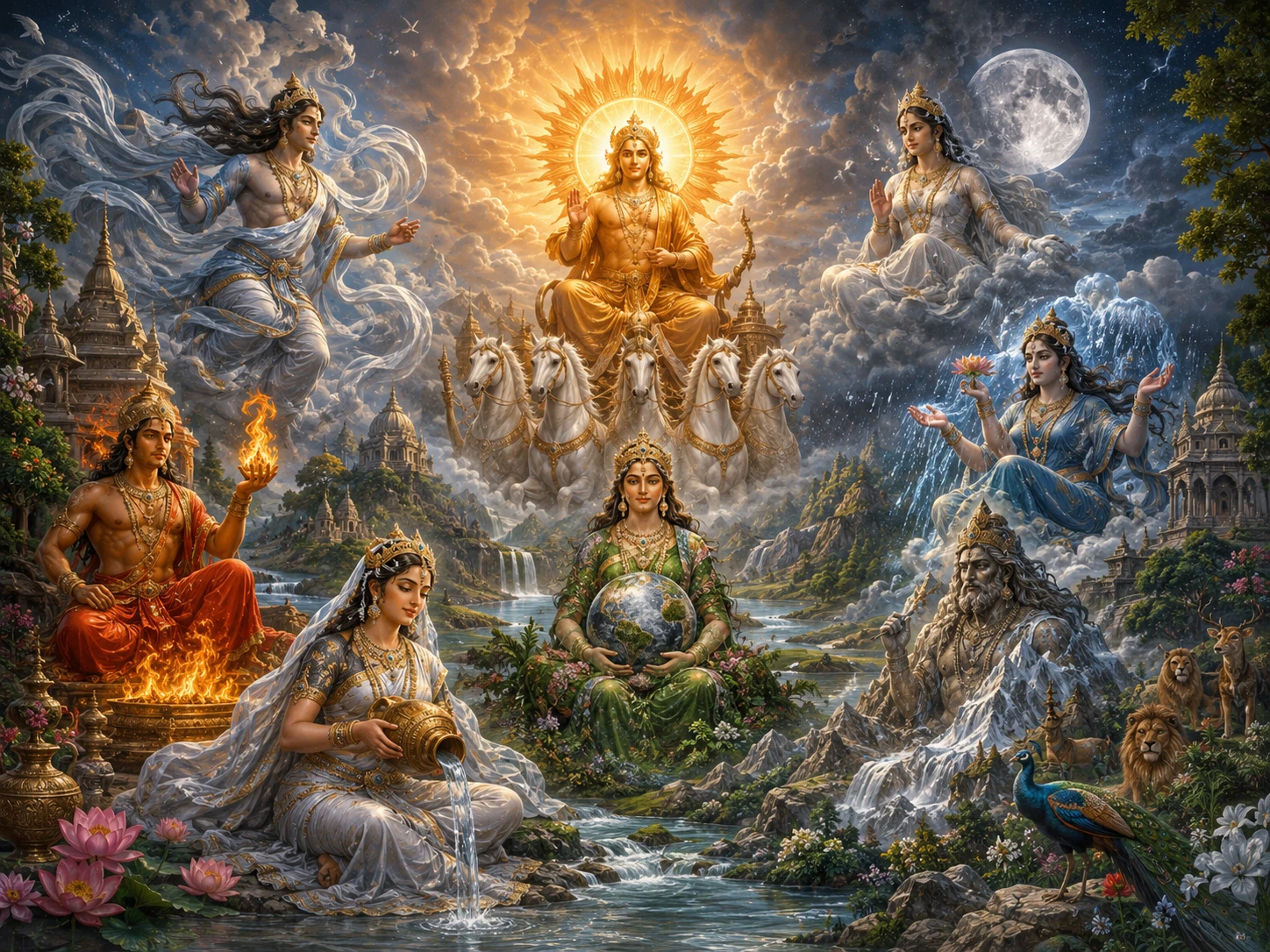
Surya's Family -- How One God Fathered Yama, Shani, the Ashwini Kumaras, and All of Humanity
सूर्य का परिवार -- कैसे एक देवता से यम, शनि, अश्विनी कुमार और सम्पूर्ण मानवजाति उत्पन्न हुई
The Story -- When a Wife Could Not Bear Her Husband's Brilliance
Surya, the Sun god, is the son of Kashyapa and Aditi -- one of the twelve Adityas. He married Sanjana (also called Saranyu), the daughter of Vishwakarma, the divine architect. The marriage was prestigious. The problem was physics.
Sanjana could not physically tolerate Surya's radiance. The Markandeya Purana (Cantos 107-108) describes how, after bearing three children -- Vaivasvata Manu, Yama, and Yami (Yamuna) -- Sanjana reached her limit. She devised an extraordinary plan: she created Chhaya ('Shadow'), an identical replica of herself, instructed Chhaya to take her place as Surya's wife, and fled to her father Vishwakarma's house. From there, she transformed into a mare and hid in the land of Uttara Kuru to perform penance.
Surya noticed nothing. He lived with Chhaya believing she was Sanjana. With Chhaya, he fathered three more children: Shani (Saturn), Tapati (the river), and Savarni Manu (destined to be the eighth Manu in the next Manvantara). But Chhaya showed favouritism toward her own biological children and mistreated Sanjana's children. When Yama complained to Surya, Chhaya's secret unravelled.
Surya confronted Chhaya, who confessed. He then went to Vishwakarma, who reduced Surya's radiance to one-sixteenth of its original intensity. From the excess solar material that Vishwakarma chipped away, he fashioned Vishnu's Sudarshana Chakra, Shiva's Trishula, and Kartikeya's spear. Surya then tracked down Sanjana in Uttara Kuru. He transformed into a stallion to approach the mare. From their equine union, the Ashwini Kumaras -- Nasatya and Dasra -- were born through Sanjana's nostrils, along with Revanta, the lord of horses.
The family reunited. Sanjana returned to her divine form. And Surya, now diminished but liveable, ruled his celestial domain with both wives and all ten children.
For anyone who has watched a dual-income couple in Mumbai struggle because one partner's career 'outshines' the other -- or seen a joint family where the stepmothers' children are treated differently -- this Puranic narrative is startlingly modern in its emotional dynamics. Sanjana did not leave because she did not love Surya. She left because proximity to his power was destroying her. Chhaya's favouritism is not villainous -- it is the most natural instinct of a biological mother. And Yama's complaint to his father is the voice of every child who has ever felt that the family system was unfair.
विवस्वतश्च सावर्णिश्छायायां समपद्यत। शनैश्चरश्च तपती भद्रा चेति सुतत्रयम्॥
vivasvatash cha saavarNish chhaayaayaam samapadyata shanaischarash cha tapatii bhadraa cheti sutatrayam
From Vivasvat (Surya) and Chhaya were born three children: Savarni (Manu), Shanaishchara (Shani/Saturn), and the daughter Tapati.
— Markandeya Purana, Canto 107 (also Vishnu Purana, Book 3, Chapter 2)
Surya's Ten Children -- Two Wives, Two Lineages
| Child | Mother | Role/Domain | Why They Matter | Key Episode |
|---|---|---|---|---|
| Vaivasvata Manu | Sanjana | 7th Manu, ancestor of all humanity | Progenitor of Solar (Ikshvaku > Rama) and Lunar dynasties | Matsya avatar rescues him from the flood |
| Yama (Dharmaraja) | Sanjana | God of Death and Justice | Judge of all souls after death; guardian of the south | First mortal to die; Nachiketa dialogue (Katha Upanishad 1.1) |
| Yami (Yamuna) | Sanjana | River goddess | One of India's holiest rivers; sister of Yama | Worshipped on Yama Dvitiya (Bhai Dooj) |
| Ashwini Kumaras | Sanjana (as mare) | Divine twin physicians (Nasatya and Dasra) | Healers of the gods; restored Chyavana's youth | Born from Sanjana's nostrils in equine form |
| Revanta | Sanjana (as mare) | Lord of horses | Master of equestrian arts and Guhyakas | Born alongside the Ashwini Kumaras |
| Shani (Saturn) | Chhaya | Planet Saturn, god of karma and justice | Most feared graha; enforces karmic consequences | Cursed his father to eclipse at birth; Shani Mahatmya |
| Tapati | Chhaya | River goddess (Tapti river, Maharashtra/Gujarat) | Married King Samvarana of Lunar dynasty | Ancestor of Kuru lineage through Samvarana > Kuru |
| Savarni Manu | Chhaya | 8th Manu (future era's ruler) | Will govern the next Manvantara after current one ends | Currently performing tapas on Mount Meru |
| Vishti (Bhadra) | Chhaya | Celestial entity in the Nakshatras | Entered the Panchanga as Bhadra Karana | Part of Hindu calendar calculations |
| Sugriva (some texts) | Sanjana (variant) | King of Vanaras (in Ramayana) | Rama's ally who provided the Vanara army | Attributed in some regional traditions only |
Sources: Markandeya Purana Cantos 107-108, Vishnu Purana Book 3 Ch. 2, Bhagavata Purana Skanda 8. Sugriva as Surya's son appears in Valmiki Ramayana (Kishkindha Kanda) but is not universally attributed to the Sanjana-Chhaya lineage in all Puranas.
Why Yama and Shani Are Brothers with Opposite Jobs
Yama judges you after death. Shani judges you during life. They are half-brothers -- same father (Surya), different mothers (Sanjana and Chhaya). And together, they form a complete system of cosmic accountability: Shani delivers karma while you are alive (through delays, obstacles, and hard lessons during Shani's seven-and-a-half-year transit called Sade Sati). Yama delivers the final verdict after you die (weighing your deeds in his court, Yamaloka).
The division is theological, not arbitrary. Sanjana's children operate in the realm of the living and the natural world: Manu creates humanity, Yamuna flows as a river, the Ashwini Kumaras heal the sick. Chhaya's children operate in the realm of consequences and cosmic timekeeping: Shani enforces karma, Savarni Manu will reset civilisation in the next era, Tapati connects to the Kuru dynasty that culminates in the Mahabharata war.
For anyone checking their Kundali before a job interview, or asking a pandit about Shani Dasha, or performing tarpan at Yamuna during Pitru Paksha -- you are engaging with Surya's family tree. The astrology apps on your phone (AstroSage, Kundli Software) are, at their core, tracking the movements and influences of Surya's children through the zodiac.
The Vishwakarma angle adds another layer. Surya's excess radiance, chipped away to make him bearable for Sanjana, became Vishnu's Sudarshana Chakra, Shiva's Trishula, and Kartikeya's Vel/Shakti. The three most iconic weapons in Hindu mythology are literally made from the Sun's discarded brilliance. Every Sudarshana Homa, every Trishula in a Shiva temple, every Vel at a Murugan shrine traces its material origin to Vishwakarma's workshop and Surya's sacrifice of his own power for the sake of his marriage.
Vishnu's Sudarshana Chakra, Shiva's Trishula, and Kartikeya's Vel (Shakti) were all forged from the same raw material -- the excess radiance of Surya, chipped away by Vishwakarma to make the Sun bearable for his wife Sanjana. The Markandeya Purana (Canto 108) describes Vishwakarma placing Surya on his lathe and reducing him to 1/16th of his original brilliance. The three most iconic weapons in Hindu mythology share a common solar origin -- and were created as a byproduct of a marital accommodation.
The festival of Bhai Dooj (Yama Dvitiya), celebrated two days after Diwali across North India, commemorates Yamuna inviting her brother Yama for a meal. Yama was so moved by his sister's love that he declared: any brother who visits his sister on this day will be freed from the fear of death. The festival originates directly from Surya's family -- Yama and Yamuna (Yami) are siblings, both children of Surya and Sanjana. When sisters apply tilak on their brothers' foreheads during Bhai Dooj, they are re-enacting a 3,000-year-old story about the Sun god's children.
Chant the Aditya Hridayam
The Aditya Hridayam, taught by Sage Agastya to Rama before the final battle with Ravana (Yuddha Kanda, Sarga 105), is the most powerful Surya stotra in the tradition. It invokes Surya as the source of all energy, life, and cosmic order.
Tags
Eternal Raga · शाश्वत राग
Institutional voice — scholarly articles on Sanatan Dharma
Deepen Your Understanding
अपनी समझ और गहरी करें
deities avatars
Kashyapa's Wives -- How One Sage Fathered Gods, Demons, and Everything In Between
Why are gods and demons always at war? Because they are cousins -- half-brothers sharing the same father, the sage Kashyapa. Aditi's sons became the Devas. Diti's sons became the Daityas. Vinata's sons became Garuda and Aruna. Kadru's sons became the serpents. And the family dynamics that produced them explain the entire cosmic conflict of Hindu mythology.
scriptural exegesis
Brahma's Children -- The First Generation of Creation
Brahma tried three times to populate the universe. First he created four sons who refused to reproduce and became monks. Then he got so angry that Rudra burst from his forehead. Finally he created ten Prajapatis from his mind -- and through them, every god, demon, human, animal, and plant in existence traces its origin. This is the original org chart of the cosmos.
scriptural exegesis
Suryavanshi -- The Solar Dynasty from the First King to Rama
Rama was not the first king of Ayodhya. He was the 67th. Before him came Ikshvaku, who sneezed into existence from Manu's nostril. Then Harishchandra, who sold himself into slavery for truth. Then Sagara, whose 60,000 sons were burned to ash. Then Bhagiratha, who brought Ganga from heaven to redeem them. Then Raghu, who conquered the world. Then Dasharatha, who gave his life for a promise. This is the Solar Dynasty -- the longest unbroken royal lineage in any mythology on earth.
vedic sciences
Kaal Ganana -- The Hindu Measure of Time
From a single blink of the eye (Nimesha) to one Day of Brahma (4.32 billion years) -- explore the complete cosmic time hierarchy of Hindu cosmology, anchored in Vishnu Purana 1.3, with its remarkable parallels to modern science.
vedic sciences
The 14 Manus -- Cosmic Reset Buttons of Hindu Time
Hindu cosmology does not have one Adam. It has fourteen. Each Manvantara -- a cosmic era of 306.72 million years -- is governed by a different Manu who repopulates the earth, establishes dharma, and oversees a fresh team of gods, sages, and an Indra. We are currently in the 7th Manvantara, ruled by Vaivasvata Manu, son of Surya. Seven Manus have served. Seven are yet to come. And Vishnu takes a new avatar for each.
scriptural exegesis
Chandravanshi -- The Lunar Dynasty from Moon to Mahabharata
The Solar Dynasty gave India Rama. The Lunar Dynasty gave India everything else: Krishna, the Pandavas, the Kauravas, Bharata (after whom India is named), Shakuntala (Kalidasa's masterpiece), and the Mahabharata itself. It begins with a scandal -- the Moon god Soma abducting Tara, wife of Brihaspati -- and it ends with the greatest war in mythology. One lineage. Two branches. Every epic.
Vishnu's Sudarshana Chakra, Shiva's Trishula, and Kartikeya's Vel (Shakti) were all forged from the same raw material -- the excess radiance of Surya, chipped away by Vishwakarma to make the Sun bearable for his wife San…
More in Deities & Avatars
33 Koti Devata -- Why Hinduism Has 33 Types of Gods, Not 33 Crore
13 min read
Agni -- The Fire God
19 min read
Annapurna -- Goddess of Food
19 min readThe same translation error that turned '33 Koti' into '33 crore' in Hinduism also happened in Buddhism. The Chinese translation of Buddhist texts rendered 'Sapta Koti Buddha' (7 Supreme Buddhas) as '7 Crore Buddhas.' The…
Deities AvatarsCommunity Reflections
🕉️
Be the first to share your reflection.