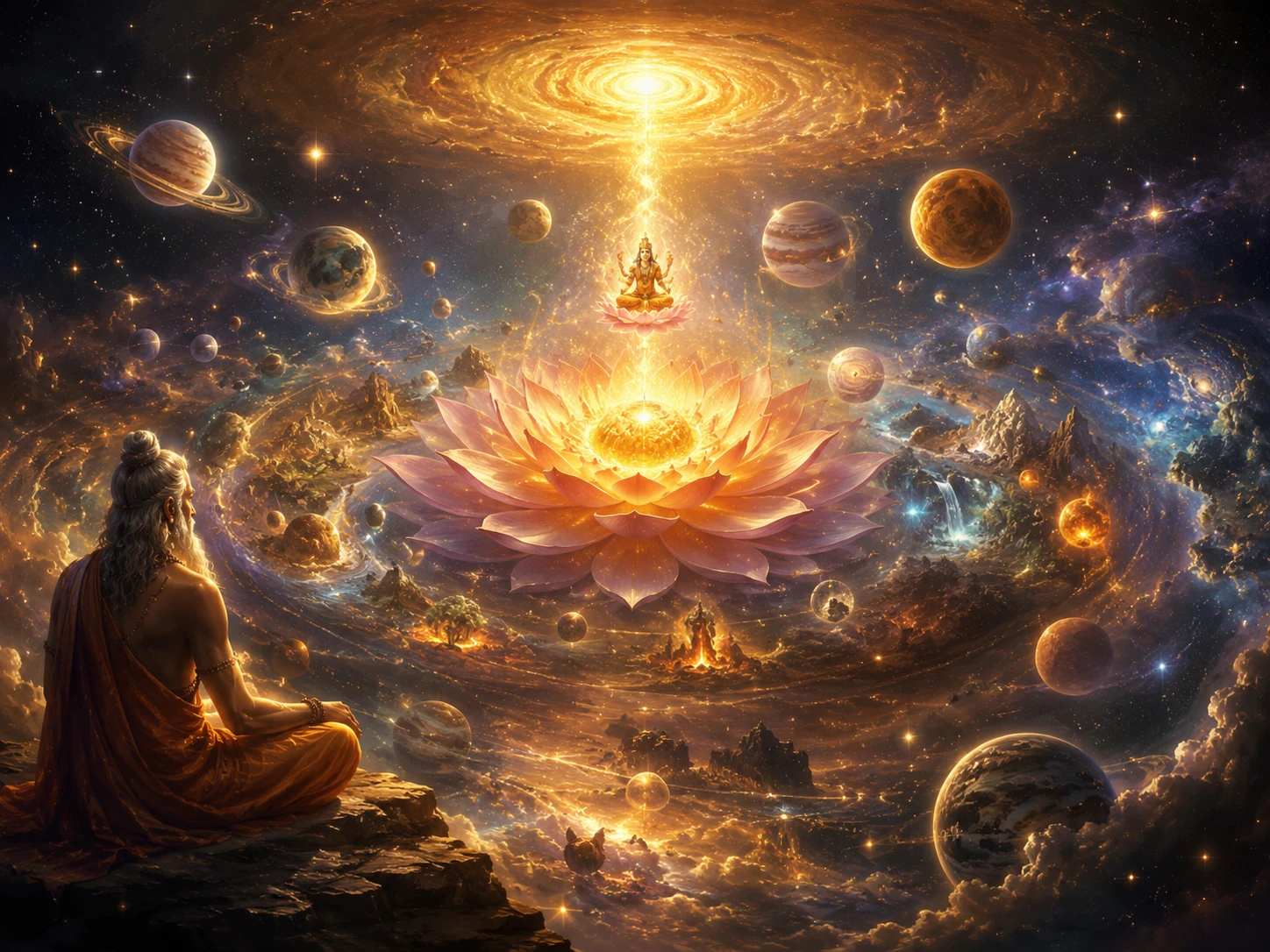
Brahma's Children -- The First Generation of Creation
ब्रह्मा की सन्तानें -- सृष्टि की प्रथम पीढ़ी
Introduction -- Why Brahma Failed Twice Before Succeeding
The creation of the universe in Hindu cosmology is not a single event. It is a management problem. Brahma -- the four-faced creator, seated on the lotus that grows from Vishnu's navel -- has the mandate to populate an entire cosmos. And his first two attempts are spectacular failures.
Attempt 1: The Sanatkumaras. The Vishnu Purana (Book 1, Chapter 7) and the Bhagavata Purana (Skanda 3, Chapter 12) describe how Brahma first created four sons from his mind: Sanaka, Sanandana, Sanatana, and Sanatkumara. These four were born with perfect knowledge. They looked at the material world, understood it completely, found it unsatisfying, and unanimously decided to remain celibate monks devoted to meditation. They refused to create. They refused to reproduce. They refused, in effect, to do their jobs. From Brahma's perspective, he had created four supremely qualified employees who immediately submitted their resignations.
Attempt 2: Rudra. Frustrated by the Sanatkumaras' refusal, Brahma's anger boiled over. From his forehead -- specifically from between his eyebrows (the seat of fury in Indian physiognomy) -- Rudra was born, half-male, half-female, roaring and weeping simultaneously (the name 'Rudra' derives from 'rud' -- to weep/roar). Brahma asked Rudra to create. Rudra began producing beings, but they were so fierce, so destructive, so uncontrollable that Brahma panicked and told him to stop. Rudra, offended, retreated into permanent tapas (austerity). He would later manifest as the eleven Rudras -- Aja, Ekapada, Ahirbudhnya, Tvashta, Rudra, Hara, Sambhu, Tryambaka, Aparajita, Isana, and Tribhuvana -- who represent destructive and transformative cosmic forces.
Attempt 3: The Prajapatis. Finally, Brahma created ten sons from his mind who would actually obey the brief: populate the cosmos. These are the Prajapatis (Lords of Progeny), and from them descend every lineage in Hindu mythology -- divine, demonic, human, animal, and botanical.
For a startup founder who has been through three pivots before finding product-market fit, Brahma's creation story is uncomfortably relatable. Attempt 1: perfect team, zero execution. Attempt 2: too much aggression, burns everything down. Attempt 3: the right people, the right scope, and it finally works.
भृगुं पुलस्त्यं पुलहं क्रतुमङ्गिरसं तथा। मरीचिं दक्षमत्रिं च वसिष्ठं चैव मानसान्॥
bhrgum pulastyam pulaham kratum angirasam tathaa mariichim daksham atrim cha vasishhtham chaiva maanasaan
Bhrigu, Pulastya, Pulaha, Kratu, Angiras, Marichi, Daksha, Atri, and Vasishtha -- these are the mind-born (Manasa) sons of Brahma.
— Vishnu Purana, Book 1, Chapter 7 (also Manusmriti 1.34 lists the same with Narada as tenth)
The Ten Prajapatis -- Who They Are and What They Created
The Vishnu Purana (Book 1, Chapter 7) and the Manusmriti (1.34) list the ten Prajapatis, sometimes called the nine Brahmarishis with Narada as the tenth. Each Prajapati was married to one or more of Daksha's daughters (or in Daksha's own case, to Prasuti, daughter of Svayambhuva Manu), and through these unions, the cosmos was populated. Here is each Prajapati's lineage contribution:
Marichi -- The most senior Prajapati. His wife was Kala. Their son was Kashyapa -- arguably the single most important figure in Hindu genealogy, because Kashyapa married thirteen of Daksha's daughters and through them fathered the Adityas (gods), Daityas (demons), Nagas (serpents), Garudas (eagles), and virtually all animal species. The next article in this series covers Kashyapa's family in detail.
Atri -- His wife was Anasuya (the famous model of wifely devotion). Their sons included Dattatreya (the three-headed guru, considered a combined avatar of Brahma-Vishnu-Shiva), Soma (the Moon god, progenitor of the Chandravanshi/Lunar Dynasty), and Durvasa (the famously short-tempered sage). From Soma descends the entire Lunar Dynasty leading to the Pandavas and Kauravas.
Angiras -- His wife was Shraddha. Their descendants include Brihaspati (Jupiter, the guru of the gods) and through Brihaspati, the tradition of Vedic ritual and priestly knowledge.
Pulastya -- His wife was Havirbhu. Their grandson was Vishrava, and Vishrava's sons were Kubera (the god of wealth) and Ravana (the king of Lanka). Yes -- Kubera and Ravana are cousins, both descended from the same Prajapati. When Ravana seized Lanka from Kubera, it was a family property dispute.
Pulaha -- His wife was Gati. His lineage includes various species of animals and forest creatures. The Puranas credit Pulaha with the creation of the animal kingdom.
Kratu -- His wife was Kriya. His descendants are the Valakhilyas -- 60,000 thumb-sized sages who surround the sun's chariot and are mentioned in the Mahabharata.
Bhrigu -- His wife was Khyati. Their daughter Lakshmi married Vishnu (in some Puranic accounts). The Bhrigu lineage includes Shukracharya (Venus, the guru of the Asuras) and Parashurama (the sixth avatar of Vishnu). The Brighu Valli of the Taittiriya Upanishad is named after this lineage.
Vasishtha -- His wife was Arundhati (the famous star in Ursa Major, shown to brides at Hindu weddings). Vasishtha was the rajguru of the Ikshvaku dynasty and therefore Rama's family priest. The star Mizar-Alcor (Vasishtha-Arundhati) is pointed out to newly married couples as a symbol of marital fidelity.
Daksha -- The most complex Prajapati. Born from Brahma's thumb (not from his mind, technically). His wife was Prasuti. He had 60 daughters (some accounts say more), and through their marriages to various gods and sages, he became the grandfather of virtually everything. Thirteen of his daughters married Kashyapa. Others married Dharma, Shiva (Sati), Soma, and the other Prajapatis. The Daksha Yagna episode -- where Sati immolates herself because Daksha insults Shiva -- is one of the most dramatic events in Shaiva theology.
Narada -- The eternal bachelor, cosmic gossip, and Vishnu's greatest devotee. Unlike the other Prajapatis, Narada never married and never produced biological offspring. His 'progeny' is bhakti itself -- devotional love. He is the original influencer, travelling between worlds carrying news and stirring divine drama.
The Ten Prajapatis and Their Key Descendants
| Prajapati | Wife | Key Descendants | What They Gave to Creation | Famous Episodes |
|---|---|---|---|---|
| Marichi | Kala | Kashyapa > Gods, Demons, all species | The entire biological cosmos through Kashyapa | Father of the universal progenitor |
| Atri | Anasuya | Dattatreya, Soma (Moon), Durvasa | Chandravanshi (Lunar Dynasty) > Pandavas, Kauravas | Anasuya's test by Trimurthi |
| Angiras | Shraddha | Brihaspati (Jupiter/Guru of Gods) | Vedic ritual knowledge and priestly tradition | Brihaspati-Tara-Soma love triangle |
| Pulastya | Havirbhu | Vishrava > Kubera and Ravana | Rakshasas and the wealth god | Kubera and Ravana as cousins |
| Pulaha | Gati | Animal and forest species | The animal kingdom | Creator of biodiversity |
| Kratu | Kriya | 60,000 Valakhilya sages | Thumb-sized sages around Sun's chariot | Mentioned in Mahabharata |
| Bhrigu | Khyati | Shukracharya, Parashurama | Asura guru lineage + Vishnu avatar | Bhrigu kicks Vishnu's chest |
| Vasishtha | Arundhati | Shakti, Parasara, Vyasa (via lineage) | Ikshvaku rajguru, Rama's priest | Vasishtha-Vishwamitra rivalry |
| Daksha | Prasuti | 60 daughters > all major lineages | Grandfather of gods, demons, Nagas, animals | Daksha Yagna, Sati's self-immolation |
| Narada | None (eternal bachelor) | Bhakti tradition itself | Devotional love as cosmic force | Stirring divine drama across all Puranas |
Sources: Vishnu Purana, Book 1, Chapter 7; Bhagavata Purana, Skanda 3, Chapters 12-14; Manusmriti 1.34. Lists vary slightly across texts -- some include Kardama or exclude Narada. The core seven (Marichi, Atri, Angiras, Pulastya, Pulaha, Kratu, Vasishtha) appear in virtually all versions, with Bhrigu, Daksha, and Narada as common additions.
Attempt 1 — Mind-born sons who refused to create
Attempt 2 — Born from fury
Attempt 3 — Ten Prajapatis who populated the cosmos
Direct human lineage
Tap any name to see their story, key descendants, and Puranic citations.
Svayambhuva Manu and Shatarupa -- The First Human Couple
Beyond the Prajapatis, Brahma created one more lineage that is crucial to the human story: Svayambhuva Manu and his wife Shatarupa. The Vishnu Purana (Book 1, Chapter 7) states that Brahma created Manu from his own self ('Svayambhuva' literally means 'self-born') and Shatarupa from his female aspect.
Manu and Shatarupa had two sons -- Priyavrata and Uttanapada -- and two daughters -- Prasuti (who married Daksha) and Akuti (who married the patriarch Ruchi). Through Prasuti and Daksha, the 60 daughters were born who married the Prajapatis, the gods, and Shiva -- creating the circular linkage that connects Brahma's direct line back to his mind-born sons.
Uttanapada's son was Dhruva -- the boy who performed such intense tapas at age five that Vishnu granted him an eternal place as the Pole Star (Dhruv Tara). When you look at the night sky and see the star that does not move, you are looking at a five-year-old boy who told the universe: 'I will not settle for less.'
Svayambhuva Manu is the first of fourteen Manus who govern successive Manvantaras (cosmic eras). We currently live in the era of the seventh Manu -- Vaivasvata Manu, son of Surya (the Sun god). Vaivasvata Manu's story connects directly to the Suryavanshi and Chandravanshi dynasties -- covered in later articles in this series.
The word 'Manushya' (human) derives from Manu. The English word 'man' may share the same Indo-European root. When a politician says 'maanavta' (humanity) in a Parliament speech, the word literally means 'descendants of Manu.'
Kubera (the god of wealth) and Ravana (the demon king of Lanka) are first cousins -- both grandsons of the Prajapati Pulastya. When Ravana conquered Lanka and drove Kubera out, it was technically a hostile takeover of a family business. Kubera then relocated to Alaka (near Mount Kailash), where he became Shiva's neighbour and the treasurer of the gods. The next time you see Kubera and Ravana in the same Purana, remember: this is not a gods-vs-demons war. This is a family feud with real estate complications.
The star Alcor (Arundhati) in the constellation Ursa Major is traditionally pointed out to the bride during Hindu wedding ceremonies. She is the wife of the Prajapati Vasishtha (the star Mizar, right next to Alcor). The couple is so inseparable in the sky that they have been used as an eye test in ancient Indian astronomy -- if you can see both stars separately with the naked eye, your vision is considered sharp. The 'Arundhati Darshana' ritual in Hindu weddings is literally asking the bride to look at a 3,000-year-old model of marital devotion in the night sky.
Explore the Prajapati Lineages
Dive deeper into the family trees of Kashyapa, Surya, and the Solar and Lunar Dynasties in the Eternal Gyan Vanshavali series. Each article maps a branch of the cosmic family tree with full Puranic citations.
Tags
Eternal Raga · शाश्वत राग
Institutional voice — scholarly articles on Sanatan Dharma
Deepen Your Understanding
अपनी समझ और गहरी करें
deities avatars
Kashyapa's Wives -- How One Sage Fathered Gods, Demons, and Everything In Between
Why are gods and demons always at war? Because they are cousins -- half-brothers sharing the same father, the sage Kashyapa. Aditi's sons became the Devas. Diti's sons became the Daityas. Vinata's sons became Garuda and Aruna. Kadru's sons became the serpents. And the family dynamics that produced them explain the entire cosmic conflict of Hindu mythology.
deities avatars
Surya's Family -- How One God Fathered Yama, Shani, the Ashwini Kumaras, and All of Humanity
Surya had two wives: Sanjana, who could not bear his radiance, and Chhaya, the shadow she left behind. From Sanjana came Yama (death), Yamuna (the river), Manu (humanity's ancestor), and the Ashwini Kumaras (divine physicians). From Chhaya came Shani (Saturn, karma's enforcer), Tapati (the river), and Savarni Manu (the next cosmic era's ruler). Same father. Two mothers. Ten children. And the entire human race.
vedic sciences
Hiranyagarbha -- The Golden Egg That Became the Universe
Before the Big Bang had a name, the Rig Veda described creation erupting from a golden cosmic egg -- Hiranyagarbha. The Shiva Purana says Shiva split it. The Vishnu Purana says Vishnu incubated it. The Manusmriti says it floated in darkness for a year. And the Nasadiya Sukta says: honestly, who really knows? Five texts, five creation stories, one civilisation honest enough to hold them all simultaneously.
scriptural exegesis
Suryavanshi -- The Solar Dynasty from the First King to Rama
Rama was not the first king of Ayodhya. He was the 67th. Before him came Ikshvaku, who sneezed into existence from Manu's nostril. Then Harishchandra, who sold himself into slavery for truth. Then Sagara, whose 60,000 sons were burned to ash. Then Bhagiratha, who brought Ganga from heaven to redeem them. Then Raghu, who conquered the world. Then Dasharatha, who gave his life for a promise. This is the Solar Dynasty -- the longest unbroken royal lineage in any mythology on earth.
scriptural exegesis
Chandravanshi -- The Lunar Dynasty from Moon to Mahabharata
The Solar Dynasty gave India Rama. The Lunar Dynasty gave India everything else: Krishna, the Pandavas, the Kauravas, Bharata (after whom India is named), Shakuntala (Kalidasa's masterpiece), and the Mahabharata itself. It begins with a scandal -- the Moon god Soma abducting Tara, wife of Brihaspati -- and it ends with the greatest war in mythology. One lineage. Two branches. Every epic.
vedic sciences
Kaal Ganana -- The Hindu Measure of Time
From a single blink of the eye (Nimesha) to one Day of Brahma (4.32 billion years) -- explore the complete cosmic time hierarchy of Hindu cosmology, anchored in Vishnu Purana 1.3, with its remarkable parallels to modern science.
Kubera (the god of wealth) and Ravana (the demon king of Lanka) are first cousins -- both grandsons of the Prajapati Pulastya. When Ravana conquered Lanka and drove Kubera out, it was technically a hostile takeover of a …
More in Scriptural Exegesis
Abhimanyu and the Chakravyuha -- The Boy Who Knew How to Enter but Not How to Leave
14 min read
Adbhuta Ramayana -- The Ramayana Where Sita Becomes Kali
9 min read
After Kurukshetra -- What Happened Next
14 min readThe same translation error that turned '33 Koti' into '33 crore' in Hinduism also happened in Buddhism. The Chinese translation of Buddhist texts rendered 'Sapta Koti Buddha' (7 Supreme Buddhas) as '7 Crore Buddhas.' The…
Deities AvatarsCommunity Reflections
🕉️
Be the first to share your reflection.