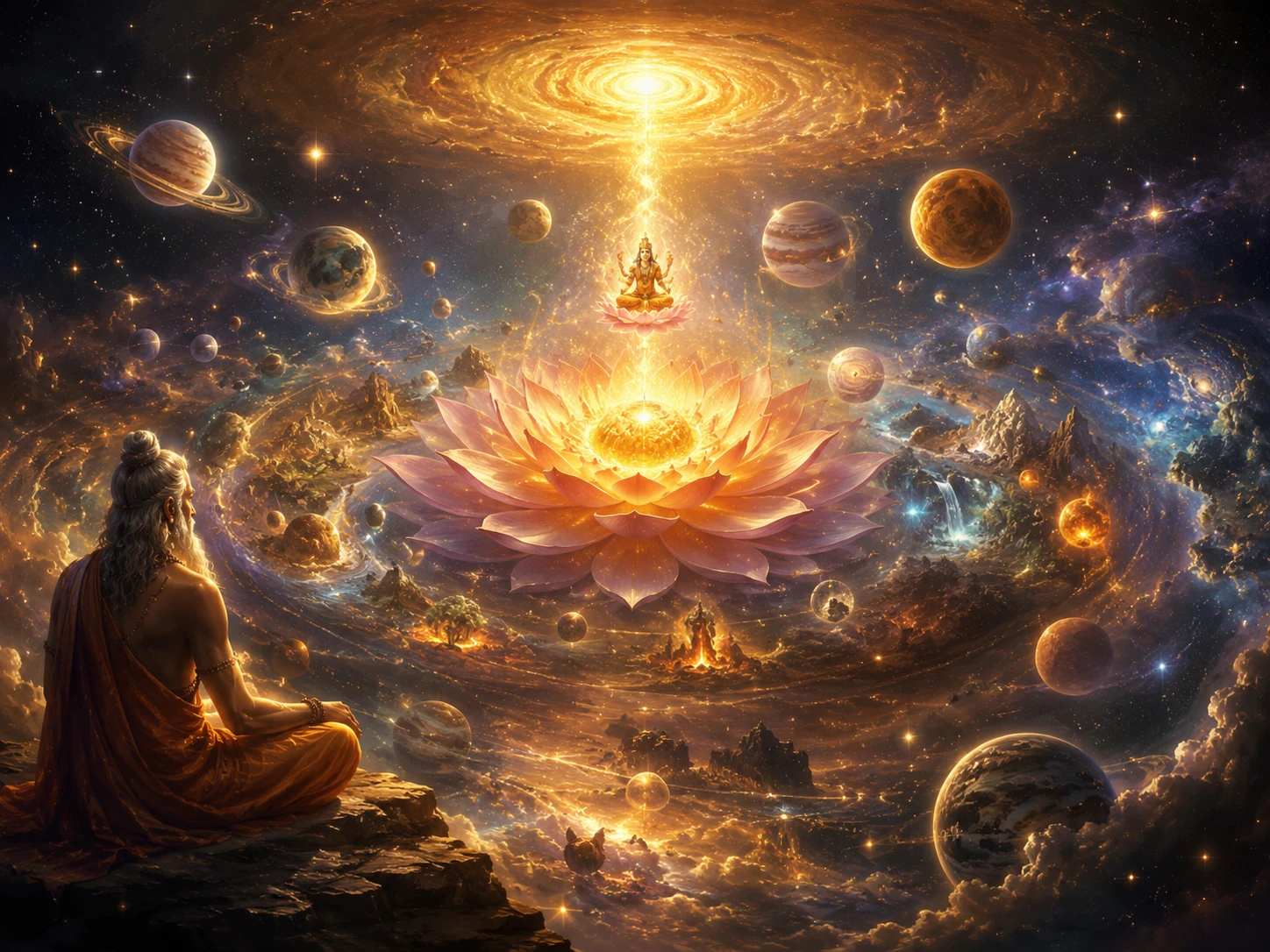
Hiranyagarbha -- The Golden Egg That Became the Universe
हिरण्यगर्भ -- वह सुवर्ण अण्ड जो ब्रह्माण्ड बन गया
Introduction -- The Oldest Question, Five Answers
How did the universe begin? Every civilisation has asked. Most have offered one answer and insisted it is the only truth. Hindu civilisation did something different. It offered multiple answers -- in the same canon, sometimes in the same text -- and held them all simultaneously, not as competing claims, but as different lenses on a mystery too large for any single narrative.
The Rig Veda alone contains at least three distinct creation accounts: the Hiranyagarbha Sukta (10.121), which describes creation emerging from a golden cosmic egg; the Nasadiya Sukta (10.129), which questions whether anyone -- including the gods -- truly knows how creation happened; and the Purusha Sukta (10.90), which describes the universe arising from the sacrifice of the Cosmic Man. These are not contradictions. They are complementary perspectives -- like viewing a mountain from three different valleys.
The Puranas then elaborate each account through their own theological lens. The Shiva Purana's Vidyeshwara Samhita (Chapters 6-10) places Shiva as the force that splits the Hiranyagarbha. The Vishnu Purana attributes the incubation of the cosmic egg to Vishnu lying on the cosmic ocean. The Manusmriti (Chapter 1) provides a remarkably scientific-sounding account of the egg floating in primordial waters before splitting into heaven and earth. And the Matsya Purana (Shloka 2.25-30) gives yet another variant.
A physics student at IIT Bombay studying the Big Bang might find the Hiranyagarbha metaphor hauntingly familiar: a singular point of origin, a period of incubation in primordial conditions, an explosive expansion into duality (matter and energy, earth and sky). This article does not claim that the Rishis 'knew about' the Big Bang. That would be overclaiming. What it does claim is that the Rishis asked the same question modern cosmologists ask -- and were honest enough to say that multiple framings might each capture a piece of the truth.
This is the article that Instagram reels on 'Vedic science' never make. Not because the content is boring, but because intellectual honesty requires more than 60 seconds.
हिरण्यगर्भः समवर्तताग्रे भूतस्य जातः पतिरेक आसीत्। स दाधार पृथिवीं द्यामुतेमां कस्मै देवाय हविषा विधेम॥
hiranyagarbhah samavartatagre bhuutasya jaatah patireka aasiit sa daadhaara prthiviim dyaam utemaam kasmai devaaya havishaa vidhema
In the beginning arose Hiranyagarbha (the Golden Womb/Egg), born as the sole lord of all created beings. He upheld this earth and heaven. To which God shall we offer our oblation?
— Rig Veda, Mandala 10, Sukta 121, Verse 1 (Hiranyagarbha Sukta)
The Rig Veda -- Two Creation Hymns in Conversation
The Hiranyagarbha Sukta (Rig Veda 10.121) is ten verses long, each ending with the haunting refrain: 'Kasmai devaya havisha vidhema?' -- 'To which God shall we offer our oblation?' This refrain is not rhetorical decoration. It is a genuine philosophical question embedded in a creation hymn. The poet is simultaneously describing the Creator and asking: who is this Creator, really?
Verse 1: Hiranyagarbha arose in the beginning. Born, he was the sole lord of all created beings. He upheld this earth and heaven.
Verse 2: He is the giver of vital breath (Atma-da), of power and vigour (Bala-da). All gods carry out his commands. His shadow is immortality -- and also death.
Verse 3: By his greatness alone, he became the sole king of the breathing and blinking world. He is the lord of two-footed and four-footed creatures.
Verse 5: By him the heavens are strong and earth is steadfast, by him light's realm and sky-vault are supported. By him the regions in mid-air were measured.
The tenth and final verse identifies this mysterious 'Ka' (Who?) as Prajapati -- the Lord of Creatures. In later Sanskrit grammar, 'Ka' itself became a name for Brahma/Prajapati, because the question 'Who?' was the only adequate response to the mystery of creation.
Now place this alongside the Nasadiya Sukta (Rig Veda 10.129), written just eight hymns later in the same Mandala. This is the hymn that says: 'Then there was neither existence nor non-existence. There was no realm of air, no sky beyond it. What covered it? Where was it? In whose keeping?' And its final verse: 'Whence this creation has arisen -- perhaps it formed itself, or perhaps it did not. The one who looks down on it, in the highest heaven, only he knows -- or perhaps he does not know.'
The Rig Veda contains both hymns. It does not choose between them. One says: there was a Creator (Hiranyagarbha/Prajapati) who arose first and made everything. The other says: maybe nobody knows, maybe even the gods do not know. A civilisation that can hold both of these in the same sacred canon is not confused. It is honest.
For a 12th-grader preparing for boards, the Nasadiya Sukta appears in the NCERT History textbook as an example of ancient philosophical inquiry. For a philosophy student at Banaras Hindu University, the pairing of 10.121 and 10.129 is one of the most sophisticated dialogues about epistemological humility in any ancient text anywhere in the world.
The Puranic Accounts -- Same Egg, Different Hands
Each major Purana takes the Vedic Hiranyagarbha concept and reframes it through its own deity-centric theology. Here are the four principal versions:
Shiva Purana (Vidyeshwara Samhita, Chapters 7-9): After the Lingodbhava episode, the Shiva Purana describes how A (Brahma, the seed/Bija), U (Vishnu, the womb/Yoni), and M (Shiva, grace) combine. From this union, a golden egg (Hiranyagarbha) manifests. The egg floats in primordial waters for a thousand years. Then Shiva strikes it, splitting it into two halves -- the upper half becomes Svarga (heaven/the celestial realm) and the lower half becomes Prithvi (earth). From within the egg, four-faced Brahma is born. This is the version the YouTube video describes, and it is textually accurate to the Shiva Purana.
Vishnu Purana (Book 1, Chapters 2-3): Vishnu lies on the cosmic serpent Shesha upon the primordial ocean (Kshira Sagara). A lotus emerges from his navel. Brahma is born on the lotus. The egg -- Brahmanda -- is the entire cosmos that Vishnu sustains. In this version, the egg does not need to be broken. It is Vishnu's own cosmic body.
Manusmriti (Chapter 1, Shlokas 5-16): Manu provides the most 'process-oriented' account. The Self-existent (Svayambhu) first created the waters and placed his seed in them. The seed became a golden egg (Hiranyagarbha), 'shining like a thousand suns.' In that egg, Brahma himself was born. The egg rested in the waters for one divine year (equivalent to 360 human years according to Manu's own time scale). Then Brahma, by thought alone, split the egg into two, making heaven from the upper shell and earth from the lower. Between them he placed the atmosphere, the eight cardinal directions, and the eternal abode of the waters.
Matsya Purana (Chapter 2, Shlokas 25-30): Offers yet another variant where the Hiranyagarbha is described as the initial state of all creation, with Vishnu as Narayana resting in the cosmic waters (Naara = waters, Ayana = abode, hence Narayana = 'one whose abode is the waters').
The differences between these accounts are not errors. They are theological positions. The Shiva Purana centres Shiva. The Vishnu Purana centres Vishnu. Manu centres process and law. The Matsya Purana centres the cosmic waters. Each is internally consistent. The tradition's genius is that it preserved all of them, not as competing fundamentalisms but as complementary gazes on a single mystery.
For a startup founder pitching to investors, think of it this way: every Purana is a pitch deck for its deity. The product (the universe) is the same. The founder story changes.
The Hiranyagarbha Across Five Texts
| Text | Citation | Who Creates the Egg? | How Long Does It Float? | Who Splits It? | What Emerges? |
|---|---|---|---|---|---|
| Rig Veda 10.121 | Hiranyagarbha Sukta, 10 verses | Self-manifested (Prajapati/Ka) | Not specified | Not specified explicitly | Heaven and Earth; Prajapati as Lord |
| Shiva Purana | Vidyeshwara Samhita Ch. 7-9 | Union of A (Brahma/seed) + U (Vishnu/womb) + M (Shiva/grace) | 1,000 years in water | Shiva strikes it | Upper = Svarga, Lower = Prithvi; Brahma born inside |
| Vishnu Purana | Book 1, Ch. 2-3 | Vishnu's cosmic body on Kshira Sagara | Not broken -- it IS the cosmos | Not applicable | Brahma from Vishnu's navel lotus |
| Manusmriti | Ch. 1, Shlokas 5-16 | Svayambhu places seed in waters | 1 divine year (360 human years) | Brahma splits it by thought | Upper shell = heaven; Lower = earth; atmosphere between |
| Matsya Purana | Ch. 2, Shlokas 25-30 | Narayana resting in cosmic waters | Not specified precisely | Implicit in Narayana's will | Five elements and all beings |
Note that the Nasadiya Sukta (Rig Veda 10.129) does not describe the Hiranyagarbha at all -- it questions whether creation can be known. It is included in the article as the tradition's self-critical counterpoint.
नासदासीन्नो सदासीत्तदानीं नासीद्रजो नो व्योमा परो यत्। किमावरीवः कुह कस्य शर्मन्नम्भः किमासीद्गहनं गभीरम्॥
naasad aasiit no sad aasiit tadaaniim naasid rajo no vyomaa paro yat kim aavariivah kuha kasya sharmann ambhah kim aasiid gahanam gabhiiram
Then there was neither existence nor non-existence. There was no realm of air, no sky beyond it. What covered it? Where was it? In whose protection? Was there water, unfathomably deep?
— Rig Veda, Mandala 10, Sukta 129, Verse 1 (Nasadiya Sukta)
Brahmanda -- Why the Universe is Called an Egg
The Sanskrit word for 'universe' is Brahmanda -- literally 'Brahma's Egg' (Brahma + Anda). This is not a metaphor that was added later. The word itself encodes the Hiranyagarbha cosmology. Every time a Hindi newsreader says 'Brahmand' to describe the cosmos, they are invoking a creation narrative that is at least 3,500 years old.
The egg metaphor is philosophically precise. An egg contains the complete genetic blueprint of the organism that will emerge -- compressed, latent, awaiting the conditions for expression. The Hiranyagarbha similarly contains all of creation in potential: the five elements, the directions, the gods, the living beings, the laws of dharma. Nothing is created from outside the egg. Everything unfolds from within. This is not creation ex nihilo (from nothing) as in Abrahamic theology. This is creation from within -- self-emergence, auto-genesis. The Sanskrit term is 'Svayambhu' -- self-born.
The egg also implies a shell -- a boundary. The upper shell becomes heaven, the lower shell becomes earth. Between them is the atmosphere (Antariksha). The boundaries of the cosmos are the remnants of the egg's casing. When modern cosmologists describe the cosmic microwave background radiation as the 'echo' of the Big Bang, they are describing, in different language, what the Rig Veda described as the residue of the Hiranyagarbha's shell.
Again -- this article does not claim identity between Vedic cosmology and modern physics. It claims structural resonance. Both describe: an initial singularity, a period of latency, an expansion into differentiated reality, and residual traces of the original state. The Hindu tradition arrived at this framework through contemplation and poetic insight. Modern physics arrived through mathematics and observation. The convergence is worth noting. The conflation would be intellectually dishonest.
The cosmic egg motif is not unique to Hinduism. It appears in ancient Egyptian mythology (the Ogdoad of Hermopolis), Greek Orphic cosmogony, Chinese Pangu mythology, and Finnish Kalevala. What is unique to Hinduism is the simultaneous preservation of a creation hymn (Hiranyagarbha Sukta) alongside a sceptical interrogation of all creation hymns (Nasadiya Sukta) in the same canonical text. No other ancient civilisation did this.
The word 'Brahmanda' -- meaning 'Brahma's Egg' -- is the standard Hindi/Sanskrit word for 'universe.' Every time ISRO scientists at Sriharikota say 'Brahmand' while discussing cosmic missions, they are using a word that literally encodes the Hiranyagarbha creation narrative. The 2006 NASA WMAP (Wilkinson Microwave Anisotropy Probe) satellite produced a map of the cosmic microwave background radiation -- the 'echo' of the Big Bang -- that shows the observable universe as an ellipsoidal shape. Some commentators noted the visual similarity to a cosmic egg, though NASA made no such connection. The resemblance is coincidental but culturally evocative.
The Nasadiya Sukta (Rig Veda 10.129) is the only creation hymn in any ancient civilisation that ends by questioning whether even the highest god knows how creation happened. Its final verse -- 'The one who surveys it from the highest heaven, only he knows, or perhaps he does not know' -- has been called by multiple scholars the earliest expression of philosophical agnosticism. It appears in the NCERT Class 12 History textbook as an example of ancient Indian intellectual sophistication. When a Western journalist asks 'Does Hinduism have a creation story?', the honest answer is: it has at least five, and one of them is a philosophical interrogation of the very concept of having a creation story.
Conclusion -- Holding Multiple Truths
The YouTube video that inspired this article presented one account -- the Shiva Purana's version of the Hiranyagarbha -- and presented it well. But it presented it as 'the' story of creation. The full tradition is far richer.
Hindu civilisation's approach to cosmogony is not a weakness to be embarrassed about ('But which version is the real one?'). It is an intellectual strength unprecedented in the ancient world. Having multiple creation narratives is not confusion. It is epistemological maturity -- the recognition that the origin of everything might be too vast for any single telling.
The Hiranyagarbha is the affirmative account: there was an egg, it split, the universe emerged. The Nasadiya Sukta is the questioning account: but who really knows? The Purusha Sukta is the sacrificial account: the cosmos is a divine offering. The Puranas are the devotional accounts: my God was there first. And the Mandukya Upanishad, as we explored in the companion article on Om, suggests that the question of cosmic origin might ultimately be less important than the investigation of the consciousness that asks the question.
That is the tradition. Hold all of it.
Chant the Hiranyagarbha Sukta
The Hiranyagarbha Sukta (Rig Veda 10.121) is traditionally chanted during Sandhya Vandana and other daily rituals. Nine of its ten verses end with 'Kasmai devaya havisha vidhema' -- to which god shall we offer? -- making it a complete meditation on the mystery of creation. Eternal Raga's page gives six of its verses with their meaning.
Tags
Eternal Raga · शाश्वत राग
Institutional voice — scholarly articles on Sanatan Dharma
Deepen Your Understanding
अपनी समझ और गहरी करें
philosophy darshana
Om -- The Sound That Contains the Universe
Om is not a chant. It is not a religious symbol. According to the Mandukya Upanishad, it is the complete map of consciousness itself -- past, present, future, and whatever lies beyond all three. Twelve verses. Four states. One syllable. This is the most concentrated philosophical text in human history, and it fits on a single page.
vedic sciences
Kaal Ganana -- The Hindu Measure of Time
From a single blink of the eye (Nimesha) to one Day of Brahma (4.32 billion years) -- explore the complete cosmic time hierarchy of Hindu cosmology, anchored in Vishnu Purana 1.3, with its remarkable parallels to modern science.
deities avatars
Dashavatara -- Why Vishnu Comes Back Ten Times
Fish, tortoise, boar, half-lion, dwarf, axe-warrior, prince, cowherd, enlightened teacher, future horseman. The ten avatars of Vishnu are not random folklore. Read them in sequence and you get something startling -- a narrative that mirrors evolutionary biology, tracks the rise and fall of political systems, and argues that God does not sit above history but enters it, gets dirty, and does the work. The Dashavatara is Hinduism's answer to the question every civilisation asks: why does the world keep breaking, and who fixes it?
tantra mantra yantra
Tantra, Mantra and Yantra -- The Three Pillars of Spiritual Practice
Tantra is the loom, Mantra is the thread, Yantra is the pattern. Together they form the complete technology of spiritual transformation that India gifted to the world -- and they are far more profound than popular culture imagines.
scriptural exegesis
Samudra Manthan -- When Gods and Demons Ran a Joint Venture and the Universe Almost Died
A cosmic ocean. A mountain for a churning rod. A serpent king for a rope. Gods on one end, demons on the other. And out came 14 treasures -- including wealth, beauty, medicine, immortality, and one poison so lethal it could end creation itself. The Samudra Manthan is not mythology. It is the original playbook for collaboration, crisis management, and how to handle it when your joint venture partner tries to cheat you.
The word 'Brahmanda' -- meaning 'Brahma's Egg' -- is the standard Hindi/Sanskrit word for 'universe.' Every time ISRO scientists at Sriharikota say 'Brahmand' while discussing cosmic missions, they are using a word that …
More in Vedic Sciences
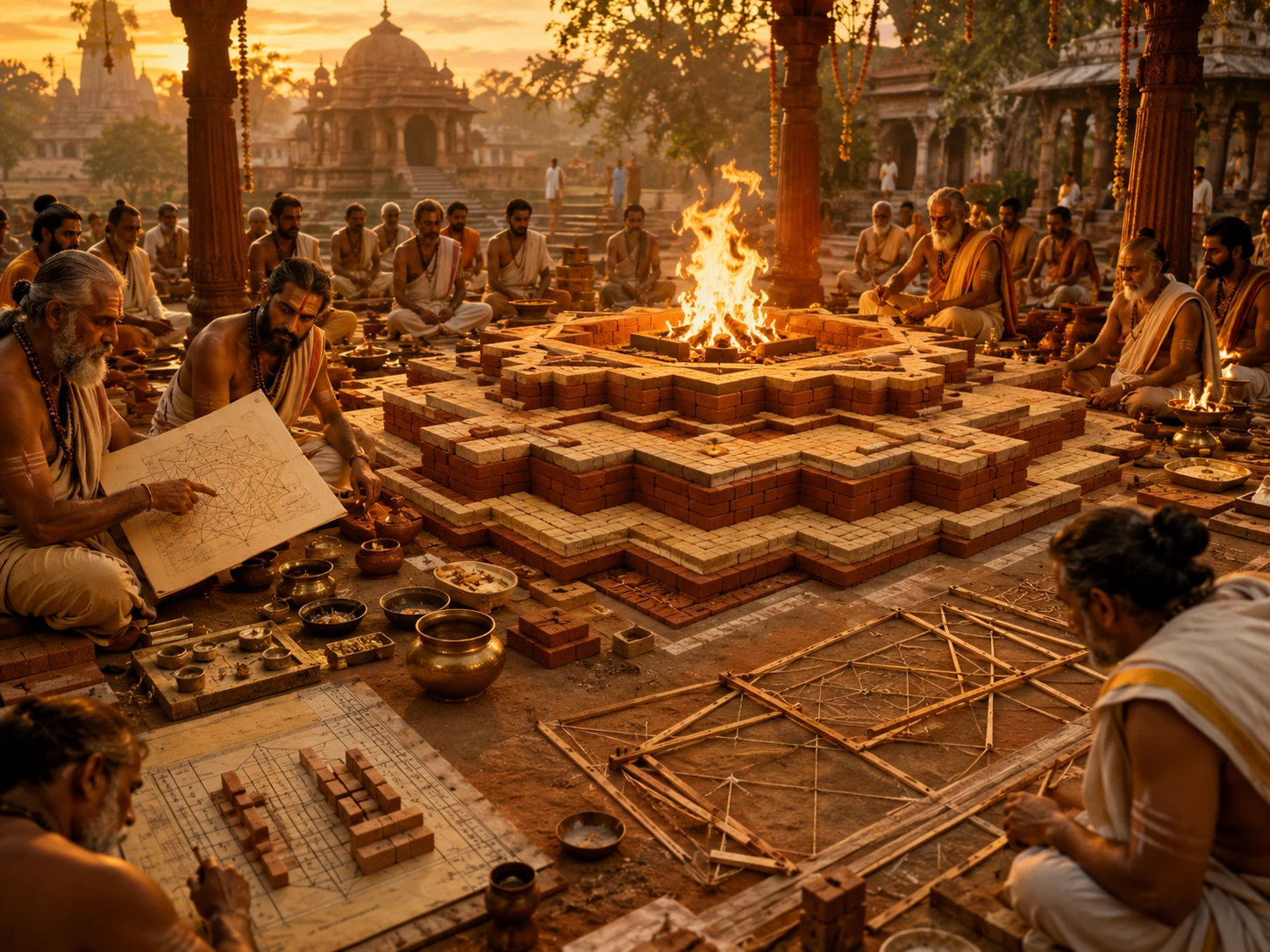
Agnichayana -- The Falcon-Shaped Fire Altar That Survived 3,000 Years
12 min read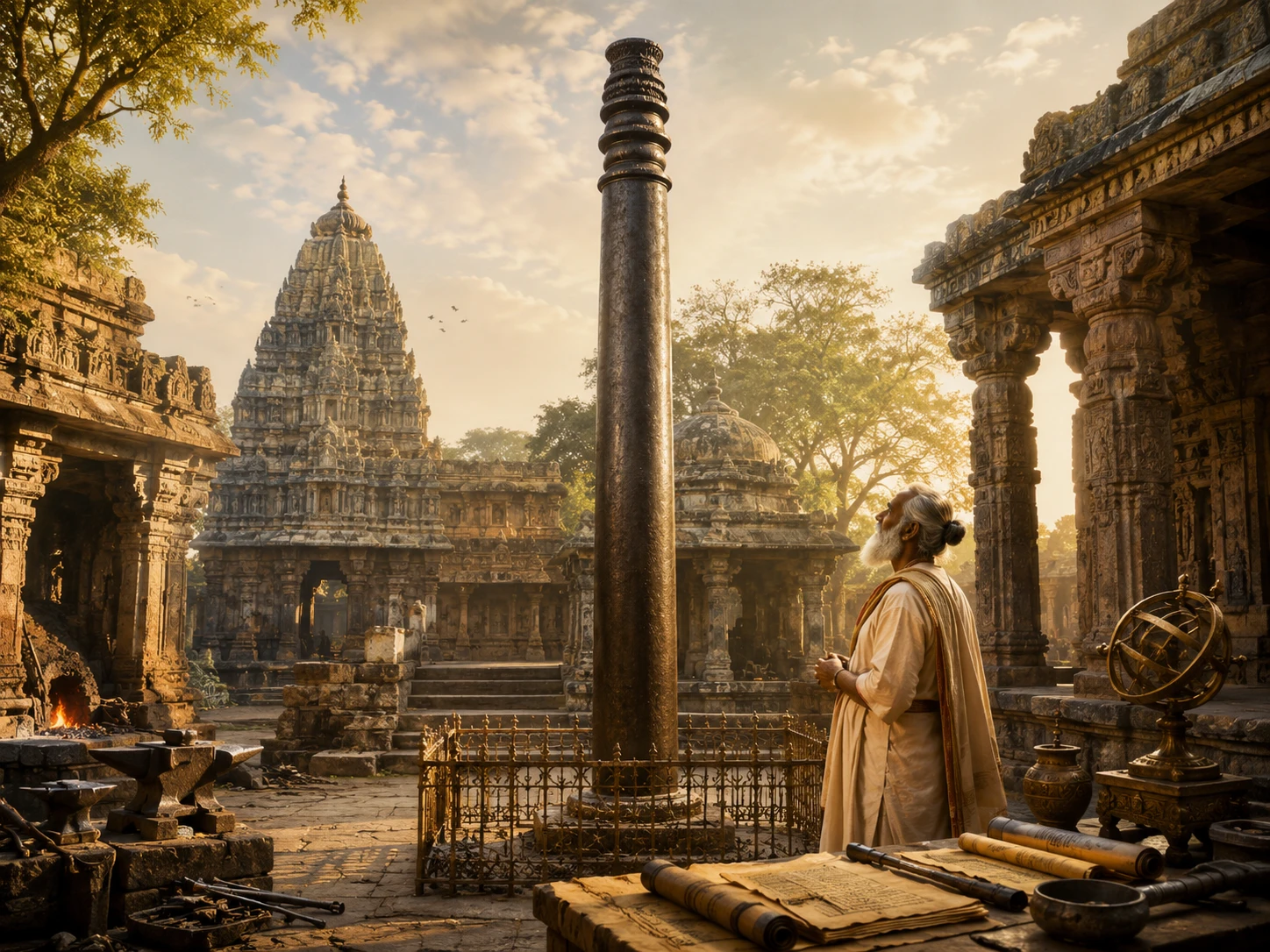
Ancient Indian Metallurgy -- The Iron Pillar That Refuses to Rust
13 min readAryabhata -- The Astronomer Who Said the Earth Turns
3 min readThe same translation error that turned '33 Koti' into '33 crore' in Hinduism also happened in Buddhism. The Chinese translation of Buddhist texts rendered 'Sapta Koti Buddha' (7 Supreme Buddhas) as '7 Crore Buddhas.' The…
Deities AvatarsCommunity Reflections
🕉️
Be the first to share your reflection.