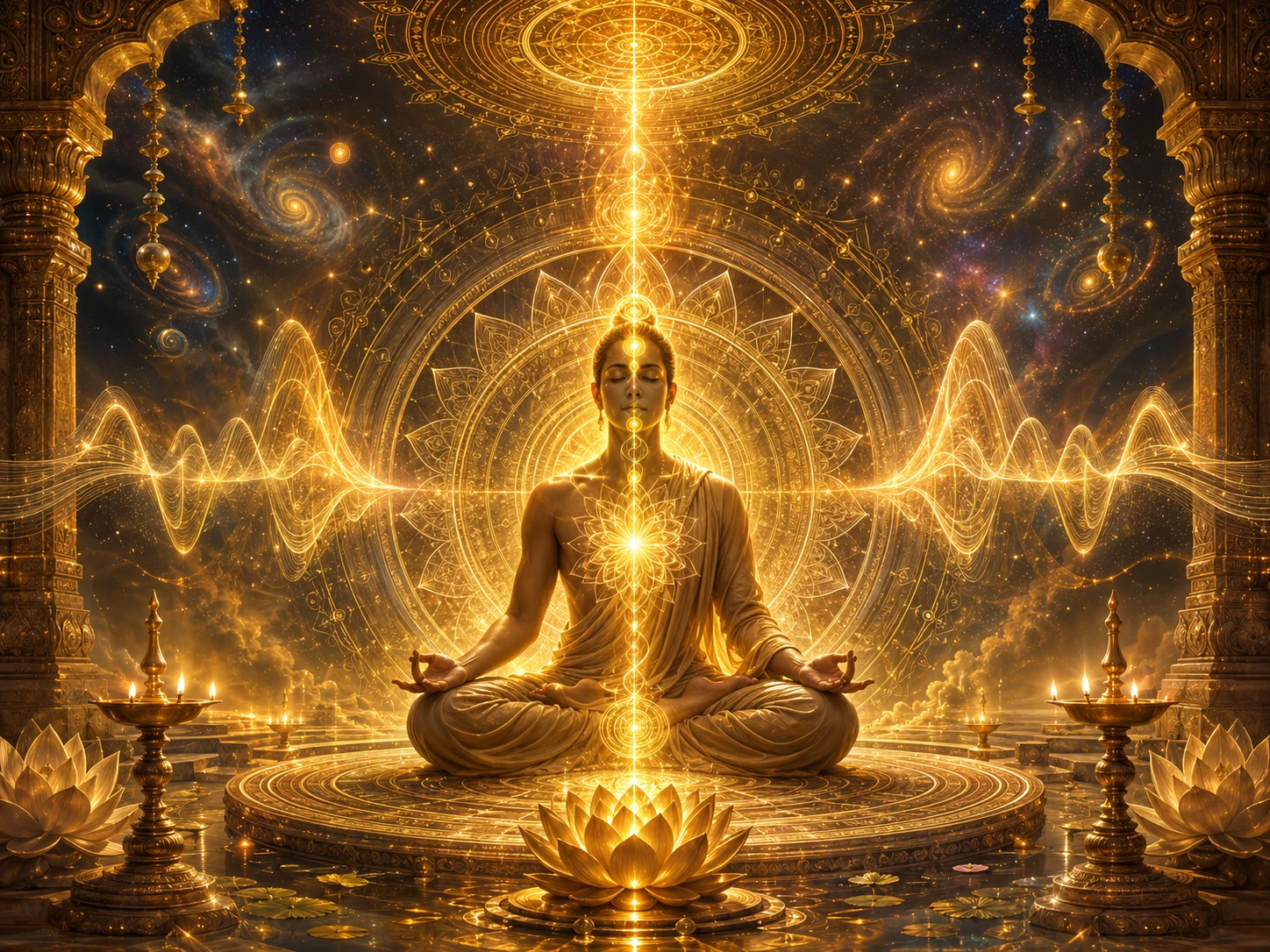
Om -- The Sound That Contains the Universe
ॐ -- वह ध्वनि जिसमें सम्पूर्ण ब्रह्माण्ड समाया है
Introduction -- The Syllable That Swallowed Philosophy
You have heard Om a thousand times. At the start of a yoga class in Koramangala, at the aarti in Kashi Vishwanath, in the opening credits of a Doordarshan serial, as a tattoo on a backpacker's forearm in Rishikesh, as your mother's ringtone. Om is everywhere. And precisely because it is everywhere, almost nobody stops to ask: what does it actually mean?
The honest answer is that Om carries at least five distinct layers of meaning across Hindu scripture, and these layers do not always agree with each other. The Mandukya Upanishad (Atharvaveda, 12 verses) maps A-U-M to three states of consciousness -- waking, dreaming, and deep sleep -- with a silent fourth state (Turiya) beyond all three. The Shiva Purana (Vidyeshwara Samhita, Chapter 10) maps A-U-M to the four faces of Shiva, making Omkara a Shaiva mantra. Popular devotional culture maps A=Brahma (creator), U=Vishnu (sustainer), M=Shiva (destroyer), making it a Trimurthi symbol. Patanjali's Yoga Sutras (1.27-28) identifies Om as the direct sound-symbol of Ishvara (God). And the Nada Yoga tradition treats Om as a vibrational frequency accessible through deep meditation -- not a symbol at all, but an actual sonic phenomenon.
All five are legitimate. None cancels the others. This article lays out each tradition's claim with exact textual citations, compares them honestly, and lets you decide which resonance speaks to your practice.
A JEE aspirant in Kota might see Om as a concentration tool. A Carnatic vocalist might hear it as the Shadja from which all swaras emerge. A philosopher at JNU might read it as the earliest phenomenological analysis of consciousness. A grandmother in Varanasi might simply close her eyes and feel it. They are all correct. That is the point.
ओमित्येतदक्षरमिदं सर्वं तस्योपव्याख्यानं भूतं भवद् भविष्यदिति सर्वमोंकार एव। यच्चान्यत् त्रिकालातीतं तदप्योंकार एव॥
om ity etad aksharam idam sarvam tasyopavyaakhyaanam bhuutam bhavad bhavishyad iti sarvam omkaara eva yach chaanyat trikaalaatiitam tad apy omkaara eva
Om -- this syllable is all this. All that was, all that is, all that will be -- all is Om. And whatever else exists beyond the three divisions of time -- that too is Om alone.
— Mandukya Upanishad, Verse 1 (Atharvaveda)
The Mandukya Upanishad -- Twelve Verses That Map Consciousness
The Mandukya Upanishad is the shortest of all the principal Upanishads -- just twelve verses, assigned to the Atharvaveda, associated with the sage Manduka. It is also, by near-universal scholarly consensus, the most concentrated philosophical text in Indian history. Adi Shankaracharya considered it sufficient by itself for moksha. The Muktika Upanishad records Rama telling Hanuman that if one can study only one Upanishad, it should be the Mandukya.
The structure is precise:
Verses 1-2: Declaration. Om is everything -- past, present, future, and beyond time. And 'all this' is Brahman. Brahman is Atman. Atman has four quarters (Padas).
Verse 3 -- Vaishvanara (Waking State, mapped to 'A'): The first quarter of the Self is outwardly cognitive, has seven limbs and nineteen mouths, and experiences the gross world. This is the universal waking consciousness that every human shares. When you are reading this article, your consciousness is in Vaishvanara.
Verse 4 -- Taijasa (Dream State, mapped to 'U'): The second quarter is inwardly cognitive, also with seven limbs and nineteen mouths, but experiencing the subtle inner world. The dreaming mind creates entire worlds -- cities, people, emotions -- from nothing. It is the same creative power that Brahma exercises on a cosmic scale.
Verse 5 -- Prajna (Deep Sleep, mapped to 'M'): The third quarter is 'a mass of consciousness' (prajnana-ghana) -- undifferentiated awareness without objects. In deep sleep, you are not unconscious. You are in a state of unified awareness without content. The proof: when you wake, you say 'I slept well, I knew nothing.' The 'I' that knew it knew nothing did not disappear. This is the seed state from which waking and dreaming emerge.
Verses 6-7 -- Turiya (The Fourth, mapped to silence after AUM): This is the Mandukya's revolutionary contribution. Turiya is described entirely through negation: not inwardly cognitive, not outwardly cognitive, not both, not a mass of cognition, not cognitive, not non-cognitive. Invisible, beyond practical dealings, beyond grasp, without characteristics, unthinkable, indescribable. It is the cessation of phenomena, tranquil, auspicious (shiva), non-dual (advaita). It is the Self. It is to be known.
Verses 8-12: The AUM mapping. Verse 8 establishes that the Self viewed through the syllable Om has the same four quarters as the Self viewed through consciousness. A = waking, U = dreaming, M = deep sleep, silence = Turiya. Verse 12 -- the final verse -- states that the 'measureless' (amatra) fourth is 'beyond practical dealings, the cessation of phenomena, auspicious, non-dual.' One who knows this merges the self in the Self.
For a UPSC aspirant, this framework appears in the Philosophy Optional paper. For a psychology student, this is a phenomenological map of consciousness that predates Freud's conscious/unconscious/preconscious by 2,500 years -- and adds a fourth state that Western psychology still has no formal category for. For a meditation practitioner at the Art of Living centre in Bangalore, the Mandukya provides the theoretical foundation for why chanting Om works: each phonetic segment systematically traverses a layer of consciousness.
The Shiva Purana -- Om as Shiva's Body
The Shiva Purana's Vidyeshwara Samhita (Chapter 10, titled 'The Five-fold Activities and the Omkara Mantra') gives a radically different -- and equally profound -- account of Om. In this narrative, Brahma and Vishnu have just been humbled by the Lingodbhava episode (the infinite pillar of fire that neither could find the end of, Chapters 6-9). Now, with their arrogance dissolved, Shiva teaches them the meaning of Om.
Shiva says: 'Omkara came out of my mouth. Originally it indicated me. It is the indicator and I am the indicated. This mantra is identical to mine. The repetition of this mantra is verily my repeated remembrance.'
Then comes the mapping specific to the Shaiva tradition: 'The syllable A came first from the northern face (Vamadeva); the syllable U from the western face (Sadyojata); the syllable M from the southern face (Aghora); and the Bindu (the dot, the nasal resonance) from the eastern face (Tatpurusha). The Nada (mystical resonance) comes from the middle face (Ishana).'
This is a critical distinction from the popular Trimurthi interpretation. In the Shiva Purana, all three phonetic elements of Om originate from different faces of the same deity -- Shiva. The A is not Brahma. The U is not Vishnu. All three are Shiva's own emanations from his five faces. The five faces correspond to the Pancha Brahma Mantras -- Sadyojata, Vamadeva, Aghora, Tatpurusha, and Ishana -- which form Shiva's 'knowledge body' (Vidya-deha), a body made entirely of mantra rather than matter.
The Pancha Brahma Mantras themselves originate from the Taittiriya Aranyaka (10.17-21) of the Krishna Yajurveda -- predating the Shiva Purana by centuries. They represent the five cosmic functions: Sadyojata = creation (Srishti), Vamadeva = preservation (Sthiti), Aghora = dissolution (Samhara), Tatpurusha = concealment (Tirobhava), Ishana = grace/liberation (Anugraha). This five-function framework is more nuanced than the popular three-function Trimurthi model.
Shiva then tells Brahma and Vishnu: 'In the context of worship, Homa and Tarpana, chant this Om on Chaturdashi day and on the day with Ardra Nakshatra. The recital at the time of Sun's transit in Ardra is million-fold efficacious.'
The Shiva Purana is explicit that this is a sectarian theology -- it places Shiva as the source of Om, just as the Vishnu Purana would place Vishnu. An intellectually honest article must acknowledge this: the Shaiva and Vaishnava traditions each claim Om as their deity's sound-form, and neither claim is 'more correct' than the other. They are parallel theological interpretations of a Vedic concept that predates both sects.
तस्य वाचकः प्रणवः॥ तज्जपस्तदर्थभावनम्॥
tasya vaacakah pranavah taj japas tad artha bhaavanam
His (Ishvara's) designator is Pranava (Om). Its repetition and contemplation of its meaning (is the way to realize Ishvara).
— Patanjali Yoga Sutras, Samadhi Pada, Sutras 1.27-28
Patanjali's Yoga Sutras and the Nada Yoga Tradition
Patanjali's approach to Om is strikingly different from both the Mandukya and the Shiva Purana. In Yoga Sutra 1.27, he states simply: 'Tasya vaachakah pranavah' -- Pranava (Om) is the sound-symbol (Vachaka) of Ishvara. In 1.28: 'Taj japas tad artha bhaavanam' -- Repeat it and contemplate its meaning. This is not philosophical analysis. This is practice instruction. Patanjali does not map Om to states of consciousness or to divine faces. He says: chant it, understand what it points to, and the obstacles to samadhi will dissolve.
The Nada Yoga tradition takes this further. 'Nada' means sound, and Nada Yoga is the practice of using sound -- specifically internal, unstruck sound (Anahata Nada) -- as a vehicle for samadhi. The Hatha Yoga Pradipika (Chapter 4, Verses 65-102) describes a progressive sequence of internal sounds the practitioner hears during deep meditation: first the sound of the ocean, then of thunder, then of kettledrums, then of a conch, then of bells, then of a flute, then of a vina, and finally the sound of a bee's hum. These are not imagined sounds. They are auditory phenomena reported consistently across contemplative traditions, including Tibetan Buddhism (Nada meditation) and Sufi mysticism (Sema).
Om, in this framework, is the gross approximation of a subtler sound that exists prior to and beyond human production. The voice chants Om. The Om leads the attention inward. The inward attention discovers Anahata Nada. And beyond even Anahata Nada lies silence -- which is Turiya.
Scientific research at NIMHANS Bangalore and IIT Kanpur has studied the neurophysiological effects of Om chanting, finding measurable changes in vagal tone, limbic activity, and default mode network deactivation -- the same neural signature associated with advanced meditation states. A 2018 study published in the International Journal of Yoga found that Om chanting significantly reduced amygdala reactivity compared to the chanting of a matched phonetically similar syllable ('Sss'). The ancients did not have fMRI machines, but they had 3,000 years of first-person observation.
Five Traditions, Five Meanings of Om -- A Comparative Map
| Tradition | Source Text | A | U | M | Fourth Element | Core Claim |
|---|---|---|---|---|---|---|
| Mandukya Upanishad | Atharvaveda, 12 verses | Waking (Vaishvanara) | Dreaming (Taijasa) | Deep Sleep (Prajna) | Silence = Turiya | Om is the Self mapping consciousness |
| Shiva Purana (Shaiva) | Vidyeshwara Samhita Ch. 10 | Northern face (Vamadeva) | Western face (Sadyojata) | Southern face (Aghora) | Bindu + Nada = Tatpurusha + Ishana | Om is Shiva's body of mantra |
| Popular Trimurthi | Devotional tradition (no single source) | Brahma (Creator) | Vishnu (Preserver) | Shiva (Destroyer) | Not typically included | Om unites the three cosmic functions |
| Patanjali Yoga Sutras | Samadhi Pada 1.27-28 | Not mapped separately | Not mapped separately | Not mapped separately | Not applicable | Om is Ishvara's sound-symbol; chant and contemplate |
| Nada Yoga | Hatha Yoga Pradipika Ch. 4 | Gross external sound | Subtle internal sound | Causal vibration | Silence = Anahata Nada | Om is the doorway to unstruck cosmic sound |
No single interpretation is 'correct' to the exclusion of others. Each represents a legitimate lineage of understanding. The Mandukya is the oldest and most philosophically rigorous. The Shiva Purana is the most theologically detailed for Shaiva practitioners. Patanjali is the most practice-oriented. Nada Yoga is the most experiential.
The Mandukya Upanishad -- all twelve verses of it -- was considered by Adi Shankaracharya to be sufficient by itself for attaining liberation. The Muktika Upanishad records a conversation between Rama and Hanuman in which Rama states that if one can study only one Upanishad, it should be the Mandukya. This makes it arguably the highest-rated text in all of Hindu philosophy -- a 100% moksha guarantee in twelve sentences. For context, the Mahabharata has 100,000 verses. The Mandukya achieves in 12 what the Mahabharata explores in 100,000.
A 2018 study at NIMHANS Bangalore published in the International Journal of Yoga found that chanting Om produced measurable vagal tone changes and reduced amygdala reactivity compared to a phonetically matched control syllable. The researchers concluded that Om has neurophysiological effects beyond mere vocalization -- the specific phonetic structure of A-U-M engages the parasympathetic nervous system in a way that generic humming does not. The Hatha Yoga Pradipika (Chapter 4) described the same calming effect 600 years ago as 'Nada Anusandhana' -- the investigation of inner sound.
The Popular Trimurthi Mapping -- Where Does It Come From?
The interpretation most people know -- A=Brahma, U=Vishnu, M=Shiva -- is genuinely ancient but does not originate from a single authoritative source. It appears in various Puranic commentaries and devotional literature as a synthetic harmonisation of the Trimurthi doctrine. The Skanda Purana and certain recensions of the Brahma Purana reference this mapping. It became dominant in popular Hinduism because it is elegant, easy to remember, and theologically inclusive: it gives each member of the Trinity equal status within a single syllable.
However, the mapping has limitations that honest scholarship must acknowledge. First, it reduces Om to a symbol of three functions (creation, preservation, destruction) while the Mandukya explicitly states that Om encompasses four states -- the fourth being the most important. Second, it flattens the internal phonetic structure: in Sanskrit phonology, A-U naturally coalesce into 'O' when pronounced, meaning Om is not actually three separate sounds but a continuous acoustic event. The Mandukya's mapping to consciousness states preserves this continuity. The Trimurthi mapping imposes a division that the sound itself resists.
None of this makes the Trimurthi interpretation wrong. Devotional simplicity has its own power. When a child at Siddhivinayak Temple in Mumbai closes their eyes and chants Om thinking of Brahma-Vishnu-Shiva, that child is engaged in genuine bhakti. But for the seeker who wants depth, the Mandukya and the Shiva Purana offer architectures of meaning that the popular version cannot reach.
अमात्रश्चतुर्थोऽव्यवहार्यः प्रपञ्चोपशमः शिवोऽद्वैत एवमोंकार आत्मैव संविशत्यात्मनाऽऽत्मानं य एवं वेद॥
amaatras chaturtho avyavahaaryah prapanchopashamah shivo advaita evam omkaara aatmaiva samvishaty aatmanaa aatmaanam ya evam veda
The measureless fourth is beyond practical dealings, the cessation of phenomena, auspicious (Shiva), and non-dual. Thus Om is verily the Self. One who knows this merges the self into the Self by the Self.
— Mandukya Upanishad, Verse 12 (Atharvaveda)
Conclusion -- Why This Matters Now
The YouTube video that inspired this article presented the Shiva Purana's account of Omkara -- the Lingodbhava, the Pancha Brahma Mantras, and the mapping of A-U-M to Shiva's five faces. Everything in that video is textually accurate to the Shiva Purana. But it presented only one thread of a much larger tapestry.
The full story of Om spans the Rig Veda (where it first appears), the Mandukya Upanishad (where it becomes a systematic map of consciousness), the Shiva Purana (where it becomes Shiva's body), Patanjali (where it becomes a practice instruction), and the Nada Yoga tradition (where it becomes an experiential doorway to inner sound). Each layer adds depth without negating the others.
The tragedy of modern spiritual discourse -- whether on Instagram, YouTube, or WhatsApp university -- is the reduction of multi-dimensional concepts to single-line captions. Om is not a tattoo. It is not a sound effect. It is not a sectarian marker. It is the oldest, most compressed, most widely practised philosophical technology in human civilisation. And it fits in a single breath.
Take that breath. Mean it.
Practice Omkara Meditation
Begin with three rounds of Om chanting, feeling the 'A' in your belly, the 'U' in your chest, and the 'M' in your skull. Then sit in the silence that follows. That silence is where the Mandukya says the real teaching lives. The Three Parts of Om dharana on Eternal Raga sets out the practice.
Tags
Eternal Raga · शाश्वत राग
Institutional voice — scholarly articles on Sanatan Dharma
Deepen Your Understanding
अपनी समझ और गहरी करें
tantra mantra yantra
Tantra, Mantra and Yantra -- The Three Pillars of Spiritual Practice
Tantra is the loom, Mantra is the thread, Yantra is the pattern. Together they form the complete technology of spiritual transformation that India gifted to the world -- and they are far more profound than popular culture imagines.
vedic sciences
Kaal Ganana -- The Hindu Measure of Time
From a single blink of the eye (Nimesha) to one Day of Brahma (4.32 billion years) -- explore the complete cosmic time hierarchy of Hindu cosmology, anchored in Vishnu Purana 1.3, with its remarkable parallels to modern science.
vedic sciences
Hiranyagarbha -- The Golden Egg That Became the Universe
Before the Big Bang had a name, the Rig Veda described creation erupting from a golden cosmic egg -- Hiranyagarbha. The Shiva Purana says Shiva split it. The Vishnu Purana says Vishnu incubated it. The Manusmriti says it floated in darkness for a year. And the Nasadiya Sukta says: honestly, who really knows? Five texts, five creation stories, one civilisation honest enough to hold them all simultaneously.
scriptural exegesis
Chandogya Upanishad -- Tat Tvam Asi
A 24-year-old returns from 12 years of Vedic study, bloated with pride and stuffed with textbook knowledge, only to have his father demolish his certainty with nine repetitions of three words: Tat Tvam Asi -- You Are That. The Chandogya Upanishad is the text that broke the wall between God and you.
sacred symbols
Sacred Directions and Dikpalas -- The Eight Guardians of Space
Why does your grandmother insist the kitchen face southeast and the master bedroom southwest? Behind every Vastu rule stands a Dikpala -- a deity assigned to guard one of eight directions of cosmic space. Meet the eight watchmen who turn empty space into sacred geography.
The Mandukya Upanishad -- all twelve verses of it -- was considered by Adi Shankaracharya to be sufficient by itself for attaining liberation. The Muktika Upanishad records a conversation between Rama and Hanuman in whic…
More in Philosophy & Darshana
The 14 Lokas -- Hindu Cosmology as a Map of Consciousness
14 min read
Achintya Bhedabheda -- Chaitanya's Theology of Inconceivable Difference-and-Unity
13 min read
Adhyasa -- Superimposition and the Foundational Error of the Self
13 min readThe same translation error that turned '33 Koti' into '33 crore' in Hinduism also happened in Buddhism. The Chinese translation of Buddhist texts rendered 'Sapta Koti Buddha' (7 Supreme Buddhas) as '7 Crore Buddhas.' The…
Deities AvatarsCommunity Reflections
🕉️
Be the first to share your reflection.