Adhyasa -- Superimposition and the Foundational Error of the Self
अध्यास -- आत्मा का मूल भ्रम और अध्यारोप का सिद्धान्त
Sometime around the year eight hundred of the common era, a young monk in his twenties walked into a debate hall in the Vindhya region of central India and changed the direction of Hindu philosophy. The monk was Adi Shankaracharya. The opening text he wrote, attached to his commentary on the Brahma Sutras, was technically not a commentary at all. It was a long preface. The Brahma Sutras themselves had not even started yet. But Shankara felt that before he could comment on a single line of the sutras, he had to deal with one prior question. How is it that anyone needs Vedanta in the first place? What exactly has gone wrong, in the deepest sense, that requires this whole apparatus of inquiry, scripture, contemplation, and final liberation? His answer to that question is the Adhyasa Bhashya, the preface that introduces the doctrine of adhyasa, superimposition. It is the philosophical seed from which the entire vast structure of Advaita Vedanta grew.
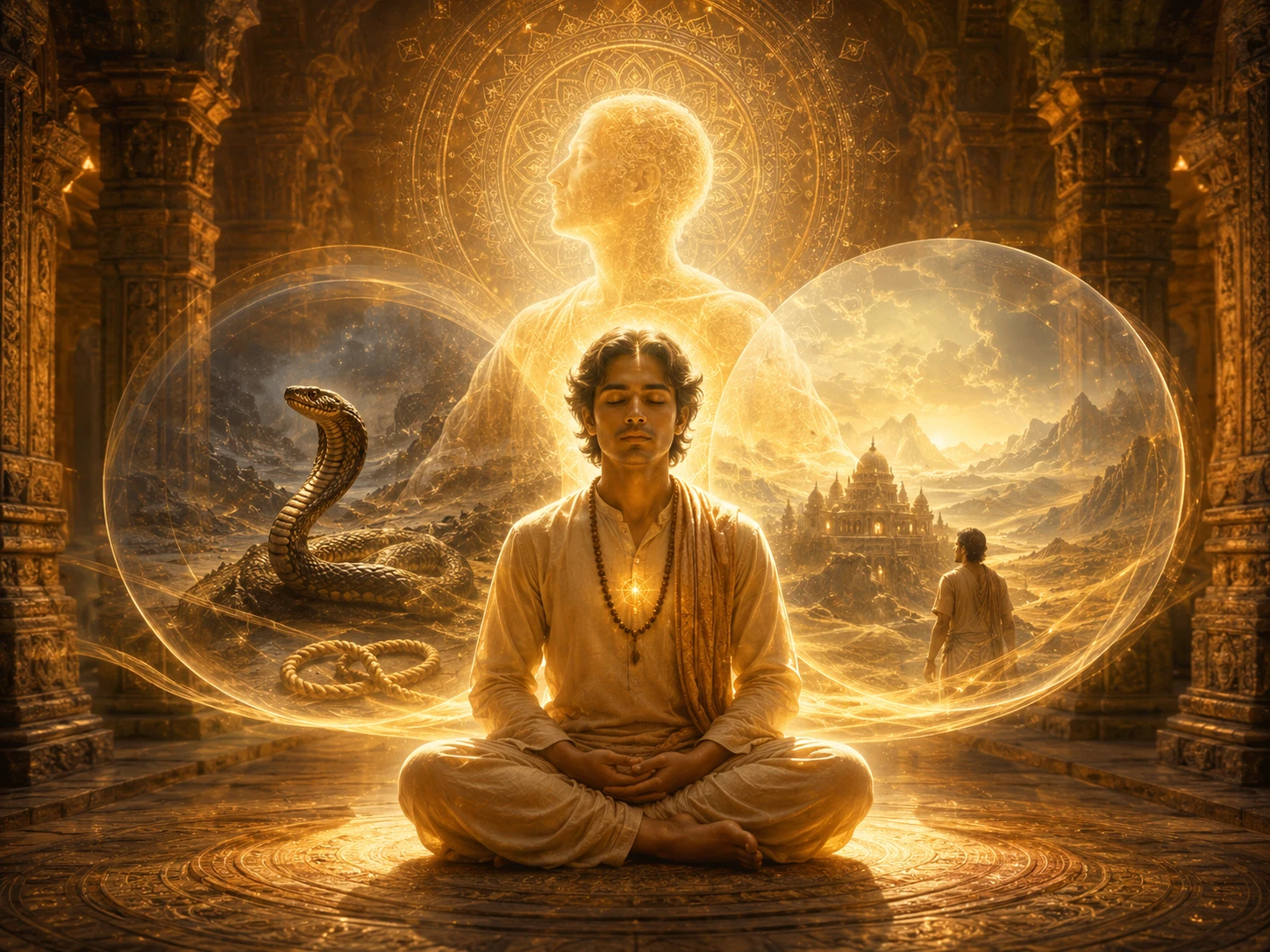
Adhyasa, in Shankara's hands, is a deceptively simple idea. It is the act by which the mind takes the property of one thing and assigns it to another. The classic illustration, used by Shankara and by his grand-teacher Gaudapada before him, is rajju-sarpa-nyaya, the rope-and-snake illustration. You walk through a half-lit room at dusk. A coiled rope lies in the corner. For an instant, the mind sees a snake. The body recoils. The heart pounds. Then someone turns on the light, the snake disappears, and only the rope remains. The crucial question is what happened in that moment of fear. There was no snake there. There was only ever a rope. But the fear was real, the recoil was real, the racing heart was real. Where did all that come from? It came, says Shankara, from adhyasa -- from the mind superimposing snake-properties onto a substrate that was, in fact, only a rope.
स्मृतिरूपः परत्र पूर्वदृष्टावभासः इति शास्त्रसमाख्या।
smṛti-rūpaḥ paratra pūrva-dṛṣṭa-avabhāsaḥ iti śāstra-samākhyā
The traditional definition is this: adhyasa is the appearance, in the form of memory, in some other place, of something previously seen elsewhere.
— Adhyasa Bhashya, Brahma Sutra Bhashya (Shankaracharya)
This single sentence from the Adhyasa Bhashya is the technical definition that the entire Advaita Vedanta tradition has unpacked for over a thousand years. Each word in it carries weight. Smriti-rupah means in the form of memory -- the snake is not freshly invented; it is recalled from somewhere. The mind has seen snakes before, somewhere, and pulls that memory forward. Paratra means in some other place -- not where the memory originally belonged, but somewhere else. Purva-drishta means previously seen, marking the source as past experience. Avabhasah means appearance, but appearance with content; not a vague wash but a specific, identifiable presentation. Putting it together, adhyasa is what happens when a previous experience returns, in memory-form, and is mistakenly placed onto a present substrate that does not actually carry it. The snake is real in the original encounter behind some bush. It is not real on this rope, in this room, this evening. The mistake is the placement.
Now comes the critical move that makes Advaita Vedanta possible. Shankara argues that the same kind of error happens at a much deeper level than dim rooms. It happens between the Self and the not-Self. Each of us has, somewhere in our experience, the absolutely certain feeling that we exist. I am. That basic awareness is not body-shaped. It is not aged. It is not Indian or American, not male or female, not happy or sad. It just is. Shankara identifies this pure I-am with Atman -- with the eternal Self, which Vedanta declares to be identical with Brahman. And then there is the apparent self -- the embodied, named, gendered, ageing, anxious individual that we ordinarily call ourselves. That apparent self is anatman, the not-Self. And here, says Shankara, the great cosmic adhyasa happens. The properties of anatman -- height, age, profession, anxiety, mortality -- are superimposed onto Atman. And the properties of Atman -- pure consciousness, undivided existence, freedom -- are superimposed onto anatman. Each takes on what belongs to the other. The whole of human suffering follows from this single confusion.
What Belongs to Atman vs Anatman
| Property | Belongs to (truly) | Mistakenly assigned to (via adhyasa) |
|---|---|---|
| Height, weight, age | Anatman (body) | Atman -- 'I am tall, old, tired' |
| Pure I-am awareness | Atman | Anatman -- 'this body is the I' |
| Hunger, thirst, illness | Anatman (body and prana) | Atman -- 'I am hungry' |
| Eternity, undividedness | Atman | Anatman -- 'my unique personality is forever' |
| Likes, dislikes, fears | Anatman (manas) | Atman -- 'I like, I fear' |
| Existence as such (sat) | Atman | Anatman -- 'this object really exists in itself' |
The leftmost column lists properties that, on Advaita's analysis, are unmistakable about themselves. The error is not in their existence; it is in the cross-wiring. The body really does have height. The Self really does have pure I-am awareness. The mistake is when each takes on what belongs to the other.
Cognitive psychologists have measured exactly the kind of misperception Shankara describes -- though they call it something else. The classic Müller-Lyer illusion, where two lines of equal length appear unequal because of the arrows at their ends, is a textbook adhyasa: the property 'longer' is superimposed onto a substrate that does not, in fact, carry it. Even after you measure the lines and confirm they are equal, the illusion persists. Shankara would say that ordinary human self-perception works the same way. Knowing intellectually that the self is not the body does not, by itself, dissolve the lived feeling that it is. That dissolution requires sustained inquiry, not just information.
Shankara distinguishes adhyasa carefully from related kinds of error. There is plain misperception, where you see something wrong and a moment later you see it right. There is hallucination, where there is no substrate at all underneath. There is dream, where a whole alternative world is constructed and dissolved. Adhyasa is none of these exactly. It has its own structure. There is always a real substrate -- the rope is really there. There is always a real, previously experienced quality -- the snake is a real species you have seen elsewhere. The error is the joining of the two in the wrong place. And critically, while the error lasts, it produces real effects. Real fear. Real action. The rope-fear, while you have it, makes you behave exactly as if a snake were there.
This is why Advaita Vedanta is so insistent that the empirical world (vyavahara) is real for as long as adhyasa lasts -- and only fully dissolves when adhyasa dissolves. The world is not a magic trick. It is the steady, lawful, well-organised consequence of a fundamental superimposition. Until you see clearly, you live in a world. After you see, you have always been the only thing that ever was. Note the difference from popular misreadings of Advaita. Shankara is not saying the world is a hallucination, that you should abandon your job and family because they are illusion. He is saying something more precise. The world has the kind of reality that a rope-snake has -- causally efficacious, lawful, frightening, real until it is seen through. The seeing through is moksha.
अनिश्चिता यथा रज्जुरन्धकारे विकल्पिता। सर्पधारादिभिर्भावैस्तद्वदात्मा विकल्पितः॥
aniścitā yathā rajjur andhakāre vikalpitā sarpa-dhārādibhir bhāvais tadvad ātmā vikalpitaḥ
Just as a rope, whose nature is not clearly known, is imagined in the dark to be a snake or a streak of water -- in the same way the Atman is variously imagined.
— Mandukya Karika 2.17 (Gaudapada)
The rope-snake illustration did not begin with Shankara. He inherited it from his parama-guru, Gaudapada, whose Mandukya Karika in the seventh century is one of the earliest systematic Advaita texts in existence. Gaudapada's verse 2.17 is one of the most quoted lines in all Vedantic literature. It establishes the rope-snake (rajju-sarpa) and the rope-water-streak as the standard analogies for adhyasa, and sets up the entire vocabulary that Shankara would later inherit and refine. The Yoga Vasishta, that vast and strange text from medieval Kashmir, also uses the same illustration, often more poetically. By the medieval period, every educated Hindu philosopher knew exactly what was meant when someone said rajju-sarpa-nyaya in the middle of a debate.
This matters because it shows that adhyasa was not some idiosyncratic move by Shankara. He was extending a long tradition. What he added was the systematic application of the principle to the entire problem of human bondage. Where Gaudapada had used the analogy primarily in cosmological argument, Shankara used it as the foundational concept of his entire epistemology. He argued, in the Adhyasa Bhashya, that without adhyasa there would be no need for any of the four Vedic concerns -- there would be no actor to act, no knower to know, no scripture to read, no goal to seek. The fact that there are these things, and that they form the structure of human life, is itself proof that adhyasa is operating. And the entire scriptural enterprise, including the Brahma Sutras whose commentary the bhashya is about to begin, exists precisely to undo this primal superimposition.
The Three Substrates of Adhyasa in Vedantic Texts
| Illustration | Substrate | Superimposed | What It Teaches |
|---|---|---|---|
| Rope-snake (rajju-sarpa) | Rope | Snake (causing fear and recoil) | How error produces real effects despite being false |
| Mother-of-pearl-silver (shukti-rajata) | Mother-of-pearl shell | Silver (causing greedy approach) | How desire arises from misperception of value |
| Mirage (maru-marichika) | Hot sand and refracted light | Water (causing thirsty pursuit) | How a wholly empty appearance can drive sustained action |
| Two-moons (chandra-dvaya) | One real moon | A second moon (in pressed-eye vision) | How even basic perception can be doubled by inner distortion |
| Body-as-self (deha-atma-buddhi) | Atman, pure consciousness | Body, mind, ego | The cosmic adhyasa -- and the entire reason for the inquiry |
The first four illustrations are training wheels. They show that adhyasa is a real, well-understood phenomenon at the everyday level. The fifth is the actual target. Once you accept that adhyasa happens at the rope-snake level, Shankara argues, you have no principled reason to deny that it can also happen at the deepest level of self-perception.
Ramana Maharshi, the twentieth-century sage of Tiruvannamalai, gave the most direct practical method for dissolving adhyasa. He called it Atma-vichara -- self-inquiry -- and the entire technique was a single question turned inward: who am I? Each time the mind threw up an answer (I am this body, I am this thought, I am this feeling), the practice was to ask again, and to whom does this body, thought, or feeling appear? The questioning eventually exhausted the candidates. What remained could not be reduced further, and was, in Ramana's reading, exactly what Shankara meant by Atman. Ramana's method, technical name notwithstanding, is a direct application of adhyasa-removal at the experiential level. Today the Ramanasramam in Tiruvannamalai still receives thousands of seekers a year, including a steady stream of MBA grads from IIM Bangalore who go for weekend retreats and come back with shelves full of Shankara translations.
It is worth being careful about what adhyasa is not, because the contemporary internet has filled with versions that miss the point. Adhyasa is not the modern psychological idea of imposter syndrome, though there is a thin parallel. Imposter syndrome is the feeling that you do not deserve your professional position; adhyasa is the feeling that you are this body. The first is a self-doubt within the false self. The second is the false self itself. Adhyasa is not the social media phenomenon of the curated versus the real self, though again the analogy is suggestive. The curated Instagram self is, in Vedantic terms, an adhyasa within an adhyasa -- a layer of false identification on top of an already false identification. Removing the curated layer does not get you to the real Self. It only gets you to the unfiltered ego, which is still an unfiltered version of anatman.
What adhyasa actually points to is harder than self-honesty and stranger than psychological clarity. It points to a structural error in the very ground of subjective experience -- the moment-by-moment, never-doubted assumption that the I that wakes up in the morning is the same kind of thing as the body that wakes up. Advaita is willing to consider this assumption refutable. That is the school's distinctive move. Most philosophical and religious systems, including most Hindu schools, leave the assumption in place. They argue about how to make the embodied self happier, more ethical, closer to God. Advaita asks whether the embodied self is what we are at all. The answer, after the inquiry, is no. The Self is what is left when adhyasa stops.
Within the Adhyasa Bhashya itself, Shankara distinguishes four kinds of adhyasa, and the distinctions are not academic. The first is dharmadhyasa, the superimposition of properties -- as when redness is mistakenly attributed to a colourless crystal that happens to be near a red flower. The second is dharmi-adhyasa, the superimposition of an entire substance -- as when the rope itself is mistaken for a snake, not just any property of the rope. The third is anyonya-adhyasa, mutual superimposition, where two things take on each other's properties simultaneously. This is the cosmic case Shankara is most interested in, the case of self and not-self. The body takes on the I-am of the Atman, and the Atman takes on the body's height, age, and mortality. Each is a screen onto which the other is projected, and the result is the lived sense of being a particular human being in a particular life. The fourth is samsarga-adhyasa, contact-based superimposition, where two things become so closely associated that the mind treats them as one even when they remain distinct -- the way many Hindus, including educated ones, do not clearly distinguish their iPhone from their personal identity until they accidentally drop it.
This classification matters because the route out depends on which kind of adhyasa is operating. For dharmadhyasa, removal of the cause -- moving the red flower away from the crystal -- ends the error. For anyonya-adhyasa, the cosmic kind, no external move can dissolve the superimposition because the substrate that needs clearing is consciousness itself. The only effective method is sustained inquiry into the nature of the I-am itself, the kind of investigation Shankara prescribes through study of the Vedanta texts under a qualified teacher.
The medieval Advaita tradition split into two main sub-schools over the question of where, exactly, avidya is located. The Bhamati school, founded by Vachaspati Mishra in the ninth century, holds that avidya resides in the individual jiva. Each soul has its own avidya, its own adhyasa, its own private bondage. Liberation, on this view, is essentially individual. The Vivarana school, founded by Prakashatman in the thirteenth century, holds the opposite. Avidya resides primarily in Brahman itself, and the apparent multiplicity of jivas is itself an effect of this single, cosmic avidya. Liberation, on this view, has a more universal character. The two schools agree on every essential point of Advaita doctrine -- non-duality, the four mahavakyas, the rope-snake analysis, the role of the guru. They disagree only on the location of the very confusion they exist to dissolve. To a beginner this looks like splitting hairs. To advanced practitioners, like the late Swami Dayananda Saraswati of Coimbatore or the still-active Vedanta teaching faculty at Arsha Vidya Gurukulam, it remains a live, consequential question with practical implications for how meditation is taught.
The contemporary student has access to all of this through teaching channels that did not exist twenty years ago. The classes given by Swami Sarvapriyananda, James Swartz, Swami Bodhananda, and others on YouTube routinely cross several lakh views per episode. A management consultant in Mumbai who downloads a Sarvapriyananda series during her commute and listens through the entire Adhyasa Bhashya over four months is, in the deepest sense, doing what twelfth-century Mithila pandits did, only with earphones and a pause button. The substrate is the same. The medium has caught up.
Swami Sarvapriyananda, the resident monk at the Vedanta Society of New York, has built one of the most influential YouTube channels for Advaita teaching in the world. His series on Shankara's Adhyasa Bhashya runs to dozens of hours, and views per episode regularly cross several lakh. The audience is heavily Indian-diaspora, especially software engineers and management consultants in the US, and includes a notable cohort of IIT and IIM graduates who first encountered Vedanta through Sarvapriyananda's lectures rather than in any classroom. The eighth-century Adhyasa Bhashya, after twelve centuries, has its largest student body ever -- and most of them are watching on a phone during a commute.
Adhyasa, in the end, is the philosophical insight that makes Advaita Vedanta logically necessary. Without it, there is no way to explain why the Self that is supposedly identical to Brahman appears, to itself, to be a small, mortal, struggling individual. With it, the entire scaffolding of Advaita falls into place. Avidya, ignorance, is the condition that allows adhyasa. Maya is the world that arises while adhyasa lasts. Vidya, knowledge, is the recognition that dissolves adhyasa. Moksha is what remains when the adhyasa is gone. The young monk who walked into the debate hall in the eighth century did not invent any of this. He gave it a single technical word and an unforgettable rope. After that, the conversation was different. Twelve centuries later, in software offices in Pune and on YouTube channels in New York and in pathshalas in Sringeri, the conversation is still going. The rope is still in the corner of the room. The light, in someone's life, is being turned on at this very moment.
Advaita Vedanta organises its understanding of reality into three distinct levels, and adhyasa fits between them in a precise way. The highest level is paramartha, the absolute -- pure undivided Brahman, which is what Atman truly is. Below this is vyavahara, the transactional or empirical level -- the world of waking experience, of objects and persons and karma and dharma. This is the level at which adhyasa operates. The world of vyavahara has the kind of reality the rope-snake has: lawful, predictable, causally efficacious, real until seen through. The Indian Railways exists at the vyavahara level, and your ticket is real, and the train will not wait for you if you are late. None of this is contradicted by Advaita. The third and lowest level is pratibhasika, the merely apparent -- the dream a few hours ago, the optical illusion you saw last week. These have no enduring reality even at the empirical level; they dissolve as soon as the conditions producing them dissolve. Adhyasa, technically, lies in between. The cosmic adhyasa that produces the sense of being a separate self is not pratibhasika -- it is too lawful and too persistent for that. But it is also not paramartha. It belongs to vyavahara, the level that is real until inquiry dissolves it.
This three-level scheme, formalised by Shankara's followers in the medieval centuries, allowed Advaita to make a difficult middle move. The school could affirm that the world is real enough that you should pay your taxes, attend to your relationships, treat suffering as worth attending to. At the same time, it could affirm that the world is not finally real in the way Brahman is. Both claims are true at their own levels, and confusing the levels produces philosophical mistakes. A common modern misreading of Advaita conflates pratibhasika with vyavahara and ends up either dismissing the world as a hallucination (which Advaita does not say) or denying that there is any deeper reality at all (which Advaita also does not say). The careful version is harder to hold and more honest. The world is real for as long as adhyasa lasts. Adhyasa lasts for as long as inquiry has not yet penetrated. Inquiry penetrates only with sustained discipline, in the company of a teacher, over time. None of this is fast. None of it is automatic. None of it is a matter of belief. Advaita asks for something rare in any tradition: patience with one's own confusion, sustained for as long as it takes.
Try Self-Inquiry on Eternal Raga
Practise the disassembly of adhyasa in the lineage of Shankara and Ramana Maharshi: each time you think 'I am tired' or 'I am this body', ask what it is that knows the tiredness, or the body. The 'I Am, Before Everything Else' dharana on Eternal Raga is a written practice of exactly this kind.
Tags
Eternal Raga · शाश्वत राग
Institutional voice — scholarly articles on Sanatan Dharma
Deepen Your Understanding
अपनी समझ और गहरी करें
philosophy darshana
Advaita Vedanta Explained -- Shankara's Radical Philosophy of Non-Duality
You are not your job title. You are not your Instagram bio. According to Adi Shankaracharya, you are not even your body or mind -- you are Brahman itself, the infinite consciousness wearing a temporary costume. Advaita Vedanta is the most radical philosophical claim in Indian history: that the entire universe is one undivided reality, and separation is the grandest illusion.
philosophy darshana
Purva Mimamsa -- The Hindu Science of Ritual and Right Interpretation
Sage Jaimini's Mimamsa Sutras open with one question: what exactly is dharma, and how do we know it? The answer he gives -- that dharma is what the Vedas enjoin, and the Vedas are eternal -- created the most rigorous hermeneutic system the ancient world ever produced.
philosophy darshana
The Six Darshanas -- India's Original Intellectual Operating Systems
Long before Greek philosophy had its first argument, India had six complete philosophical systems -- each with its own logic, metaphysics, epistemology, and liberation path. Nyaya built formal logic. Vaisheshika invented atomic theory. Samkhya mapped consciousness. Yoga engineered the mind. Mimamsa decoded ritual. Vedanta asked the final question. Together, they are the most comprehensive intellectual framework any civilisation has produced.
philosophy darshana
The Four Mahavakyas -- Upanishadic Sentences That Changed Civilisation
Four sentences. Twelve words of Sanskrit. Three thousand years of commentary. The Mahavakyas are the most compressed, most powerful, and most debated statements in all of Indian philosophy. Each one claims that the individual self and the ultimate reality of the universe are not two different things. And each one has been interpreted to mean something completely different by every major school of Vedanta.
philosophy darshana
Nyaya -- The Hindu School of Logic and Right Reasoning
Two and a half thousand years before formal logic appeared in European universities, Akshapada Gautama wrote down the rules. Four valid sources of knowledge, a five-step syllogism, sixteen categories, and a single goal: liberation through clear thinking.
philosophy darshana
Vaisheshika -- The Hindu Science of Atoms and Categories
Long before John Dalton drew his atomic diagrams, sage Kanada in ancient India argued that all matter reduces to indivisible particles called paramanus. The Vaisheshika school built an entire ontology -- nine substances, six categories, atomic combination -- on this insight.
Cognitive psychologists have measured exactly the kind of misperception Shankara describes -- though they call it something else. The classic Müller-Lyer illusion, where two lines of equal length appear unequal because o…
More in Philosophy & Darshana
The 14 Lokas -- Hindu Cosmology as a Map of Consciousness
14 min read
Achintya Bhedabheda -- Chaitanya's Theology of Inconceivable Difference-and-Unity
13 min readAdi Shankaracharya -- The Teacher of Advaita
4 min readThe same translation error that turned '33 Koti' into '33 crore' in Hinduism also happened in Buddhism. The Chinese translation of Buddhist texts rendered 'Sapta Koti Buddha' (7 Supreme Buddhas) as '7 Crore Buddhas.' The…
Deities AvatarsCommunity Reflections
🕉️
Be the first to share your reflection.