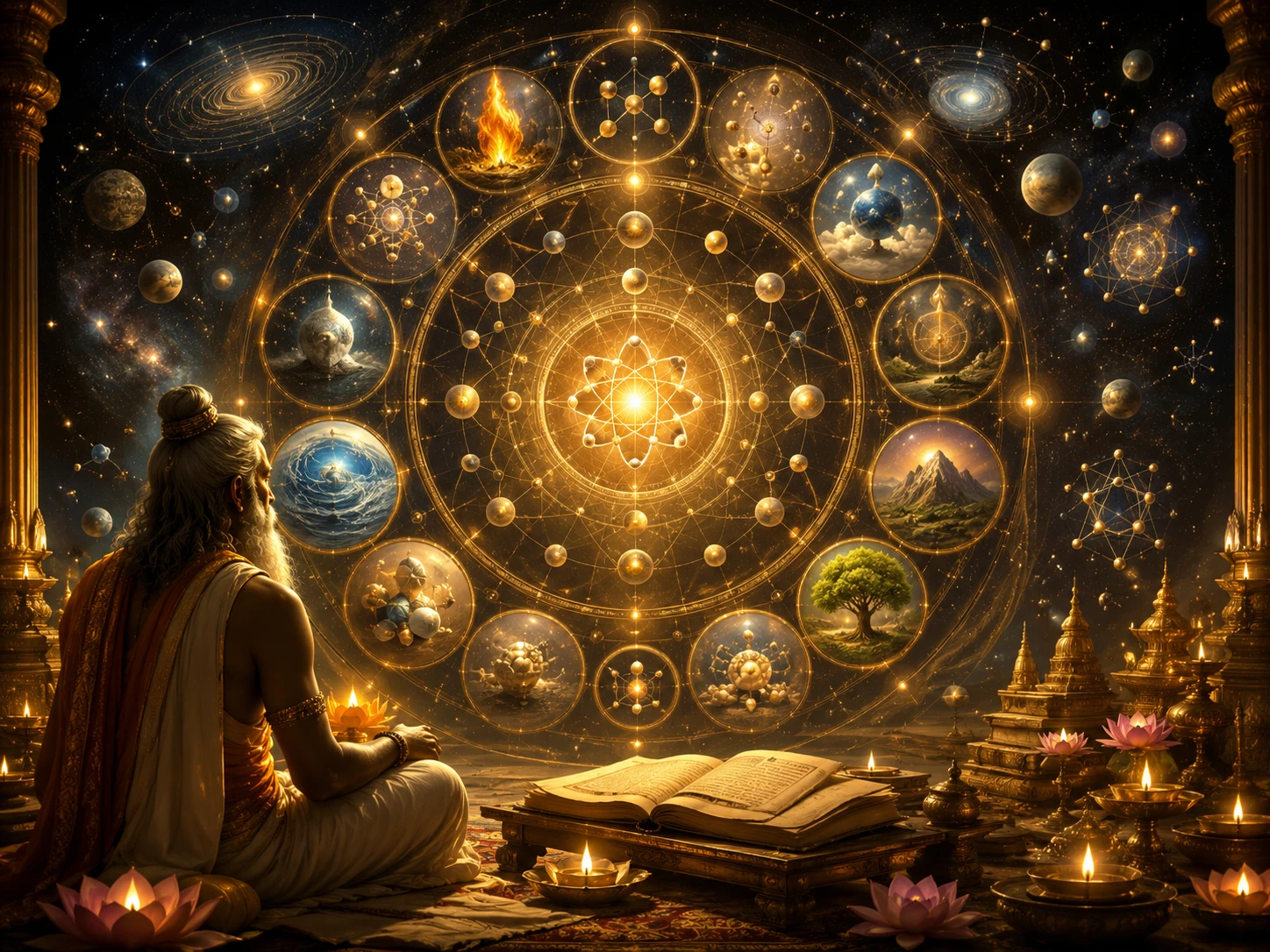
Vaisheshika -- The Hindu Science of Atoms and Categories
वैशेषिक दर्शन -- परमाणु और पदार्थों का शास्त्र
There is an old story about how the Vaisheshika school got its founder's name. The sage was wandering one day and noticed grains of food scattered along a roadside. Hungry but unwilling to take more than the smallest unit, he stopped to pick up the grains -- kana in Sanskrit -- one by one. Hence, kanada, the grain-picker. The story is almost certainly invented, but it survives because it captures something true about the school. Vaisheshika is the philosophy that takes the universe apart, particle by particle, and asks what every separable thing actually is.
Vaisheshika is one of the six classical darshanas of Hindu philosophy. Its founding text is the Vaisheshika Sutras, attributed to Kanada -- also called Kanabhuk, Kanabhakshaka, Uluka, and sometimes Kashyapa -- whose date is conservatively placed somewhere between the sixth and second centuries BCE. The text is short and dense, organised into ten chapters, and is one of the most metaphysically ambitious documents in any tradition. In about three hundred sutras, Kanada attempts to give a complete inventory of everything that exists.
The word vaisheshika comes from vishesha, meaning particularity or distinguishing feature. The school is named after one of its categories: the irreducible particularity by which one paramanu of earth is different from another paramanu of earth, even though they share all general properties. This is not a casual choice. The whole school is, at its heart, an argument that reality is genuinely plural. There are real things in the world, they really differ from each other, the differences are not illusions, and the job of philosophy is to see those differences clearly enough that suffering ends.
यतोऽभ्युदयनिःश्रेयससिद्धिः स धर्मः॥
yato'bhyudaya-niḥśreyasa-siddhiḥ sa dharmaḥ
That from which arises the attainment of worldly prosperity and the supreme good -- that is dharma.
— Vaisheshika Sutras 1.1.2 (Kanada)
Notice where Kanada starts. Not with atoms. Not with categories. Not with logic. With dharma. And his definition of dharma is unusually balanced. He does not say dharma is what leads only to liberation. He says dharma is what produces both worldly success and final liberation. Abhyudaya is everyday flourishing -- a stable income, a healthy family, a respected reputation. Nihshreyasa is the highest good -- moksha, freedom from rebirth. The two are linked, not opposed. The reader who turns to Vaisheshika expecting a dry physics manual will find, before the atoms ever appear, a moral framework that takes ordinary life seriously.
From this opening, Kanada moves quickly to the heart of his project. To know dharma rightly, you must know reality rightly. To know reality rightly, you must be able to classify what exists. So he gives the famous list of six padarthas -- categories of reality -- around which the whole system organises itself. They are dravya (substance), guna (quality), karma (action), samanya (universal), vishesha (particularity), and samavaya (inherence). Later thinkers in the tradition added a seventh, abhava (non-existence), to handle absences and negations. These categories are not random. Together they exhaust what can be talked about. Anything you can name -- a chair, the colour brown, the act of sitting, the property of being a chair, this particular chair, the relation that connects brown to the chair, the absence of the chair when you remove it -- maps onto exactly one category.
The Six (and Seventh) Padarthas of Vaisheshika
| Padartha | Sanskrit | Meaning | Everyday Example |
|---|---|---|---|
| Substance | Dravya (द्रव्य) | The bearer of qualities and actions | A clay pot, a body, a single atom |
| Quality | Guna (गुण) | Properties that depend on a substance | Red colour, sweet taste, hardness |
| Action | Karma (कर्म) | Motion, the change of position | Throwing, contracting, expanding, walking |
| Universal | Samanya (सामान्य) | The shared nature that makes a class | Cow-ness present in every individual cow |
| Particularity | Vishesha (विशेष) | What makes one eternal substance distinct from another | What sets one paramanu apart from another |
| Inherence | Samavaya (समवाय) | The inseparable relation that ties qualities to substances | The way redness is in a rose, not next to it |
| Non-existence | Abhava (अभाव) | Real absence (added later by Sridhara, Udayana) | The absence of the laptop on your desk |
Kanada's original six were enough to inventory positive reality. Abhava was added by post-classical Vaisheshika thinkers to handle real absences -- a category that turns out to matter when you try to formalise terms like 'no flour in the kitchen' without smuggling in another substance.
NCERT Class 9 science textbooks make a brief mention of Kanada as the ancient Indian thinker who first proposed an atomic theory. The mention is honest about what it is: a philosophical insight, not an experimental discovery. Kanada had no microscope. He arrived at paramanus by pure analytical reasoning -- if matter is divisible, division must end somewhere, and the smallest indivisible unit is the paramanu. This is the same reasoning Democritus used in fifth-century BCE Greece. Whether either tradition influenced the other is debated; what is undebated is that two separate civilisations reached the idea on their own.
Within the category of dravya, Kanada lists nine substances, and the list is illuminating. There are five physical substances -- earth (prithvi), water (apas), fire (tejas), air (vayu), and ether (akasha). There are two cosmic substances -- time (kala) and direction (dik). And there are two non-material substances -- soul (atman) and mind (manas). Notice what this list does. It treats time and direction as substances, not as relations or frameworks. It treats mind as a substance distinct from soul -- a small, atomic, internal organ that mediates between consciousness and the senses. And it treats soul as plural. Each of us has our own atman; Vaisheshika is not a monist school like Advaita Vedanta.
The first four physical substances -- earth, water, fire, and air -- are the ones that have paramanus. Akasha, time, direction, soul, and mind do not have paramanus; they are continuous or singular in their own ways. So the famous Vaisheshika atomic theory applies only to ordinary matter. Each kind of paramanu is eternal, indivisible, spherical, and has the irreducible vishesha that makes it identifiable. By itself a paramanu is invisible. Two paramanus combine to form a dvyanuka, a dyad, also still invisible. Three dyads combine to form a tryanuka, a triad, which is the smallest visible particle -- the kind you can see dancing in a sunbeam through a slit window in your grandmother's house in Pune. From there, by progressive combination, the whole physical world is built up.
सदकारणवन्नित्यम्॥ तस्य कार्यं लिङ्गम्॥
sad akāraṇavat nityam || tasya kāryaṃ liṅgam ||
That which exists and has no cause is eternal. Its existence is known by its effect, which serves as the inferential mark.
— Vaisheshika Sutras 4.1.1 -- 4.1.2 (Kanada)
These two short sutras are the philosophical hinge of the entire atomic theory. Kanada is making a careful, double argument. Anything that has a cause was produced; anything that was produced has parts; anything that has parts can be broken back into them. So the ultimate building block must be uncaused, must be partless, and must be eternal. That is the paramanu. But how do we know paramanus exist if we cannot see them? Through their effect. We see compound objects, we see them being broken into smaller parts, and we infer by anumana that the process must terminate in something indivisible. The paramanu is reached not by perception but by inference -- the same anumana that Nyaya formalised, applied here to the structure of matter.
This is the part of Vaisheshika that excited European Indologists in the nineteenth century, and that excites popular WhatsApp forwards now. The connection is real, but it must be stated carefully. Kanada's paramanu is not the modern atom. Modern atoms are divisible into protons, neutrons, and electrons; they were divisible exactly when Rutherford forced them to be. Modern physics has gone further down to quarks and to the constituents of the standard model, and remains uncertain whether any current candidate is truly fundamental. Kanada's paramanu was an analytical limit, a logical end-point of division. The two are conceptually parallel but historically and physically distinct. The honest claim is the more interesting one: in the fifth or fourth century BCE, sitting under a tree, a sage in northern India arrived at the same broad insight that experimental physics would take twenty-five centuries to operationalise.
The Nine Substances (Nava-Dravya) of Vaisheshika
| Substance | Sanskrit | Has Paramanus? | Distinctive Quality |
|---|---|---|---|
| Earth | Prithvi (पृथ्वी) | Yes | Smell |
| Water | Apas (अप्) | Yes | Taste |
| Fire | Tejas (तेजस्) | Yes | Form / colour and heat |
| Air | Vayu (वायु) | Yes | Touch |
| Ether | Akasha (आकाश) | No (singular, all-pervading) | Sound |
| Time | Kala (काल) | No (singular) | Sequence and simultaneity |
| Direction | Dik (दिक्) | No (singular) | Position |
| Soul | Atman (आत्मन्) | No (plural, all-pervading) | Consciousness |
| Mind | Manas (मनस्) | No (atomic and singular per soul) | Inner attention |
The pairing of substance with a distinguishing quality is not arbitrary -- in Vaisheshika, you cannot smell ether or hear earth. Each physical substance is the bearer of a specific sensory quality, which is how it gets perceived in the first place.
After Kanada, the most important figure in Vaisheshika is Prashastapada, around the fourth or fifth century CE. His Padartha-dharma-samgraha is technically a commentary on the Vaisheshika Sutras but is so original that it counts as a foundational text in its own right. Prashastapada introduced the doctrine of Ishvara as the cosmic regulator who initiates the combination of paramanus at the start of each cosmic cycle. The original Vaisheshika Sutras of Kanada are nearly silent on God. Vaisheshika became theistic only after Prashastapada -- a reminder that even the most ancient darshanas had internal evolution.
By around the eleventh century, Vaisheshika and Nyaya had merged so completely that students no longer studied them separately. The combined school is called Nyaya-Vaisheshika, and its working assumption is simple. Vaisheshika tells you what exists. Nyaya tells you how to know what exists. Take the categories from one school, the pramanas from the other, and you have a complete realist philosophy. Sridhara's Nyaya-Kandali (around 991 CE) and Udayana's Kiranavali (tenth century) are the most influential expressions of this synthesis. Shivaditya's Saptapadarthi consolidated the tradition by formalising the seven categories with abhava added. By the time Gangesha wrote the Tattvachintamani in the early thirteenth century, kicking off the Navya-Nyaya revolution, both Nyaya and Vaisheshika had been moving forward as one school for two hundred years.
The later Nyaya-Vaisheshika tradition has had a remarkable life of its own. Ayurveda absorbed Vaisheshika categories of dravya, guna, and karma into its medical theory; the Charaka Samhita and Sushruta Samhita both borrow heavily, especially in their sections on substances and qualities. Indian medical training in colleges like the Government Ayurveda College in Thiruvananthapuram still requires students to learn Padartha Vigyan, the Vaisheshika-derived science of substances, as a foundational subject in the first year of BAMS. The atomic theory shows up in modern philosophy of science discussions; the categorial scheme shows up in cognitive science programs at the Indian Institute of Information Technology in Allahabad. The school that began with a wandering sage picking up grains has, over twenty-five centuries, fed itself into medicine, logic, ontology, and now into computer science.
The full Vaisheshika inventory of qualities and motions is one of the most complete in any classical metaphysics. Twenty-four gunas are listed, divided into three groups. The five sensory gunas -- colour, taste, smell, touch, and sound -- belong to specific physical substances. The six numerical and quantitative gunas -- number, dimension, distinctness, conjunction, disjunction, and remoteness/proximity -- govern how objects relate to one another in space. The seven mental and motivational gunas -- pleasure, pain, desire, aversion, effort, knowledge, and merit-demerit (dharma-adharma) -- belong only to the soul. To these are added gravity, fluidity, viscidity, latent tendency (samskara), and the simple property of being-such-and-such. Each guna is itself a metaphysical resident; it is not a subjective impression but a real feature of substances that, in suitable conditions, can be perceived. The list is so comprehensive that the seventh-century commentator Prashastapada built an entire treatise -- the Padartha-dharma-samgraha -- by exhaustively cataloguing the gunas, their substrates, their causes, and their effects.
Motions, the karma category, are listed as exactly five. Utkshepana is upward motion, avakshepana is downward motion, akunchana is contraction, prasarana is expansion, and gamana is generic locomotion of any other kind. Karma in the Vaisheshika sense is not the moral karma of popular Hindu thought; it is physical motion in the strictest sense, what physicists today would call kinematics. The school's analysis of how motion produces conjunction, conjunction produces effects, and effects propagate through chains of cause and effect bears comparison with classical mechanics, even if the underlying assumptions are different. What sets Vaisheshika apart from any modern equivalent is the insistence that the soul too has motion-like properties through manas, the inner organ, which moves between sensory contacts and produces what we feel as attention. The mind in Vaisheshika is not a passive screen. It is an atomic substance with its own pattern of motions, and the careful study of those motions belongs to the same science that studies falling stones.
The most consequential downstream inheritance of Vaisheshika is its influence on Ayurveda. The Charaka Samhita and Sushruta Samhita, the foundational medical texts, both adopt the Vaisheshika categories of dravya, guna, and karma as the basis of their pharmacological analysis. A medicinal plant in Charaka is not just a herb. It is a dravya bearing specific gunas (rasa, virya, vipaka, prabhava) which produce specific karmas in the body when ingested. This entire framework, called Padartha Vigyan, remains a foundational subject in the first year of the BAMS degree at every Ayurveda college in India, from the Government Ayurveda College in Thiruvananthapuram to the Banaras Hindu University Faculty of Ayurveda. A Class XII Bengaluru student starting BAMS in 2026 spends her first semester in essentially the same conceptual world that Kanada laid out two and a half thousand years ago. Few branches of any ancient philosophy can claim that kind of unbroken transmission into a regulated modern professional curriculum.
Niels Bohr, the Danish physicist who gave us the modern atomic model, once visited Tagore at Shantiniketan and discussed Indian thought. The conversation has been overinterpreted by enthusiasts on both sides. Bohr was respectful and curious, but he did not say modern physics had been anticipated by ancient India. He noted, more carefully, that questions raised in Hindu and Buddhist thought about observation, complementarity, and the relationship between observer and observed had also surfaced in quantum mechanics. The Vaisheshika contribution to that conversation is real and worth taking seriously, without inflating it into discoveries the texts never made.
Vaisheshika is, in the end, the Hindu darshana most committed to the seriousness of the everyday physical world. It does not say the world is illusion. It says the world is real and the soul is real and the structure that holds them together is also real, and the only path through is to see it clearly. To know the categories of reality is, in the school's startling original claim, to be on the road to liberation. Whether you ever sit under a tree counting paramanus or whether you simply notice that the dust in your sunbeam this morning is exactly the kind of tryanuka Kanada described, you are, at some level, doing Vaisheshika. The school that takes the world apart does so not to dismiss it but to honour it. That is not an obvious move in Hindu philosophy. It may be the most Hindu move of all.
One important development inside Vaisheshika deserves separate mention, because it is often misunderstood. The original sutras of Kanada are nearly silent on God. There is no creator-deity in classical Vaisheshika, no cosmic regulator who initiates the combination of paramanus. The world functions through the interaction of categories under impersonal laws. This is striking, and it places early Vaisheshika in the company of similarly non-theistic schools like early Samkhya, early Mimamsa, and the entire Jaina tradition. Theism is not the default position of classical Indian philosophy; it is a position certain schools come to, often through later doctrinal pressure rather than original commitment. In Vaisheshika the turn happens with Prashastapada. In his Padartha-dharma-samgraha around the fourth or fifth century CE, Prashastapada introduces an Ishvara who, at the start of each cosmic cycle, sets the otherwise inert paramanus into the motions that produce the world. This is a precise philosophical role for God -- not a cosmic CEO, not a cosmic father, but a kinetic initiator. After each pralaya, when all compound things have dissolved back into their constituent paramanus, motion has stopped. Ishvara restarts it. The argument is later refined and defended through the same anumana procedures that Nyaya developed, and by the medieval period the combined Nyaya-Vaisheshika school is solidly theistic.
This matters for two reasons. First, it shows that classical Indian philosophy is not uniformly theistic in the way popular accounts suggest. Different schools came to God through different routes, and some did not come at all. Second, it shows that even within a single school, fundamental questions could remain genuinely open for centuries. The Vaisheshika of Kanada and the Vaisheshika of Prashastapada are recognisable as the same school, but they answer the question of God differently. A modern student raised on the assumption that Hindu philosophy is one undifferentiated body of belief is often surprised to discover, on careful reading, that it is far more like classical Greek philosophy -- a contested space full of internal disagreements that ran for centuries and were never finally resolved. Vaisheshika is one of the schools where that internal evolution is most clearly visible in the surviving record.
An aspect of Vaisheshika that is worth pulling out separately is its analysis of perception, because the school's account is unusually careful about the role of the body. Each of the five sense organs (indriyas) is, in Vaisheshika, made of a particular bhuta. The eye is made of fire (tejas) -- which is why it perceives colour and form, both of which are tejas-properties. The ear is made of ether (akasha) and so perceives sound, which is the distinctive akasha-property. The nose is earth, the tongue is water, the skin is air. This is a precise mapping, not a poetic one. It explains why each sense organ has its specific competence, and why the same object presents different aspects to different senses without contradiction. A mango is not changing as you smell it and then taste it; rather, your earth-organ is contacting the earth-aspect, your water-organ the water-aspect.
Manas, the inner organ, then has its own role. Vaisheshika argues that manas is atomic in size and singular per soul -- there is exactly one manas attached to each atman. This solves a problem the school noticed early. If perception happened simultaneously through all five sense organs, why do we never have two perceptions at the same instant? You cannot, in fact, fully attend to a sound and a colour and a taste in the same moment; attention shifts. The Vaisheshika answer is that manas, being atomic, can only contact one sense organ at a time. What feels like simultaneous perception is actually rapid serial contact. The mind atom moves between sense organs faster than ordinary awareness can register the movement, but not infinitely fast. Modern cognitive science, working through entirely independent methods, has confirmed something close to this picture -- attention is fundamentally serial, the apparent simultaneity of conscious experience is a perceptual illusion produced by the brain's binding mechanisms. The Vaisheshika analysis arrived at a structurally similar result two and a half thousand years earlier, by sheer reasoning from the data of introspection. The school deserves credit for that, even when its specific atomic mechanism does not survive modern neuroscience. The honest claim, again, is the more interesting one. The Indians knew the question was real and gave a careful answer. The answer turned out to be partly right.
Read the Six Darshanas Hub
See how Vaisheshika sits among the six classical darshanas, beside its long-time partner Nyaya. The Darshanas page on Eternal Raga gathers the root texts of all six, including the Vaisheshika Sutras.
Tags
Eternal Raga · शाश्वत राग
Institutional voice — scholarly articles on Sanatan Dharma
Deepen Your Understanding
अपनी समझ और गहरी करें
philosophy darshana
Nyaya -- The Hindu School of Logic and Right Reasoning
Two and a half thousand years before formal logic appeared in European universities, Akshapada Gautama wrote down the rules. Four valid sources of knowledge, a five-step syllogism, sixteen categories, and a single goal: liberation through clear thinking.
philosophy darshana
The Six Darshanas -- India's Original Intellectual Operating Systems
Long before Greek philosophy had its first argument, India had six complete philosophical systems -- each with its own logic, metaphysics, epistemology, and liberation path. Nyaya built formal logic. Vaisheshika invented atomic theory. Samkhya mapped consciousness. Yoga engineered the mind. Mimamsa decoded ritual. Vedanta asked the final question. Together, they are the most comprehensive intellectual framework any civilisation has produced.
philosophy darshana
Purva Mimamsa -- The Hindu Science of Ritual and Right Interpretation
Sage Jaimini's Mimamsa Sutras open with one question: what exactly is dharma, and how do we know it? The answer he gives -- that dharma is what the Vedas enjoin, and the Vedas are eternal -- created the most rigorous hermeneutic system the ancient world ever produced.
philosophy darshana
Sankhya -- The Oldest Philosophy of Creation
Before the Bhagavad Gita. Before Patanjali. Before Shankaracharya. There was Sankhya -- a philosophy that explained everything from cosmic creation to human suffering without invoking God. Founded by Kapila, compressed into 72 devastating verses by Ishvarakrishna, and quietly embedded in every other Indian philosophical system that came after it.
philosophy darshana
Advaita Vedanta Explained -- Shankara's Radical Philosophy of Non-Duality
You are not your job title. You are not your Instagram bio. According to Adi Shankaracharya, you are not even your body or mind -- you are Brahman itself, the infinite consciousness wearing a temporary costume. Advaita Vedanta is the most radical philosophical claim in Indian history: that the entire universe is one undivided reality, and separation is the grandest illusion.
vedic sciences
Kaal Ganana -- The Hindu Measure of Time
From a single blink of the eye (Nimesha) to one Day of Brahma (4.32 billion years) -- explore the complete cosmic time hierarchy of Hindu cosmology, anchored in Vishnu Purana 1.3, with its remarkable parallels to modern science.
NCERT Class 9 science textbooks make a brief mention of Kanada as the ancient Indian thinker who first proposed an atomic theory. The mention is honest about what it is: a philosophical insight, not an experimental disco…
More in Philosophy & Darshana
The 14 Lokas -- Hindu Cosmology as a Map of Consciousness
14 min read
Achintya Bhedabheda -- Chaitanya's Theology of Inconceivable Difference-and-Unity
13 min read
Adhyasa -- Superimposition and the Foundational Error of the Self
13 min readThe same translation error that turned '33 Koti' into '33 crore' in Hinduism also happened in Buddhism. The Chinese translation of Buddhist texts rendered 'Sapta Koti Buddha' (7 Supreme Buddhas) as '7 Crore Buddhas.' The…
Deities AvatarsCommunity Reflections
🕉️
Be the first to share your reflection.