Purva Mimamsa -- The Hindu Science of Ritual and Right Interpretation
पूर्व मीमांसा -- यज्ञ और सम्यक् व्याख्या का शास्त्र
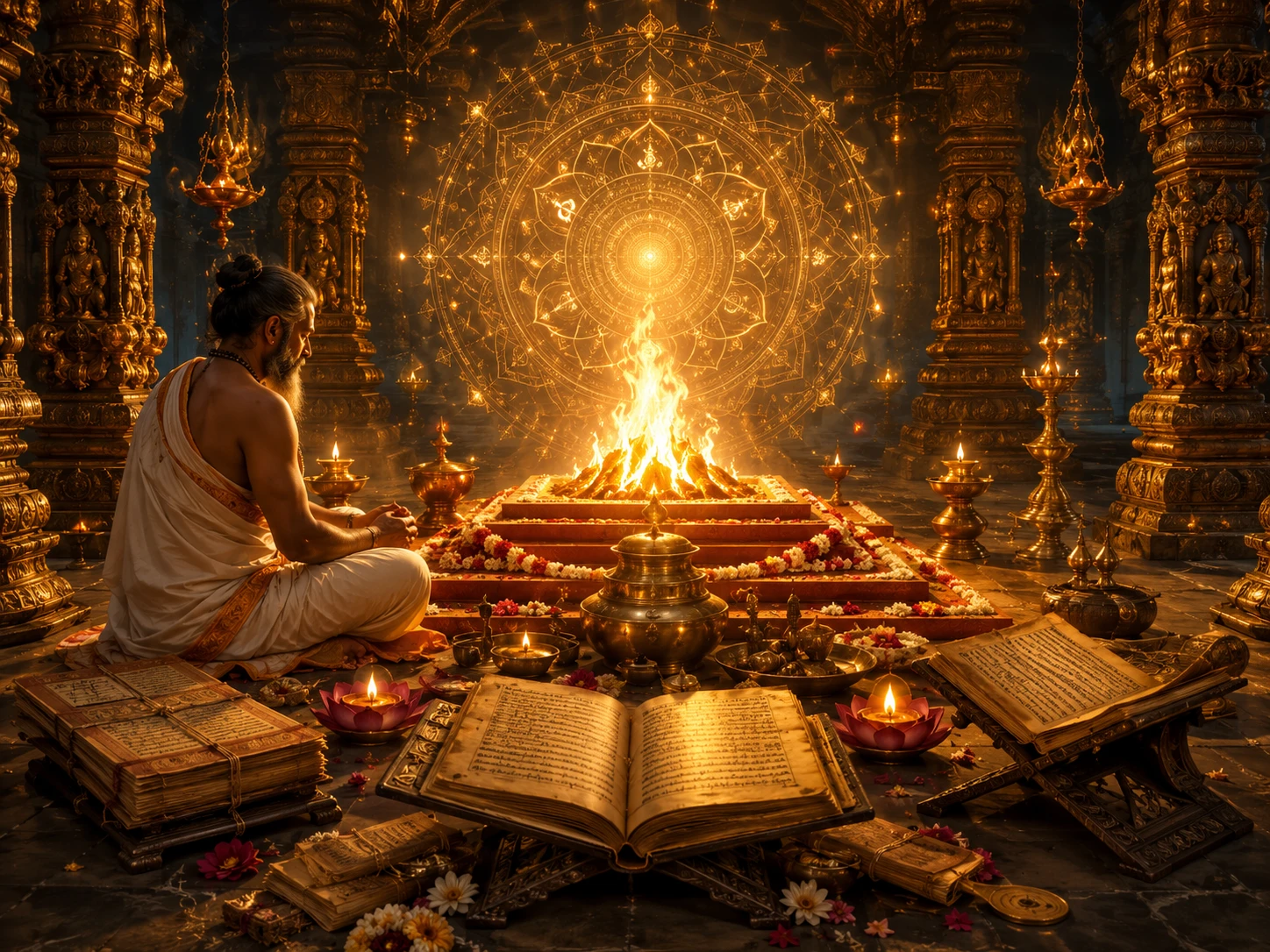
Imagine a Vedic priest in the second century BCE preparing for a Soma yagna. Around him are altars built to specific dimensions, vessels of specific shapes, mantras to be chanted at specific hours, offerings to be poured at specific moments. A single mistake in any of these specifications -- a substituted word in a mantra, an altar facing the wrong direction, an offering poured a moment too early -- could, the tradition held, undo the entire ritual. Now imagine someone walks up to this priest and asks an apparently simple question. How do you know that you are doing it right? What in the world tells you, with certainty, that this particular order of words and objects produces the spiritual result it claims to produce?
That single question is the seed of an entire darshana. Purva Mimamsa is the school of Hindu philosophy that takes that question with full seriousness and spends twelve chapters and several thousand sutras working out an answer. Its founding text is the Mimamsa Sutras, attributed to the sage Jaimini, dated by most scholars to roughly the third or second century BCE. The word mimamsa itself means inquiry or thoughtful investigation, and Purva (earlier) refers to its focus on the karma-kanda, the earlier or ritual portion of the Vedas. Its sister school is Uttara (later) Mimamsa, better known to most people as Vedanta, which focuses on the jnana-kanda, the knowledge portion centred on the Upanishads.
Mimamsa is the least romantic of the six classical darshanas. It does not promise mystical experience, atomic theory, or a rope-and-snake metaphor. It promises something far quieter and far more demanding: a precise method for reading sacred text, applying its instructions, and being certain you have not deceived yourself in the process. For nearly fifteen hundred years, this method dominated the intellectual life of Sanskritic India. It is also, surprisingly, alive in courtrooms and law schools today.
अथातो धर्मजिज्ञासा॥
athāto dharma-jijñāsā
Now, therefore, the inquiry into dharma.
— Mimamsa Sutras 1.1.1 (Jaimini)
Three Sanskrit words. Atha (now), atah (therefore), dharma-jijnasa (inquiry into dharma). And on these three words rests the largest single body of philosophical writing in the Hindu tradition. The Brahma Sutras of Badarayana, which inaugurate Vedanta, deliberately echo this opening with athato brahma-jijnasa -- now therefore, the inquiry into Brahman. The structural rhyme is intentional. Both are systematic inquiries; both follow the Vedic discipline of beginning at the right moment with a clear question. Mimamsa simply asks first what dharma is, while Vedanta asks first what Brahman is.
What does atha mean here? Not just temporal now. The classical commentary tradition reads it as: now that the student has studied the Veda under a teacher, now that she has been initiated and trained in correct recitation, now that she has the textual instrument in her hand and is ready to put it to use -- now begins the genuine inquiry. The Veda has been received. The next question is what to do with it. Jaimini's answer is: investigate dharma. Find out, by careful reasoning, exactly what the Vedic injunctions enjoin and exactly how to perform what they enjoin. Without this inquiry, the Veda sits inert. With it, the entire structure of human action becomes meaningful.
Purva Mimamsa and Uttara Mimamsa (Vedanta) Compared
| Feature | Purva Mimamsa | Uttara Mimamsa (Vedanta) |
|---|---|---|
| Founder | Jaimini | Badarayana |
| Foundational text | Mimamsa Sutras (12 chapters) | Brahma Sutras (4 chapters) |
| Veda portion focused on | Karma kanda (Samhitas, Brahmanas) | Jnana kanda (Upanishads) |
| Central question | What is dharma, and how do we know it? | What is Brahman, and how do we know it? |
| Path to highest goal | Performance of Vedic injunctions | Knowledge of Brahman |
| Original stance on Ishvara | Effectively non-theistic | Theistic in most sub-schools |
| Original stance on moksha | Heaven (svarga) through ritual; later schools added moksha | Moksha is the final goal |
The two schools share a common Vedic source and a common method of textual interpretation, but read different parts of the Veda for different ends. Most pre-modern Sanskrit students studied both, beginning with Purva Mimamsa for its rigour and moving to Vedanta for its metaphysics.
The Mimamsa rules of interpretation are still actively used in Indian courts. The Supreme Court of India has cited Mimamsa principles in cases including K.P. Varghese vs Income Tax Officer (1981) and U. P. Bhatt vs Tahil Ram (1979). Law schools like NLSIU Bengaluru and NUJS Kolkata teach Mimamsa-derived hermeneutic rules -- the linga (indicatory mark), vakya (sentence), prakarana (context), and others -- as part of statutory interpretation modules. The Allahabad High Court has explicitly referenced Mimamsa in disputes about the meaning of Hindu law texts.
By the seventh and eighth centuries CE, Purva Mimamsa had crystallised into two great schools, named after their founders. The Bhatta school was founded by Kumarila Bhatta, born in the south but active across Bharatavarsha. The Prabhakara school was founded by Prabhakara Mishra, traditionally considered Kumarila's contemporary and rival, possibly his student. The two schools agree on most matters of ritual and on the absolute authority of the Vedas. They disagree, sometimes ferociously, on technical questions in epistemology and the philosophy of language.
Kumarila is the more famous figure outside Mimamsa circles, partly because of his role in the Buddhist-Hindu debates of the seventh century. His Shloka-vartika and Tantra-vartika -- two enormous commentaries on Shabara's bhashya on the Mimamsa Sutras -- contain some of the most powerful arguments against Buddhist epistemology in classical Sanskrit literature. Tradition credits Kumarila and Adi Shankara, working in different ways, with the intellectual displacement of Buddhism from its dominant position in Indian academic life. Prabhakara, less polemical, was the deeper systematiser. His Brihati commentary on the Shabara Bhashya rebuilt Mimamsa epistemology around a single distinctive theory of language and meaning. Students who studied Mimamsa traditionally had to be conversant in both schools and able to argue either side.
चोदनालक्षणोऽर्थो धर्मः॥
codanā-lakṣaṇo'rtho dharmaḥ
Dharma is that meaningful purpose which is indicated by Vedic injunction.
— Mimamsa Sutras 1.1.2 (Jaimini)
If the first sutra opens the inquiry, the second sutra defines its object. Codana means a Vedic injunction, the imperative form by which the scripture commands an action -- yajeta, juhuyat, dadyat, kuryat, all the optatives that say what one should do. Lakshana means indicator or defining mark. Artha is the meaningful end, the action with its result. Put together: dharma is that beneficial action and result which is identifiable by Vedic injunction. Notice what this definition rules out. Dharma is not what feels right. Dharma is not what most people do. Dharma is not what worldly authority commands. Dharma is what the Veda enjoins. Nothing else qualifies.
This austere definition is what gives Mimamsa its philosophical bite. To defend it, the school developed the doctrine of apaurusheya -- the Vedas are not authored. They have no human composer, and Mimamsa argues, no divine composer either. The Vedas are eternal, beginning-less, self-validating. This claim sounds extreme to modern ears, and it shaped Indian intellectual history in deep ways. If the Vedas had a divine author, then any disagreement could be settled by appealing to that author's intention; but humans cannot read minds, including divine ones, and would be reduced to guessing. If the Vedas had a human author, they would inherit human fallibility. By making the Vedas eternal and impersonal, Jaimini placed them outside the reach of authorial dispute. Their authority comes from their existence, and the question for the inquirer is only how to read them correctly.
From this foundation, Mimamsa builds its theory of pramanas -- valid means of knowledge. The Bhatta school accepts six. The first four are the same as Nyaya: pratyaksha (perception), anumana (inference), upamana (comparison), shabda (verbal testimony). Mimamsa adds two more. Arthapatti is postulation, the act of supposing an unstated fact to make a known fact intelligible -- as when we know that the corpulent Devadatta does not eat by day and infer he must eat by night. Anupalabdhi is non-perception, the means by which we know an absence -- you walk into a room, you do not see the laptop, you correctly conclude the laptop is not there. The Prabhakara school accepts only the first five and disputes anupalabdhi.
The Six Pramanas of Bhatta Mimamsa
| Pramana | Function | Modern Example |
|---|---|---|
| Pratyaksha | Direct perception via the senses | Seeing your phone screen turn on |
| Anumana | Inference from observed sign | Hearing a notification chime, inferring a message arrived |
| Upamana | Knowledge by similarity to a known thing | Recognising a wagon-R because it resembles your dad's Maruti |
| Shabda | Reliable verbal testimony | Trusting the IRCTC PNR status because the railway is authoritative |
| Arthapatti | Postulation to make a known fact coherent | Your friend's swiggy order keeps arriving though he says he never eats; arthapatti supplies the missing premise |
| Anupalabdhi | Non-perception as a valid mode of knowing absence | Walking into the office, not seeing your colleague, knowing she is on leave |
The first four are shared with Nyaya. Arthapatti and anupalabdhi are Mimamsa's distinctive contributions to Indian epistemology. The Prabhakara sub-school disputes the sixth, arguing that anupalabdhi is just a special case of pratyaksha.
Original Purva Mimamsa is technically non-theistic. Jaimini does not deny the existence of gods -- the Veda mentions Indra, Agni, Varuna in countless ritual contexts -- but in his system, the gods are not the source of dharma. The Vedic injunction is. The deity invoked in a yagna is, in classical Mimamsa reading, more like a grammatical placeholder than a worshipped supreme being. Later Mimamsakas, especially after Kumarila, allowed more space for theism, but the school's logical core does not depend on God. This is why Mimamsa is sometimes paired with Samkhya as the two darshanas where divinity is structurally optional.
Mimamsa's deepest legacy is in language and law. Because the school's core enterprise is reading the Veda correctly, it had to develop a precise theory of how Sanskrit sentences mean what they mean. The result was an entire discipline of vakyartha-vichara -- the analysis of sentence-meaning. The Bhatta school holds the abhihita-anvaya theory: words first signify their isolated meanings, and these meanings are then connected into a sentence-meaning. The Prabhakara school holds the anvitabhidhana theory: words signify their meanings only as already connected, never in isolation. This dispute looks academic but turns out to matter enormously when you are interpreting a complex legal or ritual text. The Mimamsakas were the first jurists in any tradition to work out, formally, what it means for a sentence's meaning to be more than the sum of its words.
This hermeneutic apparatus then became the working toolkit of Hindu law. The Dharmashastra texts -- Manusmriti, Yajnavalkya Smriti, the various Nibandhas -- could not interpret themselves. Whenever there was a contradiction or ambiguity in these texts, scholars resolved it using Mimamsa rules. The samanya-vishesha rule (specific overrides general), the angangi-bhava rule (subordinate parts serve their principal), the linga rule (an indirect indicator can settle a meaning when direct words fall short), the prakarana rule (context determines meaning), and dozens more were developed in the Mimamsa tradition for parsing Vedic ritual and then exported wholesale into legal interpretation. When the British in the late eighteenth and nineteenth centuries set about codifying Hindu law, they encountered a fully developed indigenous hermeneutic system that was simultaneously more rigorous and more flexible than what they had at home. Sir Thomas Strange, Henry Colebrooke, and other early colonial jurists wrote with frank admiration about Mimamsa's interpretive power.
What lifts Purva Mimamsa from a hermeneutical exercise into a metaphysical doctrine in its own right is the concept of apurva. The school faces an obvious problem. The Vedas promise that performing a yajna -- say, the jyotishtoma -- produces svarga, heaven, after death. But the yajna takes place at a specific moment in time, and the result is meant to come much later, often after the performer has died. What carries the causal connection across that gap? Mimamsa answers with apurva: an unseen residue, a kind of metaphysical accounting entry, that the ritual produces in the soul of the performer and that ripens later into the promised result. Apurva is not God. It is not karma in the popular sense. It is a strictly impersonal mechanism by which the right ritual, correctly performed, generates its right fruit, without anyone watching, without divine bookkeeping. The Mimamsakas were quite happy to do their philosophy without an active God. The Vedas, the rituals, and apurva are enough.
Closely connected is the school's careful classification of every sentence in the Vedic corpus into five technical categories. Vidhi is the injunction, the binding command. Yajeta svarga-kamah, says the Veda -- one who desires heaven should perform the sacrifice. That is a vidhi. Nishedha is the prohibition, the equivalent on the negative side -- na surám pibet, do not drink intoxicating soma at the wrong stage. Mantra is the sentence used during the ritual itself, recited at the precise moment by the priest. Namadheya is the naming sentence, the part of the Veda that gives a particular ritual its name and identity, distinguishing the agnishtoma from the rajasuya. Arthavada is the descriptive supplement -- the parts of the Veda that explain, glorify, or warn about the ritual without themselves issuing commands. The Mimamsakas argued that arthavada is not literally factual; it is rhetorical, meant to motivate the performer toward the vidhi. When the Veda says that one who performs a particular sacrifice will become the eater of food in the heaven of Indra, the Mimamsakas read this as praise, not literal description. The vidhi alone is binding; everything else is in service of the vidhi.
This fivefold scheme had enormous practical consequences. It meant that Mimamsa could read a long, complicated, often poetic Vedic passage and tell you, line by line, what was binding and what was not. It also meant that the school developed sophisticated rules for when sentences contradict each other. The principle of guna-pradhana, the precedence of main injunction over subordinate description, has a direct modern descendant in the principle of statutory interpretation that says specific provisions override general ones. The principle of vakya-bheda, the splitting of a long sentence into independently binding sub-injunctions, finds an echo in how courts treat conditional clauses in tax law. None of this happened by accident. The Indian legal tradition, even after the colonial period imposed common-law hermeneutics on top of it, retained a deep substrate of Mimamsa interpretation that survives today in published law journals and in the reasoning of judges trained at NUJS Kolkata, NLSIU Bengaluru, and the Hindu College law programs.
In the 1970s, Dutch Indologist Frits Staal at UC Berkeley organised the recording of an entire Agnicayana ritual in Kerala, performed by Nambudiri Brahmin priests over twelve days. The ritual is one of the oldest continuously performed Vedic yagnas in the world, and Staal's footage and analysis remain the most detailed study any scholar has ever made of a living Mimamsa-prescribed performance. The recording is now housed at multiple universities and stands as evidence that Mimamsa is not a museum artefact -- the ritual life it codifies is still operative in parts of South India.
Purva Mimamsa is, perhaps, the strangest darshana to a modern reader. It does not promise self-discovery, mystical union, atomic theory, or release. It promises something both narrower and stranger -- a way to read a text correctly. And then it argues, patiently, that reading correctly is itself the path to the highest good, because what the text says is what dharma is, and dharma rightly performed shapes the world the performer enters next. To the contemporary Indian raised on Vedanta's mysticism, Yoga's experiential practice, or even Nyaya's logical sport, Mimamsa can feel like an austere uncle at the family wedding -- the one who knows exactly which mantra is to be recited at which moment and is unmoved by everyone else's enthusiasm. He may not be the most fun guest. But when something genuinely needs to be settled -- the right way to interpret a contested phrase, the right priority among conflicting injunctions, the right method for reading a text whose author is no longer alive -- the family quietly turns to him. Mimamsa is the Hindu tradition's careful, patient, almost legalistic conscience. It has been keeping the textual house in order for two thousand three hundred years.
The single most consequential intellectual battle Mimamsa ever fought was with classical Buddhism, and Kumarila Bhatta was its general. By the seventh century, Buddhist philosophy had risen to dominant influence at major Indian centres of learning -- Nalanda, Vikramashila, Odantapuri. Buddhist epistemologists like Dharmakirti and Dignaga had built sophisticated theories of perception and inference that explicitly rejected the eternality and authority of the Vedas. Mimamsa was, structurally, the school best positioned to respond. Kumarila's Shloka-Vartika is in large part an extended philosophical answer to Dharmakirti, defending Vedic authority on grounds that any Buddhist would have to address. He argued for the apaurusheyatva of the Vedas not by appealing to faith but by demonstrating, sentence by sentence, that no human author could be located, that scriptural transmission has structural features unlike any composed text, and that Buddhist alternatives produce more philosophical problems than they solve. By the eighth century, the intellectual tide had turned. Tradition records Kumarila as one of the figures who set the stage for Shankara's own work in Vedanta, and Indian historians like Hajime Nakamura and B.K. Matilal have argued that the resurgence of Vedic-rooted philosophy in the eighth century onward owes a substantial debt to Mimamsa polemics that are now read by very few outside specialised academic settings.
The practical legacy of this contest is, paradoxically, more visible in the present than the philosophical one. The continuity of Hindu temple ritual today, from Tirupati to Pashupatinath in Kathmandu, depends on a chain of training and certification that runs through Mimamsa-trained Sanskrit pandits. The Tirumala Tirupati Devasthanam runs a dedicated Veda Pathashala that produces, every year, a small but steady stream of priests certified in correct ritual performance. The certification rests on Mimamsa principles of right interpretation. The Sringeri Math, the Kanchi Kamakoti Peetham, and the four Shankaracharya seats all maintain Mimamsa scholarship as part of their core curriculum, even when their public face is Vedantic. To attend a major shastrartha at Kashi during the Sanskrit week and watch elderly pandits debate a single sutra of Jaimini for forty minutes is to see the school still doing exactly what Kumarila once did -- defending the precision of the text, line by line, against any challenger.
Of all the curiosities of Mimamsa, perhaps the most surprising to a modern reader is the school's evolving relationship with moksha. The original Mimamsa Sutras of Jaimini are conspicuously silent on liberation. The promised result of dharma is svarga, heaven -- a temporary residence among the devas, after which one returns to the cycle of birth. Moksha, the permanent freedom from rebirth that other Hindu schools centre on, is simply not on Jaimini's agenda. Karma, ritual action correctly performed, is the highest pursuit; svarga is its highest fruit; the question of escaping samsara altogether is left to other inquiries. This is one of the more austere positions in classical Indian thought, and it sat awkwardly with later Hindu sensibilities. By the time Kumarila Bhatta and Prabhakara wrote in the seventh and eighth centuries, the surrounding intellectual environment had absorbed the Vedantic and Buddhist concern with liberation as the highest good. Both Bhatta and Prabhakara, without abandoning the centrality of dharma, found ways to incorporate moksha. The Bhatta solution treats moksha as the natural consequence of cessation of new karma -- if you stop generating fresh apurva through desire-driven action, the existing apurva exhausts itself and rebirth eventually ceases. The Prabhakara solution is similar in outline though differently argued. Either way, by the medieval period, Mimamsa is recognisably a school of moksha as well as a school of dharma, even if the original sutras were not.
This evolution is worth pausing over because it complicates a common misreading of Hindu philosophy. The popular sense that all Indian schools always pointed toward moksha is false. Moksha emerged as the dominant goal of orthodox Hindu inquiry only gradually, and not all schools were ever fully convinced. Mimamsa is the most visible case of a school that started without it and accepted it only after centuries of pressure. Charvaka, the materialist school, never accepted it at all. Early Samkhya placed it in tension with the cessation of suffering rather than with knowledge of Brahman. The historical truth is more complex and more interesting than the simplification. Hindu thought is not one road; it is a country with many roads, and Mimamsa is one of the longest, slowest, most argumentative roads in the country. Its destination changed at least once across two and a half millennia. Few systems of thought are honest enough about their own evolution to record that change in the texts themselves -- but the Mimamsa tradition, as is its habit, was meticulous enough to record everything.
Read the Six Darshanas Hub
See how Purva Mimamsa connects to its sister school, Uttara Mimamsa (Vedanta), and to the other classical darshanas. The Darshanas page on Eternal Raga gathers the root texts of all six, including the Mimamsa Sutras.
Tags
Eternal Raga · शाश्वत राग
Institutional voice — scholarly articles on Sanatan Dharma
Deepen Your Understanding
अपनी समझ और गहरी करें
philosophy darshana
Adhyasa -- Superimposition and the Foundational Error of the Self
Why does a rope look like a snake in a half-lit room? And why does the eternal Self look like a busy, mortal, anxious individual to itself? Shankaracharya answers both questions with one word: adhyasa, superimposition. Out of this single concept, all of Advaita Vedanta unfolds.
philosophy darshana
The Six Darshanas -- India's Original Intellectual Operating Systems
Long before Greek philosophy had its first argument, India had six complete philosophical systems -- each with its own logic, metaphysics, epistemology, and liberation path. Nyaya built formal logic. Vaisheshika invented atomic theory. Samkhya mapped consciousness. Yoga engineered the mind. Mimamsa decoded ritual. Vedanta asked the final question. Together, they are the most comprehensive intellectual framework any civilisation has produced.
philosophy darshana
Nyaya -- The Hindu School of Logic and Right Reasoning
Two and a half thousand years before formal logic appeared in European universities, Akshapada Gautama wrote down the rules. Four valid sources of knowledge, a five-step syllogism, sixteen categories, and a single goal: liberation through clear thinking.
philosophy darshana
Vaisheshika -- The Hindu Science of Atoms and Categories
Long before John Dalton drew his atomic diagrams, sage Kanada in ancient India argued that all matter reduces to indivisible particles called paramanus. The Vaisheshika school built an entire ontology -- nine substances, six categories, atomic combination -- on this insight.
philosophy darshana
Advaita Vedanta Explained -- Shankara's Radical Philosophy of Non-Duality
You are not your job title. You are not your Instagram bio. According to Adi Shankaracharya, you are not even your body or mind -- you are Brahman itself, the infinite consciousness wearing a temporary costume. Advaita Vedanta is the most radical philosophical claim in Indian history: that the entire universe is one undivided reality, and separation is the grandest illusion.
philosophy darshana
Sankhya -- The Oldest Philosophy of Creation
Before the Bhagavad Gita. Before Patanjali. Before Shankaracharya. There was Sankhya -- a philosophy that explained everything from cosmic creation to human suffering without invoking God. Founded by Kapila, compressed into 72 devastating verses by Ishvarakrishna, and quietly embedded in every other Indian philosophical system that came after it.
The Mimamsa rules of interpretation are still actively used in Indian courts. The Supreme Court of India has cited Mimamsa principles in cases including K.P. Varghese vs Income Tax Officer (1981) and U. P. Bhatt vs Tahil…
More in Philosophy & Darshana
The 14 Lokas -- Hindu Cosmology as a Map of Consciousness
14 min read
Achintya Bhedabheda -- Chaitanya's Theology of Inconceivable Difference-and-Unity
13 min read
Adhyasa -- Superimposition and the Foundational Error of the Self
13 min readThe same translation error that turned '33 Koti' into '33 crore' in Hinduism also happened in Buddhism. The Chinese translation of Buddhist texts rendered 'Sapta Koti Buddha' (7 Supreme Buddhas) as '7 Crore Buddhas.' The…
Deities AvatarsCommunity Reflections
🕉️
Be the first to share your reflection.