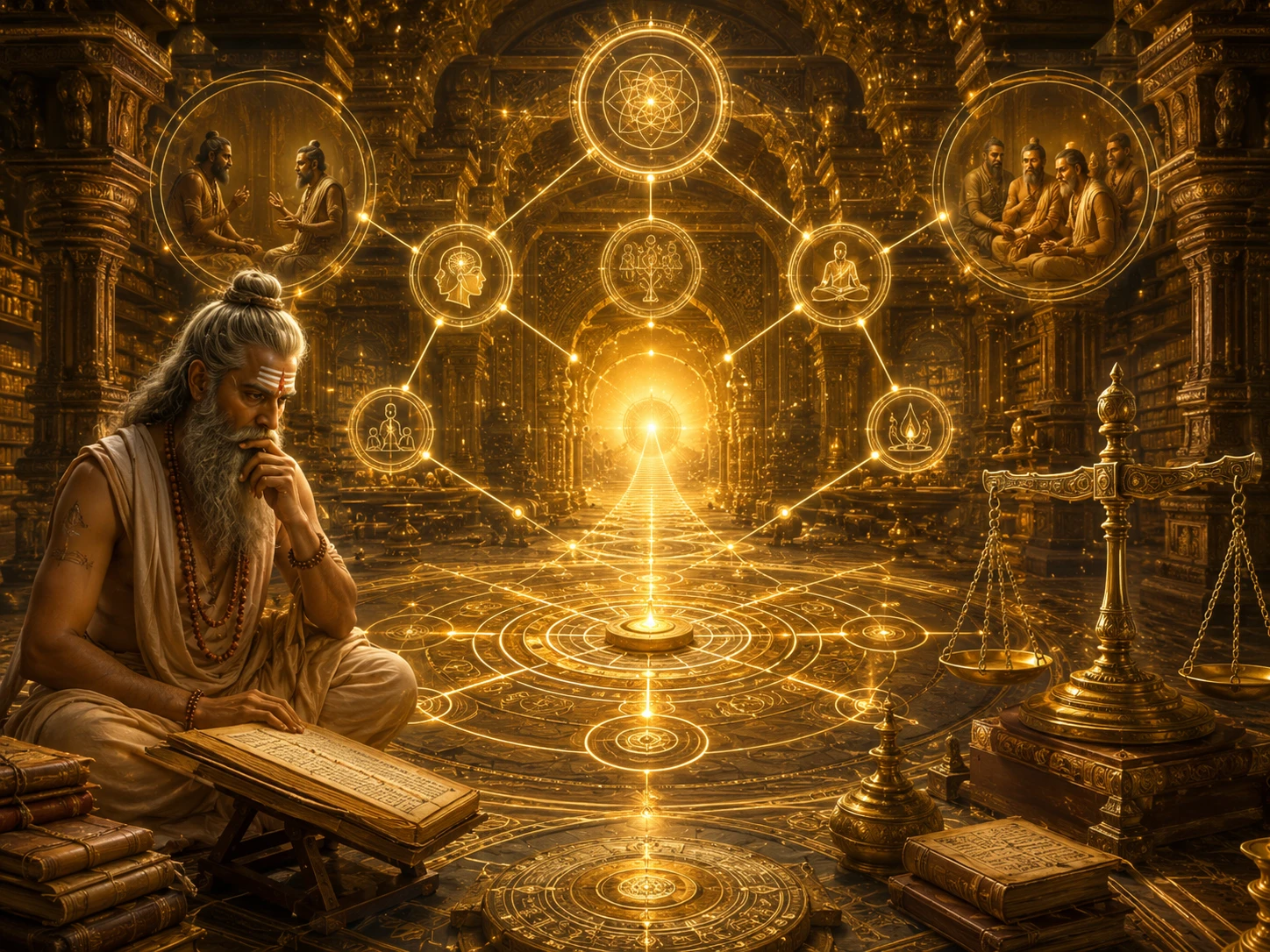
Nyaya -- The Hindu School of Logic and Right Reasoning
न्याय दर्शन -- तर्क और सम्यक् ज्ञान का शास्त्र
If you have ever sat in a debate club at Stephen's or LSR, watched a panel argument on Republic TV at midnight, prepared the philosophy optional for UPSC, or simply found yourself in a long-running family WhatsApp argument about whether Aadhaar should be mandatory for school admissions -- you have, in some shape, used Nyaya. Nyaya is the Hindu school of logic and epistemology. It is one of the six classical darshanas of Hindu philosophy, and its founder, Akshapada Gautama, lived sometime around the second century BCE, give or take a few hundred years. The text he composed is called the Nyaya Sutras, and it sits at the foundation of every serious Indian conversation about how we know what we know.
The word nyaya itself means right reasoning, or the going-along-with that takes a thinker from a question to a conclusion through valid steps. Unlike Vedanta, which begins with metaphysics, or Yoga, which begins with practice, Nyaya begins with method. Before you can ask whether the soul is eternal, Nyaya says, you have to be clear about what counts as evidence, what counts as proof, what counts as fallacy, and what to do when two valid arguments contradict each other. Without that clarity, you are not philosophising. You are arguing.
This sounds dry until you notice what Nyaya promises in return for the discipline. The very first sutra of the Nyaya Sutras says, with a confidence that surprises every first-time reader, that knowing the categories of right reasoning leads to nihshreyasa -- the highest good, moksha. Liberation, in Nyaya's reading, is not separate from clear thinking. It is its eventual fruit.
प्रमाणप्रमेयसंशयप्रयोजनदृष्टान्तसिद्धान्तावयवतर्कनिर्णयवादजल्पवितण्डाहेत्वाभासच्छलजातिनिग्रहस्थानानां तत्त्वज्ञानान्निःश्रेयसाधिगमः॥
pramāṇa-prameya-saṃśaya-prayojana-dṛṣṭānta-siddhāntāvayava-tarka-nirṇaya-vāda-jalpa-vitaṇḍā-hetvābhāsa-cchala-jāti-nigrahasthānānāṃ tattvajñānān niḥśreyasādhigamaḥ
From the true knowledge of these sixteen categories -- means of valid knowledge, objects of knowledge, doubt, purpose, example, settled tenet, the members of a syllogism, reasoning, ascertainment, debate, sophistry, cavil, fallacy, quibble, false analogy, and grounds of defeat -- the supreme good is attained.
— Nyaya Sutras 1.1.1 (Akshapada Gautama)
This single sutra, recited as one breath, is Gautama's table of contents and his thesis at the same time. The sixteen categories are not chosen at random. They cover everything that can go right or wrong in a careful inquiry. Pramana is how you get reliable knowledge. Prameya is what you can know -- the soul, the body, the senses, mental activity, and so on. Samshaya is structured doubt, the kind of doubt that leads to investigation rather than paralysis. The middle group covers the working parts of an argument: the example, the established tenet, the steps of inference, the ascertained conclusion. The last group is the cautionary half -- jalpa, vitanda, hetvabhasa, chala, jati, nigrahasthana -- the ways debates collapse, the fallacies, the quibbles, the points at which a participant has lost without realising it.
A whole school of inquiry organised around the difference between honest debate and verbal trickery is something every Indian still walks into. Nyaya simply codified, two thousand years before YouTube and primetime television, the difference between vada (debate genuinely seeking truth), jalpa (debate aimed only at winning), and vitanda (debate that destroys the opponent's view without offering its own). If you have ever wished a TV anchor had heard of these distinctions, you are not the first.
Nyaya recognises four pramanas -- four valid sources of knowledge. Pratyaksha is direct perception, the report of the senses contacting an object. Anumana is inference from what is perceived to what is not perceived, the famous example being smoke on a hill leading to inference of fire. Upamana is comparison, the way a child knows a wild gavaya by being told it resembles a domestic cow. Shabda is verbal testimony, the knowledge that comes from a reliable speaker -- a teacher, a scripture, an expert. These four together cover, Nyaya argues, every honest avenue by which a human being can come to know anything.
The Five Steps of Indian Inference (Pancha-Avayava)
| Step | Sanskrit | Function | Smoke-on-Hill Example |
|---|---|---|---|
| Proposition | Pratijna (प्रतिज्ञा) | State the claim to be proved | There is fire on this hill |
| Reason | Hetu (हेतु) | Give the evidence or reason | Because there is smoke |
| Example | Udaharana (उदाहरण) | Cite the universal rule with an example | Wherever there is smoke, there is fire, as in a kitchen |
| Application | Upanaya (उपनय) | Apply the rule to the present case | This hill has smoke just like a kitchen |
| Conclusion | Nigamana (निगमन) | Restate the proven proposition | Therefore, this hill has fire |
Aristotle's syllogism in Greece had three steps. Gautama's had five. The two extra steps -- example and application -- ensure the inference is grounded in the world, not just in the symbol. This is one of the few areas where the Indian system is more demanding than the Greek.
Late professor Bimal Krishna Matilal at Oxford spent decades arguing that Indian logic, especially Navya-Nyaya, deserves a place alongside Aristotelian logic in the standard syllabus of philosophy departments worldwide. His students at IIT Kanpur and JNU continued the project. Today researchers in computational linguistics and AI knowledge representation at IISc Bengaluru and IIT Bombay study Navya-Nyaya's technical vocabulary as a possible foundation for formal ontology systems. The 13th-century Bengali pandit Gangesha would have been pleased.
Nyaya did not stay frozen in the second century BCE. Around the eleventh and twelfth centuries CE, in the Mithila and Bengal regions, the school underwent a complete renovation called Navya-Nyaya, the New Logic. The pivotal figure was Gangesha Upadhyaya of Mithila, whose Tattvachintamani in the early thirteenth century rebuilt the entire system on a more technical foundation. The Navya-Nyaya school developed a precise, almost mathematical vocabulary for relations and properties -- a vocabulary so dense that students traditionally spent twelve years just learning to read it fluently. Raghunatha Shiromani in fifteenth-century Navadvipa pushed it further. By the time Western analytical philosophers in the twentieth century discovered Navya-Nyaya, they often found their own technical breakthroughs already mapped out, in Sanskrit, six centuries earlier.
The Mithila tradition is not a museum piece. There are still pandit families in towns near Madhubani and Darbhanga who teach Nyaya in the old way, in Sanskrit, with manuscripts and oral commentary. The Sanskrit universities -- Sampurnanand in Varanasi, Rashtriya Sanskrit Sansthan in Tirupati, Karnataka Sanskrit University in Bengaluru -- run formal Nyaya programs. Most of their graduates do not become professional philosophers. They become Sanskrit teachers, temple scholars, sometimes lawyers. The training in Nyaya, however, marks them. They argue differently.
दुःखजन्मप्रवृत्तिदोषमिथ्याज्ञानानामुत्तरोत्तरापाये तदनन्तरापायादपवर्गः॥
duḥkha-janma-pravṛtti-doṣa-mithyājñānānām uttarottarāpāye tadanantarāpāyād apavargaḥ
When false knowledge ceases, faults cease; when faults cease, activity ceases; when activity ceases, birth ceases; when birth ceases, suffering ceases -- and from the cessation of all of these in this order, liberation is reached.
— Nyaya Sutras 1.1.2 (Akshapada Gautama)
Read together, the first two sutras of Nyaya make a single compact argument. The first promised liberation through clear knowledge of categories. The second explained how that works in practice. Mithyajnana -- false knowledge -- is the first link. From wrong understanding flows dosha, the inner faults of attachment and aversion. From these flows pravritti, compulsive activity. From compulsive activity flows janma, repeated birth. From repeated birth flows duhkha, suffering. Liberation, Gautama says, is not a metaphysical bonus. It is what is left when this entire chain dissolves from its first link, false knowledge.
This is why Nyaya is not just academic logic. It is moral logic. The reason a student spends years sitting in a guru's room learning what counts as a valid inference is not so that she can win an argument with her cousin in Hyderabad. It is so that her mind stops generating false knowledge -- the misperception that fleeting things are permanent, that pain-producing things are pleasures, that the self is the body. Once those false cognitions are dismantled by trained reasoning, the chain that produces suffering loses its first link. Liberation follows on its own.
Nyaya is also a profoundly realist school. It believes that the world out there is real, that the senses generally tell us the truth, that other minds exist, that words refer to actual things. This realism puts Nyaya in lively conversation with Buddhist schools, especially the Madhyamaka thinkers like Nagarjuna and the Yogacara school, which questioned whether external objects exist independently of consciousness. For more than a thousand years -- roughly from the fourth to the twelfth centuries -- Indian philosophical literature is full of Nyaya pandits and Buddhist logicians refining each other's arguments. When Buddhism eventually weakened in India after the Turkish invasions, much of its formal logic survived inside Nyaya texts that had been arguing against it for centuries.
The Four Pramanas of Nyaya
| Pramana | Definition | Modern Example |
|---|---|---|
| Pratyaksha (Perception) | Direct sense contact with an object | You see the IRCTC train in front of you |
| Anumana (Inference) | Reaching the unseen from the seen via a universal rule | Hearing a horn at the level crossing, you infer the train is coming |
| Upamana (Comparison) | Knowing X by being told it resembles Y | Recognising a wagon-R because it was described as similar to your dad's Maruti |
| Shabda (Verbal Testimony) | Knowledge from a reliable speaker or text | Trusting the IRCTC app's PNR status because the railway is a reliable authority |
Other darshanas accept fewer or more pramanas. Charvaka accepts only pratyaksha. Samkhya and Yoga accept three (without upamana). Mimamsa adds two more -- arthapatti (postulation) and anupalabdhi (non-perception). Nyaya's four is the working middle of the Indian epistemological spectrum.
Indian courts of law, even today, lean heavily on the structure of anumana. When a public prosecutor in a Mumbai sessions court argues that recovered fingerprints prove presence at the scene, she is using a chain Gautama would recognise instantly: hetu (the fingerprint), drishtanta (the universal rule that a fingerprint indicates presence), upanaya (this fingerprint is on this object), nigamana (therefore the accused was here). Several scholars at NLSIU Bengaluru and NUJS Kolkata have argued that Indian evidence law has deep, often unacknowledged Nyaya roots.
By the medieval period, Nyaya and its sister school Vaisheshika had drawn so close that they often appear in textbooks as a single combined system, Nyaya-Vaisheshika. Vaisheshika supplied the metaphysics -- the categories of substance, quality, motion, and the atomic theory of paramanus. Nyaya supplied the logic -- the pramana theory and the rules of debate. Together they form the most realist, most analytical pair in the six classical darshanas. A student trained in Nyaya-Vaisheshika tends to insist on definitions, on examples, on tightly drawn distinctions. The Vedantic seeker can reach for moksha through devotion or contemplation. The Nyaya-Vaisheshika seeker reaches for it through the discipline of seeing exactly what is in front of her, naming it correctly, and not letting language pretend to know more than the world allows.
What does Nyaya offer the contemporary Indian who is not headed to Mithila? At the most practical level, it offers a vocabulary for the everyday battles where reasoning matters. The next time someone in your office WhatsApp group makes a sweeping claim with a confident voice, you can quietly ask -- what is the hetu, what is the drishtanta, is this vada or jalpa. You will rarely change anyone's mind. But you will have changed the temperature of the conversation. At a deeper level, Nyaya offers the harder gift: a steady, slow training in not believing what you have not examined. In a media environment where false knowledge is generated at industrial scale, the school that promised liberation through dismantling false knowledge is still doing its old, patient work.
The technical heart of Nyaya inference is a relation called vyapti, usually translated as universal concomitance or invariable connection. When you see smoke and conclude there is fire, the inference works only because there is a reliable, exception-free rule that smoke is always accompanied by fire. That rule is the vyapti. Without it, the smoke could be from anything -- dry ice, special effects at a Bollywood shoot, a mist machine in a Bandra wedding hall. The whole question that obsessed medieval Naiyayikas was how to establish vyapti. Mere correlation is not enough. You may have seen smoke with fire a thousand times, but a thousand observations cannot rule out the thousand-and-first case being different. Gangesha and the Navya-Nyaya school developed elaborate analyses of how vyapti is grasped through a special kind of cognition called samanya-lakshana-pratyasatti, the perception of the universal nature itself. The smoke that you see, on this analysis, is perceived not just as this particular smoke but as a token of smoke-in-general; and smoke-in-general carries within it the connection to fire-in-general. Whether this account survives modern philosophical scrutiny is a long-running debate at JNU and at the philosophy department of Calcutta University. What is clear is that the Naiyayikas were doing rigorous epistemology centuries before any comparable Western treatment of the problem of induction.
A second, equally distinctive contribution is the Nyaya theory of fallacies, the hetvabhasa. Akshapada lists five basic ways an inference can go wrong. Asiddha is the unestablished reason, where the supposed evidence is not actually present in the case at hand -- claiming that a hill has fire because it has smoke, when in fact there is no smoke. Viruddha is the contradictory reason, where the alleged evidence actually proves the opposite of what is claimed. Anaikantika is the inconclusive reason, the most common fallacy, where the evidence is found both with and without the conclusion -- as in the case of weight, which is found in both fire-bearing and fire-less things, and so cannot be a mark of fire. Satpratipaksha is the counterbalanced reason, where there is equally good evidence for both the conclusion and its opposite, leaving the matter undecided. Badhita is the contradicted reason, where the conclusion is ruled out by some stronger pramana even though the evidence is otherwise sound. To debate in classical India was to know these five fallacies cold and to spot them, in real time, in your opponent's reasoning. Anyone who has watched a Lok Sabha debate or a primetime panel discussion can amuse herself by tagging fallacies as they pass. There is rarely a five-minute span on the air without three or four of these old defects appearing in modern dress.
Madhusudana Saraswati, the sixteenth-century Advaitin polymath, used to say that no one should be considered a real Vedantin until they had first mastered Nyaya. The reason was simple. Vedanta makes very strong metaphysical claims. Without a Nyaya-trained mind, the seeker has no way to defend those claims against objections, and no way to test whether her own intuitions about Brahman are clear or merely cloudy. The two schools that look like opposites -- the dry logician and the silent meditator -- are, at the highest level, partners.
Nyaya, in the end, is the most practical of all darshanas. It does not ask you to believe in Brahman or surrender to a deity. It asks something harder. It asks you to be careful about the moves your own mind makes. It asks you to hold yourself to the same standards in private thought that you would expect from a courtroom witness. It assumes, with a quiet confidence that two and a half millennia have not exhausted, that if you do this honestly, the rest takes care of itself. The hill has smoke. Therefore, the hill has fire. The mind has false knowledge. Therefore, the mind has suffering. Take away the smoke -- the false knowledge -- and the fire goes out on its own.
One last contribution of Nyaya deserves explicit notice because it is so often overlooked. The school is one of the few in classical India to develop, formally, an argument for the existence of God. The Nyaya proof of Ishvara, found in its mature form in Udayana's Kusumanjali in the eleventh century, runs roughly as follows. The world is a complex effect, and complex effects always have intelligent causes; therefore, the world has an intelligent cause, and that cause is Ishvara. The argument is structurally identical to the cosmological and design arguments that William Paley would make in eighteenth-century England, eight centuries later. Whether the argument succeeds is, of course, a separate question, and modern philosophy of religion has subjected both versions to the same critiques. What is interesting from a Nyaya standpoint is that the school arrived at theism through pure inference, not through scriptural appeal. The early Nyaya Sutras of Akshapada are nearly silent on God; theism enters the school as a logical consequence of its other commitments, and is debated, defended, and refined within the school for centuries before settling into its mature form. This makes Nyaya the rare classical Indian darshana whose theism is the conclusion of an argument rather than the assumed starting point.
The parallel argument for the soul (atman) is equally important. Nyaya argues for the existence of the atman through specific inferences -- desire, aversion, effort, pleasure, pain, and cognition all require a substrate that persists through their succession; the body cannot be that substrate because the body itself changes; therefore there must be a non-physical substrate, the atman. Each of these arguments is laid out in the Nyaya Sutras and elaborated in the bhashyas. None of them depend on revelation. All of them are accessible to any careful reasoner. This is what makes Nyaya, even today, the bridge school for any seeker who wants to take Hindu philosophy seriously without first accepting the Veda's authority. You can enter Nyaya as a sceptic and find the school willing to argue with you on your own terms, all the way down.
The Nyaya school's longest-running intellectual conversation was with the Buddhist epistemologists, and that conversation lasted close to a thousand years. The opening move came from Nagarjuna, the second-century Madhyamaka master, who wrote the Vigrahavyavartani as a direct attack on the Nyaya theory of pramanas. Nagarjuna's argument was elegant and disturbing. Pramanas are supposed to certify what is real, he said; but how do you certify the pramanas themselves? If by another pramana, you have an infinite regress; if by themselves, you have a circle. Either way, the foundations of Nyaya epistemology collapse. Vatsyayana, the fifth-century commentator, responded in his Nyaya Bhashya with a careful counter -- pramanas, he argued, do not need certification by another pramana because their reliability is established by their successful application in the world. The argument continued for centuries. Dharmakirti in the seventh century renewed the Buddhist attack from a different angle, proposing that only two pramanas exist (perception and inference) and that even these must be grounded in moment-by-moment particulars rather than in universals. Udayana in the eleventh century replied for the Nyaya side with technical precision that Bertrand Russell would have appreciated. By the time Buddhism declined as a major Indian intellectual presence in the thirteenth century, Indian logic on both sides had been refined to a level that took European philosophy several more centuries to approach.
This is part of why Nyaya occupies a unique place in the Hindu philosophical canon. It is the one classical Hindu darshana that achieved its mature form not by retreating from challenge but by sustained engagement with sophisticated opponents. The school's vocabulary for fallacies, for evidential standards, for the structure of inference, was sharpened against Buddhist objections that took those questions as seriously as anyone has ever taken them. When the contemporary Indian philosophy student picks up a Nyaya text, she is reading the residue of arguments that survived the most rigorous philosophical environment in the ancient world. There is, in this, a quiet lesson about how good philosophy actually develops. It does not develop by community agreement. It develops by being attacked, defended, refined, attacked again, and refined further -- across schools, across centuries, across language families. The Nyaya texts are still readable today not because they were protected, but because they were tested and held up. The same cannot be said for many philosophical systems.
Read the Six Darshanas Hub
See how Nyaya sits beside Vaisheshika, Sankhya, Yoga, Mimamsa and Vedanta. The Darshanas page on Eternal Raga gathers the root texts of all six schools, including the Nyaya Sutras, with translation.
Tags
Eternal Raga · शाश्वत राग
Institutional voice — scholarly articles on Sanatan Dharma
Deepen Your Understanding
अपनी समझ और गहरी करें
philosophy darshana
Vaisheshika -- The Hindu Science of Atoms and Categories
Long before John Dalton drew his atomic diagrams, sage Kanada in ancient India argued that all matter reduces to indivisible particles called paramanus. The Vaisheshika school built an entire ontology -- nine substances, six categories, atomic combination -- on this insight.
philosophy darshana
The Six Darshanas -- India's Original Intellectual Operating Systems
Long before Greek philosophy had its first argument, India had six complete philosophical systems -- each with its own logic, metaphysics, epistemology, and liberation path. Nyaya built formal logic. Vaisheshika invented atomic theory. Samkhya mapped consciousness. Yoga engineered the mind. Mimamsa decoded ritual. Vedanta asked the final question. Together, they are the most comprehensive intellectual framework any civilisation has produced.
philosophy darshana
Purva Mimamsa -- The Hindu Science of Ritual and Right Interpretation
Sage Jaimini's Mimamsa Sutras open with one question: what exactly is dharma, and how do we know it? The answer he gives -- that dharma is what the Vedas enjoin, and the Vedas are eternal -- created the most rigorous hermeneutic system the ancient world ever produced.
philosophy darshana
Advaita Vedanta Explained -- Shankara's Radical Philosophy of Non-Duality
You are not your job title. You are not your Instagram bio. According to Adi Shankaracharya, you are not even your body or mind -- you are Brahman itself, the infinite consciousness wearing a temporary costume. Advaita Vedanta is the most radical philosophical claim in Indian history: that the entire universe is one undivided reality, and separation is the grandest illusion.
philosophy darshana
Sankhya -- The Oldest Philosophy of Creation
Before the Bhagavad Gita. Before Patanjali. Before Shankaracharya. There was Sankhya -- a philosophy that explained everything from cosmic creation to human suffering without invoking God. Founded by Kapila, compressed into 72 devastating verses by Ishvarakrishna, and quietly embedded in every other Indian philosophical system that came after it.
philosophy darshana
Yoga Darshana -- Patanjali's Science of the Mind
Before yoga became a global fitness trend worth $80 billion, it was India's most rigorous system of psychology. Patanjali's 196 sutras are not about touching your toes -- they are about rewiring your mind. Here is the philosophy the world forgot when it turned yoga into exercise.
Late professor Bimal Krishna Matilal at Oxford spent decades arguing that Indian logic, especially Navya-Nyaya, deserves a place alongside Aristotelian logic in the standard syllabus of philosophy departments worldwide. …
More in Philosophy & Darshana
The 14 Lokas -- Hindu Cosmology as a Map of Consciousness
14 min read
Achintya Bhedabheda -- Chaitanya's Theology of Inconceivable Difference-and-Unity
13 min read
Adhyasa -- Superimposition and the Foundational Error of the Self
13 min readThe same translation error that turned '33 Koti' into '33 crore' in Hinduism also happened in Buddhism. The Chinese translation of Buddhist texts rendered 'Sapta Koti Buddha' (7 Supreme Buddhas) as '7 Crore Buddhas.' The…
Deities AvatarsCommunity Reflections
🕉️
Be the first to share your reflection.