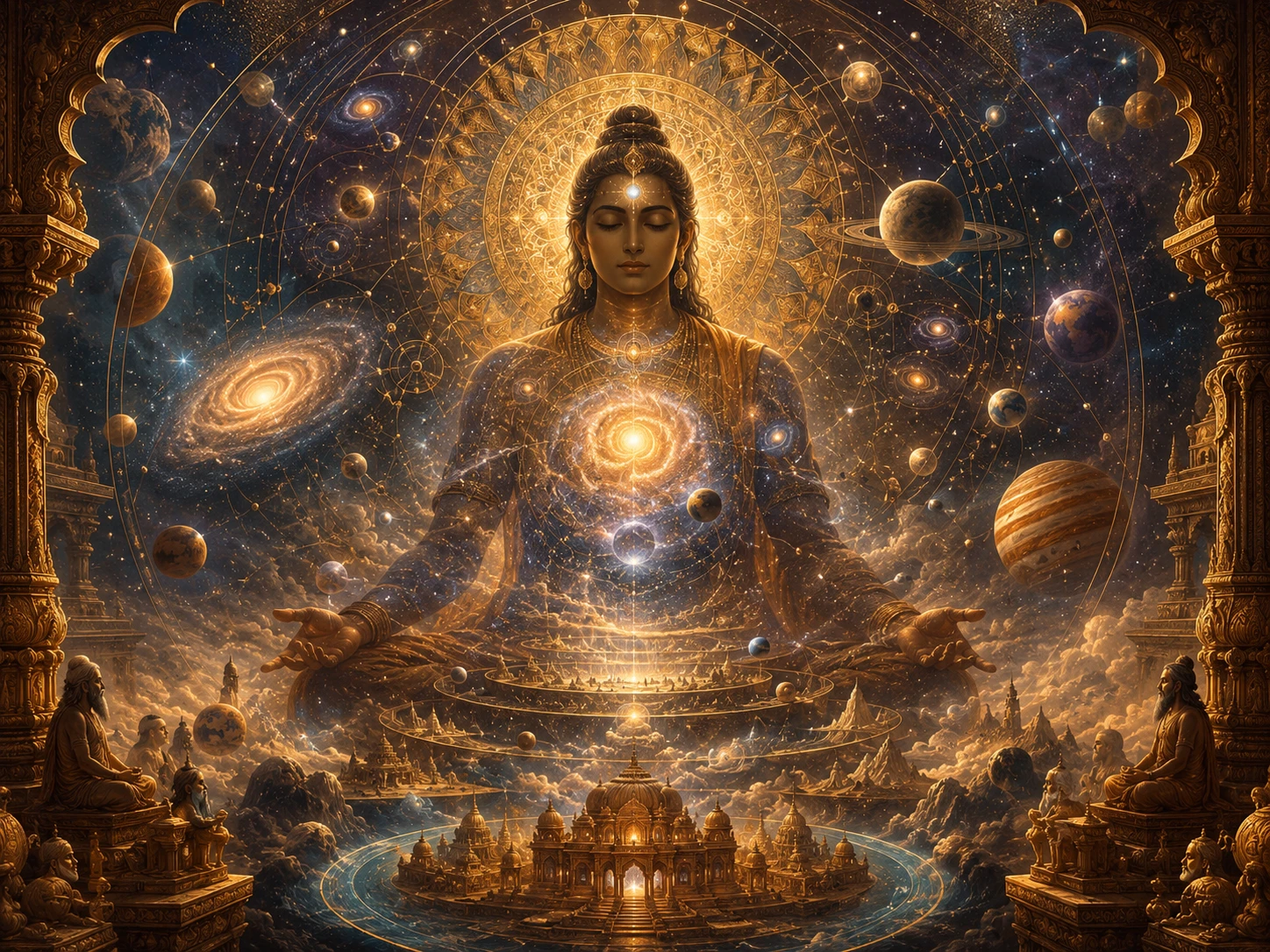
The 14 Lokas -- Hindu Cosmology as a Map of Consciousness
१४ लोक -- चेतना के मानचित्र के रूप में हिन्दू ब्रह्माण्ड
What if heaven and hell are not places?
Open any standard description of Hindu cosmology and you will be told the same thing. There are fourteen worlds. Seven above the earth -- Bhuloka, Bhuvarloka, Svarloka, Maharloka, Janaloka, Tapaloka, Satyaloka. Seven below it -- Atala, Vitala, Sutala, Talatala, Mahatala, Rasatala, Patala. The Bhagavata Purana measures them in yojanas. The Vishnu Purana names their presiding rulers. Children's textbooks draw them as a layer cake with Brahma at the top and Vasuki at the bottom.
All of which is correct, and all of which somehow misses the point.
Because if you ask a serious Yogi or a Vedantic teacher what the lokas actually are, the answer is not astronomical. It is psychological. The 14 lokas, in the Yogic reading, are not separate places to which souls travel after death. They are states of mind that you move through, sometimes within a single Tuesday afternoon. Satyaloka is what pure awareness feels like at 4 AM when the city is still and the breath has settled. Patala is what depression feels like at 4 PM when the work email arrives and the body refuses to move. Both are real. Both are mapped. And the map is older than the Pyramids.
This article holds two readings together. The Puranic cosmology -- ancient, literal, full of Daityas and Nagas and yojana measurements -- is the authority. The Yogic interpretation -- consciousness as cartography -- is the lens through which most thoughtful Hindu seekers actually use the cosmology today. Both belong. Neither replaces the other.
ॐ भूः । ॐ भुवः । ॐ स्वः । ॐ महः । ॐ जनः । ॐ तपः । ॐ सत्यम् ॥
om bhuh. om bhuvah. om svah. om mahah. om janah. om tapah. om satyam.
Om: Earth. Om: the Atmosphere. Om: the Heavens. Om: the Great. Om: the Generative. Om: the Austere. Om: the Real.
— Taittiriya Aranyaka 10.27.1 (the Sapta Vyahriti, recited daily in Sandhyavandanam)
Climbing upward: consciousness expanding
Start at Bhuloka. This is the world your senses register. The smell of dosa batter at the Udupi cafeteria. The weight of the laptop bag on your shoulder during the 8 AM Mumbai local. The coldness of a Bangalore air-conditioned office. Bhuloka is solid, sensory, here. The Yogic reading calls this physical consciousness, and it is not a low or unworthy state. It is simply the floor.
Above Bhuloka sits Bhuvarloka, the realm of vital and mental signals. The Bhagavata Purana places it between earth and the sun, populated by celestial Siddhas and minor deities. The Yogic reading describes it as the layer where thought arises -- the constant background hum of mental signals you receive without realising it. The Instagram reel that shifted your mood before breakfast. The line from a podcast that made you reconsider your job. Bhuvarloka is the realm of received transmissions. You do not generate most of your thoughts. You catch them.
Svarloka is the realm of svar -- of light, of sun, of celebration. Indra rules it in the Puranic account. The Yogic reading equates it with peak experience: the moment your name is called at the convocation, the second the cricket ball clears the boundary in the World Cup final, the night your startup gets its first paying customer. Svarga is real, and the Yogic tradition wants you to know two things about it. It is a state, not a destination. And like every state, it ends.
Maharloka is harder to translate. The Puranic account places it above the Polestar, where great sages dwell after the dissolution of lower worlds. The Yogic reading calls it the witness state -- the moment you stop reacting and start watching. The colleague snaps at you in the meeting; instead of firing back, something in you observes the whole exchange like a scene in a film. That observation is Maharloka. It is the first taste of the part of you that is not your reactions.
Janaloka, Tapaloka, Satyaloka -- these are the three upper realms reserved in Puranic tradition for souls beyond ordinary reach. Janaloka is the realm of Brahma's mind-born sons. Tapaloka is the realm of accumulated tapas, ascetic heat. Satyaloka is the realm of pure being. The Yogic reading mirrors this in deepening order: Janaloka is total clarity, the moment when what you should do becomes obvious without needing a pros-and-cons list. Tapaloka is total absorption, the state of focus where the IIT student forgets to eat for six hours. Satyaloka is what remains when even focus drops away -- pure awareness, before any object arises in it.
These are not metaphors stacked on top of cosmology. They are the same map read at two different scales. The Vedic seers who composed the Sapta Vyahriti understood that the body, the breath, and the cosmos share an architecture. Bhur bhuvah svah is the chant of three worlds and three layers of self at once.
14 Lokas — Map of Consciousness
Tap any loka — three readings unfold
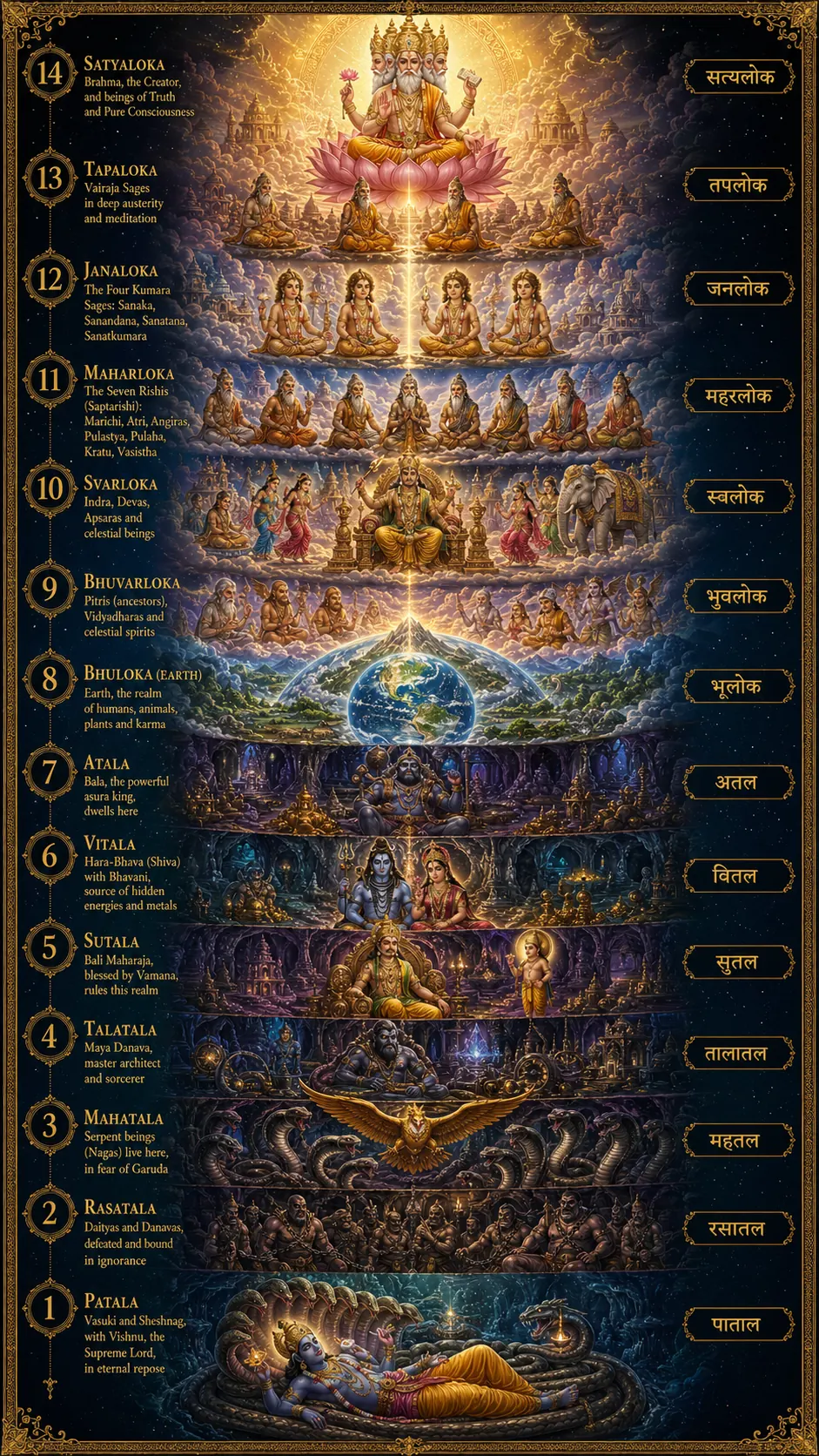
Sources: Srimad Bhagavata Purana · Vishnu Purana · Taittiriya Aranyaka
The Sapta Vyahriti -- the seven-fold chant of bhuh, bhuvah, svah, mahah, janah, tapah, satyam -- is recited by every Brahmin performing daily Sandhyavandanam. Most people know the first three from the Gayatri Mantra preamble. The full seven actually traverse all seven upper lokas. So a morning sandhya in Pune or Madurai is, technically, a daily walk up the cosmic ladder -- whether the reciter is conscious of it or not. The chant has been doing the inner climb on autopilot for three thousand years.
Going down: how consciousness descends
The Bhagavata Purana describes the seven lower lokas as bila-svarga -- subterranean heavens. It is a striking phrase. The lower realms in the Puranic account are not simple hells. They are realms of intense sensual pleasure, vast wealth, and architectural splendour. Daityas, Danavas, and Nagas live in mansions and gardens. The text is explicit that these worlds outshine the upper ones in material opulence.
What makes them lower is not poverty. It is direction.
The Yogic reading clarifies the distinction. The upper lokas are states where consciousness expands -- you become aware of more, you identify with more, you see further. The lower lokas are states where consciousness contracts -- you become aware of less, you identify with one narrow thing, you cannot see past it. Atala's pleasure trap is a contraction into the next scroll. Talatala's comparison illusion is a contraction into one Instagram grid. Patala's depression is contraction into the body that will not move.
Both directions feel like fullness from the inside. That is the deception. The luxury palaces of Mahatala feel like success. The dim cave of Patala feels like the only place you have ever really lived. Each loka, upper or lower, presents itself as the whole world while you are inside it. This is precisely why the cosmology was drawn -- to give the soul a map larger than any single state, so that the state can be located instead of mistaken for reality.
अवनेरप्यधस्तात्सप्त भू-विवरा एकैकशो योजनायुतान्तरेण। अतलं वितलं सुतलं तलातलं महातलं रसातलं पातालमिति॥
avaner apy adhastat sapta bhū-vivarā ekaikaśo yojanāyutāntareṇa. atalaṁ vitalaṁ sutalaṁ talātalaṁ mahātalaṁ rasātalaṁ pātālam iti.
Below the earth too are seven cavernous worlds, separated one from another by ten thousand yojanas: Atala, Vitala, Sutala, Talatala, Mahatala, Rasatala, and Patala.
— Srimad Bhagavata Purana 5.24.7 (Shukadeva Goswami to King Parikshit)
Three readings of the same map
| Loka | लोक | Puranic cosmology | Yogic state of mind | Modern signal |
|---|---|---|---|---|
| Satyaloka | सत्यलोक | Brahma's abode, beyond rebirth | Pure objectless awareness | The 4 AM stillness no app can give |
| Tapaloka | तपलोक | Realm of the Vairaja gods | Total absorption, ascetic heat | JEE topper losing track of six hours |
| Janaloka | जनलोक | Mind-born sons of Brahma | Direct insight without analysis | AIIMS doctor reading the chart by the door |
| Maharloka | महर्लोक | Above Polestar; great rishis | Witness state, watching the reaction | Manager pausing before the email reply |
| Svarloka | स्वर्लोक | Indra's heaven, Apsaras, Soma | Peak experience, summit happiness | Green-card phone call at 2 AM |
| Bhuvarloka | भुवर्लोक | Realm of Pitris, Siddhas, Charanas | Vital and thought signals | Mood shifted by sixty seconds of Reels |
| Bhuloka | भूलोक | The earth, Mount Meru at centre | Physical sensory consciousness | The chair, the chai, this paragraph |
| Atala | अतल | Bala the demon's pleasure realm | The pleasure trap, soft addiction | Two hours of Reels called 'relaxation' |
| Vitala | वितल | Hara-Bhava and Bhavani | Reactivity overtaking thought | The reply you regret by evening |
| Sutala | सुतल | Bali Maharaja's devoted court | Spiritual material as craving | Counting yoga followers, not breaths |
| Talatala | तलातल | Maya Danava, master of illusion | Comparison illusion, branded ego | LinkedIn at 11 PM, every night |
| Mahatala | महातल | Many-hooded serpents in fear | Anxiety as ambient default | Waking at 3 AM convinced something's wrong |
| Rasatala | रसातल | Daityas and Danavas confined | Extreme low energy, fuel gone | Thesis open nine days, untouched |
| Patala | पाताल | Vasuki and the Naga kings | The depression abyss | The exit is real but invisible from inside |
The three readings are not in conflict. The Puranic cosmology is the literal text. The Yogic state-of-mind interpretation is the inner application taught by Vedantic and Tantric lineages. The modern signal is the layer at which you and I encounter the same architecture in 2026.
What is canonical, what is interpretive
Honesty matters here. Not every claim in this article carries the same authority.
The 14 lokas as cosmic regions, the names in their Bhagavata order, and the inhabitants of each are canonical. They appear in the Bhagavata Purana, the Vishnu Purana, the Padma Purana, and others -- with some variation in lower-loka ordering across texts. Quoting them as the scriptural cosmology is straightforward.
The mapping of lokas to states of consciousness is interpretive. It has solid roots in the Yogic and Vedantic traditions -- the Hindupedia consciousness studies entry traces it through the Mandukya Upanishad and the Pancha Kosha framework, and David Frawley's American Institute of Vedic Studies treats it as standard Yogic teaching. But it is not stated in this exact psychological form in the Puranic text itself.
The Instagram-and-burnout layer -- Atala as scrolling, Talatala as LinkedIn, Patala as clinical depression -- is contemporary application. It is the lens this article uses because it is how the framework actually meets present life. But it is one application among many. A rural farmer in Bundelkhand and a Mumbai banker may both cycle through the lokas, though the specific triggers and faces will differ.
Read this article as three layers. Do not let the modern application crowd out the ancient cosmology, and do not let the cosmology be reduced to mere psychology. Both are doing real work. The Puranic seers gave us a vocabulary deeper than any modern psychological language for naming inner states. Honouring the source is the first step of using the gift well.
The climb back, and why it begins so small
Every Yogic teacher who has worked with the lokas as states of mind says the same thing about the climb back from any lower realm. It does not begin large. It begins absurdly small.
From Patala -- the abyss -- the first step is breath. Just one. Not pranayama, not a session, not a routine. One conscious inhale and exhale. From Rasatala -- the dullness -- the first step is a glass of water and standing up. From Mahatala -- the anxiety -- the first step is naming what you are anxious about, out loud, to one human being. From Talatala -- the comparison loop -- the first step is closing one app for one hour. From Atala -- the pleasure trap -- the first step is letting yourself be bored for ten minutes without reaching for the phone.
Why so small? Because each lower loka has installed a particular contraction, and the contraction has reduced what feels possible. From inside Patala, climbing to Bhuloka feels like climbing Everest. So you do not aim for Bhuloka. You aim for the next breath. And in taking it, the contraction loosens by exactly one breath's worth. Then the next loosening becomes possible.
This is the practical teaching of the cosmology. The map is not for admiration. It is for navigation. You locate your loka -- which one is currently playing as the sound of your life -- and you take the smallest action that points one notch upward. The Sapta Vyahriti chant, Gayatri Mantra Japa, Sandhyavandanam at dawn, even just lighting a single diya at dusk -- these are the small actions traditional Hinduism has handed down for exactly this purpose. The action is small. The architecture it walks within is fourteen worlds tall.
Begin with the Sapta Vyahriti
The Sapta Vyahriti -- Om Bhuh, Om Bhuvah, Om Svah, Om Mahah, Om Janah, Om Tapah, Om Satyam -- names the seven upper lokas and takes thirty seconds. Recited at dawn, it walks the cosmic ladder once before the day begins. It is not yet on Eternal Raga as a page of its own; the mantra library has the Gayatri and other Vedic mantras.
Tags
Eternal Raga · शाश्वत राग
Institutional voice — scholarly articles on Sanatan Dharma
Deepen Your Understanding
अपनी समझ और गहरी करें
vedic sciences
Kaal Ganana -- The Hindu Measure of Time
From a single blink of the eye (Nimesha) to one Day of Brahma (4.32 billion years) -- explore the complete cosmic time hierarchy of Hindu cosmology, anchored in Vishnu Purana 1.3, with its remarkable parallels to modern science.
vedic sciences
The 14 Manus -- Cosmic Reset Buttons of Hindu Time
Hindu cosmology does not have one Adam. It has fourteen. Each Manvantara -- a cosmic era of 306.72 million years -- is governed by a different Manu who repopulates the earth, establishes dharma, and oversees a fresh team of gods, sages, and an Indra. We are currently in the 7th Manvantara, ruled by Vaivasvata Manu, son of Surya. Seven Manus have served. Seven are yet to come. And Vishnu takes a new avatar for each.
vedic sciences
The Four Yugas -- How Long They Last, How People Lived, and Where We Are Now
Hindu cosmology divides time into four ages -- Satya, Treta, Dvapara, and Kali -- each shorter, darker, and more morally degraded than the last. In Satya Yuga, humans lived 100,000 years and dharma stood on all four legs. In Kali Yuga -- our age -- the average lifespan is 100 years and dharma balances on one leg. This is not pessimism. It is a cosmic weather forecast.
philosophy darshana
Pancha Kosha -- The Five Sheaths of Consciousness and What Actually Leaves the Body at Death
The internet says the soul weighs 21 grams. The Taittiriya Upanishad says the soul has no weight because it is not a physical thing -- it is consciousness layered in five sheaths from food to bliss. Hindu psychology mapped the human being into five nested layers 2,500 years before Freud drew three. Here is the complete framework, with what actually happens at death according to scripture.
vedic sciences
Hiranyagarbha -- The Golden Egg That Became the Universe
Before the Big Bang had a name, the Rig Veda described creation erupting from a golden cosmic egg -- Hiranyagarbha. The Shiva Purana says Shiva split it. The Vishnu Purana says Vishnu incubated it. The Manusmriti says it floated in darkness for a year. And the Nasadiya Sukta says: honestly, who really knows? Five texts, five creation stories, one civilisation honest enough to hold them all simultaneously.
philosophy darshana
Maya -- The Cosmic Illusion That Runs the Universe
You walk down a dark path and see a snake. Your heart pounds, your body freezes. Then someone brings a lamp. It was a rope. The snake was never there. Hindu philosophy says the entire universe works exactly like this -- and the lamp is called knowledge. Welcome to Maya, the most counterintuitive and most liberating idea in Indian thought.
The Sapta Vyahriti -- the seven-fold chant of bhuh, bhuvah, svah, mahah, janah, tapah, satyam -- is recited by every Brahmin performing daily Sandhyavandanam. Most people know the first three from the Gayatri Mantra prea…
More in Philosophy & Darshana
Achintya Bhedabheda -- Chaitanya's Theology of Inconceivable Difference-and-Unity
13 min read
Adhyasa -- Superimposition and the Foundational Error of the Self
13 min readAdi Shankaracharya -- The Teacher of Advaita
4 min readThe same translation error that turned '33 Koti' into '33 crore' in Hinduism also happened in Buddhism. The Chinese translation of Buddhist texts rendered 'Sapta Koti Buddha' (7 Supreme Buddhas) as '7 Crore Buddhas.' The…
Deities AvatarsWatch: The 14 Lokas Explained
Community Reflections
🕉️
Be the first to share your reflection.