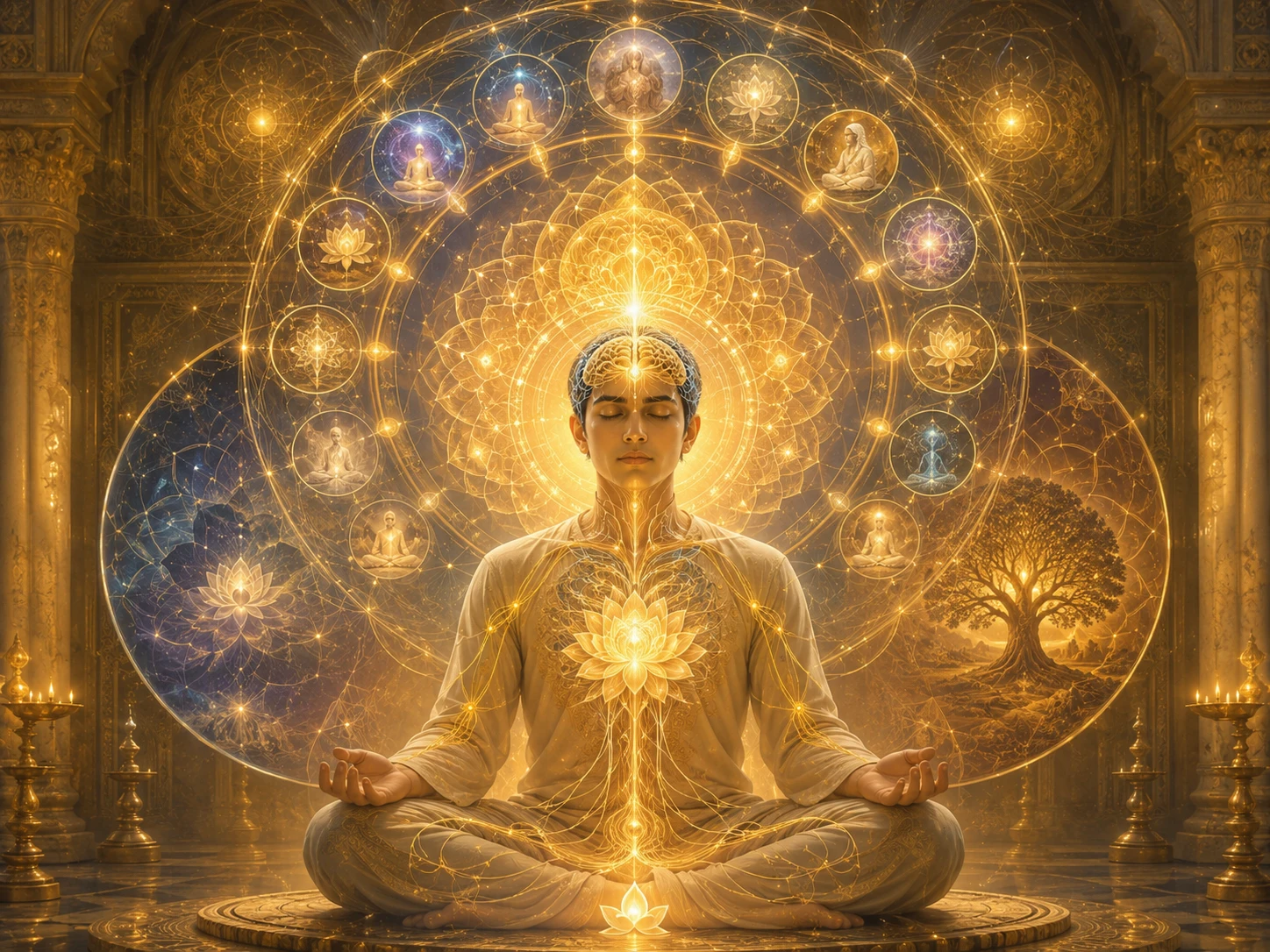
Pancha Kosha -- The Five Sheaths of Consciousness and What Actually Leaves the Body at Death
पञ्चकोश -- चेतना के पाँच आवरण और मृत्यु पर शरीर से वास्तव में क्या जाता है
Introduction -- You Are Not Your Body. You Are Not Your Mind Either.
A viral claim circulates on the internet: the human soul weighs 21 grams. The source is an experiment conducted in 1907 by Dr. Duncan MacDougall of Haverhill, Massachusetts, who placed six dying patients on a bed-scale and measured any weight change at the moment of death. One patient showed a drop of approximately 21 grams. The other five gave inconsistent, contradictory, or no measurable results. Sample size: 6. Positive result: 1. Controls: none. The experiment has never been replicated in 117 years of modern science. It was popularised in 2003 by the Sean Penn film '21 Grams' and has since become one of the internet's most persistent pseudoscientific memes.
The claim is false. But the question behind it is genuine: does something leave the body at death? If so, what? And can it be described systematically?
The Taittiriya Upanishad answered this question approximately 2,500 years ago -- not with a bathroom scale but with one of the most rigorous psychological frameworks in human intellectual history. The Pancha Kosha model (Five Sheaths), presented in the Brahmananda Valli (Chapter 2, Anuvakas 1-5), maps the human being as five concentric layers of existence, nested like the sheaths of a sword. The outermost layer is physical. The innermost is bliss. And the Atman -- the Self, the consciousness -- is not any of these layers. It is what remains when all five are removed.
The Bhagavad Gita calls this knowledge 'Adhyatma Vidya' -- the Science of the Self -- and Krishna declares it the supreme among all sciences (Gita 10.32: 'adhyatma vidya vidyanam'). Professor L.D. Russell's observation is precise: if Western science is the study of the Observed, the Vedic tradition is the exhaustive science of the Observer.
This article presents the five Koshas with exact Upanishadic citations, explains what actually happens at death according to the Brihadaranyaka Upanishad, debunks the 21 grams myth, and connects the framework to modern psychology, neuroscience, and the lived experience of any human being who has ever asked: 'Who am I, really?'
सत्यं ज्ञानमनन्तं ब्रह्म। यो वेद निहितं गुहायां परमे व्योमन्। सोऽश्नुते सर्वान् कामान् सह ब्रह्मणा विपश्चितेति॥
satyam jnaanam anantam brahma yo veda nihitam guhaayaam parame vyoman so ashnute sarvaan kaamaan saha brahmanaa vipashchiteti
Brahman is Truth, Knowledge, and Infinite. One who knows It as hidden in the cave of the heart, in the highest space -- that one attains all desires along with the omniscient Brahman.
— Taittiriya Upanishad, Brahmananda Valli, Anuvaka 2.1.1
The Five Koshas -- Layer by Layer
The Brahmananda Valli of the Taittiriya Upanishad (Chapter 2, Anuvakas 1-5) presents the five Koshas as progressively subtler layers of existence, each enveloping and concealing the one within it. The metaphor is precise: the word 'Kosha' means 'sheath' -- like the scabbard of a sword. The sword (Atman) is hidden inside, but the sheaths are not the sword.
1. ANNAMAYA KOSHA -- The Food Sheath (Anuvaka 2.1) The outermost layer. 'Anna' means food. The physical body is literally made of food: you eat rice, dal, vegetables, and your body converts them into flesh, bone, blood, and tissue. When you die, the body decomposes back into the elements from which food grows. The Upanishad states: 'From food all beings are born. Having been born, they live by food. On departing, they merge into food.' This is not metaphor. This is biochemistry stated in 7th century BCE Sanskrit.
Modern parallel: The entire field of nutrition science, dietetics, and sports physiology operates at the Annamaya level. When a NEET aspirant studies anatomy, they are studying the Annamaya Kosha. A gym trainer calculating macros is optimising the Annamaya Kosha. This layer is real, important, and necessary -- but it is only the outermost.
2. PRANAMAYA KOSHA -- The Vital Breath Sheath (Anuvaka 2.2) Inside the food body lives the breath body. 'Prana' is not just breathing. It is the animating life-force -- the difference between a living body and a corpse. Both have the same physical components. What the corpse lacks is Prana. The Upanishad identifies five Pranas: Prana (inhalation), Apana (exhalation/elimination), Vyana (circulation), Udana (upward movement -- responsible for speech, vomiting, and the moment of death), and Samana (digestion). When Prana leaves, the body is dead. The physical matter remains; the animation stops.
Modern parallel: When AIIMS doctors declare a patient brain-dead but keep the heart pumping with ventilators for organ harvesting, they are maintaining the Annamaya while the Pranamaya has departed. The transplant window operates in precisely this gap between the Koshas.
3. MANOMAYA KOSHA -- The Mental Sheath (Anuvaka 2.3) Inside the breath body lives the mind. Manas (mind) includes thoughts, emotions, desires, fears, and memory. This is the layer where you experience joy, anger, anxiety, love, and the 3 AM existential crisis about your career. The Upanishad says the Manomaya is characterised by 'the power to will' and 'the ability to wish.' It is the seat of personality.
Modern parallel: Western psychology -- from Freud to CBT to mindfulness-based therapy -- operates almost entirely at the Manomaya level. When a therapist at Practo or Talkspace asks you to examine your thought patterns, they are working on the Manomaya Kosha. This is the layer most modern humans identify as 'who I am,' and the Upanishad's entire point is that this identification is incomplete.
4. VIJNANAMAYA KOSHA -- The Wisdom/Intellect Sheath (Anuvaka 2.4) Deeper than the reactive mind is the discriminating intellect. Vijnana means 'special knowledge' -- the capacity for discernment, ethical reasoning, and truth-seeking. This is not just IQ. It is the faculty that distinguishes right from wrong, real from unreal, permanent from temporary. The Upanishad says the Vijnanamaya is characterised by 'faith (shraddha), justice (ritam), truth (satyam), yoga, and mahas (power to perceive).'
Modern parallel: The entire legal system, ethical philosophy, and scientific method operate at Vijnanamaya. When a Supreme Court judge weighs constitutional principles, or when a scientist designs a controlled experiment to separate correlation from causation, or when a UPSC aspirant studies Ethics in Paper IV -- that is Vijnanamaya functioning.
5. ANANDAMAYA KOSHA -- The Bliss Sheath (Anuvakas 2.5-2.6) The innermost sheath. Ananda means bliss -- not pleasure, not excitement, not the dopamine hit from Zomato delivering biryani. It is the deep, objectless contentment that occasionally surfaces in dreamless sleep, in moments of spontaneous wonder, or in deep meditation. The Upanishad identifies it as the closest layer to the Atman -- but even this is still a Kosha, still a sheath. Beyond Anandamaya lies the Atman itself, which is not a Kosha but the witness of all five.
Modern parallel: The 'flow state' described by psychologist Mihaly Csikszentmihalyi, the 'peak experience' described by Abraham Maslow, and the measurable changes in default mode network deactivation during deep meditation all point toward the Anandamaya level. But these are still experiences. The Atman, says the Upanishad, is the experiencer.
The Five Koshas -- A Complete Map
| Kosha | Sanskrit | Meaning | What It Contains | Modern Equivalent | Source Anuvaka |
|---|---|---|---|---|---|
| Annamaya | अन्नमय | Made of Food | Physical body, organs, bones, tissue | Anatomy, nutrition, sports science | 2.1 |
| Pranamaya | प्राणमय | Made of Breath | Five Pranas: Prana, Apana, Vyana, Udana, Samana | Respiratory physiology, acupuncture, breathwork | 2.2 |
| Manomaya | मनोमय | Made of Mind | Thoughts, emotions, desires, memory, personality | Psychology, psychiatry, CBT, mindfulness | 2.3 |
| Vijnanamaya | विज्ञानमय | Made of Wisdom | Discernment, ethics, reason, faith, truth-seeking | Philosophy, law, scientific method, ethics | 2.4 |
| Anandamaya | आनन्दमय | Made of Bliss | Deep contentment, objectless joy, seed of all experience | Flow state, peak experience, deep meditation | 2.5-2.6 |
Source: Taittiriya Upanishad, Brahmananda Valli, Anuvakas 2.1 through 2.6. The Atman (Self) is NOT a sixth Kosha -- it is the witness consciousness that remains when all five sheaths are transcended. The Bhrigu Valli (Chapter 3) narrates Bhrigu's progressive discovery of each Kosha, discarding each in turn until reaching Ananda and beyond.
What Actually Leaves the Body at Death -- The Scriptural Account
The 21 grams experiment tried to weigh the departure of the soul. The Upanishads describe the process in detail -- but what they describe is not a physical departure of mass. It is a withdrawal of consciousness through layers.
The Brihadaranyaka Upanishad (Chapter 4, Brahmana 4, 'Death and the Hereafter') provides the most precise description of the death process in all of Hindu scripture. Yajnavalkya teaches King Janaka:
Brihadaranyaka 4.4.1-2: When the Self is about to depart, the Pranas (vital forces) gather around it. The self collects these points of light (the faculties of perception) to itself and descends into the heart. The tip of the heart lights up. Through that illuminated tip, the Self departs -- through the eye, the skull, or other aperture, depending on the individual's karma and state of consciousness. The life-force (Prana) departs along with the Self. When Prana departs, all the other Pranas depart after it. The Self becomes 'conscious' and goes to whatever state its consciousness and karma lead it.
In Pancha Kosha terms, this is what happens: the Annamaya Kosha (physical body) stays behind as a corpse. Everything else -- Pranamaya (vital breath), Manomaya (mind, memories, desires), Vijnanamaya (intellect, karma-impressions), and a seed-form of Anandamaya -- departs with the Atman as the 'Sukshma Sharira' (subtle body). This is what 'leaves' at death. It has no mass because it is not made of matter. It is made of Prana, Manas, Vijnana, and Ananda -- none of which register on a physical scale.
The Bhagavad Gita (2.22) offers the most famous metaphor for this process: 'Vasamsi jirnani yatha vihaya navani grhnati naro aparani, tatha sharirani vihaya jirnani anyani samyati navani dehi.' -- 'As a person discards worn-out clothes and puts on new ones, so the embodied Self discards worn-out bodies and enters new ones.'
The Katha Upanishad (1.1.20) adds: 'The Self is subtler than the subtle, greater than the great. It is hidden in the heart of each creature. One who is free from desire, with mind and senses composed, beholds the glory of the Self and is freed from sorrow.'
For an organ donor registered with NOTTO (National Organ and Tissue Transplant Organisation), the Kosha framework provides an elegant ethical basis: the Annamaya Kosha (physical organs) can serve others because the person -- the Atman with its four subtler Koshas -- has already departed. The body is not 'you' anymore. It is the discarded sheath.
वासांसि जीर्णानि यथा विहाय नवानि गृह्णाति नरोऽपराणि। तथा शरीराणि विहाय जीर्णान्यन्यानि संयाति नवानि देही॥
vaasaamsi jiirnaani yathaa vihaaya navaani grhnaati naro aparaani tathaa shariraani vihaaya jiirnaany anyaani samyaati navaani dehii
As a person discards worn-out clothes and puts on new ones, so the embodied Self discards worn-out bodies and enters new ones.
— Bhagavad Gita, Chapter 2, Verse 22
Adhyatma Vidya -- The Supreme Science
In Bhagavad Gita 10.32, Krishna lists his divine manifestations (Vibhutis) and declares: 'Adhyatma vidya vidyanam' -- 'Among sciences, I am the Science of the Self.' This is not a casual remark. It is a categorical ranking. Krishna does not say Adhyatma Vidya is one among many sciences. He says it is the supreme science -- the science that, when mastered, makes all other sciences comprehensible in their proper context.
The Patanjali Yoga Sutras (2.17) define the core problem: 'Drashtri-drishyayoh samyogo heya-hetuh' -- 'The cause of suffering is the identification of the Seer (Drashta) with the Seen (Drishya).' In Kosha language: you mistake the Annamaya for yourself, or the Manomaya for yourself, and suffer because these layers change, age, get sick, get anxious, and die. The Atman -- the Seer, the Observer -- does none of these things. It watches.
Professor Russell's formulation is elegant: Western science has mastered the Observed. It can split atoms, sequence genomes, and photograph black holes. What it has not done is turn the instrument of investigation on the investigator. Hindu psychology -- through the Pancha Kosha model, the Mandukya Upanishad's four states of consciousness, and the Yoga Sutras' systematic training of attention -- offers exactly this: a technology for the Observer to observe itself.
The Taittiriya Upanishad's Bhrigu Valli (Chapter 3) dramatises this method. Bhrigu approaches his father Varuna and asks: 'Teach me Brahman.' Varuna says: 'That from which beings are born, by which they live, and into which they return -- seek to know That. That is Brahman.' Bhrigu performs tapas (concentrated inquiry) and first concludes: 'Food (Anna) is Brahman!' He goes deeper. 'Prana is Brahman!' Deeper. 'Mind is Brahman!' Deeper. 'Vijnana is Brahman!' Deeper still. 'Ananda is Brahman!' Each time he discovers that the previous answer was a Kosha, not the core. Each time Varuna sends him back to inquire further.
This is the original scientific method applied to consciousness -- hypothesis, investigation, refinement, repeat -- 2,500 years before Bacon formalised it for the physical world.
अध्यात्मविद्या विद्यानां वादः प्रवदतामहम्।
adhyaatma vidyaa vidyaanaam vaadah pravadataam aham
Among sciences, I am the Science of the Self (Adhyatma Vidya). Among debates, I am the conclusive argument.
— Bhagavad Gita, Chapter 10, Verse 32
The 21 grams experiment (Dr. Duncan MacDougall, 1907) had a sample size of 6 patients. Only 1 showed a 21-gram weight loss at death. The other 5 gave no consistent results. The experiment has never been replicated in 117 years. MacDougall himself called his results 'not conclusive' in his original paper published in American Medicine (March 1907). The number '21 grams' entered popular culture through a 2003 film starring Sean Penn. Meanwhile, the Brihadaranyaka Upanishad (4.4.1-2), composed circa 700 BCE, describes the death process with far greater specificity: the pranas gather, the faculties collect like points of light, the heart tip illuminates, and the Self departs through a specific aperture. The Upanishad does not assign a weight because consciousness is not matter.
The Pancha Kosha model maps remarkably onto Abraham Maslow's Hierarchy of Needs (1943): Annamaya = Physiological needs, Pranamaya = Safety/survival, Manomaya = Belonging/love, Vijnanamaya = Esteem/self-actualisation, Anandamaya = Transcendence (which Maslow added as a late revision in 1969). But the Kosha model is more precise -- it does not merely list needs but describes layers of identity that must be progressively transcended. Where Maslow says 'fulfil this need,' the Upanishad says 'you are not this layer.' The direction is opposite: Maslow builds upward from deficiency. The Upanishad peels inward toward sufficiency.
Conclusion -- The Observer Behind the Observed
The 21 grams meme will continue to circulate. Instagram will keep posting it. YouTube shorts will keep dramatising it with spooky music and a ticking scale. And every time it appears, it will reveal the same gap: the Western materialist instinct to weigh, measure, and photograph everything -- including consciousness -- against a tradition that spent 2,500 years mapping consciousness from the inside and concluded that it has no weight because it is not a thing. It is the knower of things.
The Pancha Kosha framework is not mysticism. It is a systematic, falsifiable, experienceable map. You can test it right now: close your eyes. Notice your body (Annamaya). Notice your breath (Pranamaya). Notice your thoughts (Manomaya). Notice that something is watching the thoughts (Vijnanamaya). And notice that even the watcher can be watched -- by a silent, content awareness that does not change (Anandamaya). That awareness is not any of the layers. It is you.
The Taittiriya Upanishad does not ask you to believe this. It asks you to verify it. That is why Krishna calls it the supreme science. It is not faith. It is investigation.
Begin.
Practice Kosha Meditation
Observe in turn your body, your breath, your thoughts, your intellect, and the silent awareness behind all of them, a few minutes each. The Taittiriya Upanishad is the script; your attention is the instrument. The Taittiriya is on Eternal Raga with Sanskrit and translation.
Tags
Eternal Raga · शाश्वत राग
Institutional voice — scholarly articles on Sanatan Dharma
Deepen Your Understanding
अपनी समझ और गहरी करें
philosophy darshana
Om -- The Sound That Contains the Universe
Om is not a chant. It is not a religious symbol. According to the Mandukya Upanishad, it is the complete map of consciousness itself -- past, present, future, and whatever lies beyond all three. Twelve verses. Four states. One syllable. This is the most concentrated philosophical text in human history, and it fits on a single page.
vedic sciences
Kaal Ganana -- The Hindu Measure of Time
From a single blink of the eye (Nimesha) to one Day of Brahma (4.32 billion years) -- explore the complete cosmic time hierarchy of Hindu cosmology, anchored in Vishnu Purana 1.3, with its remarkable parallels to modern science.
vedic sciences
Hiranyagarbha -- The Golden Egg That Became the Universe
Before the Big Bang had a name, the Rig Veda described creation erupting from a golden cosmic egg -- Hiranyagarbha. The Shiva Purana says Shiva split it. The Vishnu Purana says Vishnu incubated it. The Manusmriti says it floated in darkness for a year. And the Nasadiya Sukta says: honestly, who really knows? Five texts, five creation stories, one civilisation honest enough to hold them all simultaneously.
tantra mantra yantra
Tantra, Mantra and Yantra -- The Three Pillars of Spiritual Practice
Tantra is the loom, Mantra is the thread, Yantra is the pattern. Together they form the complete technology of spiritual transformation that India gifted to the world -- and they are far more profound than popular culture imagines.
scriptural exegesis
Chandogya Upanishad -- Tat Tvam Asi
A 24-year-old returns from 12 years of Vedic study, bloated with pride and stuffed with textbook knowledge, only to have his father demolish his certainty with nine repetitions of three words: Tat Tvam Asi -- You Are That. The Chandogya Upanishad is the text that broke the wall between God and you.
The 21 grams experiment (Dr. Duncan MacDougall, 1907) had a sample size of 6 patients. Only 1 showed a 21-gram weight loss at death. The other 5 gave no consistent results. The experiment has never been replicated in 117…
More in Philosophy & Darshana
The 14 Lokas -- Hindu Cosmology as a Map of Consciousness
14 min read
Achintya Bhedabheda -- Chaitanya's Theology of Inconceivable Difference-and-Unity
13 min read
Adhyasa -- Superimposition and the Foundational Error of the Self
13 min readThe same translation error that turned '33 Koti' into '33 crore' in Hinduism also happened in Buddhism. The Chinese translation of Buddhist texts rendered 'Sapta Koti Buddha' (7 Supreme Buddhas) as '7 Crore Buddhas.' The…
Deities AvatarsCommunity Reflections
🕉️
Be the first to share your reflection.