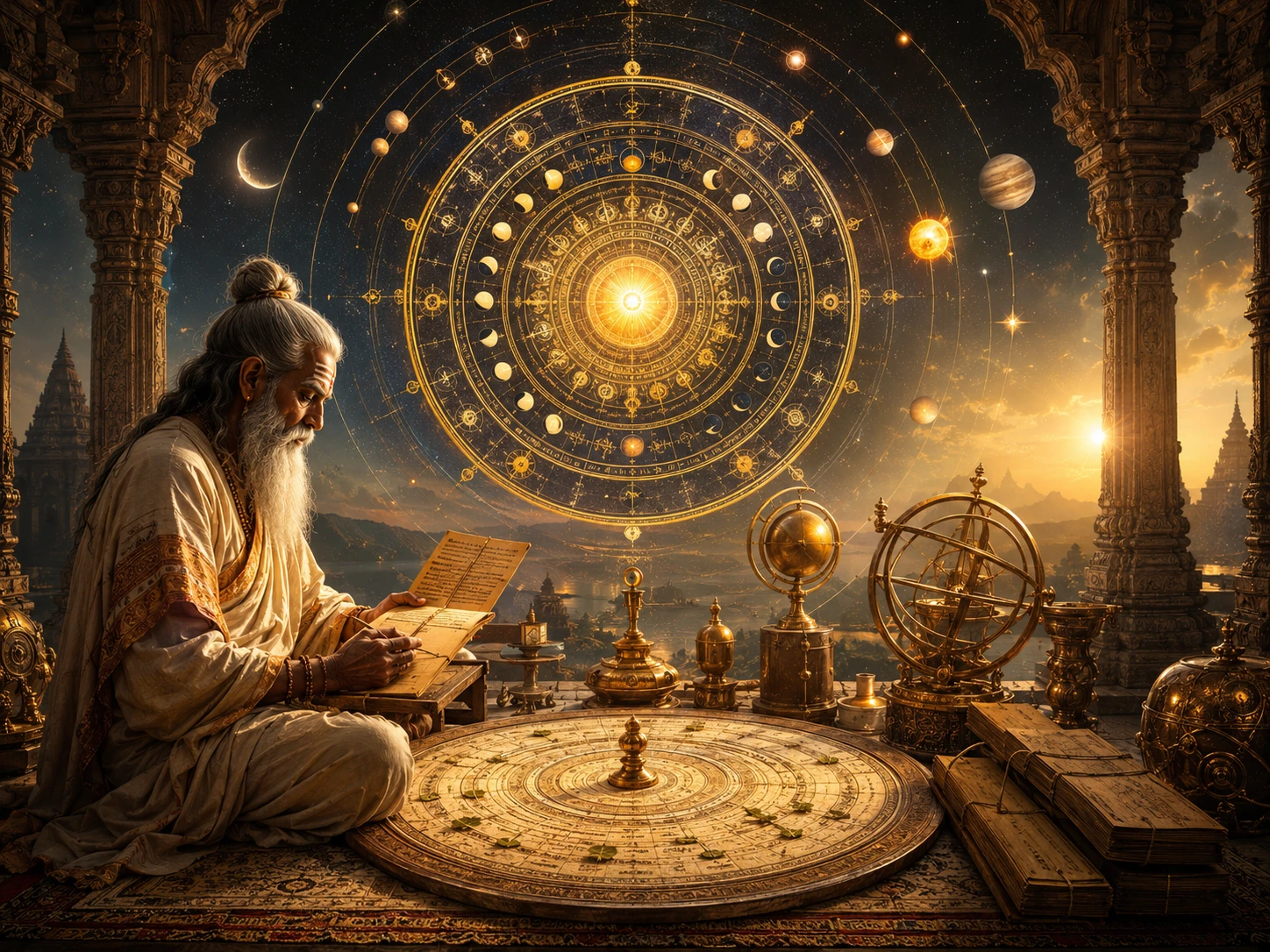
Kaal Ganana -- The Hindu Measure of Time
काल गणना -- हिन्दू काल मापन पद्धति
Long before the world measured time in seconds and milliseconds, the ancient Rishis of Bharat conceived a system so vast that it stretches from the duration of a single human breath to the lifespan of the Creator himself. This system, known as Kaal Ganana, is not merely a calendar -- it is a philosophical framework that places human life within the immense canvas of cosmic existence.
What makes this system extraordinary is its internal mathematical consistency. Each unit builds precisely upon the one before it through clean multiplication. And at its grandest scale, it arrives at numbers that modern astrophysics would recognize as remarkably accurate estimates of geological and cosmic time.
The Vishnu Purana opens its third chapter not with a date but with a breath. The smallest unit of time, the Rishis tell Maitreya, is the Nimesha -- a single blink of the eye. From that blink, the text builds upward through Kashtha and Kala, through Muhurta and day-night, through Yuga and Manvantar, until it arrives at the breath of Brahma himself.
The cosmos in this telling is not a stage on which time runs forward in a straight line. It is a body that inhales and exhales, again and again, across scales the human mind can barely hold. One Kalp is one in-breath of Brahma. One Pralaya is the silence between two breaths. We live inside that breath -- and so does every JEE topper, every UPSC aspirant in Old Rajinder Nagar, every startup founder pulling an all-nighter in Koramangala, every grandmother lighting her evening diya in Lucknow. The Rishis chose this image deliberately. Time, in the Vishnu Purana, is not a clock the universe obeys. It is the rhythm of the universe being alive.
कालः सृजति भूतानि कालः संहरते प्रजाः। काले जागर्ति भूतानि कालो हि दुरतिक्रमः॥
kaalah srijati bhutaani kaalah samharate prajaah kaale jaagarti bhutaani kaalo hi duratikramah
Time creates all beings, Time destroys all creatures. All beings awaken in Time -- Time is truly insurmountable.
— Mahabharata, Shanti Parva 231.26
How Different Texts Count the Micro-Units
| Source Text | ग्रन्थ | Nimesha to Kashtha | Kashtha to Kala | Kala to Muhurta |
|---|---|---|---|---|
| Vishnu Purana 1.3.8 | विष्णु पुराण 1.3.8 | 15 | 30 | 30 |
| Manu Smriti 1.64 | मनुस्मृति 1.64 | 18 | 30 | 30 |
| Mahabharata Shanti Parva 12.231 | महाभारत शान्ति पर्व 12.231 | 15 | 30 | 30 + 1/10 |
| Markandeya, Matsya, Kurma, Vayu, Linga Puranas | मार्कण्डेय, मत्स्य, कूर्म, वायु, लिंग पुराण | 15 | 30 | 30 |
| Bhavishya Purana, Padma Purana | भविष्य पुराण, पद्म पुराण | 18 | 30 | 30 |
The Vishnu Purana 1.3 reckoning of 15 Nimeshas to a Kashtha is followed by the majority of Puranas. The 18-count tradition is preserved in Manu Smriti and the two Puranas that follow Manu's chronology. Both traditions are canonical -- the variance reflects the textual plurality of Sanatana Dharma rather than a contradiction. The Mahabharata's fractional Muhurta (30 + 1/10 Kalas) is a scholarly refinement noted by traditional commentators.
The 19-Level Time Hierarchy
From the blink of an eye to the lifespan of Brahma -- each unit precisely multiplies from the one before. Tap any level to explore.
~0.2 seconds (one blink of the eye)(Base unit (Vishnu Purana 1.3.8))
~3 seconds (15 Nimeshas, per Vishnu Purana)(15 Nimeshas = 1 Kashtha)
~96 seconds, ~1.6 minutes (30 Kashthas)(30 Kashthas = 1 Kala)
1 breath cycle (~4 seconds)(Yogic base unit (parallel to Nimesha))
~24 seconds (6 Praans)(6 Praans = 1 Pal)
~48 minutes (2 Ghatikas)(120 Pals = 1 Muhurat)
~3 hours (1/8th of a day)(~4 Muhurats = 1 Prahar)
24 hours (8 Prahars)(8 Prahars = 1 Ahoratra)
~15 days(15 Ahoratras = 1 Paksha)
~30 days (2 Pakshas)(2 Pakshas = 1 Maas)
~2 months(2 Maas = 1 Ritu)
~6 months(3 Ritus = 1 Ayan)
1 year (2 Ayans)(2 Ayans = 1 Varsha)
10 years(10 Varshas = 1 Dashabda)
100 years(10 Dashabdas = 1 Shatabda)
4,320,000 years (43.2 lakh years)(4 Yugas = 1 Chaturyug)
306,720,000 years (~30.67 crore years)(71 Chaturyugs = 1 Manvantar)
4,320,000,000 years (4.32 billion years)(14 Manvantars = 1 Kalp)
311.04 trillion years(100 Brahma-years (each = 720 Kalps))
Hold these numbers next to anything you know. The age of human writing is about 5,500 years. The age of the Indian subcontinent's geological landmass is about 1.4 billion years. The age of life on Earth is about 3.7 billion years. The age of the Earth itself is 4.54 billion years. One Day of Brahma -- the figure the Rishis arrived at by counting blinks upward through Kashtha, Kala, Muhurta, Yuga, and Manvantar -- is 4.32 billion years. The convergence is striking enough to take seriously, while keeping the difference in mind: modern geology gets to 4.54 billion through radiometric dating of zircon crystals from Western Australia, and the Vishnu Purana gets to 4.32 billion through philosophical reasoning about the nested rhythms of breath. Two paths to neighbouring numbers. The Rishis were not running an experiment; they were not guessing either. They were thinking carefully about what it means for a universe to live.
What does this framework do for the person reading this on a Tuesday afternoon in Mumbai or Munich? It re-scales the small panics. The placement-season anxiety, the visa rejection, the broken engagement, the seat that did not come through in NEET -- these are real, and they sting, and they will shape years. The Kaal Ganana does not erase that. It places it. One human lifetime is roughly 80 Varshas. One Yuga is 432,000 Varshas in its smallest form. One Kalp holds a thousand Yugas. The point is not that your suffering is unimportant -- the Bhagavad Gita is at pains to say it matters. The point is that no single moment, good or bad, is the whole story. The cosmos has a heartbeat. You are inside one beat of it. That is enough freedom to act, and enough humility to bear what comes. The Rishis built this entire system to give a frightened mind a place to stand.
There is also a quieter use for the framework. It is what Hindus invoke every time a Sankalp is recited before a puja. The priest at Tirupati, the grandmother in Pune lighting her morning lamp, the IIT graduate doing his first griha pravesh in Bengaluru -- all of them name the current Manvantar (Vaivasvata), the current Kalp (Shveta-Varaha), and the current Yuga (Kali) before stating their personal intention. The Sankalp is not folklore. It is the speaker locating themselves inside the cosmic breath before asking it to make room for one small human wish. When you understand the time-ladder, the Sankalp stops being a recitation. It becomes an address.
Brahma's Day (1 Kalp = 4.32 billion years) is remarkably close to the scientifically estimated age of Earth (4.54 billion years). The margin is barely 5 percent. Modern geology gets there through radiometric dating of zircon crystals from the Jack Hills in Western Australia. The Vishnu Purana gets there through philosophical reasoning about the breath of Brahma -- starting from a single Nimesha and multiplying upward. The Rishis were not running an experiment. They were not lucky guessers either. They were thinking carefully about the rhythms of a universe that breathes. NASA's Carl Sagan, in Cosmos (1980), specifically singled out Hindu cosmology as the only religious tradition whose timescales match the order of magnitude of modern astrophysics.
Yuga Proportions -- The 4:3:2:1 Ratio
| Yuga | युग | Duration (years) | Ratio | Dharma (Bull's Legs) |
|---|---|---|---|---|
| Satya (Krita) | सत्य (कृत) | 1,728,000 | 4 | 4 legs -- full dharma |
| Treta | त्रेता | 1,296,000 | 3 | 3 legs -- dharma declines |
| Dvapara | द्वापर | 864,000 | 2 | 2 legs -- dharma halved |
| Kali | कलि | 432,000 | 1 | 1 leg -- dharma minimal |
The base unit is 432,000 years (Kali Yug). Each preceding Yuga is a whole-number multiple of this base.
सहस्रयुगपर्यन्तमहर्यद्ब्रह्मणो विदुः। रात्रिं युगसहस्रान्तां तेऽहोरात्रविदो जनाः॥
sahasra-yuga-paryantam ahar yad brahmano viduh ratrim yuga-sahasrantam te 'ho-ratra-vido janah
Those who know that Brahma's day lasts a thousand Yugas, and his night also a thousand Yugas -- they truly understand the nature of day and night.
— Bhagavad Gita 8.17
What makes Kaal Ganana extraordinary is not merely its mathematical precision -- it is the philosophical worldview it embodies. Time in Hinduism is cyclical, not linear. There is no single beginning and no final end. Creation, preservation, and dissolution repeat endlessly, like the in-breath and out-breath of Vishnu in cosmic sleep. Every Kalp ends in Pralaya, and every Pralaya gives birth to a new Kalp. Even Brahma, the creator, lives within time -- 311 trillion human years, and then he too dissolves into the unmanifest, until a new Brahma is born from the cosmic lotus.
For the seeker, this framework offers profound relief: no single lifetime carries the burden of being the only chance. The Rishis did not promise you escape from suffering in this birth. They promised you that suffering is not the final word. The breath continues. And yet -- this very Muhurta, right now, is precious, because it is the one you are alive to experience. The cosmic in-breath that is your one Kalp on this Earth is happening only once in this exact form. The Vishnu Purana asks you to hold both truths at the same time: the universe is vast beyond measure, and your single human moment within it matters.
Practice the Gayatri Mantra
The Gayatri Mantra, traditionally chanted at the junctions of the day, connects the seeker to the cosmic rhythm of time. Chant it at sunrise and sunset on a mala; its page on Eternal Raga gives its meaning and how to chant it.
Tags
Eternal Raga · शाश्वत राग
Institutional voice — scholarly articles on Sanatan Dharma
Deepen Your Understanding
अपनी समझ और गहरी करें
vedic sciences
Vedic Mathematics -- 16 Sutras, One Shankaracharya, and a Controversy That Won't Die
In 1965, a posthumous book by Shankaracharya Bharati Krishna Tirthaji claimed that 16 Sanskrit sutras could solve all of mathematics -- from basic arithmetic to calculus. The techniques are brilliant. The 'Vedic' label is contested. The debate reveals everything about how modern India negotiates between civilisational pride and academic rigour.
deities avatars
Dashavatara -- Why Vishnu Comes Back Ten Times
Fish, tortoise, boar, half-lion, dwarf, axe-warrior, prince, cowherd, enlightened teacher, future horseman. The ten avatars of Vishnu are not random folklore. Read them in sequence and you get something startling -- a narrative that mirrors evolutionary biology, tracks the rise and fall of political systems, and argues that God does not sit above history but enters it, gets dirty, and does the work. The Dashavatara is Hinduism's answer to the question every civilisation asks: why does the world keep breaking, and who fixes it?
vedic sciences
Panchang -- The Five-Limbed Hindu Calendar That Runs on the Moon and the Sun
Your phone uses the Gregorian calendar. Your grandmother uses the Panchang. One tracks the Sun. The other tracks the Sun AND the Moon AND the stars AND something called Yoga AND something called Karana. Five moving parts, one unified system -- and it determines every wedding date, every festival, and every 'shubh muhurat' in a billion Hindu lives.
vedic sciences
Surya Siddhanta -- The Ancient Astronomy Text That Got the Year Right to 1.4 Seconds
Before Copernicus, before Galileo, before the telescope existed -- an Indian text calculated the tropical year as 365.2421756 days. The modern value is 365.2421904. The difference is 1.4 seconds per year. The Surya Siddhanta also described gravity, computed planetary diameters within 1% accuracy, and invented the sine function. It did all this in Sanskrit verse.
vedic sciences
Pranayama -- The Yogic Science of the Breath
The fourth limb of Patanjali's yoga, and the bridge between the body and the mind. What pranayama is in the classical texts, the main practices from the Hatha Yoga Pradipika, how to begin safely, and why the old teachers warned against rushing it.
philosophy darshana
The 14 Lokas -- Hindu Cosmology as a Map of Consciousness
From Satyaloka above to Patala below, Hindu scriptures map fourteen worlds along a vertical axis. The Yogic tradition reads this same map as a description of mind itself -- and that reading explains why your worst Tuesday afternoon feels like Patala.
Brahma's Day (1 Kalp = 4.32 billion years) is remarkably close to the scientifically estimated age of Earth (4.54 billion years). The margin is barely 5 percent. Modern geology gets there through radiometric dating of zi…
More in Vedic Sciences
Agnichayana -- The Falcon-Shaped Fire Altar That Survived 3,000 Years
12 min read
Ancient Indian Metallurgy -- The Iron Pillar That Refuses to Rust
13 min readAryabhata -- The Astronomer Who Said the Earth Turns
3 min readThe same translation error that turned '33 Koti' into '33 crore' in Hinduism also happened in Buddhism. The Chinese translation of Buddhist texts rendered 'Sapta Koti Buddha' (7 Supreme Buddhas) as '7 Crore Buddhas.' The…
Deities AvatarsCommunity Reflections
🕉️
Be the first to share your reflection.