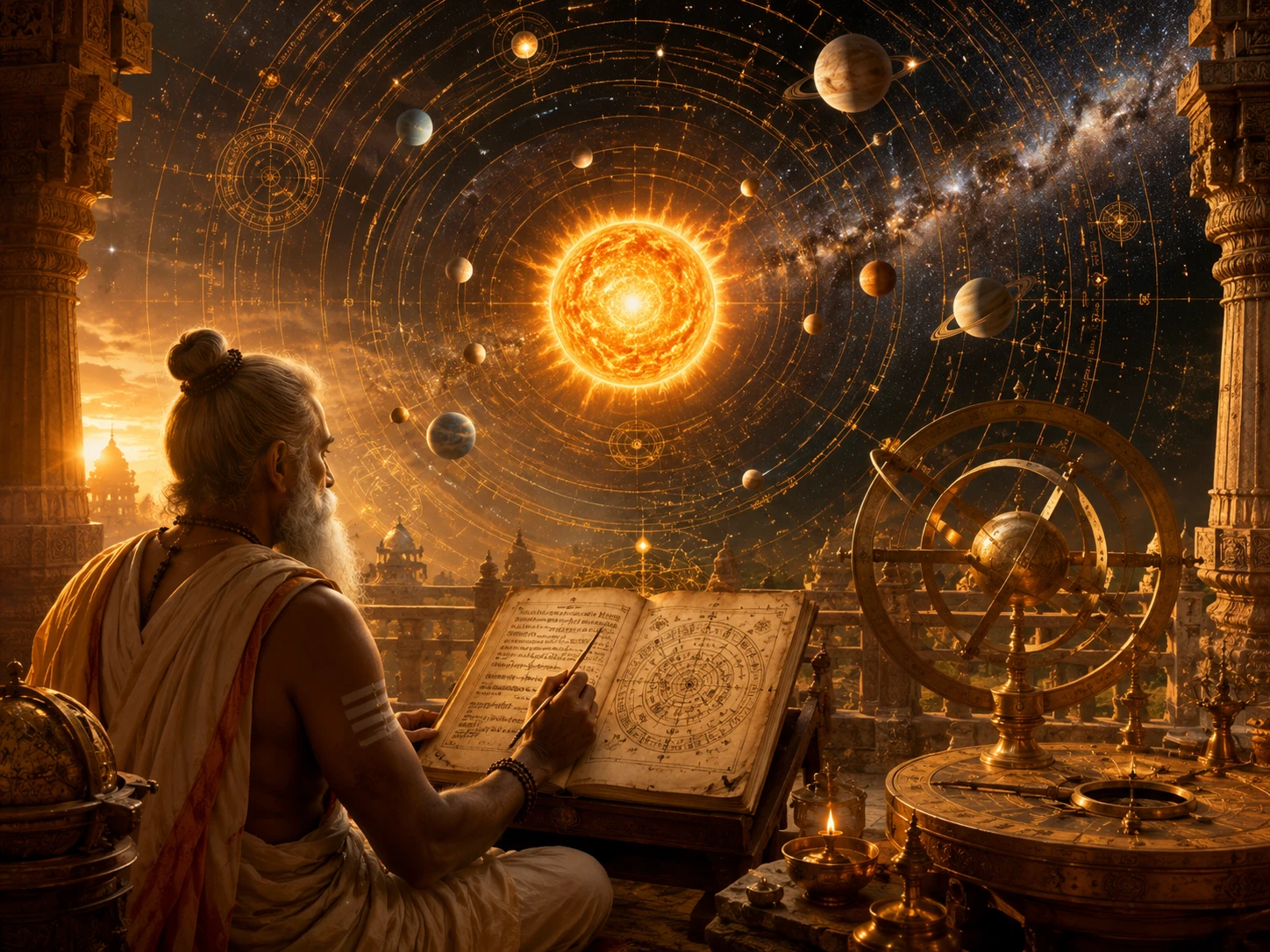
Surya Siddhanta -- The Ancient Astronomy Text That Got the Year Right to 1.4 Seconds
सूर्य सिद्धान्त -- वो प्राचीन खगोलशास्त्र ग्रन्थ जिसने वर्ष की गणना 1.4 सेकंड तक सही की
In 1856, an American missionary named Ebenezer Burgess, posted in Pune during the British Raj, became curious about the Sanskrit texts the local Brahmins had memorised. When he was told about a treatise on astronomy called the Surya Siddhanta, he decided to translate it into English with the help of Pune's scholarly community. What he found astonished him -- and then, as was the fashion of the time, he spent most of his commentary trying to prove it had been borrowed from the Greeks.
Burgess was wrong about the borrowing. But he was right to be astonished. The Surya Siddhanta -- literally 'The Sun's Established Doctrine' -- is one of the most remarkable scientific texts produced by any pre-modern civilisation. Written in approximately 500 Sanskrit verses across 14 chapters, it presents mathematical formulae for calculating the motions of the Sun, Moon, Mercury, Venus, Mars, Jupiter, and Saturn. It computes their orbital periods, estimates their diameters, predicts eclipses, and provides the foundations of trigonometry -- all without a telescope, without a computer, and without any awareness that Copernicus would not be born for another thousand years.
The text as we have it today is dated by scholars to approximately the 4th-5th century CE, with revisions extending into the 8th-10th century CE. But its internal narrative is far older: the text presents itself as knowledge revealed by Surya (the Sun God) to Maya, an Asura sage, at the end of the Satya Yuga. This mythological framing is characteristic of Indian scientific texts, which embed empirical knowledge within cosmological narrative. The science is no less real for being wrapped in story.
For the complete treatment, see [Rahu, Ketu and the Science of Eclipses -- Svarbhanu's Two Stories](/scripture/eternal-gyan/vedic-sciences/rahu-ketu-eclipses).
भूगोलः सर्वतो वृत्तः शिखरैः पर्वतैर्वृतः। द्वीपैः सागरकुण्डैश्च सोऽयं मध्यसमुच्छ्रितः॥
bhūgolaḥ sarvato vṛttaḥ śikharaiḥ parvatair vṛtaḥ | dvīpaiḥ sāgarakuṇḍaiś ca so'yaṃ madhyasamucchritaḥ ||
The Earth is a sphere, surrounded on all sides by peaks and mountains, by islands and ocean basins -- standing aloft in the middle of space.
— Surya Siddhanta, Chapter 12, Verse 32
The numbers speak for themselves. The Surya Siddhanta calculates the tropical year -- the time Earth takes to complete one orbit relative to the vernal equinox -- as 365.2421756 days. The modern value, determined by atomic clocks and satellite telemetry, is 365.2421904 days. The difference is 0.0000148 days per year, which translates to approximately 1.4 seconds. This was the most accurate estimate of the tropical year available anywhere in the world for over a thousand years.
The sidereal year -- Earth's orbital period relative to the fixed stars -- is given as 365.2563627 days. The modern value is 365.25636305 days. The error is in the fifth decimal place.
The text computes the Earth's diameter as approximately 8,000 miles (the modern value is 7,928 miles -- an error of about 0.9%). It estimates the Moon's diameter as 2,400 miles (actual: approximately 2,160 miles) and the Earth-Moon distance as 258,000 miles (actual: approximately 238,900 miles). These are remarkable approximations made without any optical instruments.
Perhaps most striking: the Surya Siddhanta contains a clear description of gravitational attraction. Chapter 12, Verse 32 states that the Earth is a sphere hanging in space. The text explains that objects fall toward the Earth 'due to a force of attraction by the Earth' and that 'the earth, planets, constellations, moon, and sun are held in orbit due to this attraction.' This is not Newtonian gravity -- it lacks the mathematical precision of the inverse-square law. But it is an explicit statement of universal gravitational attraction, written over a millennium before Newton's Principia Mathematica (1687).
The text also introduces trigonometric functions for the first time in recorded mathematical history. It uses jya (sine), kojya (cosine), and otkrama jya (versine/inverse sine) to compute planetary positions. The sine table in the Surya Siddhanta, computed at 3.75-degree intervals, was the most accurate such table in the world when it was created and formed the basis for all subsequent Indian astronomical calculations.
For the complete treatment, see [Jya -- How the Indian Sine Became the Global Sine](/scripture/eternal-gyan/vedic-sciences/jya-indian-trigonometry).
Surya Siddhanta vs Modern Astronomy -- Key Calculations Compared
| Parameter | Surya Siddhanta Value | Modern Value | Error |
|---|---|---|---|
| Tropical Year | 365.2421756 days | 365.2421904 days | 1.4 seconds per year |
| Sidereal Year | 365.2563627 days | 365.25636305 days | ~0.003 seconds per year |
| Earth Diameter | ~8,000 miles (est.) | 7,928 miles | ~0.9% |
| Moon Diameter | ~2,400 miles | ~2,160 miles | ~11% |
| Mercury Diameter | ~3,008 miles | ~3,032 miles | <1% |
| Saturn Diameter | ~73,882 miles | ~74,580 miles | <1% |
| Obliquity of Ecliptic | 24 degrees | 23.44 degrees | ~0.56 degrees |
| Earth is Spherical | Yes (explicit statement) | Yes | Correct |
Values from Burgess translation (1860) and modern astronomical constants. Surya Siddhanta uses yojanas as unit of distance (estimated 8-15 km per yojana); mile conversions are approximate. Planetary diameter estimates vary across manuscripts.
The Surya Siddhanta did not exist in isolation. It was the crown jewel of a rich tradition. Varahamihira (505-587 CE), in his Pancha-Siddhantika ('Of Five Theories'), compared five competing astronomical systems and ranked the Surya Siddhanta as the most accurate. Aryabhata (476-550 CE) built on this tradition to produce the Aryabhatiya, which explicitly described the Earth's rotation and computed pi to four decimal places. Brahmagupta (598-668 CE) advanced the mathematics further with his Brahmasphutasiddhanta, which defined zero as a number and laid down rules for negative number arithmetic. The Surya Siddhanta's sine tables directly enabled the Kerala School of Mathematics (14th-16th century CE) to develop infinite series for trigonometric functions -- anticipating Newton and Leibniz by two centuries.
The text's influence was not limited to India. In the 8th century, the Abbasid Caliph al-Mansur commissioned Arabic translations of Indian astronomical texts including the Surya Siddhanta. These translations -- known as the Zij al-Sindhind -- became foundational texts for Islamic astronomy, which in turn transmitted Indian mathematical innovations (including the decimal system, zero, and trigonometric functions) to medieval Europe via scholars in Al-Andalus (Spain). The word 'sine' itself derives from a Latin misreading of the Arabic 'jiba,' which was a transliteration of the Sanskrit 'jya' -- the Surya Siddhanta's term for the half-chord of an arc.
Every Panchang published in India today -- from the Rashtriya Panchang to the regional almanacs of Tamil Nadu, Kerala, and Bengal -- uses computational methods that trace their lineage directly to the Surya Siddhanta. Every time your family consults a pandit for a wedding date, every time a temple announces the timing of an eclipse, every time the Kumbh Mela dates are fixed -- the Surya Siddhanta's mathematical DNA is at work.
For the UPSC aspirant, the Surya Siddhanta appears in Indian Heritage and Culture, History of Science and Technology, and occasionally in the Science optional. For the IIT aspirant, its trigonometric innovations are the historical foundation of the mathematics they use every day. For the NRI parent explaining to a child in Cupertino why the Hindu calendar seems to 'move around' relative to the Gregorian one, the answer is the Surya Siddhanta: because our calendar tracks the Moon as well as the Sun, and the Moon does not care about January.
For the complete treatment, see [The Five Limbs of Panchang -- Tithi, Vara, Nakshatra, Yoga, Karana](/scripture/eternal-gyan/vedic-sciences/panchang-five-limbs).
The word 'sine' -- the foundation of modern trigonometry -- is ultimately derived from the Surya Siddhanta. The Sanskrit term was 'jya' (literally 'bowstring,' referring to the half-chord of a circle). Arab translators phonetically rendered it as 'jiba.' European scholars, misreading the Arabic consonantal script, interpreted 'jiba' as 'jaib' (meaning 'bay' or 'fold' in Arabic). They then translated 'jaib' into Latin as 'sinus' (meaning 'bay' or 'curve'). From 'sinus' came the English 'sine.' Every time a JEE aspirant in Kota writes 'sin theta' on their answer sheet, they are unknowingly completing a 1,500-year etymological journey that began in an Indian astronomical text.
Find Tonight's Nakshatra
The Eternal Raga Panchang shows which of the 27 nakshatras the Moon occupies today -- the same observation the Surya Siddhanta taught astronomers to make over 1,500 years ago. After dark, find the Moon and the stars beside it.
Tags
Eternal Raga · शाश्वत राग
Institutional voice — scholarly articles on Sanatan Dharma
Deepen Your Understanding
अपनी समझ और गहरी करें
vedic sciences
The 27 Nakshatras and Their Junction Stars -- Bharat's Lunar Map of the Sky
Long before Greenwich drew a line through London, the Rishis of Bharat had already divided the ecliptic into 27 precise segments of 13 degrees 20 minutes each, anchoring each to a brightest star called the Yogatara. The Surya Siddhanta catalogued their positions with an accuracy that modern astronomy still respects.
vedic sciences
Jya -- How the Indian Sine Became the Global Sine
The word sine in every mathematics textbook on Earth is a mistranslated memory of the Sanskrit jya, meaning bowstring. Aryabhata built the first true sine table in 499 CE, Bhaskara and Brahmagupta refined it, and Madhava of Sangamagrama found the infinite series for sine three centuries before Newton. This is the story of how the archer's string became the world's most-used mathematical function.
vedic sciences
Indian Astronomical Instruments -- From Shanku to Samrat Yantra
Long before the telescope reached India, astronomers here were measuring the sun's declination with a vertical stick, the precession of equinoxes with a brass disc, and time to the second with sundials larger than buildings. Trace the instrument tradition from Aryabhata's wooden sphere to Jai Singh's 27-metre Samrat Yantra still working today.
vedic sciences
Rahu, Ketu and the Science of Eclipses -- Svarbhanu's Two Stories
Every eclipse carries two truths at once. The Purana says Rahu swallowed the sun. The Surya Siddhanta says the moon crossed its node. Both were recorded in Sanskrit, in the same period, with no contradiction. Trace the mythology of Svarbhanu from Rigveda 5.40 to the geometry of lunar nodes, and understand why the Panchang your grandmother consults still gets eclipse timings right within seconds.
vedic sciences
Yojana -- How Hindu Astronomers Measured the Cosmos
Long before telescopes, the Surya Siddhanta gave Earth a diameter of 1600 yojanas and tracked planetary orbits in yojanas running into tens of millions. This is the unit that measured the cosmos from a finger-width upward.
vedic sciences
The Five Limbs of Panchang -- Tithi, Vara, Nakshatra, Yoga, Karana
The word Panchang literally means 'five limbs'. Each limb tracks a different relationship between the Sun and the Moon. Together they produce every auspicious date, every muhurta, and every festival in the Hindu calendar.
vedic sciences
Kaal Ganana -- The Hindu Measure of Time
From a single blink of the eye (Nimesha) to one Day of Brahma (4.32 billion years) -- explore the complete cosmic time hierarchy of Hindu cosmology, anchored in Vishnu Purana 1.3, with its remarkable parallels to modern science.
vedic sciences
The Kerala School of Mathematics: Madhava and the Roots of Calculus
In a small village near 14th-century Cochin, a Brahmin mathematician named Madhava computed pi to eleven decimal places using infinite series -- 250 years before Newton or Leibniz. Today the world calls it the Madhava-Gregory-Leibniz formula. This is the honest story of the Kerala School: the priority is established, the achievements stand on their own, and the conspiracy framing was never needed.
The word 'sine' -- the foundation of modern trigonometry -- is ultimately derived from the Surya Siddhanta. The Sanskrit term was 'jya' (literally 'bowstring,' referring to the half-chord of a circle). Arab translators p…
More in Vedic Sciences

Agnichayana -- The Falcon-Shaped Fire Altar That Survived 3,000 Years
12 min read
Ancient Indian Metallurgy -- The Iron Pillar That Refuses to Rust
13 min readAryabhata -- The Astronomer Who Said the Earth Turns
3 min readThe same translation error that turned '33 Koti' into '33 crore' in Hinduism also happened in Buddhism. The Chinese translation of Buddhist texts rendered 'Sapta Koti Buddha' (7 Supreme Buddhas) as '7 Crore Buddhas.' The…
Deities AvatarsCommunity Reflections
🕉️
Be the first to share your reflection.