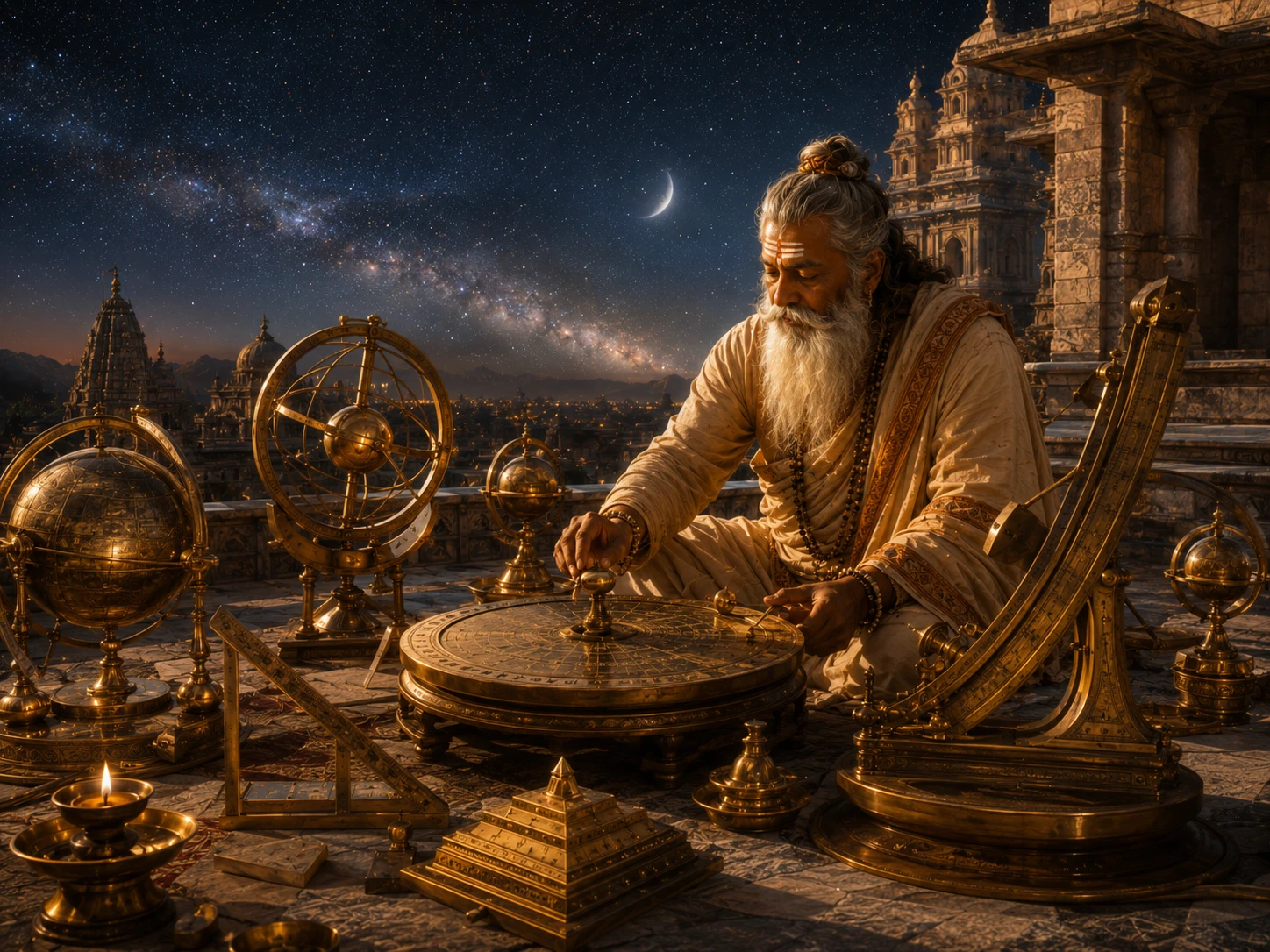
Indian Astronomical Instruments -- From Shanku to Samrat Yantra
भारतीय खगोलीय यन्त्र -- शङ्कु से सम्राट यन्त्र तक
Stand at Jaipur's Jantar Mantar just before sunrise. The Vrihat Samrat Yantra, a triangular gnomon 27 metres tall, throws no shadow yet. Over the next hour, as the sun climbs, its shadow will sweep across a curved marble quadrant at exactly one millimetre per second -- roughly a hand's breadth every minute. A visitor who waits long enough watches the earth rotate in real time. This is not a museum piece. It is a working instrument, completed in 1734, and it still measures local solar time to within two seconds.
And it belongs to a line of Indian astronomical instrument-making that stretches back at least two millennia further. Long before Aurangzeb, before Akbar, before even the Guptas, Indian astronomers were asking a simple question with astonishing discipline: how do you put a number on the sky?
The driver was never abstract curiosity. Hindu ritual life is tied to celestial events with surgical precision. Sandhyavandana needs the exact moment of sunrise. A griha pravesh puja needs the correct muhurta. The Panchang your grandmother still consults for Ekadashi, Karwa Chauth, or a wedding date is the direct descendant of calculations once made with wooden staffs, brass discs, water clocks, and stone walls the size of buildings. India measured time because India lived by time. And the instruments that made the measurement possible form one of the clearest technical legacies of classical Indian civilisation.
शङ्कुयष्टिधनुश्चक्रैश्छायायन्त्रैरनेकधा। गुरूपदेशाद्विज्ञेयं कालज्ञानमतन्द्रितैः॥
śaṅku-yaṣṭi-dhanuś-cakraiś-chāyā-yantrair-anekadhā gurūpadeśād vijñeyaṃ kāla-jñānam atandritaiḥ
Through the shanku (gnomon), yashti (staff), dhanu (arc), chakra (circle), and chhaya (shadow) instruments, in their many forms -- the knowledge of time is to be understood by the diligent, under the guidance of a teacher.
— Surya Siddhanta, Yantradhyaya 13.20
The oldest of the five is the Shanku Yantra -- the vertical gnomon. A stick, planted upright in level ground. Nothing more. And yet everything that followed rests on it.
At noon, the shanku's shadow points true north. At sunrise and sunset, the tip of its shadow traces a line across the ground. On the equinoxes, that line runs exactly east to west. On the summer solstice, it curves northward; on the winter solstice, southward. The Surya Siddhanta specifies that the shanku should be twelve digits tall, made of ivory or hardwood, set in a circular platform marked with concentric rings. From the length of its shadow at any moment, an astronomer could read the sun's altitude, declination, and the local time.
This is not primitive. A well-made shanku in the hands of a trained observer resolves solar altitude to within half a degree. Aryabhata used one in sixth-century Kusumapura (today's Patna) to determine the length of the solar year as 365.358 days -- close to the modern value of 365.256. Varahamihira's Panchasiddhantika (sixth century CE) describes shanku readings as the fundamental calibration for every other instrument. And the principle migrates effortlessly: the Samrat Yantra at Jantar Mantar is, at heart, a shanku scaled up by a factor of two thousand. Same geometry, same physics, 27 metres tall.
If you have ever watched a board-exam student in a Noida tuition centre argue that the shadow of a one-metre pole points true north at local noon -- that student is repeating an observation that the Surya Siddhanta standardised over fifteen centuries ago.
From the shanku, the tradition moved to angle-measuring instruments. The Yashti Yantra, the Dhanu Yantra, and the Chakra Yantra.
The Yashti -- literally 'staff' -- is a graduated rod pivoted at one end, aimed like a telescope without lenses. You sight a star or a planet along its length and read the angle off the ground scale. Bhaskaracharya (twelfth century) calls it the Dhi Yantra, the instrument of intellect, because its accuracy depends entirely on how steadily the observer holds it. His Siddhanta Shiromani describes using the yashti to calculate the height of trees, hills, and the moon by triangulation. Indian surveyors employed variants of it into the eighteenth century.
The Dhanu Yantra is a semi-circular arc, marked in degrees, used to measure the altitude of the sun, moon, or any star above the horizon. The astronomer hangs a plumb line from the centre. When the sun's rays pass over two pinholes along the arc, the plumb line marks the sun's exact altitude on the scale. Lalla in the eighth century describes a Dhanu Yantra in his Shishya Dhi Vriddhida.
The Chakra Yantra is the circular version of the Dhanu -- a full disc graduated in 360 degrees, with a sighting vane at the centre. Aryabhata's lost Arya Siddhanta described one; Varahamihira preserved the description. For measuring the angular separation between two stars, or between a planet and the ecliptic, the chakra was the tool of choice.
Ask an IIT Delhi physics undergraduate today what instrument measures angular distance between celestial bodies and she will answer 'theodolite' or 'astrolabe.' Both are Greek and Arabic descendants of this same classical Indian pair. The sighting logic did not change. Only the manufacturing did.
The fourth and fifth entries in that Surya Siddhanta list -- Chhaya Yantra and Ghatika Yantra -- measure something different. Not angles. Time itself.
The Chhaya Yantra is a shadow instrument. A circular platform, a central pin, and a set of graduated concentric rings. The shadow of the pin moves across the rings as the sun traverses the sky, and the rings are marked in muhurtas. This is the direct ancestor of the sundials you see in old mission-school courtyards from Ooty to Darjeeling, and of the ghadis that villagers in rural Maharashtra were still using into the 1950s.
The Ghatika Yantra is a water clock, and it is among the most striking instruments of classical India. A hemispherical brass bowl, roughly the size of a modern wok, has a tiny hole in its base. The bowl is floated on a larger water-filled vessel. Water seeps in through the hole. When the bowl sinks, one ghatika has passed -- exactly twenty-four minutes. An attendant strikes a gong, empties the bowl, and floats it again. The Arthashastra of Kautilya (third to second century BCE) already describes royal timekeeping by ghatika. Temple courtyards used ghatika clocks to mark prayer watches. Medieval Indian kings kept ghatika-attendants on night duty just as a modern Bangalore startup keeps a support rota. The unit 'ghatika' still survives -- 60 ghatikas make a full day, 30 ghatikas a Paksha boundary, and the word ghadi for 'clock' in modern Hindi comes directly from this instrument.
Aryabhata went one step further. In the Golapada of his Aryabhatiya, he describes a rotating wooden globe driven by water, mercury, and oil -- a mechanical clock and planetarium in one.
काष्ठमयं समवृत्तं समन्ततः समगुरुं लघुं गोलम्। पारदतैलजलैस्तं भ्रमयेत्स्वधिया च कालसमम्॥
kāṣṭha-mayaṃ sama-vṛttaṃ samantataḥ sama-guruṃ laghuṃ golam pārada-taila-jalais-taṃ bhramayet sva-dhiyā ca kāla-samam
A sphere made of wood, perfectly round, uniformly dense on every side yet light in weight -- it should be made to rotate in pace with time, by means of mercury, oil, and water, through the application of one's own intelligence.
— Aryabhatiya, Golapada 22
Classical Siddhantic Instruments -- Form and Function
| Yantra | Form | Measures | Earliest Text Reference |
|---|---|---|---|
| Shanku / शङ्कु | Vertical gnomon, 12 digits tall / सीधा खड़ा गोमन, 12 अङ्गुल | Sun's altitude, declination, true north / सूर्य की ऊँचाई, क्रान्ति, वास्तविक उत्तर | Surya Siddhanta (ca. 4th-5th c. CE) / सूर्य सिद्धान्त (लगभग चौथी-पाँचवीं शताब्दी) |
| Yashti / यष्टि | Graduated sighting rod on pivot / अङ्कित दृष्टि-छड़, एक ओर पिन पर | Angular heights and ground-object heights by triangulation / कोणीय ऊँचाई और त्रिभुजन से भू-वस्तु की ऊँचाई | Aryabhatiya Golapada (ca. 499 CE) / आर्यभटीय गोलपाद (लगभग 499 ई.) |
| Dhanu / धनु | Graduated semi-circular arc with plumb line / साहुल-डोरी सहित अङ्कित अर्ध-वृत्ताकार चाप | Solar and stellar altitude above horizon / सूर्य और तारों की क्षितिज से ऊँचाई | Lalla, Shishya Dhi Vriddhida (8th c. CE) / लल्ल, शिष्य धी वृद्धिदा (आठवीं शताब्दी) |
| Chakra / चक्र | Full graduated disc with sighting vane / दृष्टि-पाल सहित अङ्कित पूर्ण चक्री | Angular separation between celestial bodies / खगोलीय पिण्डों के बीच कोणीय दूरी | Arya Siddhanta (lost), cited by Varahamihira / आर्य सिद्धान्त (लुप्त), वराहमिहिर उद्धृत |
| Ghatika / घटिका | Pierced brass bowl floated in water / छिद्रित पीतल कटोरी, जल में तैरती | Twenty-four-minute interval (one ghatika) / चौबीस मिनट का अन्तराल (एक घटिका) | Arthashastra (3rd-2nd c. BCE) / अर्थशास्त्र (तीसरी-दूसरी शताब्दी ई.पू.) |
| Gola / गोल | Rotating wooden globe driven by mercury, oil, water / पारद, तेल, जल से घूमने वाला काष्ठ-गोल | Simulation of celestial motion and time / आकाशीय गति और काल का अनुकरण | Aryabhatiya Golapada 22 / आर्यभटीय गोलपाद 22 |
| Chhaya / छाया | Marked circular sundial platform / अङ्कित गोल धूप-यन्त्र चबूतरा | Muhurtas of the daytime / दिन के मुहूर्त | Surya Siddhanta 13 (Yantradhyaya) / सूर्य सिद्धान्त 13 (यन्त्राध्याय) |
All seven instruments appear in Indian astronomical texts centuries before medieval Europe built equivalents. Only the gola yantra and ghatika are non-optical; the remaining five rely on shadow or direct sighting.
For more than a thousand years after Aryabhata, Indian astronomical instruments remained portable. A brass chakra, a wooden yashti, a pierced ghatika bowl -- tools that fit in a scholar's bag. Then, in 1723, a Rajput king set out to do something that had never been attempted at this scale anywhere in the world.
Sawai Jai Singh II of Amber, born in 1688, was unusual even by the standards of his own dynasty. He had inherited the throne at eleven. Aurangzeb, meeting the young prince at the Mughal court, asked what he intended to do with his kingdom. The legend goes that Jai Singh offered his right hand to clasp the emperor's, and when Aurangzeb asked why, replied that a bridegroom who holds the bride's hand cannot abandon her. Aurangzeb laughed and doubled his lands.
That same political dexterity later served him as an astronomer. Jai Singh had been appointed governor of Agra and Ujjain by Emperor Muhammad Shah. During his tenure, he requested and received imperial sanction to build astronomical observatories in five cities: Delhi, Jaipur, Ujjain, Mathura, and Varanasi. He sent emissaries to Portugal, France, and the Ottoman court to collect the latest European and Arab astronomical tables. He commissioned Sanskrit translations of Ptolemy and the Zij-i-Ulugh-Begi of Samarkand. When his Jesuit guests brought him brass astrolabes and European quadrants, he studied them and found them wanting. The brass instruments were small. Small instruments carry large percentage errors.
His solution was to build instruments so large that the errors vanished.
Between 1724 and 1735, five Jantar Mantars rose across north India. The word itself is a corruption: yantra-mantrana, 'the instrument of calculation,' became Jantar Mantar in spoken Rajasthani and Brajbhasha. The first was built in Delhi -- the one a few minutes' walk from Connaught Place that office workers now cross on their way to lunch. The second, largest, and most technically ambitious stood in Jaipur, next to the City Palace. A third was raised on the banks of the Yamuna at Mathura; it was destroyed during the Revolt of 1857 and a fort built over it. The fourth still stands in Ujjain on the traditional prime meridian of Hindu astronomy. The fifth lies in Varanasi on the roof of Man Mandir Ghat, overlooking the Ganga.
What made these observatories unlike anything the world had seen was the choice of material. Jai Singh built them in stone and masonry. A quadrant ninety feet tall. A sundial the height of a seven-storey building. A hemispherical bowl so large that an astronomer could walk inside it and read the stars directly off its inner surface.
The design logic was purely mathematical. If you want to read an angle to an accuracy of one arc-minute on a circle, and the smallest division your eye can see is one millimetre, then the circle needs a radius of roughly three and a half metres. For one arc-second accuracy, the radius jumps to over 200 metres. Brass astrolabes, at best, resolve five arc-minutes. The Jantar Mantar's Samrat Yantra, at 27 metres, resolves to two seconds of time -- equivalent to fifteen arc-seconds of the sun's apparent motion. For an instrument built without a single lens, that is an achievement that stood unmatched anywhere in the world until the invention of the transit telescope.
UNESCO declared the Jaipur Jantar Mantar a World Heritage Site in 2010. The Delhi one is a national monument. The Varanasi observatory is still used by traditional panchang-makers to verify their tables at each solstice.
Major Instruments at Jantar Mantar, Jaipur
| Yantra | Dimension | Function | Accuracy |
|---|---|---|---|
| Vrihat Samrat / वृहत् सम्राट | 27 m tall gnomon, 44 m quadrant / 27 मी. शङ्कु, 44 मी. चतुर्थांश | Local apparent solar time, declination / स्थानीय सौर काल, क्रान्ति | Two seconds of time / दो सेकंड |
| Laghu Samrat / लघु सम्राट | Smaller sundial, 27 deg tilt / छोटी धूप-घड़ी, 27 डिग्री झुकाव | Secondary time reading / द्वितीयक समय-पठन | Twenty seconds of time / बीस सेकंड |
| Jai Prakash / जयप्रकाश | Two hemispherical bowls, marble lined / दो अर्ध-गोल कटोरे, संगमरमर की परत | Altitude, azimuth, hour angle, declination / ऊँचाई, दिगंश, होरा कोण, क्रान्ति | One arc-minute / एक कला |
| Ram Yantra / राम यन्त्र | Paired open cylindrical buildings / दो खुले बेलनाकार भवन, जोड़ी में | Altitude and azimuth of any body / किसी भी पिण्ड की ऊँचाई और दिगंश | Six arc-minutes / छह कला |
| Nadi Valaya / नाडी वलय | Two disc faces, N and S / दो चक्र-मुख, उत्तर और दक्षिण | Equatorial time, hemisphere determination / विषुवतीय काल, गोलार्ध-निर्धारण | Less than one minute / एक मिनट से कम |
| Rashi Valaya / राशि वलय | Twelve gnomon dials, one per zodiac / बारह शङ्कु-चक्र, प्रत्येक राशि हेतु | Ecliptic coordinates of stars and planets / तारों-ग्रहों की क्रान्ति-वृत्त स्थिति | One arc-minute / एक कला |
| Misra Yantra / मिश्र यन्त्र | Composite of five instruments / पाँच यन्त्रों का सम्मिलित रूप | Simultaneous noon-time reading at five cities / पाँच नगरों का मध्याह्न-काल एक साथ | One minute of time / एक मिनट |
| Chakra Yantra / चक्र यन्त्र | Four metal rings on a stand / आधार पर चार धातु वलय | Hour angle and declination of stars / तारों का होरा कोण और क्रान्ति | Three arc-minutes / तीन कला |
The Jaipur observatory holds nineteen masonry instruments in total. The Misra Yantra is the sole instrument Jai Singh did not build himself -- it was added by his son Madho Singh I in 1743.
The Vrihat Samrat Yantra deserves a closer look because it is, in a very literal sense, the climax of the Indian shanku tradition. Everything the Surya Siddhanta said about the gnomon, scaled up and engineered into a building.
The instrument is a triangular wall. Its hypotenuse, 39 metres long, is tilted at exactly 27 degrees above the horizontal -- the latitude of Jaipur -- and points true north. On either side of this triangle, two large quadrants of marble-faced masonry curve outward. The quadrants are graduated in hours, minutes, and 2-second intervals. A staircase climbs the hypotenuse to a small cupola at the top, called the chhatri, which is used to this day to announce the arrival of the monsoon and the timing of eclipses to the citizens of the old city.
At any moment during daylight, the sun casts a shadow of the hypotenuse onto one of the quadrants. The point where the shadow's edge falls, read against the graduations, is the local apparent solar time. The shadow moves visibly. A tourist from Bengaluru who has never seen anything like it can stand beside the scale at 11:57 am and watch the shadow's edge cross three seconds before she has the chance to exhale. The Samrat Yantra does not display time. It makes time visible.
Adjust for the Equation of Time and the longitude correction and the reading matches your smartphone's clock to within two seconds. Engineers from the Indian Institute of Astrophysics (IIA) in Bangalore verified this in 2008 with atomic-clock cross-calibration. Eighteenth-century stone, keeping pace with twenty-first century caesium. That is not a miracle. It is geometry, executed by craftsmen who understood what geometry was doing.
The Samrat Yantra is the monumental one. The real ingenuity of the Jantar Mantars, however, sits in three other instruments that Jai Singh seems to have designed himself: the Jai Prakash Yantra, the Ram Yantra, and the Misra Yantra.
The Jai Prakash Yantra is a pair of hemispherical bowls, sunk into the ground, lined with marble. Inside each bowl, the night sky is projected in inverse. An observer stands in a slot between the two bowls, looks up at a crosshair wire suspended above, and as a star's image falls across the marble, reads off its altitude, azimuth, hour angle, and declination simultaneously. The two bowls are offset so that together they provide complete sky coverage. It is the only instrument in the premodern world that let a single observer read four celestial coordinates at once, with the body itself inside the measuring apparatus.
The Ram Yantra, named after Jai Singh's son, is a pair of open cylindrical buildings. The floor and walls are marked in degrees. A pillar rises from the centre of each cylinder. The shadow of the pillar's top, falling somewhere on the wall or floor, gives the altitude and azimuth of the sun by day. At night, the cylinders work as sighting frames for star positions. The paired design exists because each cylinder has a blind zone at its centre; the two together cover the sky.
The Misra Yantra -- 'mixed instrument' -- is the last of the five built by Jai Singh's successor Madho Singh I in 1743. It combines four separate sundials with a fifth instrument that reads the exact moment of noon at Notre Dame in Paris, at the Greenwich meridian, at Zurich, and at two Japanese cities. The instrument is essentially an eighteenth-century Indian world clock. For a pre-telegraph, pre-radio society, it was a tool for diplomatic correspondence. For a modern visitor who arrives wondering if classical Indian astronomy engaged with the wider world, the Misra Yantra answers the question directly.
The classical instrument tradition did not end in the eighteenth century. It continued, transformed.
The Indian Institute of Astrophysics at Kodaikanal, founded in 1899, preserved Jai Singh's observational logic in its solar-tower telescope. The Giant Metrewave Radio Telescope (GMRT) near Pune, built by the Tata Institute of Fundamental Research, extends the old Indian preference for large-aperture, multi-element instruments into the radio spectrum -- thirty dish antennas spread over 25 kilometres, together forming an eye large enough to observe pulsars on the other side of the galaxy. GMRT is, in one honest sense, the Jantar Mantar of the twenty-first century: build large, combine many, trust geometry.
ISRO's Aryabhata satellite, launched in 1975, carried the name of the man who first described the gola-yantra fifteen centuries earlier. The Aditya L1 mission, currently parked at the Lagrangian point facing the sun, is doing with ultraviolet detectors what classical astronomers did with the shanku: measuring the sun's behaviour with instruments appropriate to the question. The questions were always asked. The answering tools changed shape.
And if you have ever visited Delhi's Jantar Mantar and stood beside the Samrat Yantra as its shadow sweeps past the 12:00 mark on a still January afternoon, you know the feeling. Two Mumbai teenagers stop their phones mid-scroll to watch. A school group from Jaipur is counting the seconds out loud. An NRI grandparent from New Jersey is quietly translating the Devanagari engravings for a visiting grandchild. The instrument still speaks to the people it was built for. The tradition does not require the past tense.
The shadow of the Vrihat Samrat Yantra at Jaipur moves at 1 mm per second -- the only sundial in the world where a visitor can watch the earth rotate with the naked eye in a second-by-second progression. The Archaeological Survey of India and the Indian Institute of Astrophysics cross-calibrated this motion against a caesium atomic clock in 2008. The discrepancy across an entire day was under two seconds, which is within the instrument's designed precision. Jai Singh's masons, working with plumb lines and string compasses in 1734, built a device that cannot be improved upon without switching materials to monocrystalline quartz.
Open the Panchang for today's exact sunrise, sunset, and muhurta timings
The same calculations these instruments once produced by hand -- sunrise, sunset, tithi, nakshatra, muhurta -- appear daily on the Eternal Raga Panchang, worked out for Pune. See the continuity from shanku yantra to your phone screen.
Tags
Eternal Raga · शाश्वत राग
Institutional voice — scholarly articles on Sanatan Dharma
Deepen Your Understanding
अपनी समझ और गहरी करें
vedic sciences
Surya Siddhanta -- The Ancient Astronomy Text That Got the Year Right to 1.4 Seconds
Before Copernicus, before Galileo, before the telescope existed -- an Indian text calculated the tropical year as 365.2421756 days. The modern value is 365.2421904. The difference is 1.4 seconds per year. The Surya Siddhanta also described gravity, computed planetary diameters within 1% accuracy, and invented the sine function. It did all this in Sanskrit verse.
vedic sciences
Kaal Ganana -- The Hindu Measure of Time
From a single blink of the eye (Nimesha) to one Day of Brahma (4.32 billion years) -- explore the complete cosmic time hierarchy of Hindu cosmology, anchored in Vishnu Purana 1.3, with its remarkable parallels to modern science.
vedic sciences
The 27 Nakshatras and Their Junction Stars -- Bharat's Lunar Map of the Sky
Long before Greenwich drew a line through London, the Rishis of Bharat had already divided the ecliptic into 27 precise segments of 13 degrees 20 minutes each, anchoring each to a brightest star called the Yogatara. The Surya Siddhanta catalogued their positions with an accuracy that modern astronomy still respects.
vedic sciences
Rahu, Ketu and the Science of Eclipses -- Svarbhanu's Two Stories
Every eclipse carries two truths at once. The Purana says Rahu swallowed the sun. The Surya Siddhanta says the moon crossed its node. Both were recorded in Sanskrit, in the same period, with no contradiction. Trace the mythology of Svarbhanu from Rigveda 5.40 to the geometry of lunar nodes, and understand why the Panchang your grandmother consults still gets eclipse timings right within seconds.
vedic sciences
Vedic Mathematics -- 16 Sutras, One Shankaracharya, and a Controversy That Won't Die
In 1965, a posthumous book by Shankaracharya Bharati Krishna Tirthaji claimed that 16 Sanskrit sutras could solve all of mathematics -- from basic arithmetic to calculus. The techniques are brilliant. The 'Vedic' label is contested. The debate reveals everything about how modern India negotiates between civilisational pride and academic rigour.
vedic sciences
Panchang -- The Five-Limbed Hindu Calendar That Runs on the Moon and the Sun
Your phone uses the Gregorian calendar. Your grandmother uses the Panchang. One tracks the Sun. The other tracks the Sun AND the Moon AND the stars AND something called Yoga AND something called Karana. Five moving parts, one unified system -- and it determines every wedding date, every festival, and every 'shubh muhurat' in a billion Hindu lives.
The shadow of the Vrihat Samrat Yantra at Jaipur moves at 1 mm per second -- the only sundial in the world where a visitor can watch the earth rotate with the naked eye in a second-by-second progression. The Archaeologic…
More in Vedic Sciences
Agnichayana -- The Falcon-Shaped Fire Altar That Survived 3,000 Years
12 min read
Ancient Indian Metallurgy -- The Iron Pillar That Refuses to Rust
13 min readAryabhata -- The Astronomer Who Said the Earth Turns
3 min readThe same translation error that turned '33 Koti' into '33 crore' in Hinduism also happened in Buddhism. The Chinese translation of Buddhist texts rendered 'Sapta Koti Buddha' (7 Supreme Buddhas) as '7 Crore Buddhas.' The…
Deities AvatarsCommunity Reflections
🕉️
Be the first to share your reflection.