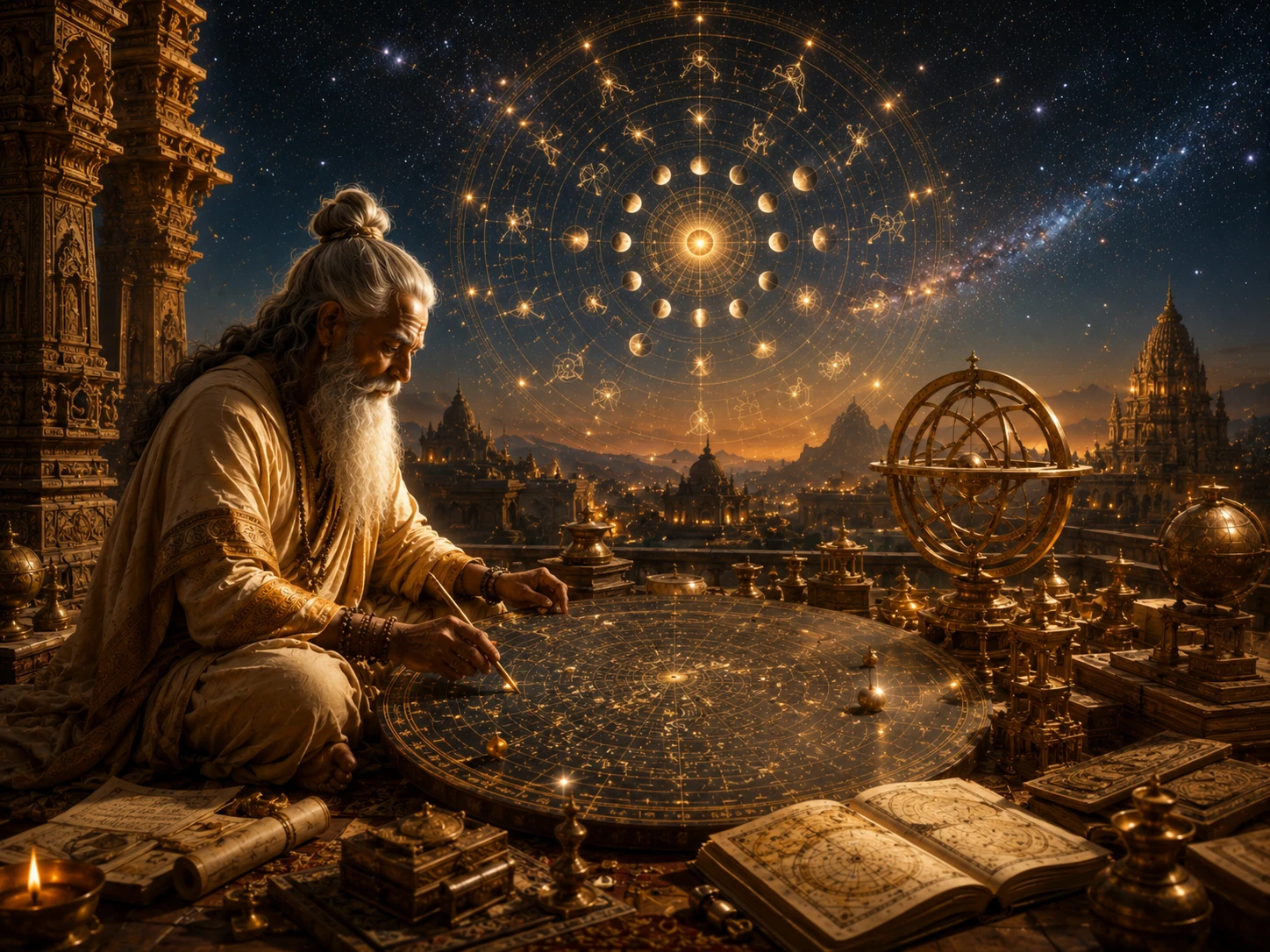
The 27 Nakshatras and Their Junction Stars -- Bharat's Lunar Map of the Sky
२७ नक्षत्र और उनकी योगताराएँ -- भारत का चान्द्र आकाश मानचित्र
Step outside on a clear October night in Panchgani or Leh. Look up. The sky is not one thing. It is twenty-seven things, and the ancient Rishis of Bharat knew it long before any telescope was built.
When the Moon finishes one orbit around the Earth against the backdrop of the fixed stars, she takes roughly 27.32 days. The Rishis noticed this with the naked eye. They also noticed that the Moon seemed to rest in a slightly different part of the sky each night, as if she were visiting a different house on her way around. They named these houses Nakshatras -- sectors of the ecliptic, each spanning exactly 13 degrees and 20 minutes of arc. Twenty-seven such sectors close the full circle of 360 degrees without any remainder.
But a sector of empty sky is hard to remember. So each Nakshatra was anchored to one specific bright star within it, which became its identity marker. That anchor star is called the Yogatara -- literally, the joining star, the star of union, the one that ties the Nakshatra to a fixed point on the celestial sphere. Chitra Nakshatra is anchored to Spica. Rohini is anchored to Aldebaran. Jyeshtha is anchored to Antares. These are not poetic metaphors. They are observational astronomy, recorded in Sanskrit verse nearly two thousand years ago in a text called the Surya Siddhanta.
आदित्यानामहं विष्णुर्ज्योतिषां रविरंशुमान्। मरीचिर्मरुतामस्मि नक्षत्राणामहं शशी॥
aadityaanaam aham vishnur jyotishaam ravir amshumaan maricir marutaam asmi nakshatraanaam aham shashi
Among the twelve Adityas I am Vishnu; among the luminaries, the luminous Sun. Among the Maruts I am Marichi; and among the Nakshatras, I am the Moon.
— Bhagavad Gita 10.21
Krishna's declaration in the tenth chapter of the Gita -- that he is the Moon among the Nakshatras -- is not a random flourish. It is a statement of function. The Moon is the sovereign of this twenty-seven-fold map because the Moon is the one who walks it. Each Nakshatra is, quite literally, a one-day stop on the Moon's monthly circuit. The Sun takes an entire year to complete the same circuit through the twelve rashis. The Moon completes it in twenty-seven and a third days. This is why the Moon rules the Nakshatra system, and the Sun rules the solar zodiac. Both are true. They measure two different scales of the same sky.
Now the practical question. If the Rishis divided the ecliptic into twenty-seven equal sectors of 13 degrees 20 minutes, how did they know where one sector ended and the next began? The answer is the Yogatara. The Surya Siddhanta, in its eighth chapter titled Nakshatragraha Yuti Adhikara -- the chapter on the conjunction of asterisms and planets -- gives the polar longitude and polar latitude of the junction star of each Nakshatra. These are coordinates. They tell a reader roughly where to look, how far from the ecliptic plane, and what brightness to expect. An astronomer in fifth-century Ujjayini could read the shloka, step out of his observatory, and point his armillary sphere directly at the star. He would not need the original observer present.
This is catalogue astronomy. It is the same idea that later became the Almagest's star list and, much later, the Yale Bright Star Catalogue. The Surya Siddhanta did it in poetry, in a meter of eight syllables per pada, so it could be memorised and transmitted without any manuscript at all.
A Yogatara is not always the brightest star in a Nakshatra region. Sometimes it is. Chitra's Yogatara is Spica, the brightest star in Virgo and one of the brightest in the entire night sky. Jyeshtha's Yogatara is Antares, the red heart of Scorpio. Rohini's Yogatara is Aldebaran, the fiery orange eye of Taurus. These are showpieces. Any child in Kurnool or Chandigarh can find them on a clear night with a phone app.
But sometimes the Yogatara is a more modest star chosen because it sits closer to the centre of the Nakshatra's 13 degrees 20 minutes, or because it lies almost exactly on the ecliptic itself, making it easier to track the Moon's passage past it. Krittika's Yogatara in the Surya Siddhanta tradition is Alcyone -- the brightest star in the Pleiades cluster. The Pleiades themselves are a whole family of seven sisters, visible as a tight smudge in the autumn sky. But for catalogue purposes, one star had to be chosen, and Alcyone was it.
This is not sloppiness. It is the opposite. The Rishis understood that a reference system needs single well-defined anchor points, not fuzzy patches. A surveyor laying out the Mumbai Metro cannot work with an entire neighbourhood as a reference; he needs one surveyed benchmark. The Yogatara is the celestial benchmark. From it, the Nakshatra extends 6 degrees 40 minutes on either side along the ecliptic, and that is the lunar mansion.
The 27 Nakshatras and Their Yogataras
| No. | Nakshatra / नक्षत्र | Yogatara (Modern) / योगतारा (आधुनिक) | Constellation / तारामण्डल | Presiding Deity / अधिदेवता |
|---|---|---|---|---|
| 1 | Ashwini / अश्विनी | Beta Arietis (Sheratan) / शेरातन | Aries / मेष | Ashwini Kumaras / अश्विनी कुमार |
| 2 | Bharani / भरणी | 41 Arietis (Bharani) / भरणी | Aries / मेष | Yama / यम |
| 3 | Krittika / कृत्तिका | Alcyone (Eta Tauri) / अलसायन | Taurus / वृष | Agni / अग्नि |
| 4 | Rohini / रोहिणी | Aldebaran (Alpha Tauri) / एल्डेबरान | Taurus / वृष | Brahma / ब्रह्मा |
| 5 | Mrigashira / मृगशिरा | Lambda Orionis (Meissa) / मेइसा | Orion / मृग | Chandra / चन्द्र |
| 6 | Ardra / आर्द्रा | Betelgeuse (Alpha Orionis) / बेटलग्यूज़ | Orion / मृग | Rudra / रुद्र |
| 7 | Punarvasu / पुनर्वसु | Pollux (Beta Geminorum) / पोलक्स | Gemini / मिथुन | Aditi / अदिति |
| 8 | Pushya / पुष्य | Delta Cancri (Asellus Australis) / पुष्य | Cancer / कर्क | Brihaspati / बृहस्पति |
| 9 | Ashlesha / आश्लेषा | Alphard (Alpha Hydrae) / अल्फर्ड | Hydra / सर्प | Sarpas / नाग गण |
| 10 | Magha / मघा | Regulus (Alpha Leonis) / रेगुलस | Leo / सिंह | Pitrs / पितर |
| 11 | Purva Phalguni / पूर्व फाल्गुनी | Zosma (Delta Leonis) / ज़ोस्मा | Leo / सिंह | Bhaga / भग |
| 12 | Uttara Phalguni / उत्तर फाल्गुनी | Denebola (Beta Leonis) / डेनेबोला | Leo / सिंह | Aryaman / अर्यमा |
| 13 | Hasta / हस्त | Delta Corvi (Algorab) / अल्गोरैब | Corvus / काक | Savitr / सविता |
| 14 | Chitra / चित्रा | Spica (Alpha Virginis) / स्पाइका | Virgo / कन्या | Tvashtr / त्वष्टा |
| 15 | Swati / स्वाति | Arcturus (Alpha Bootis) / आर्कट्यूरस | Bootes / स्वाति | Vayu / वायु |
| 16 | Vishakha / विशाखा | Alpha Librae (Zubenelgenubi) / ज़ुबेनेलगेनुबी | Libra / तुला | Indragni / इन्द्राग्नी |
| 17 | Anuradha / अनुराधा | Delta Scorpii (Dschubba) / डशुब्बा | Scorpio / वृश्चिक | Mitra / मित्र |
| 18 | Jyeshtha / ज्येष्ठा | Antares (Alpha Scorpii) / अन्टारेस | Scorpio / वृश्चिक | Indra / इन्द्र |
| 19 | Mula / मूल | Shaula (Lambda Scorpii) / शौला | Scorpio / वृश्चिक | Nirrti / निर्ऋति |
| 20 | Purva Ashadha / पूर्वाषाढ़ा | Kaus Australis (Delta Sagittarii) / कौस ऑस्ट्रेलिस | Sagittarius / धनु | Apas / आप |
| 21 | Uttara Ashadha / उत्तराषाढ़ा | Nunki (Sigma Sagittarii) / नुंकी | Sagittarius / धनु | Vishvedeva / विश्वेदेव |
| 22 | Shravana / श्रवण | Altair (Alpha Aquilae) / अल्टायर | Aquila / गरुड़ | Vishnu / विष्णु |
| 23 | Dhanishtha / धनिष्ठा | Beta Delphini (Rotanev) / रोटानेव | Delphinus / डेल्फिनस | Ashta Vasu / अष्ट वसु |
| 24 | Shatabhisha / शतभिषा | Lambda Aquarii / लैम्डा कुम्भ | Aquarius / कुम्भ | Varuna / वरुण |
| 25 | Purva Bhadrapada / पूर्व भाद्रपदा | Markab (Alpha Pegasi) / मर्कब | Pegasus / अश्व | Aja Ekapad / अज एकपाद |
| 26 | Uttara Bhadrapada / उत्तर भाद्रपदा | Algenib (Gamma Pegasi) / अल्गेनिब | Pegasus / अश्व | Ahirbudhnya / अहिर्बुध्न्य |
| 27 | Revati / रेवती | Zeta Piscium (Revati) / रेवती | Pisces / मीन | Pushan / पूषा |
Yogatara assignments follow the Surya Siddhanta tradition as reconstructed by Burgess (1860) and subsequent Indological scholarship. Some Yogataras differ slightly between the Surya Siddhanta, Brahmasphuta Siddhanta, and later commentaries; these are the most widely accepted identifications.
Look at the table closely. A remarkable pattern emerges.
The ecliptic is the path the Sun traces across the sky over the year. The Moon stays close to this same path, drifting at most five degrees above or below it. For the Nakshatra system to work, the Yogataras must sit close enough to the ecliptic to serve as landmarks that the Moon can be seen beside. And they do. Aldebaran sits just five degrees south of the ecliptic. Spica sits two degrees south. Regulus sits almost exactly on it. Antares sits four degrees south. These are not coincidences. The Rishis chose stars whose celestial latitude made them useful for tracking the Moon.
This is why, from August to early October in 2024, viewers across Tamil Nadu could watch the Moon glide past Antares on clear evenings. The Moon was transiting Jyeshtha Nakshatra, and Antares, its Yogatara, was the visible marker confirming the position. The same event was logged in Sanskrit panchangams that week, under the entry Jyeshtha Pravesha -- the Moon's entry into Jyeshtha. A JEE student in Kota tracking planetary positions on Stellarium and a Vedic priest in Kanchipuram consulting his almanac were looking at the same physical event, named in two technical vocabularies.
There is more. The division of the ecliptic into 27 equal arcs means each Nakshatra spans exactly 800 minutes of arc, because 13 degrees 20 minutes equals 13 and one-third degrees, and three Nakshatras fit into 40 degrees, nine into 120 degrees, and 27 into 360. The arithmetic is clean. No fractional residue. This cleanliness is why the system survived three thousand years with only minor corrections for precession, while other ancient calendar systems collapsed under accumulated drift.
Chitra Nakshatra is named after the star we call Spica. The word Chitra means brilliant, variegated, or painted, and the star is so luminous that it is the fifteenth brightest in the entire night sky. When ISRO's Chandrayaan missions track their lunar trajectories, one of the reference coordinates in their sidereal system uses the Chitra longitude -- the same longitude the Surya Siddhanta listed as 180 degrees almost a thousand five hundred years ago. The choice of Chitra as a reference is not religious. It is technical. Spica sits almost exactly on the ecliptic, is bright enough to be seen even from moderately light-polluted skies, and moves slowly enough that its position is effectively fixed on human timescales. The Rishis picked a natural constant, and modern Indian astronomy still uses it.
The Nakshatra system is not locked in a library. It is still alive in almost every Indian home.
When a baby is born in Kerala's Palakkad or Gujarat's Anand, the first question the elder relatives ask the hospital is not the weight or the length. It is the time of birth, to the minute. That time is fed into a panchang calculation to determine the baby's Janma Nakshatra -- the lunar mansion the Moon was occupying at the moment of birth. From that Janma Nakshatra follows the first syllable of the child's name. A child born under Rohini may be named Rajesh or Rama. A child born under Ashwini may be named Amit or Aishwarya. The name-letter chart from the 108 padas of the 27 Nakshatras has been used for naming ceremonies across Bharat for over two thousand years. On every second Indian birth certificate application, in the box marked rashi nakshatra, this system is still being recorded.
When a family in Pune schedules a Namakarana ceremony or a Mundan or a first rice feeding, the Muhurat is chosen with reference to the Nakshatra active on that day. Certain Nakshatras are considered auspicious for particular rites. Pushya Nakshatra, for example, is the universal lucky star -- most Muhurat tables mark Pushya as ideal for beginning anything new, from starting a shop to breaking ground on a house. The auto-rickshaw driver in Indiranagar who buys his new vehicle on Guru Pushya Yoga is applying the same Nakshatra logic that a Chola king used two thousand years ago for consecrating a temple wall.
Wedding astrology is the domain where the Nakshatra system is most intensively applied. When families exchange kundalis for match-making, one of the first tables consulted is the Nakshatra compatibility -- Ashta Kuta Milan, the matching of eight attributes, of which Nadi Kuta, Bhakut Kuta, and Graha Maitri all depend on the Nakshatras of the prospective bride and groom. Matrimonial sites like Shaadi, BharatMatrimony, and Jeevansathi ask for the Janma Nakshatra in the very first profile form. The old system, reformatted for a web interface, lives on.
Festivals are anchored to Nakshatras as strongly as to tithis.
Karthigai Deepam in Tamil Nadu -- the festival of a million lamps lit across Tiruvannamalai -- occurs on the day the full Moon conjoins Krittika Nakshatra in the month of Karthigai. The word Karthigai is a Tamil form of Krittika itself. The entire celebration of the festival is timed by the Moon's arrival at the Krittika Yogatara, Alcyone. Millions of pilgrims who ascend the Arunachala hill that night are witnesses to an astronomical event first catalogued in the Surya Siddhanta.
Onam in Kerala centres on Thiru Onam -- which is the Tamil-Malayalam rendering of Shravana Nakshatra. The harvest festival is celebrated on the day the Moon reaches Shravana in the month of Chingam. The Vamana legend attached to Onam speaks of King Mahabali's annual return, but the timing is strictly astronomical. When the Yogatara of Shravana -- Altair, the brightest star of Aquila -- is ascendant at dusk, Onam is celebrated.
Guru Purnima falls on the full Moon that conjoins a Nakshatra in Ashadha month -- traditionally Purva Ashadha or Uttara Ashadha. Buddha Purnima tracks Vaishakha full Moon, conjoining Vishakha Nakshatra -- the very name of the month derives from the Nakshatra, not the other way around. The Sanskrit name Vaishakha literally means of or relating to Vishakha. Chaitra month is named for Chitra. Magha month is named for Magha. Phalguna is named for Phalguni. The Hindu calendar's months are all named after the Nakshatras that the full Moon typically visits during each lunation.
This is why the calendar never loses sync with the sky for long. If ever the months drift too far from their associated Nakshatras -- which does happen over centuries due to precession -- traditional astronomers issue corrections known as ayanamsha adjustments. The Surya Siddhanta gave rules for these corrections, and the system is still used by the Lahiri ayanamsha that the Government of India adopted in 1955 for its official calendar.
A question that often comes up: why 27, not 28?
The Moon's sidereal period is 27.32 days. Round it down, you get 27. Round it up, you get 28. Both numbers appear in the ancient literature. The Atharvaveda lists 28 Nakshatras, including one extra called Abhijit. The Rig Veda list is closer to 27 functional asterisms. The Taittiriya Samhita gives 27 at one point and 28 elsewhere. So which is correct?
The Surya Siddhanta's answer is both. Twenty-seven for timekeeping, because 27 divides 360 degrees evenly. Twenty-eight for certain ritual purposes, with Abhijit -- whose Yogatara is Vega, the brilliant star of Lyra -- inserted between Uttara Ashadha and Shravana as a special inter-Nakshatra. Abhijit's span is irregular, roughly 4 degrees 13 minutes, carved out of the latter part of Uttara Ashadha and the first part of Shravana. It is used in Muhurat astrology as a particularly auspicious window. The Pandavas are said in the Mahabharata to have begun the Kurukshetra war in Abhijit Muhurat, the half-ghatika of extreme auspiciousness each day when Abhijit is active.
So the working system is 27, and Abhijit is a 28th overlay for ritual use. This is exactly how a modern calendar engineer would design it -- keep the mathematics clean with 27, and add a correction or bonus category for special uses. The same logic governs leap seconds in Coordinated Universal Time. The base grid is clean. The adjustments sit on top without disturbing it.
A recent chapter in the Nakshatra story is the work being done in Indian astrophysics departments to reconcile the Surya Siddhanta Yogatara positions with modern observed coordinates.
The reason this matters is precession. The Earth's axis wobbles like a slow-spinning top, completing one wobble every 25,772 years. Over fifteen hundred years, the ecliptic longitude of every star drifts by about 21 degrees. When the Surya Siddhanta was composed -- or last redacted, around the sixth century CE -- its Yogatara longitudes were observationally accurate for that epoch. Today, those longitudes are off by about 24 degrees. This is exactly what modern astronomy expects. The drift is predictable. Running the Yogatara coordinates backwards using the standard precession formula lands you approximately in the year 499 CE, matching the era of Aryabhata I, who was a contemporary of the likely Surya Siddhanta redactor Lata Deva.
In 2018, a paper in the Journal of Astronomical History and Heritage ran exactly this calculation on all 27 Yogatara positions and found that the Surya Siddhanta's mean positional error was in the range of a few tens of arcminutes -- an accuracy comparable to what a trained naked-eye observer with a good armillary sphere could achieve. That is a serious result. It means the Rishis were not guessing. They were measuring, writing down what they measured, and transmitting it through verse.
At IIT Bhubaneswar and at IIT Kharagpur's Centre for Excellence in Space Sciences, researchers have used similar precession-reversal methods to identify Yogatara epochs for the Aryabhatiya, the Brahmasphuta Siddhanta of Brahmagupta, and the Siddhanta Shiromani of Bhaskara II. The results confirm that the Indian astronomical tradition maintained a continuous observational record from at least the fifth century CE through the twelfth century, with each new siddhanta correcting its predecessor's coordinates for the accumulated precession of the intervening centuries. This is how you know it was astronomy, not myth.
One last thread to pull. The 27 Nakshatras have a mythological family tree attached to them that is as old as the astronomical scheme itself.
In the Taittiriya Brahmana and the Bhagavata Purana, the 27 Nakshatras are called the daughters of Daksha Prajapati, and all of them are married to Chandra, the Moon. The story goes that Chandra favoured Rohini above the others, and his father-in-law cursed him to wane. The waxing and waning of the Moon, in this reading, is Chandra rotating his attention among his twenty-seven wives over the lunar month, spending approximately one day with each. Rohini, the favoured one, is linked to the fullest phase. Amavasya is the moment Chandra is farthest from Rohini in his circuit.
This is a story. But it is also an astronomical teaching encoded in story form, which is exactly how complex observational knowledge was transmitted in pre-print cultures. A child who hears the Rohini-Chandra story grows up knowing, without needing a textbook, that the Moon takes twenty-seven-ish days to circuit the Nakshatras, that its brightness peaks once per cycle, and that there is a meaningful relationship between the Moon's phase and its position against the fixed-star backdrop. The story is a mnemonic wrapped around a fact.
The same layering happens for each Nakshatra. Each has a presiding deity -- Ashwini's is the divine twin physicians, Bharani's is Yama, Rohini's is Brahma, Jyeshtha's is Indra, and so on. Each has a symbol, an animal, a guna, a gender, an element, and a purushartha alignment. A student of Jyotisha learns these associations before ever being allowed to interpret a chart. The full matrix of 27 by 20-odd attributes becomes a dense lookup table for everything from name-selection to marriage-matching to agricultural planting.
And underneath it all, quietly, sit the Yogataras. Spica. Aldebaran. Antares. Regulus. Altair. Fourteen of the twenty-seven Yogataras are among the hundred brightest stars visible from Bharat. This is not a coincidence. This is a carefully selected celestial reference frame, the native Indian sky map, older than the Greek constellations in their present form and precise enough to still be in use fifteen centuries after its latest redaction.
भानि भानि च सर्वाणि भगणाश्च ग्रहास्तथा। चक्रवच्चक्रमध्यस्थं ध्रुवं प्रदक्षिणं गताः॥
bhaani bhaani cha sarvaani bhaganashcha grahaas tathaa chakravac chakramadhyastham dhruvam pradakshinam gataah
All the asterisms one by one, all the constellations, and all the planets similarly, go around the fixed pole star at the centre, just as the spokes go around the hub of a wheel.
— Surya Siddhanta 12.43 (adapted imagery on circumpolar motion)
The names of five of the brightest stars in the entire night sky come directly from Sanskrit Nakshatra tradition. Rohini's star is not called Aldebaran in Hindi -- it is simply Rohini. Chitra is both the Nakshatra and the Sanskrit name for Spica. Jyeshtha is the Nakshatra and the Sanskrit name for Antares. Pushya refers both to the Nakshatra and its Yogatara in Cancer. Shravana is both the Nakshatra and, in Sanskrit, a name for Altair. When an astronomer at IUCAA Pune or at ISRO Bengaluru discusses sidereal coordinates in Hindi, these Sanskrit names often appear alongside their Greek-Latin equivalents. The two vocabularies coexist in Indian science without any confusion, because they describe the same stars.
Step back and see the whole picture.
The 27 Nakshatra system is a lunar-anchored, equally-spaced, star-indexed division of the ecliptic, complete with presiding deities, symbols, and ritual associations. Underneath the ritual layer is a working observational astronomy capable of tracking the Moon's position within arcminutes and the Sun's position within arcseconds. Underneath the astronomy is a mathematical elegance -- 27 times 13 and one-third equals exactly 360, with no remainder, no correction, no messy fractions. This elegance is what allowed the system to propagate for millennia through shlokas memorised by village priests who could not read Sanskrit but could chant it perfectly.
The Surya Siddhanta's eighth chapter captured this working knowledge in numerical form so precise that, 1,500 years later, modern astronomers can reverse-engineer the observation epoch from the coordinates alone. This is what intellectual continuity looks like. It is not a vague feeling of ancient wisdom. It is a specific, verifiable chain: Yogatara positions listed in verse, cross-checked against modern observations, with precession applied, producing a consistent picture of astronomers in Ujjayini and Nalanda and Pataliputra watching the same sky we watch tonight -- the sky above the Chaayam Inn rooftop in Kochi, above the Anand Vihar rooftop in Delhi, above the IIT Madras Chennai hostel roof.
The stars have not moved much in 1,500 years. The Moon has not changed her rhythm. The ecliptic still cuts the sky at the same angle. The 27 Yogataras are still out there, quiet, bright, waiting. Every panchangam printed this month in Varanasi, in Bengaluru, in Guwahati, and in every NRI temple in New Jersey and Auckland uses them. When a Gujarati family in Surat picks a wedding Muhurat, they are reading Surya Siddhanta Chapter 8 in modernised notation. When a baby is named in Kolkata according to her Nakshatra, the Yogataras are speaking. When Chandrayaan 3 calculated its lunar descent, a trace of the old system sat quietly in the sidereal reference frame.
The Rishis did not leave us legends. They left us a working star map. And the map still works.
Find Your Janma Nakshatra
Enter your birth date, time, and place to discover the Nakshatra the Moon occupied at your birth, along with its Yogatara, presiding deity, name-letter guidance, and the traditional attributes associated with it.
Tags
Eternal Raga · शाश्वत राग
Institutional voice — scholarly articles on Sanatan Dharma
Deepen Your Understanding
अपनी समझ और गहरी करें
vedic sciences
Surya Siddhanta -- The Ancient Astronomy Text That Got the Year Right to 1.4 Seconds
Before Copernicus, before Galileo, before the telescope existed -- an Indian text calculated the tropical year as 365.2421756 days. The modern value is 365.2421904. The difference is 1.4 seconds per year. The Surya Siddhanta also described gravity, computed planetary diameters within 1% accuracy, and invented the sine function. It did all this in Sanskrit verse.
vedic sciences
Kaal Ganana -- The Hindu Measure of Time
From a single blink of the eye (Nimesha) to one Day of Brahma (4.32 billion years) -- explore the complete cosmic time hierarchy of Hindu cosmology, anchored in Vishnu Purana 1.3, with its remarkable parallels to modern science.
vedic sciences
Jya -- How the Indian Sine Became the Global Sine
The word sine in every mathematics textbook on Earth is a mistranslated memory of the Sanskrit jya, meaning bowstring. Aryabhata built the first true sine table in 499 CE, Bhaskara and Brahmagupta refined it, and Madhava of Sangamagrama found the infinite series for sine three centuries before Newton. This is the story of how the archer's string became the world's most-used mathematical function.
vedic sciences
Panchang -- The Five-Limbed Hindu Calendar That Runs on the Moon and the Sun
Your phone uses the Gregorian calendar. Your grandmother uses the Panchang. One tracks the Sun. The other tracks the Sun AND the Moon AND the stars AND something called Yoga AND something called Karana. Five moving parts, one unified system -- and it determines every wedding date, every festival, and every 'shubh muhurat' in a billion Hindu lives.
vedic sciences
Vedic Mathematics -- 16 Sutras, One Shankaracharya, and a Controversy That Won't Die
In 1965, a posthumous book by Shankaracharya Bharati Krishna Tirthaji claimed that 16 Sanskrit sutras could solve all of mathematics -- from basic arithmetic to calculus. The techniques are brilliant. The 'Vedic' label is contested. The debate reveals everything about how modern India negotiates between civilisational pride and academic rigour.
deities avatars
Dashavatara -- Why Vishnu Comes Back Ten Times
Fish, tortoise, boar, half-lion, dwarf, axe-warrior, prince, cowherd, enlightened teacher, future horseman. The ten avatars of Vishnu are not random folklore. Read them in sequence and you get something startling -- a narrative that mirrors evolutionary biology, tracks the rise and fall of political systems, and argues that God does not sit above history but enters it, gets dirty, and does the work. The Dashavatara is Hinduism's answer to the question every civilisation asks: why does the world keep breaking, and who fixes it?
Chitra Nakshatra is named after the star we call Spica. The word Chitra means brilliant, variegated, or painted, and the star is so luminous that it is the fifteenth brightest in the entire night sky. When ISRO's Chandra…
More in Vedic Sciences
Agnichayana -- The Falcon-Shaped Fire Altar That Survived 3,000 Years
12 min read
Ancient Indian Metallurgy -- The Iron Pillar That Refuses to Rust
13 min readAryabhata -- The Astronomer Who Said the Earth Turns
3 min readThe same translation error that turned '33 Koti' into '33 crore' in Hinduism also happened in Buddhism. The Chinese translation of Buddhist texts rendered 'Sapta Koti Buddha' (7 Supreme Buddhas) as '7 Crore Buddhas.' The…
Deities AvatarsCommunity Reflections
🕉️
Be the first to share your reflection.