Agnichayana -- The Falcon-Shaped Fire Altar That Survived 3,000 Years
अग्निचयन -- तीन हज़ार साल जीवित बची शृंगार-शिखर अग्नि वेदी
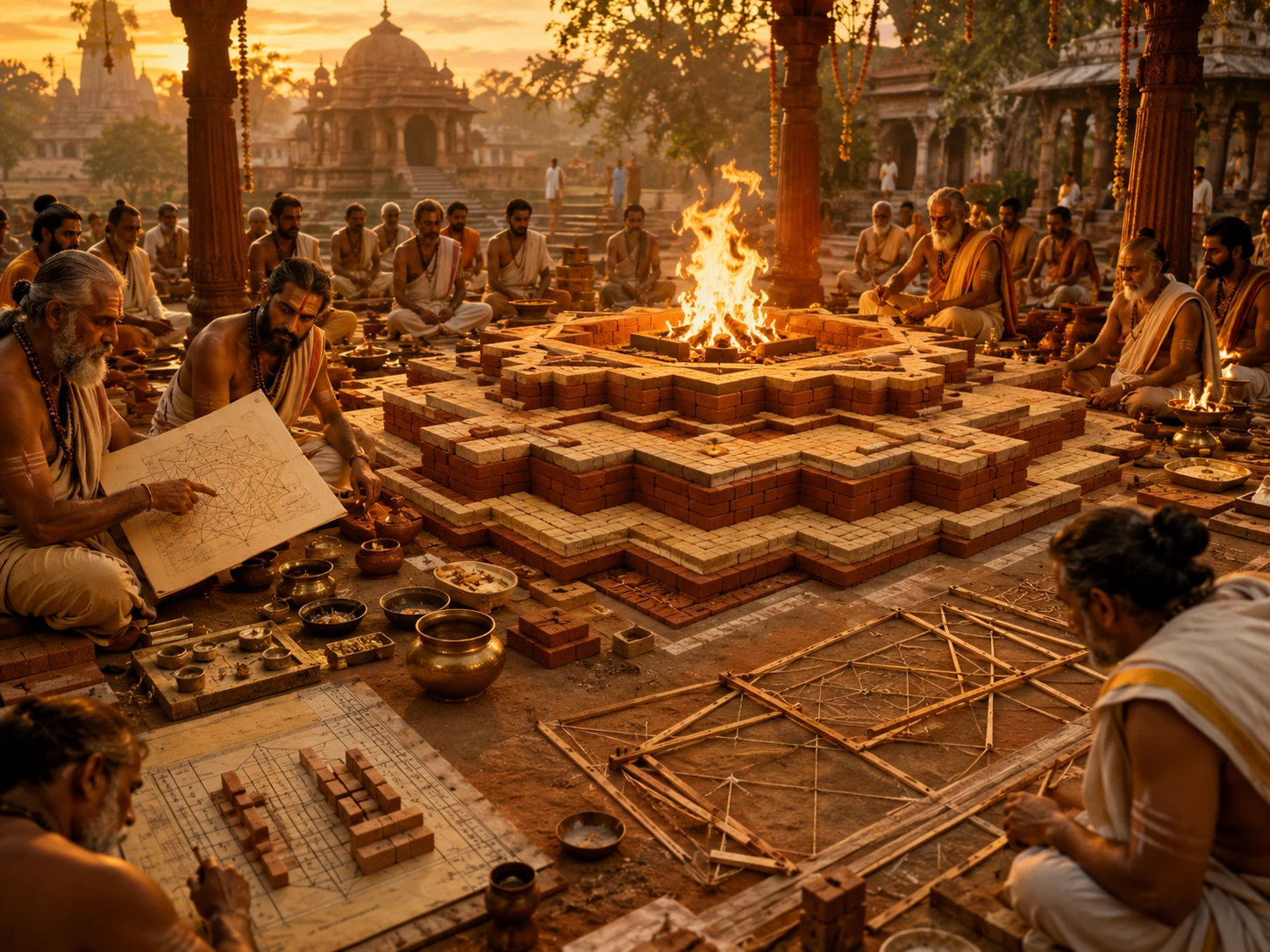
In April 1975, in a small village called Panjal in Thrissur district of Kerala, seventeen Nambudiri Brahmin priests performed a ritual that almost no living person had seen complete. It took twelve days. It used 10,800 specially baked clay bricks. It built, layer by careful layer, a falcon-shaped fire altar covering about 27 square metres of ground. The principal yajamana, Cherumukku Vaidikan Vallabhan Somayajipad, was already in his sixties. The Dutch Indologist Frits Staal had spent two years arranging the funds, the personnel, and the ritual permission. He brought a film crew from the United States. The altar was built. The fires were lit. The chants -- some of them in melodic patterns nobody else in India still remembered -- were recorded.
For most of the twentieth century, the Agnichayana was thought to have died. The Shrauta tradition that maintained these large fire rituals -- distinct from the household Agnihotra and the smaller Soma rites -- had been in retreat since the 11th century. Gupta-era and Chola-era revivals had pushed it forward in waves, but by the British period it survived in just a few Nambudiri families in central Kerala, who had kept the practice going under unbroken oral transmission. By the 1970s, even those families were down to a handful of qualified yajamanas.
Frits Staal's two-volume Agni: The Vedic Ritual of the Fire Altar (1983) is the most complete documentation any Vedic ritual has ever received. After 1975, Athirathram was performed again in 1990, 2006, 2011, and 2015. The 2015 Panjal Athirathram drew about ten thousand visitors over the twelve days. In 2026 it is no longer a ritual on the brink of disappearance. It is a 3000-year-old ritual that survived because three or four families refused to let it stop, and because one foreign scholar arrived just in time.
युञ्जानः प्रथमं मनस्तत्त्वाय सविता धियः। अग्नेर्ज्योतिर्निचाय्य पृथिव्या अध्याभरत्॥
yuñjānaḥ prathamaṃ manas tattvāya savitā dhiyaḥ | agner jyotir nicāyya pṛthivyā adhy ābharat ||
Yoking the mind first, with intellects yoked to truth, Savitar -- having perceived the light of Agni -- brought it forth from the earth.
— Krishna Yajurveda Taittiriya Samhita 4.1.1 (opening verse of the Agnichayana section)
This verse is the first mantra chanted at the start of an Agnichayana. Its imagery captures the entire framework of the ritual. Savitar -- the deity of impulse, of the rising sun -- yokes his own mind first, then his intellect, then perceives the light of Agni hidden inside the earth, and lifts it out. The yajamana is meant to repeat this internal action even as he physically lays the bricks. The fire altar is not a representation of cosmic creation. It is, in the ritual's own framing, the act of cosmic creation, repeated in miniature.
The mythological backdrop comes from the Shatapatha Brahmana, which devotes nearly a third of its enormous bulk to the Agnichayana. In that account, Prajapati -- the lord of creation -- emits living beings from his own body and is left exhausted, his body in pieces. He says to Agni: restore me. The gods say: in you, Agni, we will heal our father Prajapati. They place offerings into the fire. The fire bakes them, and the baked offerings (ishta) become bricks (ishtaka). The bricks are laid one on top of another. When the structure is complete, Prajapati stands restored. The yajamana, by performing the Agnichayana, restores Prajapati and his own self at the same time.
This is also why the altar is bird-shaped. The shyena (falcon) carries the ritual heavenward. The altar is meant to fly. In the ritual's logic, it does fly -- the yajamana ascends to heaven during the performance, and is brought back at the end. The construction is an act of ascension folded into the surface of the earth.
The Five Layers of the Falcon Altar
| Layer | परत | Pattern | Symbolic association |
|---|---|---|---|
| Layer 1 (foundation) | पहली परत (आधार) | Yajusmati pattern A | Earth (prithvi); the body of the bird |
| Layer 2 | दूसरी परत | Pattern B (different) | Antariksha (atmosphere); the breath |
| Layer 3 | तीसरी परत | Pattern A (same as Layer 1) | Dyaus (sky); the wings spread |
| Layer 4 | चौथी परत | Pattern B (same as Layer 2) | Sun (surya); the gathered light |
| Layer 5 (summit) | पाँचवीं परत (शिखर) | Pattern A (same as Layers 1 and 3) | Heaven (svarga); the moment of flight |
Layers 1, 3, and 5 share an identical brick pattern. Layers 2 and 4 share a different pattern. The alternation is a 3:2 alternation that mirrors the basic prosodic pattern of Sanskrit chanting. The five layers also stand for the five seasons (vasanta, grishma, varsha, sharad, hemanta plus shishira combined into the fifth) and the five cardinal directions including the zenith.
The geometry of the bird-shaped altar is what links Agnichayana to the Shulba Sutras -- the geometric texts of the Vedic period (roughly 800 to 200 BCE) that contain India's earliest mathematical writing. The Shulba Sutras of Baudhayana, Apastamba, Manava, and Katyayana all discuss altar construction in detail. They give methods to construct squares of given area, circles equal in area to a given square, and altars of complex shape that must preserve fixed area through transformations of shape. They contain a clear statement of what is now called the Pythagorean theorem, applied to altar diagonal calculation. The Baudhayana Shulba Sutra states the rule for the diagonal of a rectangle in plain Sanskrit prose, several centuries before Pythagoras.
The Agnichayana required all of this geometry simultaneously. The falcon altar must have a precise total area -- the standard purusha-measure, defined as the height of the yajamana with arms extended. As the size of the altar grows for repeated performances, the area must increase by exactly one purusha-square per performance, while the shape stays a falcon. This is a non-trivial geometric problem. The Shulba Sutra texts read like working manuals for solving exactly this problem.
The bricks themselves are made in 396 distinct yajusmati shapes, each with its own name, dimensions, and place in the layer pattern. They are baked in a temporary brick kiln set up next to the altar site. They are laid in five layers in a precisely choreographed sequence that lasts the better part of a week. The lokamprna or ordinary bricks number 10,800 -- a count chosen because it equals the number of muhurtas (48-minute units of time) in a year. The altar is, by construction, a calendar made of stone.
The 1975 Agnichayana at Panjal cost approximately Rs 1 lakh -- around Rs 90 lakhs in today's money once you adjust for inflation. The Nambudiri community could not have funded it alone. Frits Staal raised the money through a combination of US National Endowment for the Humanities grants, Smithsonian funding, and a Ford Foundation contribution. Without that international funding, the 1975 performance would not have happened, and the unbroken Nambudiri transmission might have lapsed for the first time in 3000 years. Some Vedic traditions in India have been preserved by accident, on the strength of foreign academic interest in them. This is one of those cases.
The Nambudiri Brahmins of Kerala have been the principal carriers of the Krishna Yajurveda Taittiriya recension and its Shrauta rituals for at least 1500 years. They are not the only Shrauta community in India -- there are smaller Shrauta lineages among Andhra Vaidikis, Kannada Madhva families, and a few Maharashtra Brahmin communities. But the Nambudiris are the only group to have kept the full Agnichayana ritual continuously practiced. They have maintained an oral chant tradition with a melodic system that bears measurable similarities to the Sama Veda, the Vedic chant found nowhere else, and certain features that musicologists believe go back to the pre-Aryan Dravidian substrate of Kerala. The Sama Veda recordings made at Panjal in 1975 are now archived at the Anthropology Department of the University of California, Berkeley.
The ritual is not symbolic theatre. The Nambudiri families understand it as an active obligation. The yajamana fasts before the ceremony, sleeps separately from his wife, and avoids prohibited foods for months in advance. The wife (yajamana-patni) is a co-officiant -- she sits beside him through the twelve days, makes specific offerings on her own, and shares the fruits of the ritual. After the ceremony, the yajamana is given the title Somayajipad and his name carries this honour for the rest of his life. The ritual is therefore expensive, exhausting, and unrepeatable for a single household. Of the Nambudiri families that historically held the eligibility, fewer than ten still produce qualified performers in 2026.
In 2011 and 2015, the Athirathram drew significant interest from outside the Nambudiri community. NASA's atmospheric chemistry researchers came in 2011 to take air-quality measurements before, during, and after the twelve days. The popular media coverage spoke of measurable changes in atmospheric properties around the altar, but the published scientific results were limited. The ritual does produce dense smoke, increases local CO2 and particulate matter, and concentrates aromatic compounds from the wood and ghee offerings. Whether this constitutes a measurable atmospheric effect of regional significance is the kind of claim that should be tested carefully and reported honestly. The 2011 NASA-related results have not been peer-reviewed at scale.
Agnichayana -- Twelve-Day Sequence
| Days | दिन | Phase | Principal activities |
|---|---|---|---|
| Pre-ritual months | पूर्व-अनुष्ठान महीने | Preparation | Yajamana eligibility, brick-making, fasting, area marking |
| Days 1-3 | दिन 1-3 | Diksha (initiation) | Yajamana takes vows, ceremonial bath, withdraws from worldly life |
| Days 4-5 | दिन 4-5 | Foundation and first layer | Field marked out, ploughed, sowed; first ishtaka layer placed |
| Days 6-7 | दिन 6-7 | Second and third layers | Bird wings begin to take shape; principal Soma offerings |
| Days 8-9 | दिन 8-9 | Fourth layer and golden man | Hiranya-purusha (golden man) and tortoise placed inside altar |
| Day 10 | दिन 10 | Fifth layer (summit) | Final layer; altar declared complete; Agni installed |
| Day 11 | दिन 11 | Atiratra (over-night) | Through-night Soma rite, including continuous chanting |
| Day 12 | दिन 12 | Avabhritha (concluding bath) | Yajamana descends from ritual state, bathes, returns to ordinary life |
Different recensions and different sub-rituals (Agnistoma, Vajapeya, Atiratra, etc.) modify the schedule. The Nambudiri practice follows the Atiratra-Agnichayana, the most complete form. The full ritual technically takes 12 days but the prior preparation can extend over months and the post-ritual obligations of the yajamana extend for the rest of his life.
What does this old ritual mean in 2026?
It means several things at once, and they pull in different directions. As religious practice, the Agnichayana is a tradition that requires very specific lineage, eligibility, and material support, and is unlikely to spread beyond the few families that have kept it. As cultural inheritance, it is one of the longest continuous ritual traditions on earth -- older than any surviving practice in Greek, Egyptian, or Mesopotamian religion. As a piece of human knowledge, it sits at the intersection of geometry, music, ritual, calendar, and architecture in ways that no modern academic discipline still combines.
IIT Bombay's Department of Architecture has run student studio exercises on the geometry of Vedic altars, treating them as case studies in proportion and symmetry. The Indira Gandhi National Centre for the Arts in Delhi has documented many of the Nambudiri chants and produced multimedia archives. The 2015 Panjal Athirathram was filmed in higher quality than the 1975 performance, and that footage has been used in graduate-level Sanskrit studies at JNU and BHU. The ritual is being studied. It is being preserved digitally. Whether it will continue to be performed depends on three or four families and the next generation that grows up in them.
The larger lesson is one that recurs across every Eternal Gyan article on applied sciences. The traditions that survived in India often did so because of specific families, specific places, and specific material conditions. The Iron Pillar survived because it was relocated and protected. Stepwells survived because some Gujarat queens had the resources to build them in stone. Vrikshayurveda survived because a manuscript ended up in Oxford. The Agnichayana survived because Cherumukku Vaidikan and a few of his peers refused to let it stop. None of this is automatic. Cultural memory is fragile. Sometimes the difference between a 3000-year-old ritual continuing or ending in a single generation is one family.
The Athirathram or full Agnichayana is one of about 21 Shrauta rituals catalogued in the Vedic texts. Most of them have not been performed in living memory anywhere in India. The Vajapeya, the Rajasuya, the Ashvamedha, the Purushamedha, and the Sarvamedha all survive only as detailed textual descriptions. The Nambudiri Athirathram is the most elaborate Shrauta ritual currently in active practice. Of all the rituals described in the Yajurveda Samhita and the Shatapatha Brahmana, this is the one that escaped extinction.
Read on Shulba Sutras and Sacred Geometry
The geometric texts of Vedic India that gave the Agnichayana its altars also gave India its earliest written mathematics.
Eternal Raga · शाश्वत राग
Institutional voice — scholarly articles on Sanatan Dharma
Deepen Your Understanding
अपनी समझ और गहरी करें
vedic sciences
Shulba Sutras -- Geometry of Sacred Altars
Centuries before Pythagoras was born, a Vedic priest named Baudhayana wrote a rule about rectangles, diagonals, and areas that would later bear a Greek mathematician's name. The Shulba Sutras are where Indian mathematics began -- not in a classroom, but at a fire altar, with a rope and a stake, solving geometry because the gods demanded precision.
vedic sciences
Vedic Mathematics -- 16 Sutras, One Shankaracharya, and a Controversy That Won't Die
In 1965, a posthumous book by Shankaracharya Bharati Krishna Tirthaji claimed that 16 Sanskrit sutras could solve all of mathematics -- from basic arithmetic to calculus. The techniques are brilliant. The 'Vedic' label is contested. The debate reveals everything about how modern India negotiates between civilisational pride and academic rigour.
vedic sciences
Ancient Indian Metallurgy -- The Iron Pillar That Refuses to Rust
A 7-metre iron pillar has stood in open Delhi air for 1,600 years without rusting. Wootz steel from Tamil Nadu became the legendary Damascus blade. From Vedic kṛṣṇāyas to Vagbhata's bell-metal recipe -- the textual and material evidence of how Bharat worked metal.
vedic sciences
Vedanga Jyotisha -- The Oldest Indian Calendar Science and the Eye of the Veda
Before Aryabhata, before the Surya Siddhanta, before the elaborate planetary models of classical Indian astronomy, there was a small text of 36 verses (Rig Veda recension) or 44 verses (Yajur Veda recension) that laid the foundation for everything. The Vedanga Jyotisha, attributed to the sage Lagadha and dated to roughly 1400-1200 BCE, is the oldest surviving Indian text on astronomy and calendrical science. It is not a stargazer's manual. It is a ritual engineer's handbook -- designed to answer one critical question: when exactly should the Vedic sacrifices be performed? From that question emerged the entire Indian tradition of tracking the sun, moon, and stars.
vedic sciences
Kalpa Sutras -- The Vedanga That Runs the Yajna, the Samskara, the Dharma, and the Altar Geometry
If Shiksha governed sound and Chandas governed meter, Kalpa governed doing -- the actual procedure of Vedic ritual from a child's naming to a king's coronation. Tucked inside its geometry manuals sits the earliest recorded statement of the theorem the Greeks later called Pythagorean.
vedic sciences
Sacred City Planning -- How Hindu Scriptures Designed Cities Before the World Had Zoning Laws
Ancient India did not stumble into urban planning. The Ramayana describes Ayodhya's seven-storey buildings and water-sprinkled highways 3,000 years before Haussmann redesigned Paris. The Arthashastra lays out road widths, waste zones, and water reservoirs with the precision of a modern municipal manual. And the Manasara Shilpa Shastra names eight distinct city grid patterns -- each with a Sanskrit name, a geometric logic, and a moat system. This is not archaeology. This is scripture.
The 1975 Agnichayana at Panjal cost approximately Rs 1 lakh -- around Rs 90 lakhs in today's money once you adjust for inflation. The Nambudiri community could not have funded it alone. Frits Staal raised the money throu…
More in Vedic Sciences
Ancient Indian Metallurgy -- The Iron Pillar That Refuses to Rust
13 min readAryabhata -- The Astronomer Who Said the Earth Turns
3 min read
Charaka vs Sushruta -- The Two Founders of Ayurveda and Why India Had Both Internal Medicine and Surgery 2,000 Years Ago
12 min readThe same translation error that turned '33 Koti' into '33 crore' in Hinduism also happened in Buddhism. The Chinese translation of Buddhist texts rendered 'Sapta Koti Buddha' (7 Supreme Buddhas) as '7 Crore Buddhas.' The…
Deities AvatarsCommunity Reflections
🕉️
Be the first to share your reflection.