Kalpa Sutras -- The Vedanga That Runs the Yajna, the Samskara, the Dharma, and the Altar Geometry
कल्प सूत्र -- वह वेदांग जो यज्ञ चलाता है, संस्कार गढ़ता है, धर्म सँवारता है, और वेदी की ज्यामिति रचता है
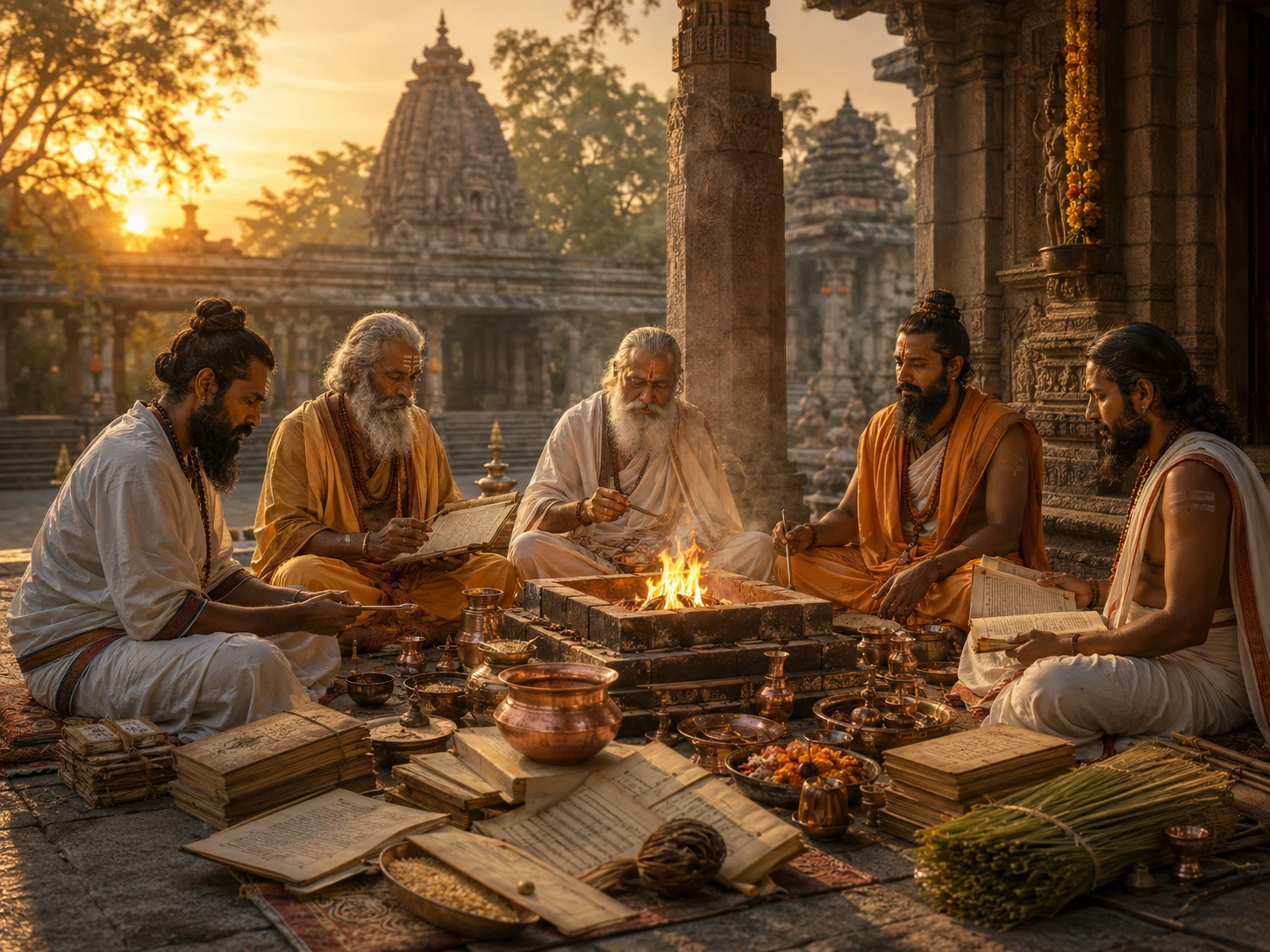
A young couple in Bengaluru decides to get married. They book a hall in Koramangala, settle a date by the family priest's muhurat calculation, and before they know it, someone is tying a knot between their garments and asking them to take seven steps around a small fire. They do not know, as they walk, that every instruction the priest is reading was codified roughly two and a half thousand years ago in a manual called the Paraskara Grihya Sutra, or one of its close cousins. They are inside a living specimen of the Vedanga called Kalpa.
Kalpa is the fifth of the six Vedangas, and it is the practical one. Shiksha governed how a syllable is produced. Chandas governed how a line of verse is metered. Nirukta governed what a word means. Vyakarana governed how a word is formed. Jyotisha governed when a ritual is performed. Kalpa governed the actual doing -- the exact choreography of hand, fire, grain, water, and spoken line that turns a set of abstract principles into an event in the physical world. The Sanskrit word kalpa literally means what is possible, what is fit, what is prescribed -- the way of doing the thing correctly.
A single Kalpa Sutra does not stand alone. The corpus breaks into four branches, each with its own specialisation. Shrauta Sutras cover the grand public yajnas that required multiple fires and teams of priests. Grihya Sutras cover the domestic rites a householder performs in his own home, from the birth of a child to the death of a parent. Dharma Sutras lay down the rules of conduct that tell a person how to live between rituals -- what to eat, whom to marry, how to treat guests, what a king owes his subjects. And Shulba Sutras are the engineering manuals, the geometry textbooks that specify how every altar used in the Shrauta rituals must be measured, laid out, and built. Between these four, the Kalpa corpus covers the entirety of Vedic ritual life -- public and private, conceptual and structural.
दीर्घचतुरस्रस्याक्ष्णया रज्जुः पार्श्वमानी तिर्यग्मानी च यत्पृथग्भूते कुरुतस्तदुभयं करोति॥
dīrghacaturaśrasyākṣṇayā rajjuḥ pārśvamānī tiryagmānī ca yat pṛthag bhūte kurutas tadubhayaṃ karoti ||
The rope stretched along the diagonal of an oblong produces an area which the horizontal and vertical sides together produce separately.
— Baudhayana Shulba Sutra 1.12
One sutra. Sixteen words. What it says, in the flat language of modern geometry, is that for a rectangle with sides a and b and diagonal c, the square built on c equals the square on a plus the square on b -- which is the result the Greek tradition later recorded as the theorem of Pythagoras of Samos. Pythagoras lived around the sixth century BCE. Baudhayana lived between 800 and 500 BCE, and most scholars place him earlier rather than later. He did not travel to Greece. Pythagoras did not have a copy of the Baudhayana Shulba Sutra. The result was found twice, in two cultures, through two different kinds of problem.
What is striking is what Baudhayana was trying to do when the theorem fell out of his workings. He was not doing mathematics for its own sake. He was writing a manual for priests who had to lay out Vedic fire altars on open earth, with rope and wooden stakes, to strict ritual specifications. A square altar of a given area might need to be converted into a rectangle of the same area. A small altar might need to be doubled. A brick-by-brick Agnichayana altar shaped like a falcon in flight might need five layers built on a precisely defined base. Every one of these construction steps demands geometry.
The Sanskrit word shulba means cord, rope. The Shulba Sutras are literally the cord-sutras -- the manual for laying out sacred space with a piece of rope. A priest holds one end at a stake, stretches the rope to a chosen length, marks a second stake, then pivots. The geometry follows. Pythagorean triples like 3-4-5, 5-12-13, 8-15-17, and 12-35-37 appear in Apastamba's Shulba text as ready-to-use tools for generating exact right angles with a knotted cord. A priest who needs a ninety-degree corner on a temple floor does not need to know the theorem abstractly. He knows that if he ties knots at three, four, and five units along a rope, he can use the triangle those knots describe to create a right angle. The Shulba Sutras are the first written record in any civilisation of a builder's mathematics that still survives as live engineering today.
The Four Divisions of Kalpa Sutras
| Division | विभाग | Scope | Principal Authors | Modern Echo |
|---|---|---|---|---|
| Shrauta Sutras | श्रौत सूत्र | Public multi-priest yajnas using three fires: Agnihotra, Soma sacrifices, Ashvamedha | Ashvalayana, Shankhayana, Baudhayana, Apastamba, Katyayana | Somayaga revival in Kerala; annual Ati-Rudra Maha Yajnas |
| Grihya Sutras | गृह्य सूत्र | Domestic rites: the sixteen samskaras from garbhadhana to antyeshti, daily puja, panchayajna | Ashvalayana, Paraskara, Gobhila, Khadira, Manava | Every modern Hindu wedding, namakarana, upanayana, and shraddha |
| Dharma Sutras | धर्म सूत्र | Rules of conduct: varna, ashrama, food, marriage, duties of king and subject, inheritance | Gautama, Baudhayana, Apastamba, Vasishtha | Seeds that later grew into Manu Smriti, Yajnavalkya Smriti, Indian legal tradition |
| Shulba Sutras | शुल्ब सूत्र | Geometry of altar construction: squares, rectangles, circles, right triangles, area transformations | Baudhayana, Manava, Apastamba, Katyayana | Earliest recorded Pythagorean theorem, sqrt(2) approximation to five decimals |
A single named author like Baudhayana or Apastamba typically wrote across multiple divisions -- a Shrauta Sutra, a Grihya Sutra, a Dharma Sutra, and a Shulba Sutra all under the same name. The four divisions together formed the teaching set of a full Vedic gurukul.
The Shrauta Sutras sit at the top of the Kalpa pyramid because they describe the most elaborate rituals the tradition knew. A Shrauta ritual requires three sacred fires: the garhapatya or householder's fire (round, in the west), the ahavaniya or invocation fire (square, in the east), and the dakshinagni or southern fire (semi-circular, in the south). Around these three fires, as many as sixteen priests with specialised roles would conduct ceremonies that could last from one afternoon to a full year. The Agnihotra is the simplest and is performed daily at sunrise and sunset. The Darshapurnamasa is fortnightly. The Chaturmasya is seasonal. Above these sit the Soma sacrifices -- the Jyotishtoma, the Agnishtoma, the Vajapeya, the Rajasuya -- each more complex than the last. At the summit stands the Ashvamedha, the horse sacrifice associated with kingly coronation, and the year-long Purushamedha.
These were not small affairs. A Soma yajna could involve hundreds of clay vessels, thousands of priests-in-training, several acres of carefully prepared ritual ground, and precise coordination of three fires with specific mantras chanted at specific moments in the diurnal cycle. The Shrauta Sutras of Ashvalayana, Shankhayana, Apastamba, Baudhayana, Katyayana, and Latyayana each provide the complete choreography for their particular Vedic school. To read a Shrauta Sutra is to read a thousand-page production manual for a civic-scale performance.
Something remarkable is that most of these rituals are still performed. The Nambudiri Brahmins of Kerala have preserved the oldest continuous tradition of Shrauta performance. In 1975 the Dutch indologist Frits Staal filmed a twelve-day Agnichayana at Panjal in Kerala, recruiting teams of Nambudiri priests who between them knew the Ashvalayana Shrauta Sutra in its recited form. That film and the accompanying two-volume monograph are now the definitive ethnographic record of a living Shrauta yajna. A few performances have happened in the fifty years since, including the Athirathram at Panjal in 2011 and a major Somayaga cycle at Kundoor in 2019. Each of these is, in effect, a live reading of a specific Shrauta Sutra against a matching altar and fire setup.
समस्य द्विकरणी। प्रमाणं तृतीयेन वर्धयेत् तच्चतुर्थेनात्मचतुस्त्रिंशोनेन सविशेषः॥
samasya dvikaraṇī | pramāṇaṃ tṛtīyena vardhayet tac caturthenātmacatustriṃśonena saviśeṣaḥ ||
The diagonal of a square. Increase the unit measure by one third, and that third by its own fourth less the thirty-fourth part of that fourth -- this, with a small excess, gives the diagonal.
— Baudhayana Shulba Sutra 2.12
Work the formula. Take the unit as one. Add one-third: you are at one plus one-third. Add one-fourth of that one-third, which is one-twelfth: you are at one plus one-third plus one-twelfth. Subtract one-thirty-fourth of that one-twelfth, which is one-four-hundred-and-eighth: you land at 577 divided by 408. Convert to decimal: 1.41421568... The actual value of the square root of two is 1.41421356... Baudhayana's formula is correct to five decimal places.
This is not an approximation that fell out of the sky. It is the answer a priest needs when he has a square altar of a given side and has to know, exactly, how long to cut the rope for its diagonal -- because the diagonal rope is what you use to lay out the next altar, which by rule must have double the area. The construction doubles the area; the diagonal solves it; the approximation handles the fact that the root of two cannot be written as a ratio of two whole numbers. Baudhayana does not prove that sqrt(2) is irrational. But his language -- saviśeṣa, with a small excess -- acknowledges that whatever rational ratio you put on the right side, you will be just a little off. The ancient Indian builder's mathematics already felt the shadow of the irrational, and honestly flagged it.
A modern IIT graduate doing first-year engineering at IIT Bombay meets the value 1.41421 in her calculator in week one of her course. She may not be told that Indians were computing it to the fifth decimal place in the eighth century before Christ, using rope and logic, with the stated purpose of cutting the diagonal of a ritual altar. A CBSE class ten student meets the Pythagorean theorem in her geometry chapter and is often told, in a single optional line, that it is also recorded in the Baudhayana Shulba Sutra. The history is not there to flatter anyone. It is there to correct a stubborn misunderstanding -- that mathematics is a Greek gift. It is not. Mathematics has at least two parallel ancient origins, and the Indian one grew out of the demand for sacred geometry.
Shrauta was only the ceiling. Most Indian life then and now happens in the kitchen and the bedroom, not on the yajna ground. The Grihya Sutras cover this lower-ceilinged domain -- the house. The core of the Grihya literature is the scheme of the sixteen samskaras, the life-cycle sacraments that escort a human from conception to cremation. The order, with some regional variation, runs roughly as follows. Garbhadhana is performed at conception. Pumsavana in the third month of pregnancy. Simantonnayana in the seventh month. Jatakarma at the moment of birth. Namakarana -- the naming ceremony -- on the eleventh or twelfth day. Nishkramana is the first taking of the infant outside the home. Annaprashana is the first feeding of solid food, usually rice and ghee, at around six months. Chudakarana is the ritual first haircut. Karnavedha is the piercing of the ears. Vidyarambha marks the beginning of formal learning. Upanayana is the sacred thread ceremony and the start of Vedic education, traditionally at age seven or eight. Vedarambha is the first formal Vedic lesson. Keshanta is the first ritual shaving of facial hair in adolescence. Samavartana is the return home at the end of studentship. Vivaha is marriage. And Antyeshti is the final rite, the cremation.
The Paraskara Grihya Sutra, the Ashvalayana Grihya Sutra, the Gobhila, and the Manava are the most widely consulted texts. When a Tamil grandmother in Chennai chants the mantras for annaprashana as she feeds her six-month-old grandson his first spoonful of rice and ghee, she is reciting fragments of Ashvalayana. When a Gujarati family performs a sacred thread ceremony for a young boy in Ahmedabad, the priest's manual derives from Paraskara. When a Bengali family in Kolkata holds a namakarana for their newborn, the rite traces its lines back to Gobhila. The core of these procedures has not changed for two thousand five hundred years. The spoken language of the mantras has not changed at all.
The saptapadi in an Indian wedding is the most visible surviving fragment of Grihya sutra practice. The couple takes seven steps around the sacred fire, one step at a time, while the priest recites a vow for each step -- first step for nourishment, second for strength, third for wealth, fourth for happiness, fifth for progeny, sixth for the seasons, seventh for lifelong friendship. In Indian law, under the Hindu Marriage Act of 1955, a Hindu marriage is legally complete only upon completion of the saptapadi. A three-thousand-year-old Grihya sutra procedure is written, word for word, into the current legal code of the Republic of India. Nothing else in the Indian legal system carries its heritage that openly.
The Dharma Sutras are the ethical sibling of the Grihya Sutras. Where Grihya tells you how to perform a ceremony, Dharma tells you how to live. The four surviving Dharma Sutras are those of Gautama, Baudhayana, Apastamba, and Vasishtha. They are older, more concise, and more varied than the later Dharmashastras like the Manu Smriti or the Yajnavalkya Smriti, and they are the root from which those later texts grew. A modern historian of Indian law, whether at the National Law School in Bengaluru or at Oxford, will tell you that to understand the structure of traditional Indian jurisprudence you must start with the Dharma Sutras, not with Manu.
The Dharma Sutras cover a lot of ground in very few words. They lay out the four varnas and the four ashramas. They list the types of marriage the tradition acknowledged, from the paternally arranged Brahma marriage to the consensual Gandharva union. They specify duties of a king, of a householder, of a student, of a forest-dweller. They legislate food -- what is permitted for which varna in which region, what is forbidden altogether, what must be done if forbidden food is eaten by mistake. They handle property. They handle inheritance. They handle the settlement of disputes. All of this sits in terse sutra form, meaning each sentence is spare, each phrase carries multiple layers of meaning, and no sutra can be read honestly without a commentary.
The honest reader has to hold two things at once about the Dharma Sutras. On one hand, they contain the oldest surviving Indian legal thought, carefully stratified by context and situation. On the other hand, they carry social assumptions -- about caste, about gender, about the relative authority of varnas -- that the Indian Republic of 2026 has explicitly rejected. The Indian Constitution, drafted under the leadership of Dr. B. R. Ambedkar, supersedes the Dharma Sutras where they conflict. Modern scholars like Patrick Olivelle, who translated the four major Dharma Sutras for Oxford University Press, and Ludo Rocher, whose posthumous Studies in Hindu Law remains a standard reference, read these texts historically -- as evidence of how pre-modern Indian society organised itself, not as legal codes to be applied now. This is how the texts should be read. They are primary source material for a history department, not a rulebook for a courtroom.
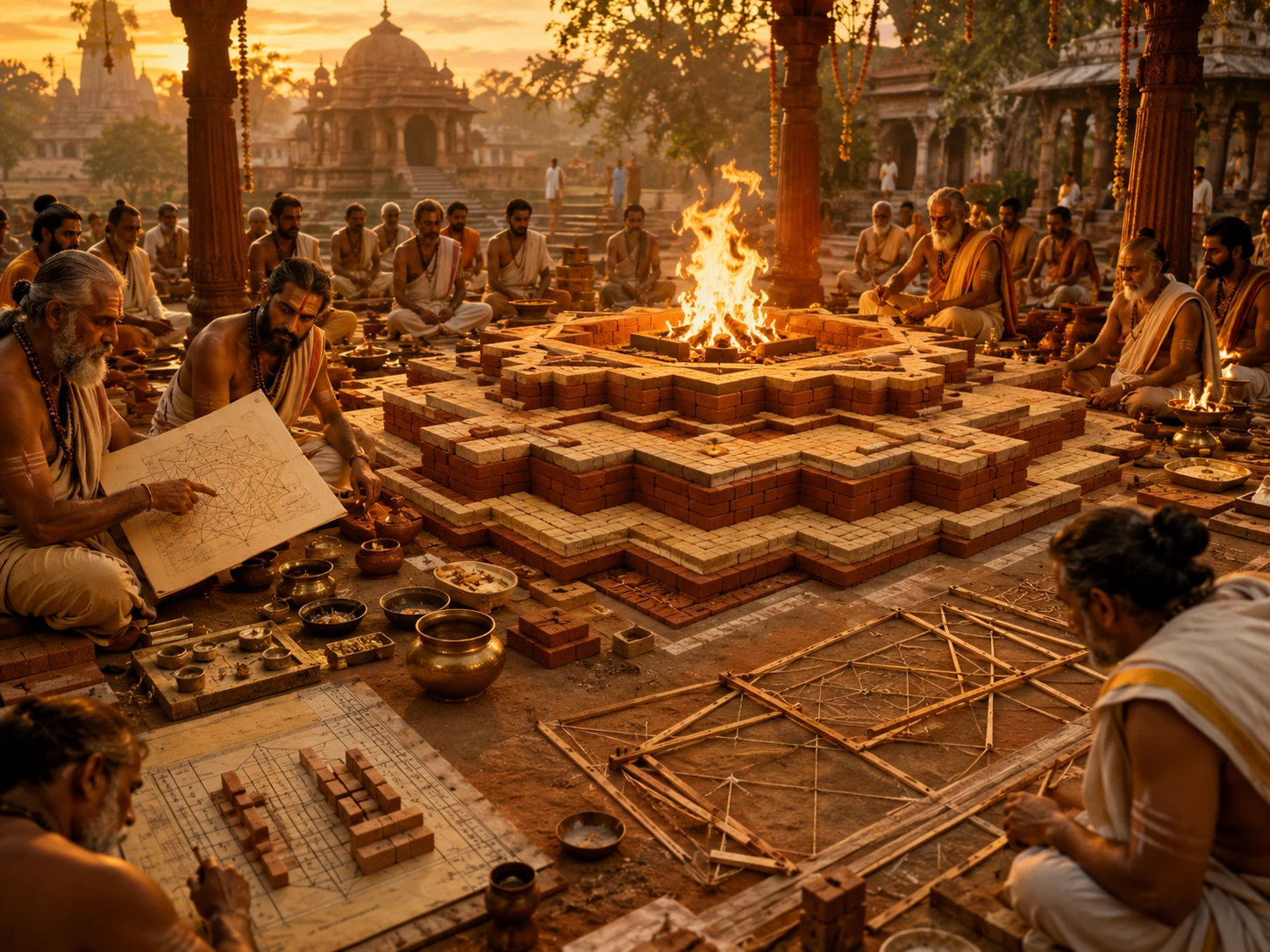
The Agnichayana altar described in the Baudhayana Shulba Sutra is shaped like a falcon in flight and built of 10,800 bricks arranged in five layers. Each brick must have a specific size, shape, and placement. The total surface area is defined to be exactly seven and a half square purusha, a unit roughly equal to the height of a man with arms outstretched. To preserve this area while changing the outline from a square first layer to the falcon shape of the later layers, the priest must perform several area-preserving geometric transformations -- exactly the transformations the Shulba Sutras spell out. A priest who successfully completed an Agnichayana was, in effect, certified in applied geometry two thousand years before the word geometry entered English.
The living chain of Kalpa in 2026 is thicker than most urban Indians realise. The Sringeri Sharada Peetham maintains daily and periodic Shrauta rituals. The Kanchi Kamakoti Peetham, the Jyotirmath at Joshimath, the Dwaraka Peeth, and the Puri Peetha together cover every major Shrauta cycle across the year. Individual gurukuls in Kurukshetra, Varanasi, Tirupati, and Kalady train students who can perform full Agnihotra and the more compact Somayagas. The Maharishi Sandipani Rashtriya Veda Vidya Pratishthan, funded by the Government of India, supports a network of about a hundred pathashalas across the country that teach Kalpa alongside the other Vedangas. The Vedic Heritage Portal maintained by IGNCA in Delhi has digitised recordings of Shrauta performance and searchable Grihya procedure. The Karnataka state government funds an annual Ati-Rudra Maha Yajna at several temples. The numbers are small by the standards of cricket or cinema, but the chain has not broken.
Outside the explicitly religious world, Kalpa continues to inform domestic Indian life in ways few people label as such. The priest who officiates a Marathi wedding in Pune reads from Paraskara. The one who officiates a Bengali wedding in New York reads from Gobhila. The namakarana of a newborn in Hyderabad follows a Grihya sequence. The annaprashana of a six-month-old in Jaipur follows the same sequence. The Kashi-yatra performed as part of an upanayana in Chennai uses mantras from Ashvalayana. The hair-cutting of a two-year-old at the Tirupati Venkateshwara temple is Chudakarana as codified in multiple Grihya sutras. The mourning observances of a family in any Indian city after a parent's passing derive from Antyeshti rules that any of the Dharma Sutras would recognise.
What the Shulba half of Kalpa gave India, over and above the altars, was a culture of taking geometry seriously. The Jantar Mantar observatories built by Jai Singh II in Jaipur, Delhi, Ujjain, Varanasi, and Mathura in the eighteenth century inherit this. The medieval Kerala School of astronomy, working in the fourteenth and fifteenth centuries CE, which produced power series for pi and for the inverse tangent, inherits this. The IIT Bombay computer graphics group, when it rendered a digital Agnichayana altar in 2014 as part of the Shulba Sutra digitisation project, inherits this. Ancient applied mathematics is not frozen in the altar; it flowed into every subsequent Indian field that needed exact numbers to do exact work.
Of all six Vedangas, Kalpa is the one that forces the reader to reckon with both ends of the Vedic enterprise at once. On one end, a priest in a small Kerala village lights three fires and chants Ashvalayana word for word. On the other end, a sage in 800 BCE stretches a rope across a rectangle and writes down the theorem that an IIT first-year student will meet three thousand years later on a blackboard. Kalpa insists that these two moments belong to one intellectual project. The priest needs the theorem to build his altar. The theorem needs the altar to have anything to prove itself on. Sacred ritual drove exact measurement; exact measurement made sacred ritual possible.
This is what makes Kalpa, for all its antiquity, the most quietly modern of the Vedangas. A civilisation that understood its rituals required engineering was already a civilisation that valued engineering. It did not need to wait for a later generation to discover that mathematics matters. It had built the commitment into the core of its religious life. The priest was also the geometer. The geometer was also the priest. Neither role was lesser for including the other.
For any Indian today -- the UPSC aspirant in Mukherjee Nagar, the Bollywood musician in Andheri, the hardware engineer at Qualcomm in Hyderabad, the grandmother threading flowers for a household puja in Thrissur -- some fragment of Kalpa is running in the background of the day. The samskara that gave them their name, the geometry embedded in the architecture of the temple they visit, the shloka their priest recites at the next family wedding, the algebraic approximation their calculator uses to compute the diagonal of a square -- all of it has the same root system. Kalpa is not a chapter in a textbook. Kalpa is a pattern of attention that a civilisation trained in itself, and that has not, three thousand years later, forgotten how to pay.
Read a Samskara in the Grihya Sutra
The Ashvalayana Grihya Sutra sets out the household rites, from namakarana to vivaha and antyeshti, with the mantras to be chanted at each step. It is on Eternal Raga with Sanskrit and translation; read the vivaha section first. The Baudhayana Shulba Sutra, also on the site, gives the geometry of the fire altars.
Tags
Eternal Raga · शाश्वत राग
Institutional voice — scholarly articles on Sanatan Dharma
Deepen Your Understanding
अपनी समझ और गहरी करें
vedic sciences
Shad Vedangas -- The Six Limbs of the Veda
The Vedas are not a single book you can pick up and read. They are a living system with six auxiliary sciences -- phonetics, metre, grammar, etymology, astronomy, and ritual procedure -- that function like limbs of a body. Without them, the Vedas are a voice without a mouth, a path without eyes. Here is the operating manual India's knowledge system ran on for three thousand years.
vedic sciences
Nirukta -- How Yaska Built the World's First Etymology Textbook
Before Panini's grammar, before Merriam-Webster, before Google defined anything, Yaska wrote the Nirukta -- a sixth century BCE manual that asked a daring question: what does a word actually mean, and how do we prove it?
vedic sciences
Chandas Shastra -- Pingala's Science of Meter, and How It Gave India the Binary Number
Roughly two thousand years before Leibniz wrote about binary arithmetic, Acharya Pingala had already built an eight-chapter sutra manual that used short and long syllables to enumerate metres. Inside that manual sits the oldest recorded description of a binary numeral system.
vedic sciences
Shiksha -- The Vedanga of Sound, and Why One Mispronounced Syllable Can Flip a Mantra's Meaning
The Vedic tradition is obsessed with how a syllable leaves the mouth -- which organ shaped it, at what pitch, for how long. The Vedanga that codifies this obsession is Shiksha. Its textbooks fix the exact acoustic architecture that has kept the Veda unchanged for three thousand years.
vedic sciences
Vedanga Jyotisha -- The Oldest Indian Calendar Science and the Eye of the Veda
Before Aryabhata, before the Surya Siddhanta, before the elaborate planetary models of classical Indian astronomy, there was a small text of 36 verses (Rig Veda recension) or 44 verses (Yajur Veda recension) that laid the foundation for everything. The Vedanga Jyotisha, attributed to the sage Lagadha and dated to roughly 1400-1200 BCE, is the oldest surviving Indian text on astronomy and calendrical science. It is not a stargazer's manual. It is a ritual engineer's handbook -- designed to answer one critical question: when exactly should the Vedic sacrifices be performed? From that question emerged the entire Indian tradition of tracking the sun, moon, and stars.
vedic sciences
Surya Siddhanta -- The Ancient Astronomy Text That Got the Year Right to 1.4 Seconds
Before Copernicus, before Galileo, before the telescope existed -- an Indian text calculated the tropical year as 365.2421756 days. The modern value is 365.2421904. The difference is 1.4 seconds per year. The Surya Siddhanta also described gravity, computed planetary diameters within 1% accuracy, and invented the sine function. It did all this in Sanskrit verse.
rituals traditions
The 16 Samskaras -- Rites of Passage from Womb to Pyre
Hinduism does not leave life to chance. From the moment a couple decides to conceive to the moment the body returns to the five elements, there are sixteen rituals -- samskaras -- designed to refine the human being at every critical transition. Think of them as firmware updates for the soul, installed at precisely the right moments.
The Agnichayana altar described in the Baudhayana Shulba Sutra is shaped like a falcon in flight and built of 10,800 bricks arranged in five layers. Each brick must have a specific size, shape, and placement. The total s…
More in Vedic Sciences
Agnichayana -- The Falcon-Shaped Fire Altar That Survived 3,000 Years
12 min read
Ancient Indian Metallurgy -- The Iron Pillar That Refuses to Rust
13 min readAryabhata -- The Astronomer Who Said the Earth Turns
3 min readThe same translation error that turned '33 Koti' into '33 crore' in Hinduism also happened in Buddhism. The Chinese translation of Buddhist texts rendered 'Sapta Koti Buddha' (7 Supreme Buddhas) as '7 Crore Buddhas.' The…
Deities AvatarsCommunity Reflections
🕉️
Be the first to share your reflection.