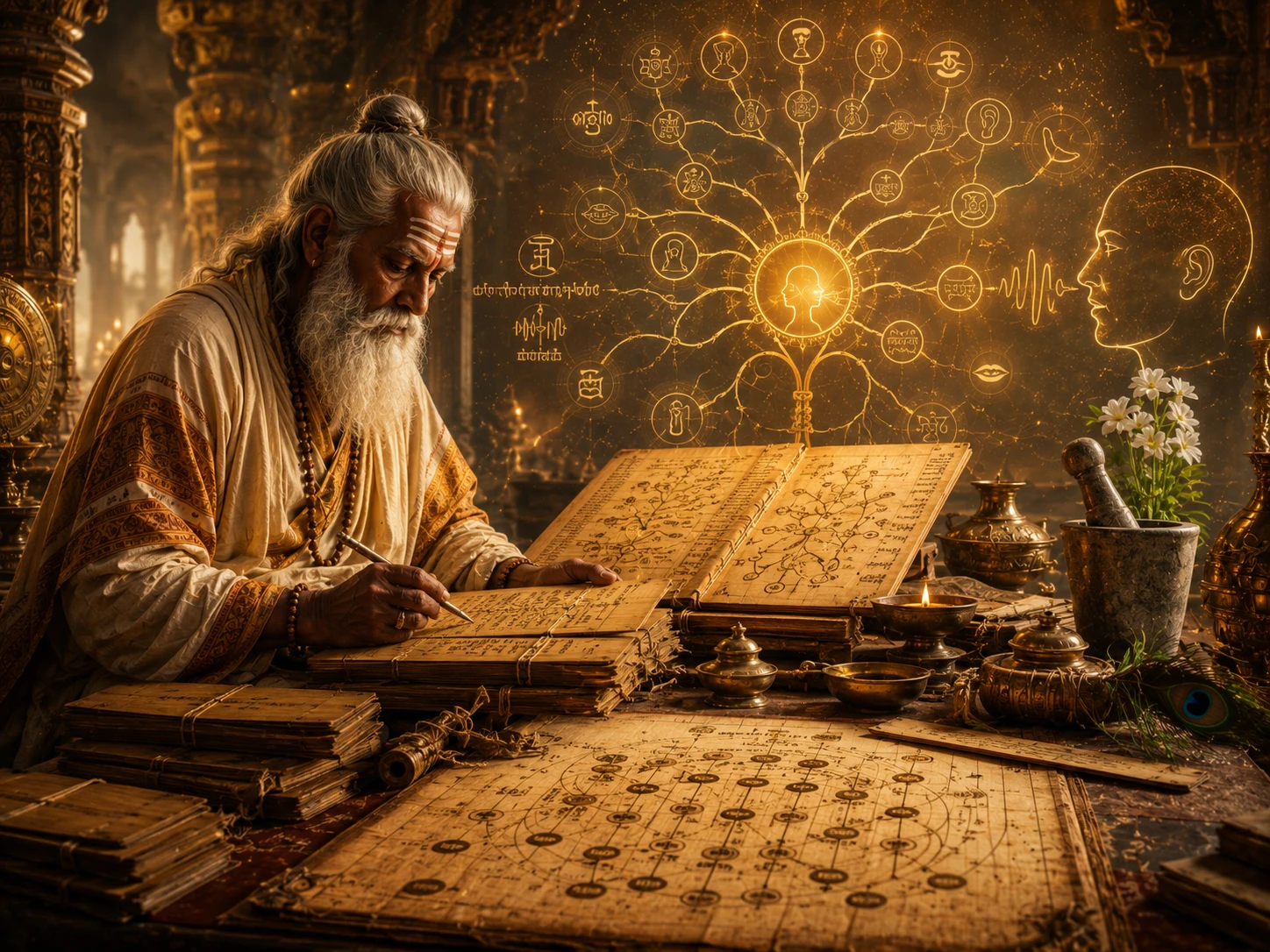
Nirukta -- How Yaska Built the World's First Etymology Textbook
निरुक्त -- यास्क का रचा विश्व का प्रथम व्युत्पत्ति शास्त्र
When a child in a Kanpur classroom asks why a bus is called a bus, the teacher usually points to the English abbreviation of omnibus. That small moment contains a much older question. Every culture at some point asks: what is this word made of, and why does it mean what it means? Around the sixth century BCE, give or take a couple of hundred years, a scholar named Yaska sat down to answer that question for the Sanskrit of the Rig Veda. The manual he produced is called the Nirukta, and it is the oldest surviving textbook of etymology in any language of the world.
Nirukta is one of the six Vedangas, the supporting disciplines a Vedic student had to master before the Samhita could open itself to him. Shiksha taught how to pronounce a sound. Chandas taught how to count its beats. Vyakarana taught how to build a grammatical form. Kalpa taught how to use that form inside a ritual. Jyotisha fixed the right moment. Nirukta was the science that came in once all the other five had done their work: the science of what the word, correctly pronounced, correctly conjugated, correctly chanted at the correct hour, actually meant.
The question sounds simple. It is not. By Yaska's time the Vedic corpus was already a thousand years old or more. Whole vocabularies had fallen out of common speech. Certain hymns contained words that priests were reciting perfectly without any confident grasp of the sense. Yaska's task was not to invent meanings. It was to build a method for recovering them.
चत्वारि पदजातानि नामाख्याते चोपसर्गनिपाताश्च तानीमानि भवन्ति।
catvāri padajātāni nāmākhyāte copasarganipātāś ca tānīmāni bhavanti
There are four classes of words: noun, verb, prefix, and particle. These are they.
— Nirukta 1.1 (Yaska)
That single sentence is the foundation slab of Indian grammatical thought. Yaska did not invent the four-fold classification of words; the older Pratishakhya texts already worked with something like it. But Yaska was the first person we know of to state it cleanly at the top of a treatise and use it as the skeleton for everything that follows.
Nama is the noun. Akhyata is the verb. Upasarga is the prefix, the small piece that clings to a verb and changes its direction (pra, para, apa, sam and others). Nipata is the particle, the tiny invariant word that holds a sentence together without carrying a meaning of its own (cha, vai, u, iti). Yaska says that the first two, noun and verb, can be defined; the other two can only be listed, because prefixes and particles draw their meaning from the company they keep. Any student who has ever struggled to explain what ka in ka vir astu actually does will recognise the problem Yaska is pointing at.
The next move Yaska makes is more radical. He says a noun is at root a verb. Naama aakhyaata-jani, he writes, quoting his predecessor Shakatayana: names are born from verbs. The Sanskrit word gau (cow) comes from the verb root gam, to move. Agni (fire) comes from a root meaning to lead to the front. Vrika (wolf) comes from vrishch, to tear. The principle is aggressive: find me a noun and I will show you the action it was born to describe. Not every scholar agreed. Gargya, another ancient authority quoted in the Nirukta, thought the project went too far -- that many nouns were simply nouns and could not be traced to verbs without inventing etymologies. The quarrel between the Shakatayana school and the Gargya school is, in miniature, the same quarrel that runs through every modern dictionary of English: how much do we insist on a root, and when do we admit that some words just exist?
The Four Padajatani -- Yaska's Classification of All Words
| Class | वर्ग | English Equivalent | Example (Sanskrit) | How Yaska Treats It |
|---|---|---|---|---|
| Nama (नाम) | नाम | Noun / substantive | gauh (cow), agnih (fire), Rama | Has sattva (being) as its core; can be defined; derived from a verb root |
| Akhyata (आख्यात) | आख्यात | Finite verb | vrajati (walks), pacati (cooks) | Has bhava (becoming, action) as its core; the primary category of meaning |
| Upasarga (उपसर्ग) | उपसर्ग | Prefix / preverb | pra, para, apa, sam, anu | No meaning in isolation; modifies the verb it attaches to |
| Nipata (निपात) | निपात | Particle / indeclinable | cha, vai, iti, u, kam | Binds sentences; some expletive, some referential; must be listed, not defined |
The modern UPSC Sanskrit optional paper still tests this four-fold scheme, and every Panini student at Shastri level begins with a version of the same categories. The bones of the classification have not moved in 2,500 years.
Halfway through the first chapter of the Nirukta, Yaska stops the argument cold and lets a ghost speak. The ghost is Kautsa, an older teacher whose views survive only because Yaska bothered to quote him in order to refute him.
Kautsa's position is startling: the Vedic mantras are meaningless. Priests chant them, certainly, and they produce ritual effects, certainly, but the idea that the words carry sense, the idea that nirukta itself is a legitimate science, Kautsa rejects. He gives reasons. The word order inside Vedic hymns is broken. Some verses seem to contradict plain experience. Certain padas are preserved even when nobody alive can say what they mean. If the words meant anything, Kautsa argues, the priests would simply speak them in ordinary Sanskrit; the fact that they are preserved in a frozen sound form suggests that the sound itself is the point, not the sense.
This is not a strawman. Kautsa's argument is close to the ritual theology of later Mimamsa, and variants of it return in every tradition that treats mantra as sound-power rather than as language. Yaska's answer, spread across Nirukta 1.15 and 1.16, is a defence of meaning itself. If Vedic words were meaningless, he argues, why do we find the same words used meaningfully in ordinary Sanskrit? Why would sages who gave up everything for the sake of knowledge compose rituals entirely out of empty noise? Why does the very structure of a hymn -- this god invoked, this blessing requested, this enemy named -- presuppose that the words are doing semantic work? The obscurity of a verse, Yaska insists, is the limit of the reader, not of the verse. One studies harder. One does not declare the text dead.
The Kautsa debate is the hinge on which the entire Indian project of scripture interpretation turns. Without Yaska's victory here, there is no Shankara commentary, no Ramanuja commentary, no Madhva commentary. There is no Mimamsa, no Vedanta, no centuries of debate over what the Gita actually says in chapter two verse forty-seven. The whole culture of reading the Sanskrit tradition closely, line by line, rests on Yaska's insistence that the words are worth reading.
भावप्रधानम् आख्यातम्। सत्त्वप्रधानानि नामानि।
bhāvapradhānam ākhyātam | sattvapradhānāni nāmāni
A verb has becoming (bhava, action, process) as its dominant sense. A noun has being (sattva, existent thing) as its dominant sense.
— Nirukta 1.1 (Yaska)
This half-line is one of the most compact statements of Indian linguistic philosophy. Verb is about becoming; noun is about being. Vrajati (he walks) foregrounds the unfolding of an action in time. Gauh (cow) foregrounds a settled, countable thing in the world. Yaska does not treat this as a pedantic grammar point. He treats it as a statement about how language carves up reality into what changes and what stays.
With the four classes of words fixed and the Kautsa question settled, Yaska turns to his second great contribution: the four modes of Vedic interpretation. A single Vedic verse, he argues, can be read on at least four different levels at once. The adhidaivata reading takes the deity at face value -- Indra is the god of rain, Agni is the god of fire. The adhiyajna reading shifts the same words to the ritual arena -- Indra becomes the element of courage the sacrificer needs, Agni becomes the physical flame on the altar. The aitihasika reading treats the hymn as historical memory -- a battle that happened, a king who ruled, a river that flowed. The adhyatmika reading lifts the whole thing inward -- Indra is the controlled mind, Agni is the inner fire of awareness, the sacrifice is the offering of ego.
This is not a mystical flourish. It is a working method. A student trained in the four modes can keep the same verse alive across completely different contexts. A Kota student preparing for the UPSC Sanskrit paper uses the adhidaivata reading to answer the factual question. A young sadhaka at Arsha Vidya Gurukulam uses the adhyatmika reading to guide meditation. A PhD candidate at JNU might use the aitihasika reading to write a paper on early Vedic politics. None of them is wrong. All of them are reading Yaska.
The Nirukta operates on an underlying text called the Nighantu. The Nighantu is a compact glossary of roughly 1,771 Vedic words, arranged into categories: synonyms, rare words, deity names. Yaska did not write the Nighantu; he inherited it, and composed the Nirukta as a running commentary on it. So when you hear that the Nirukta has twelve chapters with two supplementary books, what is actually being said is that Yaska walks through the Nighantu class by class, picking out the hard words, and showing in each case how his method unlocks the meaning.
What does Yaska's method actually look like when he picks up a word? Take the word agni, one of the most frequent in the Rig Veda. Yaska breaks it apart into three possible derivations, drawn from three different verbal roots: agni comes from anc (to go, to move), because fire goes upward; or from ang (to lead), because the sacrifice is led to the front by fire; or from daha (to burn), by irregular sound change. Yaska does not pick one answer. He lists all three, lets the reader hold them together, and treats the living word as the meeting point of its possible origins.
Take ashva, the horse. Yaska derives it from ash, to travel fast -- the horse is, by naming, the fast one. Take prithvi, the earth. He derives it from prath, to spread out -- the earth is the spread-out one. Take satya, truth. He splits it as sat (what is) plus ya (that which is connected) -- truth is that which is tied to what actually exists. Every such derivation is an argument the reader is free to reject. The derivation is not offered as a proof. It is offered as a working hypothesis, and the text gives you the tools to test it.
This method has a technical name in the Nirukta itself: samskara, the refining or treatment of a word. Yaska's samskara proceeds in steps. First, he identifies the verbal root the word seems to descend from. Second, he checks the sound changes needed to go from root to surface form. Third, he compares the meaning of the root with the way the word is used in context. Fourth, he offers an interpretation that respects both the etymology and the usage. A student of the Nirukta is being trained in this four-step operation, not in a list of answers. The answers change as the evidence changes. The method does not.
Roughly two centuries after Yaska, another man named Panini sat down in the northwest of the subcontinent and wrote the Ashtadhyayi -- the 3,959 sutras that still define Sanskrit grammar. Panini and Yaska are the two founding personalities of Sanskrit linguistic science. They are not rivals. They are sister sciences working on the same raw material from opposite ends.
Vyakarana, Panini's domain, is the science of form. Given a verb root and a set of suffixes, Vyakarana tells you exactly which final word shape is correct. Nirukta, Yaska's domain, is the science of meaning. Given a correct word shape already fixed by grammar, Nirukta tells you what the word is likely to have meant when it first took that shape. A Sanskrit sentence needs both disciplines standing behind it. If Vyakarana builds the house, Nirukta tells you who has lived there and what the rooms were once used for.
Yaska himself insists that a student should study Vyakarana before approaching the Nirukta. He quotes several grammatical predecessors -- Shakatayana, Gargya, Shakapuni, Audumbarayana -- and engages their views in detail. Panini in turn cites Shakatayana and the Nairukta school, which tells us that the two traditions were already aware of each other and in conversation. By the time classical commentators like Patanjali (the grammarian, author of the Mahabhashya) and Katyayana were writing, the two sciences were treated as parallel and complementary.
The distinction matters for how a serious Sanskrit student works today. At the Rashtriya Sanskrit Sansthan, at the Sanskrit departments of BHU and Pune University, at Chinmaya International Foundation Shodha Sansthan in Kerala, students in the Shastri and Acharya programs are still trained in both lines. One tells them how to parse; the other tells them how to interpret. A researcher doing computational work on the Rig Veda at IIT Bombay faces the same duality. The parser is a Paninian tool. The word-sense disambiguation module is a Nairuktika tool. Split them and the system collapses.
The Nirukta has been copied, recopied, argued over and saved by hand for nearly two and a half millennia. That survival is not an accident. It is the result of a commentarial chain that runs from Yaska down to us without breaking.
The single most important link in that chain is Durgacharya, the commentator who wrote the Nirukta-Vritti, probably between the eleventh and thirteenth centuries CE. Durgacharya's commentary is not a paraphrase. It is a second book sitting inside the first. When Yaska's Sanskrit is cryptic, Durgacharya unfolds it. When a verse is quoted in shorthand, Durgacharya supplies the full reference. When Yaska's etymology is obscure, Durgacharya offers a second reading and tells the student how to choose between them. Most Sanskrit scholars reading the Nirukta today are, in fact, reading it through Durgacharya's eyes.
Before Durgacharya there was Skandaswamin, whose partial commentary also survives. After Durgacharya the tradition continues with the Nirukta-Bhashya of Nilakantha Gargya Yajvan in the south, various Vyakhyas in Kerala and Karnataka, and modern critical editions in the twentieth century. The critical edition that forms the basis of most current scholarly work was published by Lakshman Sarup in the 1920s under the Panjab University Oriental Publications series. Sarup translated the first six chapters of the Nirukta into English and provided a careful textual apparatus. Since then, serious Indian scholars have issued further editions with Hindi commentaries, most notably Pandit Jayashankar Lal Tripathi's and the Chowkhamba Sanskrit Series editions out of Varanasi.
The Nirukta is also recited orally in certain Vedic gurukuls even today, in the traditional style of memorization with accent markers. At the Karapatra Swami Vedanta Mahavidyalaya in Varanasi and at several Veda-Pathashalas in Tamil Nadu, a young Brahmachari still hears Yaska's opening sutra the way his great-grandfather would have heard it -- out loud, first, before any book is opened. That living oral chain is older than the written editions. It is one reason the text is so clean.
When IIT Bombay's Computation for Indian Language Technology group and the Sanskrit-Computational Linguistics team at IIT Kharagpur build Sanskrit morphological analysers, they encode Yaska's four classes -- nama, akhyata, upasarga, nipata -- into the tag set that the machine applies to each input word. The Heritage Sanskrit Parser developed by INRIA uses a similar scheme. A 2,500-year-old taxonomy is still the first thing a modern natural language processing pipeline for Sanskrit has to agree with before it can do anything else.
Yaska's influence reaches far beyond Sanskrit departments. When a Zomato copywriter in Gurgaon pushes back on a founder's choice of the word sankalp for a product launch, and argues that vachan carries a softer promise -- she is doing nirukta. When a Malayalam film title is argued over in a WhatsApp group because two cousins disagree on whether the word is derived from a Tamil root or a Sanskrit root -- that argument is nirukta. When a Bengaluru startup names itself Agnikul and the marketing team has to decide whether agni should evoke fire, fuel, ritual, or all three -- they are using, without realising it, Yaska's framework of multiple simultaneous readings.
Nirukta also reshapes how a reader approaches sacred text. The Bhagavad Gita has been translated into English more than three hundred times, and every honest translator has had to choose between an adhidaivata reading (the gods and battles are literal), an aitihasika reading (the Kurukshetra war happened, Krishna was a historical figure), and an adhyatmika reading (the whole conversation is the soul talking to God inside one mind). No single translation captures all four levels at once. The Sanskrit does. That is why serious students eventually leave the translation behind. Even a word every Indian says daily, namaste, opens under Yaska's method: namas (bow, a verbal noun from the root nam, to bend) plus te (to you), the whole word therefore carrying its meaning inside its form -- bending toward you.
The deeper lesson of the Nirukta is epistemic, not linguistic. Yaska teaches that a word is not a label pasted onto a thing. A word is a fossil of an action, a trace of human attention, a record of what a community chose to notice about the world when it first needed the word. Every time you learn the true etymology of a familiar Hindi word -- say, samasya, which comes from sam + as, to be together in a knot -- the word stops being a flat object and becomes a small history. That is Yaska's gift. The gift outlasts him by 2,500 years, and shows no sign of aging.
Read the Nighantu and Nirukta
Read Yaska's Nirukta alongside the Nighantu, the word-list it comments on. Pick one difficult Vedic word, find it in the Nighantu, then follow Yaska's derivation of it. Both texts are on Eternal Raga with Sanskrit and translation.
Tags
Eternal Raga · शाश्वत राग
Institutional voice — scholarly articles on Sanatan Dharma
Deepen Your Understanding
अपनी समझ और गहरी करें
vedic sciences
Shad Vedangas -- The Six Limbs of the Veda
The Vedas are not a single book you can pick up and read. They are a living system with six auxiliary sciences -- phonetics, metre, grammar, etymology, astronomy, and ritual procedure -- that function like limbs of a body. Without them, the Vedas are a voice without a mouth, a path without eyes. Here is the operating manual India's knowledge system ran on for three thousand years.
vedic sciences
Vedanga Jyotisha -- The Oldest Indian Calendar Science and the Eye of the Veda
Before Aryabhata, before the Surya Siddhanta, before the elaborate planetary models of classical Indian astronomy, there was a small text of 36 verses (Rig Veda recension) or 44 verses (Yajur Veda recension) that laid the foundation for everything. The Vedanga Jyotisha, attributed to the sage Lagadha and dated to roughly 1400-1200 BCE, is the oldest surviving Indian text on astronomy and calendrical science. It is not a stargazer's manual. It is a ritual engineer's handbook -- designed to answer one critical question: when exactly should the Vedic sacrifices be performed? From that question emerged the entire Indian tradition of tracking the sun, moon, and stars.
vedic sciences
Surya Siddhanta -- The Ancient Astronomy Text That Got the Year Right to 1.4 Seconds
Before Copernicus, before Galileo, before the telescope existed -- an Indian text calculated the tropical year as 365.2421756 days. The modern value is 365.2421904. The difference is 1.4 seconds per year. The Surya Siddhanta also described gravity, computed planetary diameters within 1% accuracy, and invented the sine function. It did all this in Sanskrit verse.
vedic sciences
Kaal Ganana -- The Hindu Measure of Time
From a single blink of the eye (Nimesha) to one Day of Brahma (4.32 billion years) -- explore the complete cosmic time hierarchy of Hindu cosmology, anchored in Vishnu Purana 1.3, with its remarkable parallels to modern science.
vedic sciences
Chandas Shastra -- Pingala's Science of Meter, and How It Gave India the Binary Number
Roughly two thousand years before Leibniz wrote about binary arithmetic, Acharya Pingala had already built an eight-chapter sutra manual that used short and long syllables to enumerate metres. Inside that manual sits the oldest recorded description of a binary numeral system.
vedic sciences
Shiksha -- The Vedanga of Sound, and Why One Mispronounced Syllable Can Flip a Mantra's Meaning
The Vedic tradition is obsessed with how a syllable leaves the mouth -- which organ shaped it, at what pitch, for how long. The Vedanga that codifies this obsession is Shiksha. Its textbooks fix the exact acoustic architecture that has kept the Veda unchanged for three thousand years.
vedic sciences
Kalpa Sutras -- The Vedanga That Runs the Yajna, the Samskara, the Dharma, and the Altar Geometry
If Shiksha governed sound and Chandas governed meter, Kalpa governed doing -- the actual procedure of Vedic ritual from a child's naming to a king's coronation. Tucked inside its geometry manuals sits the earliest recorded statement of the theorem the Greeks later called Pythagorean.
When IIT Bombay's Computation for Indian Language Technology group and the Sanskrit-Computational Linguistics team at IIT Kharagpur build Sanskrit morphological analysers, they encode Yaska's four classes -- nama, akhyat…
More in Vedic Sciences
Agnichayana -- The Falcon-Shaped Fire Altar That Survived 3,000 Years
12 min read
Ancient Indian Metallurgy -- The Iron Pillar That Refuses to Rust
13 min readAryabhata -- The Astronomer Who Said the Earth Turns
3 min readThe same translation error that turned '33 Koti' into '33 crore' in Hinduism also happened in Buddhism. The Chinese translation of Buddhist texts rendered 'Sapta Koti Buddha' (7 Supreme Buddhas) as '7 Crore Buddhas.' The…
Deities AvatarsCommunity Reflections
🕉️
Be the first to share your reflection.