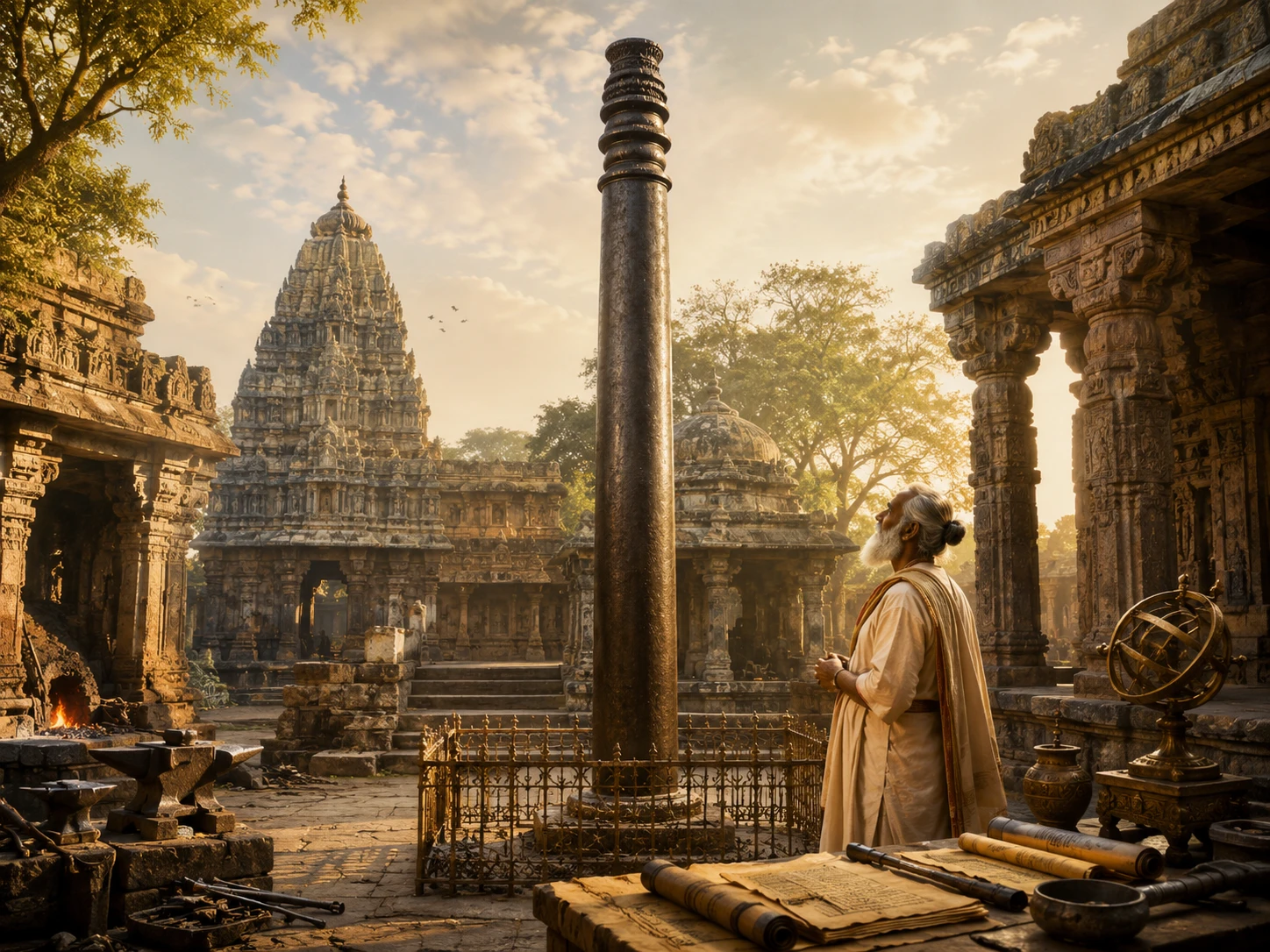
Ancient Indian Metallurgy -- The Iron Pillar That Refuses to Rust
प्राचीन भारतीय धातु विज्ञान -- वो लौह स्तम्भ जो जंग नहीं पकड़ता
Walk through the Qutb complex in Mehrauli on any winter morning and you will see a slim dark column standing in an inner courtyard, dwarfed by the minar that towers next to it. School groups walk past without slowing down. A few foreign tourists pause to read the plaque. Most people miss the point.
That column is roughly 7.21 metres tall, weighs over six tonnes, and was forged sometime around 400 CE during the reign of Chandragupta II of the Gupta dynasty. It has stood out in the open Delhi weather for over 1,600 years through summer heat, monsoon rain, smog, and acid showers. It has not rusted. The oxide layer that should have eaten an exposed iron column down to a stub centuries ago is, on this pillar, less than a millimetre thin and chemically stable.
This is not folklore. It is the most carefully measured metallurgical artefact in India, and the work of one IIT Kanpur professor in particular -- Ramamurthy Balasubramaniam, who passed away in 2009 -- gave us the first proper explanation of why.
Balasubramaniam's analysis is straightforward chemistry. The pillar is wrought iron with about 0.25 percent phosphorus -- many times higher than modern wrought iron. The Gupta-era smiths smelted it without lime, which means the phosphorus from the ore was never removed. They forge-welded the pillar from many smaller blooms of iron, and small particles of slag and unreduced iron oxide remained scattered through the metal.
When this iron meets Delhi's wet-dry seasons, something unusual happens. The phosphorus migrates to the surface and forms a thin, sticky, crystalline film of iron hydrogen phosphate hydrate -- a compound with the formula FePO4·H3PO4·4H2O. That film is electrochemically stable. It seals the iron underneath from further oxidation. The pillar essentially passivates itself, the way a stainless steel teaspoon does, but through a completely different chemistry that has no analogue in modern industrial steel.
Whether the smiths who built this pillar consciously selected high-phosphorus ore, or simply worked with what their bloomeries produced, is debated. Balasubramaniam argued for conscious selection based on the consistency of phosphorus content across the pillar. Other archaeometallurgists are more cautious. What is not in dispute is the result -- a 1,600-year-old standing test that no contemporary mild steel rod could pass.
अष्टभागेन ताम्रेण द्विभागेन कुटिलेन च। विद्रुतेन भवेत् कांस्यं श्रेष्ठं सौराष्ट्रसम्भवम्॥
aṣṭabhāgena tāmreṇa dvibhāgena kuṭilena ca | vidrutena bhavet kāṃsyaṃ śreṣṭhaṃ saurāṣṭra-sambhavam ||
Eight parts of copper combined with two parts of tin, when melted together, become bell-metal (kāṃsya) -- the finest is produced in Saurashtra.
— Rasaratnasamuccaya 5.205 (Vagbhata, c. 13th century CE)
The verse above is not poetry decorated with metal-talk. It is a metallurgical formula -- 80 percent copper, 20 percent tin, melt together, prefer Saurashtra. Modern bell-metal in Indian foundries today still works on roughly the same proportions, and the harmonics of a temple bell depend on this ratio. A bell with too much tin sounds shrill and cracks; with too little, the tone dies quickly.
Vagbhata's Rasaratnasamuccaya, compiled around the 13th century CE, sits at the end of a long Indian tradition of rasaśāstra -- the science of metallic and mineral preparations. The text classifies metals into three groups. Four śuddha lohas or pure metals: gold (suvarṇa), silver (rajata), copper (tāmra), and iron (lauha). Two pūti lohas or low-melting metals: lead (nāga) and tin (vaṅga). And three miśra lohas or alloys: brass (pittala, copper-zinc), bell-metal (kāṃsya, copper-tin), and varta-loha, the five-metal mixture. This is the same classification that survives today in Ayurvedic pharmacy when a vaidya prepares loha-bhasma for anaemia or tāmra-bhasma for liver complaints.
Seven Classical Metals -- Sanskrit Names and Identifications
| Sanskrit | संस्कृत | Modern equivalent | Earliest text reference | Use in tradition |
|---|---|---|---|---|
| Suvarṇa / Hiraṇya | सुवर्ण / हिरण्य | Gold (Au) | Rig Veda; Atharva Veda | Idols, ornaments, rasāyana |
| Rajata | रजत | Silver (Ag) | Atharva Veda | Coinage, vessels, kavacha |
| Tāmra | ताम्र | Copper (Cu) | Rig Veda (lohita-ayas) | Vessels, bhasma, water purification |
| Lauha / Kṛṣṇāyas | लौह / कृष्णायस | Iron (Fe) | Yajur Veda; Atharva Veda | Weapons, tools, structural |
| Nāga | नाग | Lead (Pb) | Arthashastra 2.12 | Pigments, metallurgy flux |
| Vaṅga | वंग | Tin (Sn) | Arthashastra 2.12 | Bell-metal alloying |
| Pittala / Ārakūṭa | पित्तल / आरकूट | Brass (Cu-Zn) | Arthashastra 2.12 | Lamps, vessels, idols |
Kautilya's Arthashastra Book 2 Chapter 12 names a lohādhyakṣa (Superintendent of Metals) responsible for manufacturing copper, lead, tin, brass, bronze, and other alloys. The state ran the mines.
While the Iron Pillar is the most visible artefact, it is not the most influential. That title belongs to wootz -- a crucible steel produced in workshops across south India, especially in what is today Karnataka, Tamil Nadu, Telangana, and Kerala. Smiths there packed iron with charcoal and certain plant materials into sealed clay crucibles and heated them at high temperatures. The result was a homogeneous high-carbon steel with a distinctive watered surface pattern.
This ingot, called wootz in English (a corruption of the Kannada-Telugu word for steel, ukku), travelled from south Indian ports to Damascus, Persia, and onwards. It was reforged in Syrian and Persian workshops into the legendary Damascus blades that European crusaders both feared and coveted. The carbide nanostructures inside wootz blades were studied as recently as 2006 by a research team in Dresden using transmission electron microscopy -- and they found nano-scale wires and carbon nanotubes inside the steel matrix. How the south Indian smiths produced this structure is still being researched.
Meanwhile, in Bidar in present-day Karnataka, a quieter tradition called Bidri took shape from around the 14th century. Black zinc-copper alloy inlaid with silver wire, polished with a special soil collected only from the unfinished walls of Bidar Fort. The alloy is technologically sophisticated, and the craft is one of the few Indian metallurgical practices to receive a Geographical Indication tag in the modern era.
Kautilya's Arthashastra, dated by Olivelle and McClish to roughly the 1st-3rd century CE in its present form, treats metallurgy as a state matter. Book 2 Chapter 12 describes a full administrative apparatus. The ākarādhyakṣa, Superintendent of Mines, examined locations for old slag, charcoal, and ash to identify previously worked deposits, or surveyed plains and slopes for new ores using mineralogists. The lohādhyakṣa, Superintendent of Metals, oversaw the manufacture of copper, lead, tin, vaikṛntaka, ārakūṭa (brass), kāṃsya (bronze), and tāla (sulphurate of arsenic). The lakṣaṇādhyakṣa, Superintendent of the Mint, controlled the alloy specifications for silver coins -- four parts silver to one part copper, with one-sixteenth māṣa of tīkṣṇa, trapu, sīsa, or añjana for hardness.
The text also gives field instructions. Ores tinted orange or pale red yield tīkṣṇa (steel-iron). Ores the colour of pigeon, with white veins and a smell of raw meat, yield lead. Ores like saline soil or burnt earth yield tin. To soften any metal, treat it with cow's-tooth powder, mushroom ash, and vajrakanda. To purify, soak in cow's urine and alkaline ash three times. These procedures were not metaphor. Many of them, when tested in modern laboratories using the same plant ashes and mineral fluxes, work as the text claims, though the chemistry behind them was understood only later.
The phosphorus content in the Mehrauli pillar (about 0.25 percent) is roughly 50 times higher than in modern wrought iron. In contemporary steelmaking, phosphorus is treated as an impurity to be removed, because at lower concentrations it makes steel brittle. The Gupta-era smiths produced exactly the opposite -- a high-phosphorus iron whose own impurity layer became its defence. IIT Kanpur's archaeometallurgy group still uses the pillar as a teaching case for what goes wrong when modern engineers assume their material assumptions are universal.
Three Classical Indian Metallurgical Achievements
| Artefact / Tradition | कीर्ति / परम्परा | Approximate date | Location | Distinctive feature |
|---|---|---|---|---|
| Iron Pillar of Delhi | मेहरौली का लौह स्तम्भ | c. 400 CE (Chandragupta II) | Mehrauli, Delhi (originally elsewhere, possibly Udayagiri) | Forge-welded high-phosphorus wrought iron, 7.21 m, self-passivating |
| Wootz / Ukku Steel | वूट्स / उक्कु इस्पात | c. 300 BCE onward | South India -- Karnataka, Tamil Nadu, Telangana, Kerala | Crucible steel; nano-scale carbide structures; basis of Damascus blade |
| Bidri Ware | बीदरी कला | c. 14th century onward | Bidar, Karnataka | Zinc-copper alloy inlaid with silver wire; finished with Bidar Fort soil |
Sushruta Samhita Sutrasthana 8 lists about 101 surgical instruments, most of bronze or iron, with cutting edges that the text says should pass through a hair without parting it. Real archaeometallurgy of recovered bronze instruments from sites like Taxila supports the high quality.
When Jamsetji Tata laid the foundation of Tata Iron and Steel in Sakchi (now Jamshedpur) in 1907, he was not starting India's relationship with iron from zero. He was joining a lineage. The same Chhota Nagpur belt that fed his Sakchi furnaces had been worked by tribal smelters for centuries. The Asur, Agaria, and Lohar communities of present-day Jharkhand and Chhattisgarh ran small bloomeries until well into the British period, when colonial taxation and industrial imports pushed most of them out of business. Some bloomery furnaces were still operating in remote pockets when Indian independence arrived.
Today Bharat Forge in Pune supplies forging components to global aerospace majors. Mishra Dhatu Nigam in Hyderabad makes the titanium-aluminium alloys that go into ISRO's PSLV rocket motors. The Defence Metallurgical Research Laboratory next door supplies superalloys for fighter jet engines. The Sakchi steel that built the Howrah Bridge in 1943 has descendants in the Atal Tunnel girders and the Chenab arch bridge. None of this is a romantic continuity with the Mehrauli pillar -- the metallurgy is completely different. But the workshops, the patronage system, the state-supported research, and even the obsessive focus on alloy composition are familiar from Kautilya. The institution is older than the technology.
There is a temptation, in any account of Indian metallurgical history, to either overclaim or underclaim. The overclaim says ancient Indians invented stainless steel before the West. The underclaim says these were lucky accidents, and the smiths did not really understand what they were doing.
Neither is right. Indians did not invent stainless steel -- modern stainless is an iron-chromium-nickel alloy with completely different chemistry. What south Indian smiths invented was a crucible steel, wootz, that produced extraordinary blades for over a thousand years and travelled along trade routes from Madurai to Toledo. What the Gupta smiths produced at the Iron Pillar was a phosphorus-rich wrought iron that happens to passivate itself, and whether their selection was conscious or accidental, the result has held up for sixteen centuries. What Vagbhata systematised in the Rasaratnasamuccaya was an alchemy-meets-pharmacy framework that allowed metals to be processed into therapeutically usable bhasmas, many of which still serve in Ayurvedic dispensaries. These are real, defensible achievements. They do not need exaggeration to remain remarkable.
The Iron Pillar carries a six-line Sanskrit inscription in Gupta-period Brahmi praising a king referred to as Chandra (most scholars identify this as Chandragupta II). The pillar was originally a dhvaja-stambha (flag staff) dedicated to Vishnu, possibly at Udayagiri in Madhya Pradesh. It was likely moved to Delhi by Anangpal Tomar around the 11th century. The Vishnu image that once stood on top is gone. The pillar remains.
Read More on Vedic Sciences
Explore the broader Eternal Gyan section on Vedic Sciences -- from Kaal Ganana to Surya Siddhanta to Shulba Sutras.
Tags
Eternal Raga · शाश्वत राग
Institutional voice — scholarly articles on Sanatan Dharma
Deepen Your Understanding
अपनी समझ और गहरी करें
vedic sciences
Shulba Sutras -- Geometry of Sacred Altars
Centuries before Pythagoras was born, a Vedic priest named Baudhayana wrote a rule about rectangles, diagonals, and areas that would later bear a Greek mathematician's name. The Shulba Sutras are where Indian mathematics began -- not in a classroom, but at a fire altar, with a rope and a stake, solving geometry because the gods demanded precision.
vedic sciences
Charaka vs Sushruta -- The Two Founders of Ayurveda and Why India Had Both Internal Medicine and Surgery 2,000 Years Ago
Charaka wrote the textbook on diagnosing disease. Sushruta wrote the textbook on cutting it out. Together, the Charaka Samhita and Sushruta Samhita represent one of the most complete medical systems of the ancient world -- covering everything from pulse diagnosis and herbal pharmacology to rhinoplasty, cataract surgery, and caesarean section. One text founded internal medicine. The other founded surgery. And both were written in India over 2,000 years ago, centuries before comparable texts appeared in Greece or Rome. This article puts the two traditions side by side and asks: what did ancient India actually know about healing the human body?
vedic sciences
Ayurveda -- The 3,000-Year-Old Science That Knows Your Body Type Before You Do
Long before personalised medicine became a Silicon Valley buzzword, the Charaka Samhita classified every human being into one of seven constitutional types based on three biological forces -- Vata, Pitta, and Kapha. Modern genomic studies at CSIR-IGIB have found that these ancient types correlate with distinct gene expression profiles. Ayurveda did not guess. It observed.
vedic sciences
Upavedas -- The Four Applied Sciences of Hindu Tradition
The Vedas gave India its philosophy and rituals. The Upavedas gave India its professions. Four applied knowledge systems -- Ayurveda (medicine), Dhanurveda (warfare), Gandharvaveda (music and performing arts), and Sthapatyaveda (architecture) -- were classified as subsidiary Vedas, each attached to one of the four main Vedas. They represent the Hindu tradition's insistence that sacred knowledge must produce practical results: a healed body, a defended nation, a beautiful performance, a well-built home. Together, the Upavedas form the intellectual infrastructure of pre-modern Indian civilisation -- from the surgeon's scalpel to the architect's blueprint to the musician's raga.
vedic sciences
Vedic Water Harvesting -- Stepwells, Tanks, and the Engineering Bharat Forgot
Bengaluru is running out of water. Chennai had a Day Zero. Yet a 5th-century Patan stepwell still holds water in summer. Sringaverapura's 2-million-litre Mauryan reservoir is intact. The water systems Bharat built between 1500 BCE and 1500 CE are starting to look like the future, not the past.
vedic sciences
Vedic Mathematics -- 16 Sutras, One Shankaracharya, and a Controversy That Won't Die
In 1965, a posthumous book by Shankaracharya Bharati Krishna Tirthaji claimed that 16 Sanskrit sutras could solve all of mathematics -- from basic arithmetic to calculus. The techniques are brilliant. The 'Vedic' label is contested. The debate reveals everything about how modern India negotiates between civilisational pride and academic rigour.
The phosphorus content in the Mehrauli pillar (about 0.25 percent) is roughly 50 times higher than in modern wrought iron. In contemporary steelmaking, phosphorus is treated as an impurity to be removed, because at lower…
More in Vedic Sciences
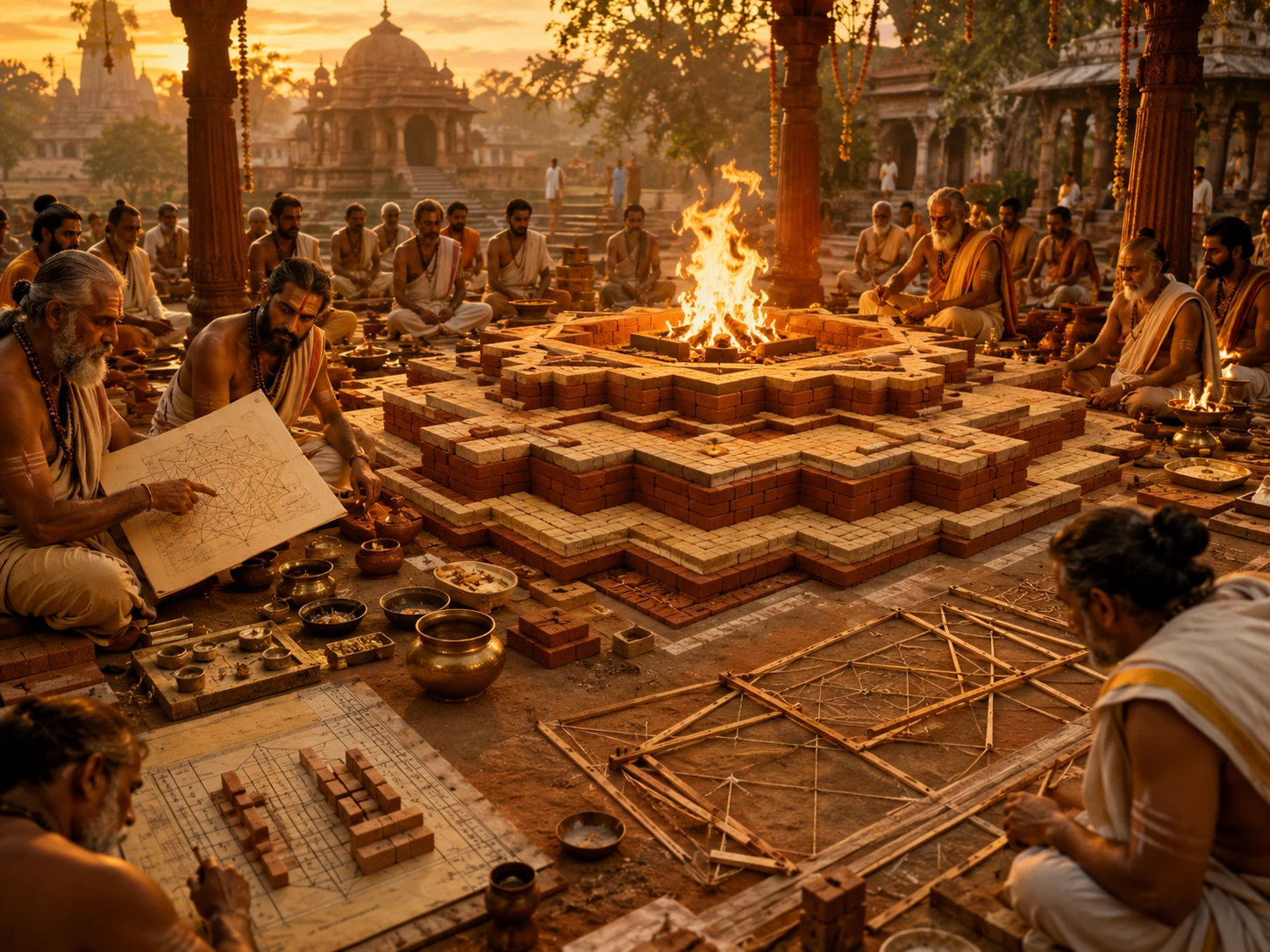
Agnichayana -- The Falcon-Shaped Fire Altar That Survived 3,000 Years
12 min readAryabhata -- The Astronomer Who Said the Earth Turns
3 min read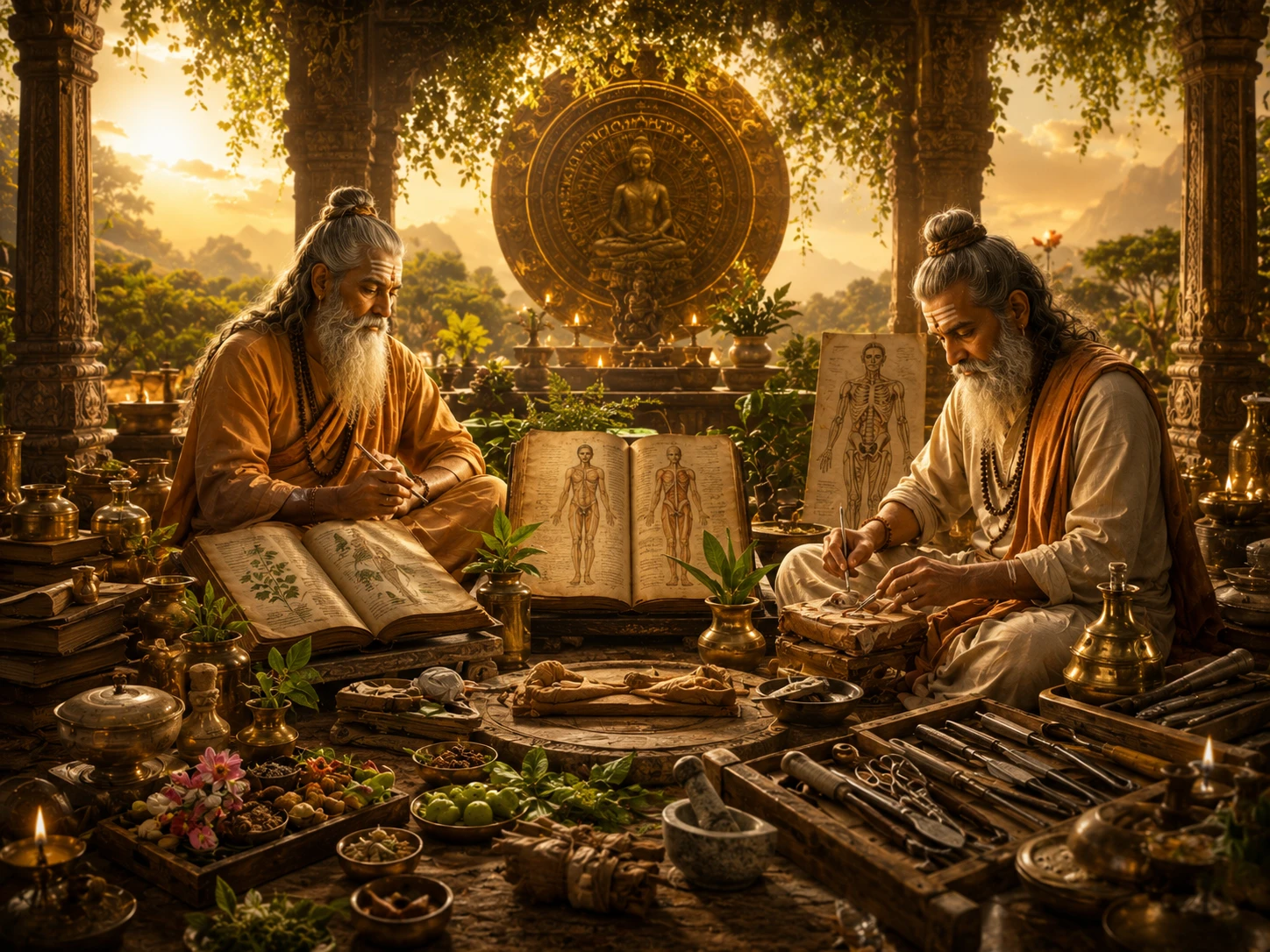
Charaka vs Sushruta -- The Two Founders of Ayurveda and Why India Had Both Internal Medicine and Surgery 2,000 Years Ago
12 min readThe same translation error that turned '33 Koti' into '33 crore' in Hinduism also happened in Buddhism. The Chinese translation of Buddhist texts rendered 'Sapta Koti Buddha' (7 Supreme Buddhas) as '7 Crore Buddhas.' The…
Deities AvatarsCommunity Reflections
🕉️
Be the first to share your reflection.