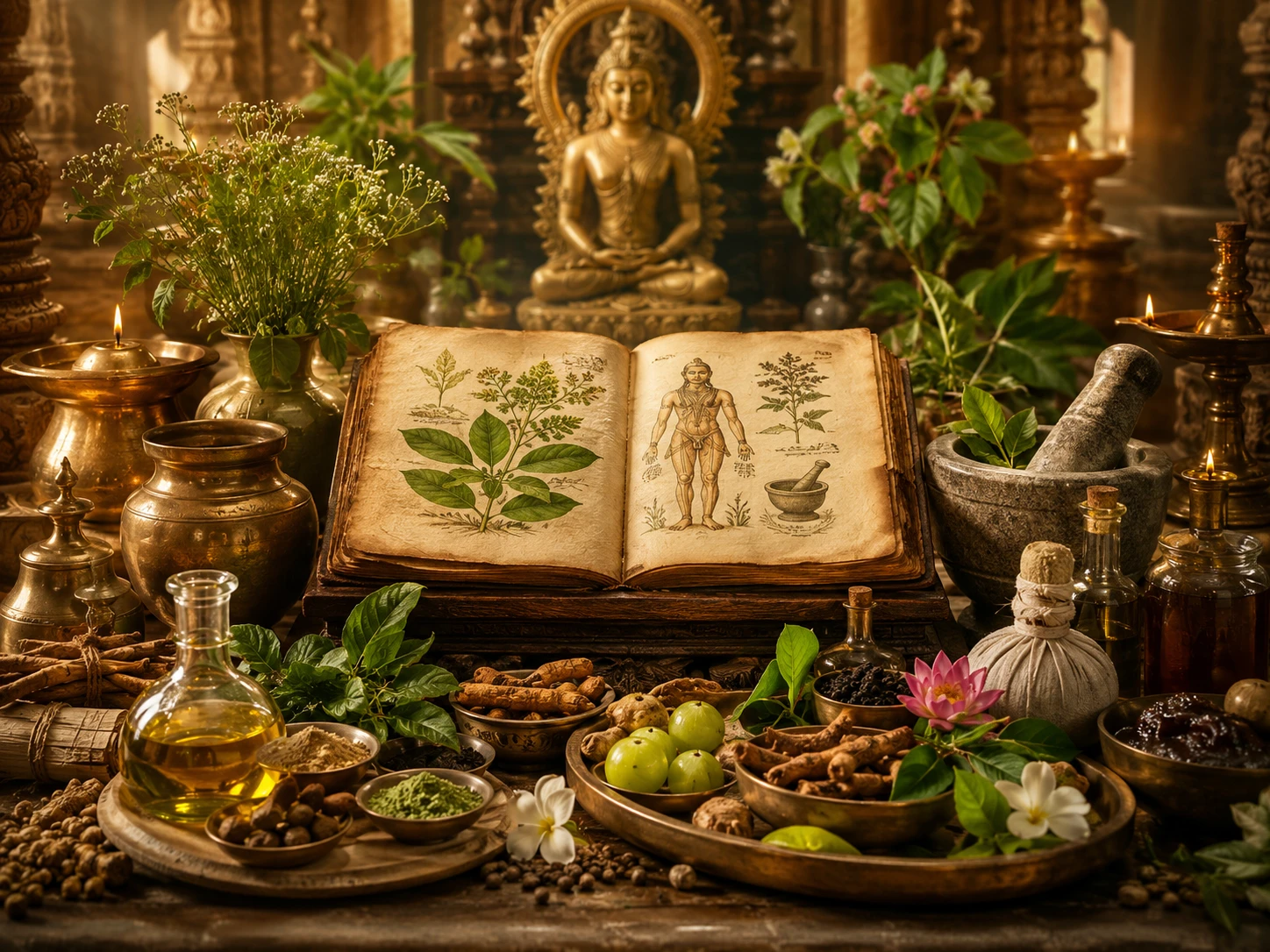
Ayurveda -- The 3,000-Year-Old Science That Knows Your Body Type Before You Do
आयुर्वेद -- 3,000 वर्ष पुरानी वह विद्या जो तुम्हारा शरीर-प्रकार तुमसे पहले जानती है
Your grandmother did not need a blood test to know you had a 'cold body.' She knew because you craved warm food, your hands were always cool, your digestion slowed in winter, and your joints cracked when you woke up. She would hand you a glass of warm water with ginger and say 'Vata badh gaya hai' -- your Vata has increased -- with the confidence of a diagnostic report. She was practising Ayurveda, the world's oldest continuously practised medical system, and she did not need a degree to do it because the knowledge had been transmitted through her family for generations.
Ayurveda -- from the Sanskrit Ayus (life) and Veda (knowledge/science) -- is literally 'the science of life.' It is not a folk remedy collection, not a spa treatment catalogue, and not a wellness trend. It is a systematic medical science with its own anatomy (Shareera Rachana), physiology (Kriya Shareera), pathology (Nidana), pharmacology (Dravya Guna), surgery (Shalya Tantra), and psychiatry (Bhuta Vidya). Its foundational texts -- the Charaka Samhita (focused on internal medicine) and the Sushruta Samhita (focused on surgery) -- are among the most detailed medical treatises produced by any ancient civilisation.
The Charaka Samhita, compiled between approximately 100 BCE and 200 CE (with revisions by Dridhabala in the 6th century CE), is organised into eight books (Sthanas) and 120 chapters. It covers diagnosis, treatment, diet, daily routine, seasonal regimen, rejuvenation therapy, and the philosophical framework within which all of this operates. The Sushruta Samhita, roughly contemporaneous, describes over 300 surgical procedures, 120 surgical instruments, and is credited with the earliest known descriptions of rhinoplasty (nose reconstruction), cataract surgery, and caesarean section. When British surgeons encountered Sushruta's rhinoplasty technique in 18th-century India, they took it back to Europe and refined it -- the modern 'Indian flap' technique in plastic surgery traces directly to Sushruta.
वायुः पित्तं कफश्चेति त्रयो दोषाः समासतः। विकृताऽविकृता देहं घ्नन्ति ते वर्त्तयन्ति च॥
vāyuḥ pittaṃ kaphaś ceti trayo doṣāḥ samāsataḥ | vikṛtā'vikṛtā dehaṃ ghnanti te varttayanti ca ||
Vata, Pitta, and Kapha -- these are the three Doshas in brief. When disturbed (Vikrita), they destroy the body; when balanced (Avikrita), they sustain it.
— Charaka Samhita, Sutrasthana, Chapter 1, Verse 57
The Tridosha system is the central organising principle of Ayurveda. Everything -- diagnosis, treatment, diet, lifestyle, seasonal behaviour, even the time of day you should eat -- flows from this framework. The three Doshas are not substances you can isolate in a lab. They are functional principles -- patterns of biological activity that govern how the body operates.
Vata (Air + Space) governs all movement. Breathing, heartbeat, nerve impulses, peristalsis, blinking, muscle contraction, cellular transport -- every motion in the body is a Vata function. When Vata is balanced, you are creative, energetic, and adaptable. When it is disturbed, you experience anxiety, insomnia, constipation, dry skin, joint pain, and scattered thinking. The JEE aspirant in Kota who cannot sleep before the exam, whose mouth goes dry and whose mind races -- that is textbook Vata aggravation.
Pitta (Fire + Water) governs all transformation. Digestion, metabolism, body temperature, visual perception, skin colour, intelligence, courage -- every process that converts one thing into another is Pitta. When balanced, you are sharp, decisive, and have strong digestion. When disturbed, you experience acidity, inflammation, skin rashes, anger, and burnout. The startup founder in Koramangala who lives on coffee, skips lunch, and has both brilliant ideas and terrible acid reflux -- Pitta imbalance.
Kapha (Water + Earth) governs all structure. Bones, muscles, fat, joint lubrication, mucous membranes, immunity, emotional stability -- every function that provides form, cohesion, and resilience is Kapha. When balanced, you are strong, calm, loyal, and have excellent immunity. When disturbed, you experience weight gain, lethargy, congestion, depression, and possessiveness. The banking professional in Nariman Point who gained 15 kg after a desk job, whose sinuses are permanently blocked, and who cannot motivate themselves to exercise -- Kapha accumulation.
Every individual is born with a unique ratio of these three forces -- this is your Prakriti (constitutional type). Prakriti is determined at conception and does not change throughout life. What changes is your Vikriti -- your current state of imbalance. Ayurvedic treatment is the process of bringing Vikriti back in line with Prakriti.
The Three Doshas -- Elements, Functions, and Imbalance Signs
| Dosha | Elements | Primary Function | When Balanced | When Imbalanced | Primary Seat in Body |
|---|---|---|---|---|---|
| Vata | Air + Space (Vayu + Akasha) | Movement -- all motion and nerve impulses | Creative, energetic, quick learner, flexible | Anxiety, insomnia, constipation, dry skin, joint pain | Colon (Pakvashaya) |
| Pitta | Fire + Water (Agni + Jala) | Transformation -- digestion, metabolism, intellect | Sharp intellect, strong digestion, courageous, warm | Acidity, inflammation, anger, skin rashes, burnout | Small intestine (Amashaya) |
| Kapha | Water + Earth (Jala + Prithvi) | Structure -- bones, immunity, lubrication, stability | Strong, calm, loyal, excellent immunity, steady | Weight gain, lethargy, congestion, depression, possessiveness | Chest and stomach (Ura / Amashaya) |
Based on Charaka Samhita, Sutrasthana Chapter 1 and Chapter 20. The 'seat' (Sthana) locations follow Charaka's classification. All three Doshas are present throughout the body; the listed seats are where they accumulate most.
The modern scientific validation of Ayurvedic principles is one of the most exciting areas of current Indian research. In 2008, a landmark study by the CSIR-Institute of Genomics and Integrative Biology (IGIB) in Delhi, published in the Journal of Translational Medicine, found that individuals classified as Vata, Pitta, or Kapha Prakriti by traditional Ayurvedic practitioners showed statistically significant differences in gene expression profiles. Pitta types had upregulated genes in immune response pathways. Vata types had upregulated genes in cell cycle pathways. Kapha types showed upregulation in immune signalling pathways. This was the first genomic evidence that the Tridosha classification -- made through pulse reading, physical examination, and questionnaire over 2,000 years ago -- corresponds to real biological differences at the molecular level.
AIIMS Delhi, JIPMER Puducherry, and BHU Varanasi all have Ayurveda research departments publishing in peer-reviewed international journals. The Ministry of AYUSH (Ayurveda, Yoga, Unani, Siddha, Homeopathy) is a full cabinet-level ministry of the Indian government with an annual budget exceeding 3,000 crore rupees. The National Ayurveda Day is observed on Dhanvantari Jayanti. Over 4 lakh registered Ayurveda practitioners operate in India.
Ayurveda's daily routine system (Dinacharya) and seasonal routine (Ritucharya) are now being studied as frameworks for chronobiology -- the science of how biological rhythms affect health. Ayurveda's insistence that you should eat your largest meal at noon (when Pitta/digestive fire is strongest) aligns with circadian research showing that insulin sensitivity and metabolic efficiency peak at midday. Its recommendation to wake before sunrise (Brahma Muhurta) correlates with melatonin and cortisol rhythms documented by modern endocrinology.
For the NEET aspirant, Ayurveda appears in BAMS entrance and in integrative medicine questions. For the UPSC aspirant, it appears in Indian Heritage, Health Policy, and Science and Technology. For every Indian who has ever been told 'aam mat khao, Pitta badhega' (don't eat mangoes, your Pitta will increase) -- Ayurveda is not ancient history. It is the language your body has always spoken, even before modern medicine learned to listen.
Sushruta (circa 6th century BCE) described rhinoplasty using a forehead flap technique over 2,600 years ago. In 1794, British surgeons observed Indian surgeons performing this exact procedure in Pune and published it in the Gentleman's Magazine of London. The technique was then adopted and refined in Europe, and the 'Indian method' of rhinoplasty remained the standard in Western plastic surgery for over a century. Today, the All India Institute of Medical Sciences (AIIMS) Delhi houses a Sushruta Museum, and the World Health Organization recognises Ayurveda as a traditional medicine system with benchmark documents for practice standards.
Reflect on Your Prakriti
Note your build, appetite, sleep and temperament against the three doshas as the Charaka Samhita describes them: vata light and variable, pitta sharp and warm, kapha steady and heavy. Which pattern runs through your life? For a proper reading of your prakriti and a daily routine to match, see a qualified Ayurvedic vaidya. The Vedic Sciences section of Eternal Gyan covers Ayurveda's foundations.
Tags
Eternal Raga · शाश्वत राग
Institutional voice — scholarly articles on Sanatan Dharma
Deepen Your Understanding
अपनी समझ और गहरी करें
vedic sciences
Surya Siddhanta -- The Ancient Astronomy Text That Got the Year Right to 1.4 Seconds
Before Copernicus, before Galileo, before the telescope existed -- an Indian text calculated the tropical year as 365.2421756 days. The modern value is 365.2421904. The difference is 1.4 seconds per year. The Surya Siddhanta also described gravity, computed planetary diameters within 1% accuracy, and invented the sine function. It did all this in Sanskrit verse.
vedic sciences
Panchang -- The Five-Limbed Hindu Calendar That Runs on the Moon and the Sun
Your phone uses the Gregorian calendar. Your grandmother uses the Panchang. One tracks the Sun. The other tracks the Sun AND the Moon AND the stars AND something called Yoga AND something called Karana. Five moving parts, one unified system -- and it determines every wedding date, every festival, and every 'shubh muhurat' in a billion Hindu lives.
vedic sciences
Kaal Ganana -- The Hindu Measure of Time
From a single blink of the eye (Nimesha) to one Day of Brahma (4.32 billion years) -- explore the complete cosmic time hierarchy of Hindu cosmology, anchored in Vishnu Purana 1.3, with its remarkable parallels to modern science.
sacred symbols
108 -- The Sacred Number That Links Your Mala to the Solar System
Why does a japa mala have exactly 108 beads? Why do temples list 108 names for every deity? The answer involves astronomy, anatomy, music, and mathematics -- and a coincidence so precise it still stuns astrophysicists: the distance from Earth to the Sun is approximately 108 times the Sun's diameter.
sacred symbols
Om -- The Primordial Sound That Contains the Universe
Every temple bell, every mantra, every meditation session begins and ends with Om. But what exactly IS Om? The Mandukya Upanishad claims this single syllable contains all of reality -- past, present, future, and whatever lies beyond time itself. Twelve verses. One sound. The entire map of consciousness.
sacred symbols
Diya -- The Sacred Lamp That Lights Every Hindu Threshold
A diya is not a candle. It is not 'mood lighting.' It is a philosophical argument made of clay, oil, and cotton -- the oldest continuous lighting tradition on Earth. When the Brihadaranyaka Upanishad prays 'Lead me from darkness to light,' the diya is the answer that arrives at every doorstep, every evening, in every Indian home that still remembers.
Sushruta (circa 6th century BCE) described rhinoplasty using a forehead flap technique over 2,600 years ago. In 1794, British surgeons observed Indian surgeons performing this exact procedure in Pune and published it in …
More in Vedic Sciences
Agnichayana -- The Falcon-Shaped Fire Altar That Survived 3,000 Years
12 min read
Ancient Indian Metallurgy -- The Iron Pillar That Refuses to Rust
13 min readAryabhata -- The Astronomer Who Said the Earth Turns
3 min readThe same translation error that turned '33 Koti' into '33 crore' in Hinduism also happened in Buddhism. The Chinese translation of Buddhist texts rendered 'Sapta Koti Buddha' (7 Supreme Buddhas) as '7 Crore Buddhas.' The…
Deities AvatarsCommunity Reflections
🕉️
Be the first to share your reflection.