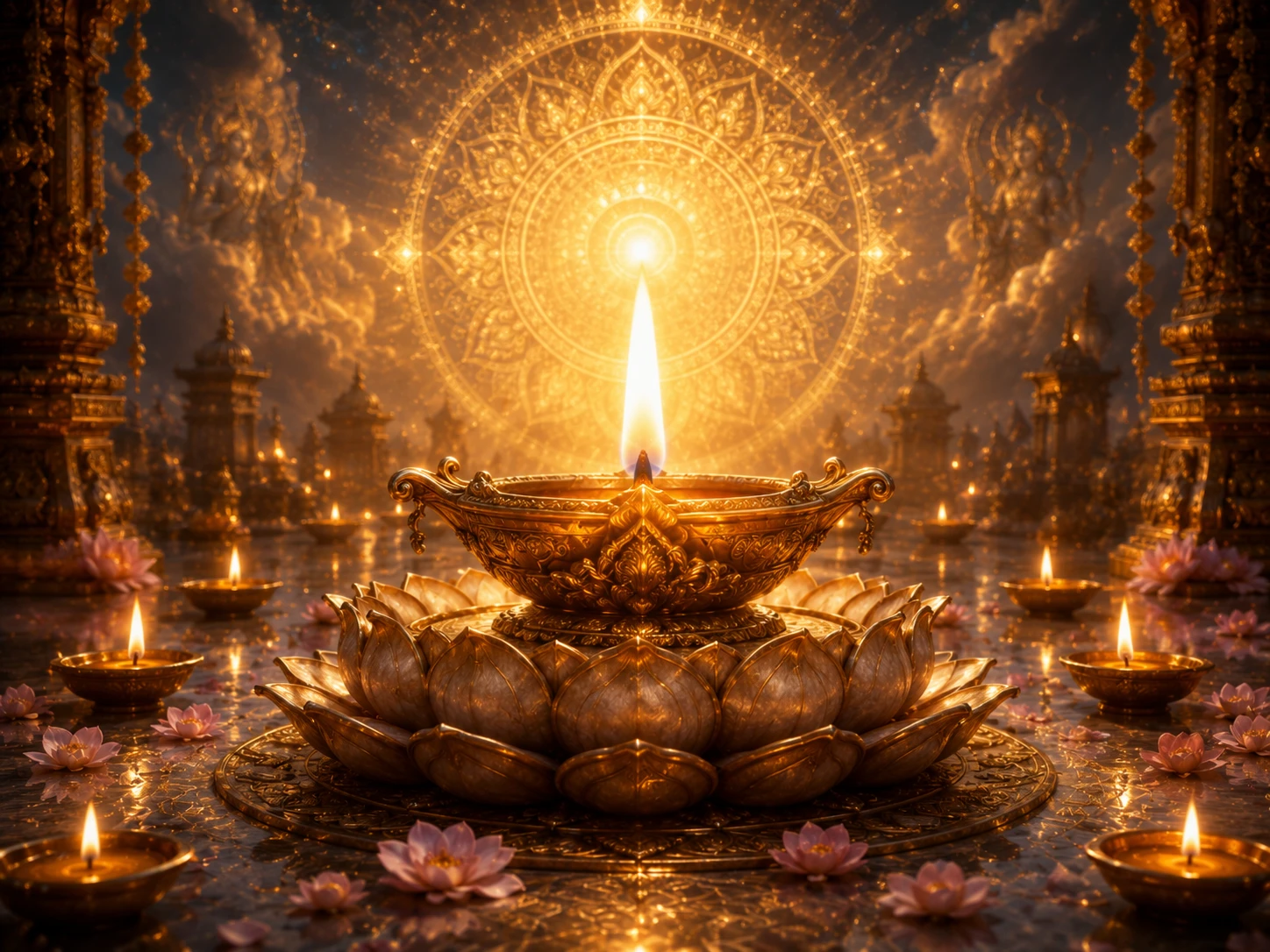
Diya -- The Sacred Lamp That Lights Every Hindu Threshold
दीया -- वो पवित्र दीप जो हर हिन्दू देहरी को रोशन करता है
At 6:17 PM today, somewhere in India, a woman will light a diya. She might be in a two-room flat in Dharavi, or a haveli in Jaipur, or a government quarters in Shillong, or a penthouse in Worli. The ritual is identical everywhere. She takes a clay lamp -- sometimes brass, sometimes silver, but the humblest is always clay. She fills it with oil -- sesame, mustard, or ghee. She places a cotton wick, twists it, dips it, and touches it with fire. The flame catches. She places the lamp at the threshold, or in the puja room, or at the tulsi plant in the courtyard. She may say a shloka. She may say nothing at all. Either way, the sandhya deepam -- the evening lamp -- is lit, and the house is now, ritually speaking, inhabited by light.
This is the oldest continuously performed domestic ritual in Hindu civilisation. There is no home too poor for a diya. There is no temple too grand to not have one. The diya is the great equalizer of Hindu practice -- it costs almost nothing, requires no priest, follows no sect, and carries a philosophical weight so enormous that the entire Upanishadic tradition can be summarised in its flame.
Because a diya is not just a source of light. It is a model of the self. The clay is the body. The oil is the karma (or vasanas, latent impressions) that fuel continued existence. The wick is the ego -- the individual identity that draws fuel from the body and karma. And the flame? The flame is the Atman -- consciousness itself, which burns as long as oil remains but whose nature is always upward, always luminous, always reaching beyond its container.
असतो मा सद्गमय। तमसो मा ज्योतिर्गमय। मृत्योर्मामृतं गमय॥
asato mā sadgamaya | tamaso mā jyotirgamaya | mṛtyormā amṛtaṃ gamaya ||
Lead me from the unreal to the real. Lead me from darkness to light. Lead me from death to immortality.
— Brihadaranyaka Upanishad, 1.3.28 (Shukla Yajurveda)
This verse -- the Pavamana Mantra -- is perhaps the most universally known prayer in Hindu tradition. It is chanted at every temple, every ceremony, every school assembly in India that begins with a prayer. When it says 'tamaso ma jyotirgamaya' -- lead me from darkness to light -- the word 'jyoti' is not metaphorical in the Indian tradition. Jyoti IS the light of the lamp. The diya IS the jyoti. The physical act of lighting a lamp and the philosophical aspiration for enlightenment are collapsed into a single gesture.
This collapse of the physical and the metaphysical is one of Hindu civilisation's most distinctive features. There is no gap between the diya on your grandmother's puja thali and the light of Brahman that Shankaracharya writes about. They are the same light at different scales. The tradition does not ask you to choose between the literal and the symbolic -- it insists they are identical.
Consider the Pancha Pradeep -- the five-wick lamp used in temple aarti. The five wicks represent the five elements: Prithvi (earth -- the clay), Jala (water -- the oil), Vayu (air -- feeds the flame), Agni (fire -- the flame itself), and Akasha (ether -- the light that radiates outward). When the priest circles the Pancha Pradeep before the deity and the congregation cups their hands over the flame and touches their foreheads, they are not merely 'taking the light.' They are symbolically absorbing the entire manifest universe -- all five elements sanctified by the deity's presence -- into their consciousness through the gateway of the Ajna chakra between the eyebrows.
In South Indian temples, the tradition of Deepa Aradhana (lamp worship) reaches extraordinary elaboration. The Meenakshi Amman Temple in Madurai lights thousands of oil lamps during Karthigai Deepam. The Brihadeeswarar Temple in Thanjavur has a single massive lamp that burns perpetually. The Thiruvannamalai Temple in Tamil Nadu hosts the annual Karthigai Deepam festival where a massive fire is lit atop Arunachala Hill -- visible for miles, it represents Shiva as the column of infinite light (Jyotirlinga) that Brahma and Vishnu could not find the end of.
The diya's role in Diwali is so central that the festival's very name derives from it. Deepavali -- literally 'a row of lamps' -- is the annual festival where the entire nation collectively performs what every Hindu household does every evening: pushes back darkness with fire. The mythology varies by region: in North India, Diwali celebrates Rama's return to Ayodhya after fourteen years of exile, and the citizens lit diyas to welcome him. In South India, it marks Krishna's victory over the demon Narakasura. In Bengal, it is a night for Kali Puja. In Gujarat, it is the start of the new business year. But across all regional variations, the diya remains the common denominator.
The economics of the diya during Diwali are staggering. India's clay diya market is estimated at over 1,500 crore rupees annually, with the bulk of production centred in Uttar Pradesh (particularly the kumhar communities of Ayodhya, Lucknow, and Varanasi), Rajasthan, and Gujarat. In 2024, the Ayodhya Ram Mandir's first Diwali saw a world record attempt with over 28 lakh (2.8 million) diyas lit along the Saryu river ghats. The visual -- a river of fire reflected in water -- went viral globally, but for the residents of Ayodhya, it was simply a scaled-up version of what every family does at home.
The modern Indian relationship with the diya is layered. In urban apartments in Gurgaon, Whitefield, and Hinjewadi, electric LED 'diyas' have become common -- energy-efficient, fire-safe, and available in packs of 50 on Amazon and Flipkart. Traditionalists argue these miss the point entirely. A diya without fire is not a diya -- it is a lamp-shaped night light. The fire is the point. The risk of fire, the need to tend the flame, the oil that must be replenished, the wick that must be trimmed -- these are not bugs but features. The diya requires attention, and attention is the essence of worship.
But the tradition is adaptive. In NRI homes in Edison, New Jersey, and Brampton, Ontario, where fire regulations in apartment buildings prohibit open flames, the LED diya has become a genuine devotional object -- not a replacement for the real thing but an extension of it into new circumstances. The IIT Bombay alumni association's Diwali event in San Francisco uses real diyas in outdoor settings and LED diyas in indoor ones, treating both as valid expressions of the same impulse.
Types of Sacred Lamps in Hindu Practice
| Lamp Type | Material | Oil / Fuel | Primary Use | Deity / Tradition |
|---|---|---|---|---|
| Diya / Deepak | Clay (mitti) | Mustard oil or sesame oil | Daily sandhya, Diwali, threshold lighting | Universal -- all deities and sects |
| Pancha Pradeep | Brass or bronze, five wicks | Ghee or sesame oil | Temple aarti, deity worship | All temple traditions |
| Akhand Jyoti | Brass, single wick, never extinguished | Ghee | Perpetual lamp in temples and during Navaratri | Shakti temples, Durga worship |
| Nilavilakku | Bronze bell-metal, tall standing lamp | Coconut oil | Kerala household and temple worship | South Indian / Kerala tradition |
| Kuthu Vilakku | Brass pillar lamp with multiple tiers | Sesame or coconut oil | Tamil wedding ceremonies, temple entrance | Tamil Nadu tradition |
| Samai | Brass or silver, two wicks facing opposite directions | Ghee or oil | Maharashtra household puja | Marathi tradition |
| Divo | Silver or brass, single wick | Ghee | Gujarati household and Jain worship | Gujarat / Jain tradition |
Oil type matters ritually: ghee is considered the purest fuel (Sattvic), sesame oil is standard for most worship, mustard oil is common in North Indian household diyas, and coconut oil is standard in South Indian traditions.
The diya's symbolism extends beyond the living. At the moment of death and during the thirteen-day mourning period (trayodashi), a diya is kept burning continuously near the departed's body and later at the place of cremation. This is the Akhand Jyoti -- the unbroken light -- which guides the departing soul through the transitional space between death and rebirth. At the Manikarnika and Harishchandra Ghats in Varanasi, the cremation fires have been burning without interruption for centuries. These are, in a sense, the world's oldest continuously burning diyas -- sacred flames that have never been extinguished.
In the temple tradition, the evening Sandhya Aarti is timed to coincide with the exact transition between day and night -- the sandhya-kala (junction time). This is not arbitrary. The tradition holds that at the junction between two states (day and night, waking and sleeping, life and death), the boundaries between the material and spiritual worlds become thin. Lighting the diya at this precise moment sanctifies the transition and establishes a protective bridge of light.
The science is interesting too. Research published in the Indian Journal of Traditional Knowledge has documented that oil lamps -- particularly those burning sesame or mustard oil -- release trace amounts of beneficial compounds into the air. The flickering flame of a diya produces a light spectrum closer to candlelight than to LED light, with a colour temperature of approximately 1,800-2,000 Kelvin. This warm light stimulates melatonin production and calms the circadian system -- the exact opposite effect of the blue-heavy LED screens that dominate modern Indian life. For the JEE aspirant in Kota staring at a phone screen until midnight, the grandmother's sandhya diya is, neurologically speaking, the antidote.
The Diwali diya also functions as an economic and social marker. In villages across Rajasthan, Madhya Pradesh, and Chhattisgarh, the kumhar (potter) community's livelihood peaks during the weeks before Diwali. A single potter family in Ayodhya can produce 2,000-5,000 diyas daily during peak season. The 'Make in India' push for clay diyas over Chinese-made LED alternatives has given the diya an additional layer of meaning: it is now also a symbol of artisan livelihood, local economy, and cultural self-determination.
From the first diya your mother lit to welcome you home from the hospital, to the last diya that will burn at your cremation, the lamp accompanies every Hindu life from beginning to end. It asks nothing except oil, wick, and attention. And in return, it provides what the Upanishads say is the only thing worth having: light.
The eternal flame at the Mahabodhi Temple in Bodh Gaya, Bihar, has been burning continuously for over 2,500 years -- making it one of the oldest known perpetual flames on Earth. In Varanasi, the Dom Raja community has maintained the cremation fire at Manikarnika Ghat for an unbroken lineage claimed to stretch back over 5,000 years. Whether or not the exact timeline is verifiable, these flames represent the deepest expression of the diya principle: that once light is kindled in the right place, it should never be allowed to go out.
Light the Evening Diya -- Sandhya Deepam
Light the lamp at sandhya, as the sun sets, near the entrance or the puja space, and recite the shloka your family uses -- 'Shubham karoti kalyanam' is the most widespread. Then sit with the flame for a few minutes; the When the Flame Is All There Is dharana on Eternal Raga turns the lamp into a meditation.
Tags
Eternal Raga · शाश्वत राग
Institutional voice — scholarly articles on Sanatan Dharma
Deepen Your Understanding
अपनी समझ और गहरी करें
sacred symbols
Om -- The Primordial Sound That Contains the Universe
Every temple bell, every mantra, every meditation session begins and ends with Om. But what exactly IS Om? The Mandukya Upanishad claims this single syllable contains all of reality -- past, present, future, and whatever lies beyond time itself. Twelve verses. One sound. The entire map of consciousness.
sacred symbols
Swastika -- The Most Misunderstood Sacred Symbol on Earth
For over 5,000 years, the Swastika has meant 'all is well' in Hindu homes. It is drawn at births, weddings, Diwali, and on the first page of new account books. Then one European regime stole it, tilted it 45 degrees, and turned it into a symbol of genocide. The original meaning did not disappear. It was buried. Time to dig it up.
sacred symbols
108 -- The Sacred Number That Links Your Mala to the Solar System
Why does a japa mala have exactly 108 beads? Why do temples list 108 names for every deity? The answer involves astronomy, anatomy, music, and mathematics -- and a coincidence so precise it still stuns astrophysicists: the distance from Earth to the Sun is approximately 108 times the Sun's diameter.
sacred symbols
Shankh -- The Sacred Conch That Declared War, Sanctifies Worship, and Purifies Water
The opening scene of the Bhagavad Gita is not a conversation. It is a sound -- five conch shells blown simultaneously on the battlefield of Kurukshetra. Krishna's Panchajanya, Arjuna's Devadatta, Bhima's Paundra. Before a single arrow flies, the war is declared by sound. The conch is Hinduism's battle cry, prayer bell, and water purifier -- all in one spiralling shell.
vedic sciences
Kaal Ganana -- The Hindu Measure of Time
From a single blink of the eye (Nimesha) to one Day of Brahma (4.32 billion years) -- explore the complete cosmic time hierarchy of Hindu cosmology, anchored in Vishnu Purana 1.3, with its remarkable parallels to modern science.
rituals traditions
Diwali -- Five Days of Light
Diwali is not one night of firecrackers. It is a five-day arc from Dhanteras to Bhai Dooj, layering wealth, ancestors, Lakshmi, community, and sibling bonds into a single liturgical sequence. Its origins span Rama's return, Krishna's Narakasura victory, Jain Mahavira's nirvana, and Sikh Bandi Chhor Divas -- making it the most theologically layered festival in the Indian calendar.
The eternal flame at the Mahabodhi Temple in Bodh Gaya, Bihar, has been burning continuously for over 2,500 years -- making it one of the oldest known perpetual flames on Earth. In Varanasi, the Dom Raja community has ma…
More in Sacred Symbols
Ashtamangala -- The Eight Auspicious Symbols of Hindu Tradition
13 min read
Bindu -- The Point from which Creation Emerges
12 min read
Gau -- Why the Cow Holds the Place She Does in Hindu Life
14 min readThe same translation error that turned '33 Koti' into '33 crore' in Hinduism also happened in Buddhism. The Chinese translation of Buddhist texts rendered 'Sapta Koti Buddha' (7 Supreme Buddhas) as '7 Crore Buddhas.' The…
Deities AvatarsCommunity Reflections
🕉️
Be the first to share your reflection.