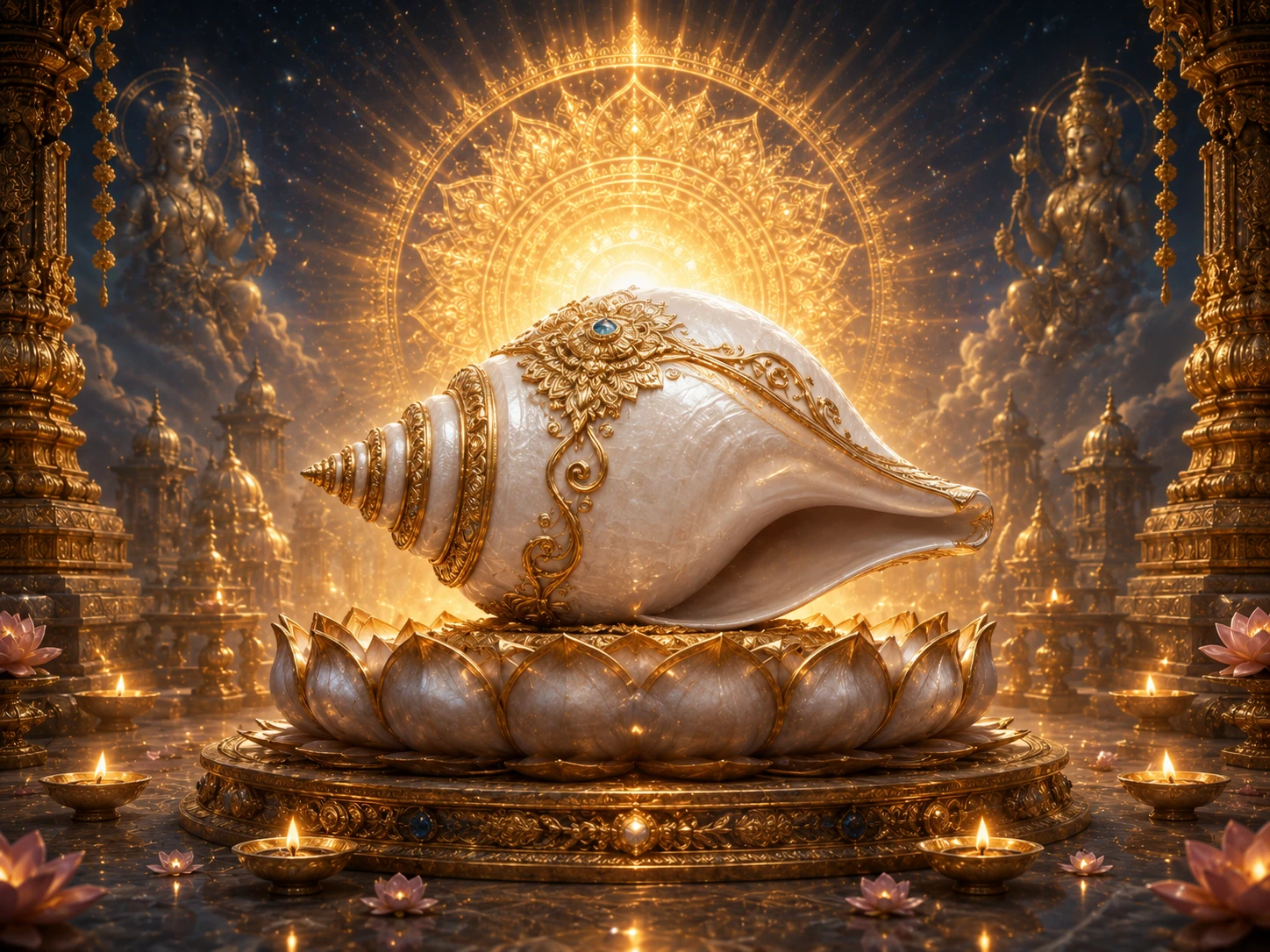
Shankh -- The Sacred Conch That Declared War, Sanctifies Worship, and Purifies Water
शंख -- वो पवित्र शंख जिसने युद्ध की घोषणा की, पूजा को पवित्र करता है, और जल शुद्ध करता है
Before there was dialogue, there was sound. The Bhagavad Gita -- arguably the most influential philosophical text in Hindu civilisation -- opens not with Krishna's wisdom or Arjuna's doubt, but with the blowing of conch shells. Bhishma blows his conch on the Kaurava side, and the sound 'like a lion's roar' gives Duryodhana a surge of confidence. Then the Pandava side responds. Krishna blows the Panchajanya. Arjuna blows the Devadatta. Bhima blows the Paundra. Yudhishthira blows the Anantavijaya. Nakula and Sahadeva blow the Sughosa and Manipushpaka. The combined sound, says the text, 'reverberated through heaven and earth and shattered the hearts of Dhritarashtra's sons.'
This is not just battlefield dramatics. The conch shell -- Shankha in Sanskrit -- is one of Hinduism's most ancient and multi-functional sacred objects. It is a musical instrument, a ritual vessel, a weapon of psychological warfare, a water purifier, an iconographic marker, and a meditation tool. Vishnu holds it in one of his four hands. Every temple aarti includes it. Every significant Hindu ceremony -- from thread ceremonies to weddings to cremations -- begins with its sound. And unlike the diya or the tilak, the shankh is not something you can make at home. It is a gift from the ocean -- the shell of the marine gastropod Turbinella pyrum, found primarily in the Indian Ocean and the waters around Sri Lanka, Tamil Nadu, and the Gulf of Mannar.
When your grandmother blows the shankh during evening aarti, she is performing the same act that Krishna performed at Kurukshetra. The scale is different. The intent is identical: to fill the space with sacred sound, to push back whatever forces occupy the silence, and to declare that this moment -- this puja, this meal, this transition -- is now consecrated.
पाञ्चजन्यं हृषीकेशो देवदत्तं धनञ्जयः। पौण्ड्रं दध्मौ महाशङ्खं भीमकर्मा वृकोदरः॥
pāñcajanyaṃ hṛṣīkeśo devadattaṃ dhanañjayaḥ | pauṇḍraṃ dadhmau mahāśaṅkhaṃ bhīmakarmā vṛkodaraḥ ||
Hrishikesha (Krishna) blew the conch Panchajanya, Dhananjaya (Arjuna) blew the Devadatta, and Bhima of terrible deeds and wolf-like appetite blew the mighty conch Paundra.
— Bhagavad Gita, Chapter 1, Verse 15
The Panchajanya has a backstory that reads like an action sequence. The name means 'born of the five elements' or 'born of Panchajana' -- and the latter is the canonical origin. In the Bhagavata Purana, Panchajana was a demon who lived in the form of a conch shell under the sea. He had kidnapped the son of Krishna's guru, Sandipani Muni. Krishna and Balarama dived into the ocean, slew the demon, and Krishna took the conch as his own. From that moment, the Panchajanya became Vishnu's personal instrument -- appearing in every depiction, every murti, every temple icon.
The conch's association with Vishnu goes deeper than the Mahabharata. In the Samudra Manthan -- the Churning of the Ocean of Milk -- the Shankha is one of the fourteen ratnas (treasures) that emerged. This places it alongside Lakshmi, the Kaustubha gem, the Parijata tree, and Dhanvantari with the pot of Amrita. The conch, in this cosmology, is as old as the goddess of wealth and as primordial as the nectar of immortality.
In Vaishnava iconography, Vishnu's four hands hold four objects: the Sudarshana Chakra (discus), the Kaumodaki Gada (mace), the Padma (lotus), and the Shankha (conch). Each represents a cosmic function. The Shankha specifically represents the Pancha Bhuta -- the five elements -- and the primordial sound of creation. When Vishnu blows the Shankha, it is not a signal. It is a statement: existence itself vibrates with divine will.
The conch also has deep connections with the goddess tradition. The Devi Bhagavata Purana describes Durga holding a conch in battle. In Bengal's Durga Puja -- the largest cultural festival in eastern India -- the shankh is blown at every transition of the ceremony: during Prana Pratishtha (infusing life into the murti), Sandhi Puja (the junction of Ashtami and Navami), and Visarjan (immersion). The Shankhini craft of Bengal -- artisans who carve bangles and ornaments from conch shells -- is a UNESCO-recognised intangible heritage tradition.
The Named Conch Shells of Kurukshetra
| Conch Name | Bearer | Meaning of Name | Significance |
|---|---|---|---|
| Panchajanya | Krishna | Born of Panchajana (demon) or the Five Elements | Vishnu's personal conch; represents primordial creative sound |
| Devadatta | Arjuna | God-given | Gifted by Devas; symbolises divine favour on the righteous warrior |
| Paundra | Bhima | Having lines/markings | A massive shell befitting Bhima's strength; its blast shook the earth |
| Anantavijaya | Yudhishthira | Infinite victory | Symbolises dharma's ultimate and endless triumph |
| Sughosa | Nakula | Sweet-sounding | Represents the power of melodious, harmonious communication |
| Manipushpaka | Sahadeva | Jewel-flowered | Represents beauty and precision -- befitting Sahadeva the astrologer |
All six conch names appear in Bhagavad Gita Chapter 1, Verses 15-16. The significance interpretations draw from Vaishnava commentarial traditions including Madhva and Ramanuja.
Two types of conch shells are ritually distinguished. The Dakshinavarti Shankh (right-spiralling, also called Valampuri in Tamil) opens to the right when held with the spout pointing upward. This is extremely rare in nature -- occurring in roughly one in every million Turbinella pyrum specimens. Its rarity has made it astronomically valuable; authenticated Dakshinavarti Shankhs can fetch lakhs of rupees in the devotional market. It is considered especially sacred to Lakshmi and is used in prosperity-related rituals.
The Vamavarti Shankh (left-spiralling) is the standard form and is used in daily puja across India. When blown, it produces a sustained, resonant note in the frequency range of 100-500 Hz -- a range that overlaps with the human voice's lower register and with the resonance frequencies of many temple sanctums. Research published in the International Journal of Environmental Science and Technology has shown that the sound waves from a conch shell can reduce certain airborne bacteria and pathogens within a confined space. The calcium carbonate structure of the conch creates a natural resonance chamber that amplifies sound efficiently.
The water purification tradition is particularly interesting. In many Hindu households, water stored overnight in a conch shell is considered sacred -- Shankha Jala -- and is used for abhishekam (ritual bathing of deities) and as prasadam. The shell is primarily composed of calcium carbonate (aragonite), and when water is stored in it, trace amounts of calcium and other minerals dissolve into the water, raising its pH slightly toward alkaline. This is not mysticism -- it is basic chemistry. Whether the effect is therapeutically significant at the quantities involved is debatable, but the tradition has been validated at the mechanistic level by researchers at IIT Kharagpur and elsewhere.
For the Bombay Stock Exchange trader who keeps a Dakshinavarti Shankh in the office safe, and the UPSC aspirant in Mukherjee Nagar who blows one every morning before study, and the temple priest at Rameswaram who has been blowing the conch at dawn for forty years until his lung capacity became legendary in the town -- the shankh is where sound becomes sacred.
The Indian Navy's official insignia features a crossed anchor and two swords with a motto ribbon -- but the original Maratha Navy under Kanhoji Angre (17th-18th century) used the shankh as a naval symbol. The conch's association with maritime power predates European naval traditions in India by centuries. Today, the Indian Coast Guard station at Daman and several Indian Navy ships still carry shankh-inspired ceremonial elements. The tradition of blowing the conch before a naval engagement has a direct line from Kurukshetra to the Konkan coast.
Shankh Naad -- Sacred Conch Sound Meditation
If you have a shankh, blow one long note and follow it with your breath until the sound is gone, then rest in the quiet it leaves. Without a conch, chant Om once on a full exhalation. The Fading of a Sound dharana on Eternal Raga is this practice.
Tags
Eternal Raga · शाश्वत राग
Institutional voice — scholarly articles on Sanatan Dharma
Deepen Your Understanding
अपनी समझ और गहरी करें
sacred symbols
Om -- The Primordial Sound That Contains the Universe
Every temple bell, every mantra, every meditation session begins and ends with Om. But what exactly IS Om? The Mandukya Upanishad claims this single syllable contains all of reality -- past, present, future, and whatever lies beyond time itself. Twelve verses. One sound. The entire map of consciousness.
sacred artefacts
Divine Gems -- Syamantaka, Kaustubha, and Chintamani
Hindu mythology's most precious stones are not mere ornaments -- they are plot devices, moral tests, and cosmic forces. The Syamantaka Mani turned Krishna into a detective. The Kaustubha emerged from the Ocean of Milk to sit forever on Vishnu's chest. The Chintamani fulfils every wish -- and teaches why that might be the worst thing that could happen to you.
sacred symbols
Diya -- The Sacred Lamp That Lights Every Hindu Threshold
A diya is not a candle. It is not 'mood lighting.' It is a philosophical argument made of clay, oil, and cotton -- the oldest continuous lighting tradition on Earth. When the Brihadaranyaka Upanishad prays 'Lead me from darkness to light,' the diya is the answer that arrives at every doorstep, every evening, in every Indian home that still remembers.
sacred symbols
Swastika -- The Most Misunderstood Sacred Symbol on Earth
For over 5,000 years, the Swastika has meant 'all is well' in Hindu homes. It is drawn at births, weddings, Diwali, and on the first page of new account books. Then one European regime stole it, tilted it 45 degrees, and turned it into a symbol of genocide. The original meaning did not disappear. It was buried. Time to dig it up.
sacred symbols
108 -- The Sacred Number That Links Your Mala to the Solar System
Why does a japa mala have exactly 108 beads? Why do temples list 108 names for every deity? The answer involves astronomy, anatomy, music, and mathematics -- and a coincidence so precise it still stuns astrophysicists: the distance from Earth to the Sun is approximately 108 times the Sun's diameter.
scriptural exegesis
Samudra Manthan -- When Gods and Demons Ran a Joint Venture and the Universe Almost Died
A cosmic ocean. A mountain for a churning rod. A serpent king for a rope. Gods on one end, demons on the other. And out came 14 treasures -- including wealth, beauty, medicine, immortality, and one poison so lethal it could end creation itself. The Samudra Manthan is not mythology. It is the original playbook for collaboration, crisis management, and how to handle it when your joint venture partner tries to cheat you.
The Indian Navy's official insignia features a crossed anchor and two swords with a motto ribbon -- but the original Maratha Navy under Kanhoji Angre (17th-18th century) used the shankh as a naval symbol. The conch's ass…
More in Sacred Symbols
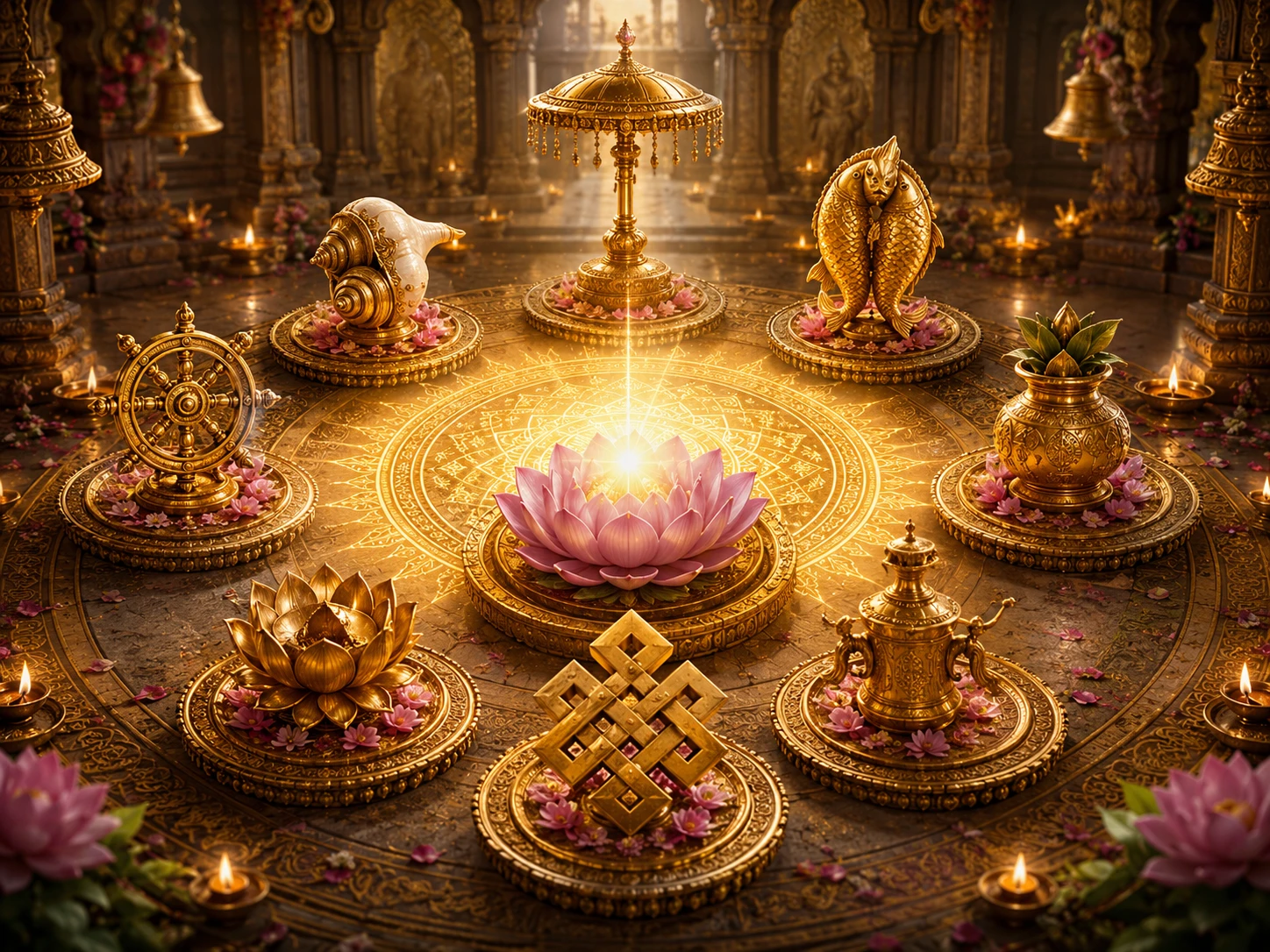
Ashtamangala -- The Eight Auspicious Symbols of Hindu Tradition
13 min read
Bindu -- The Point from which Creation Emerges
12 min read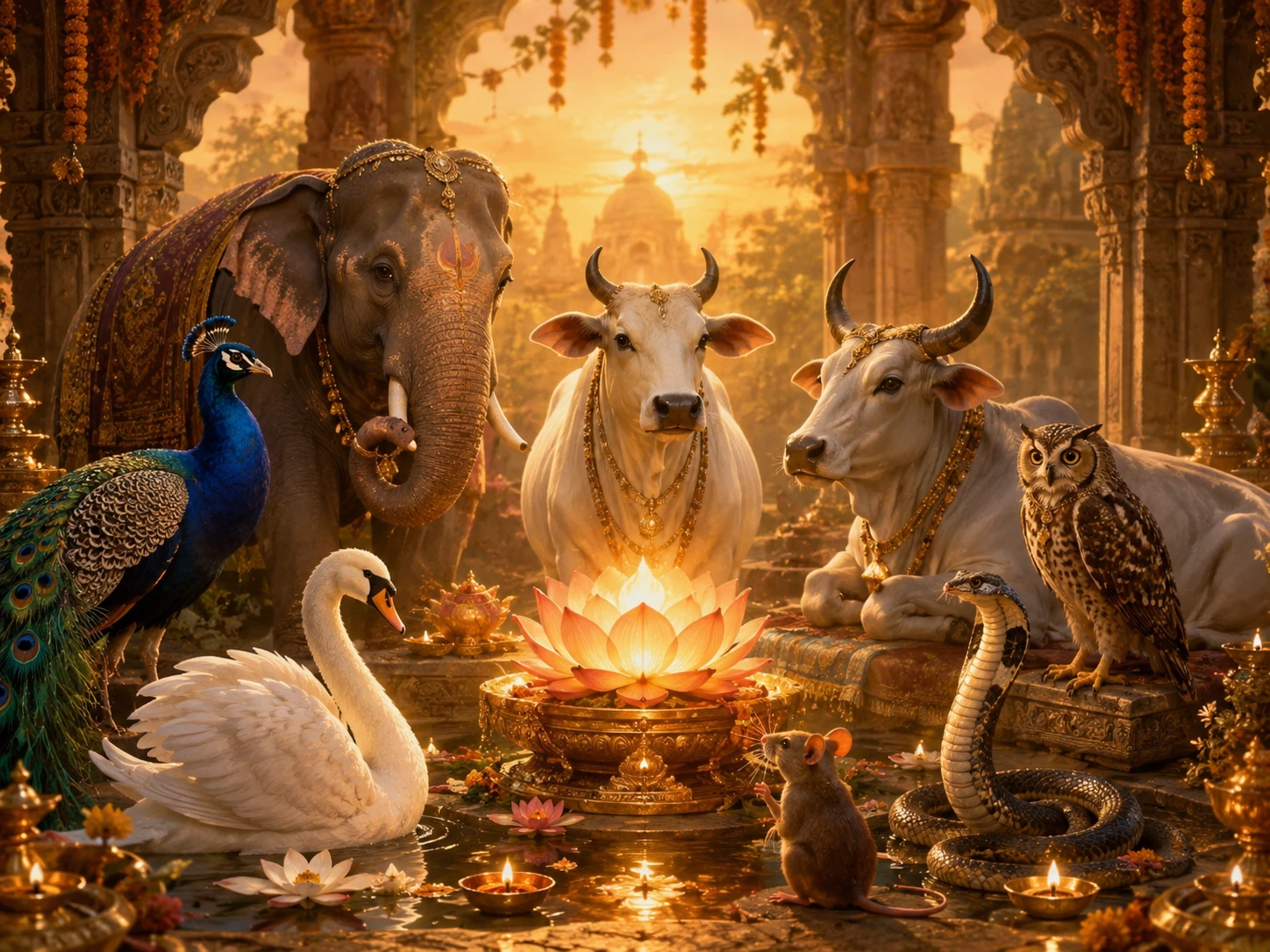
Gau -- Why the Cow Holds the Place She Does in Hindu Life
14 min readThe same translation error that turned '33 Koti' into '33 crore' in Hinduism also happened in Buddhism. The Chinese translation of Buddhist texts rendered 'Sapta Koti Buddha' (7 Supreme Buddhas) as '7 Crore Buddhas.' The…
Deities AvatarsCommunity Reflections
🕉️
Be the first to share your reflection.