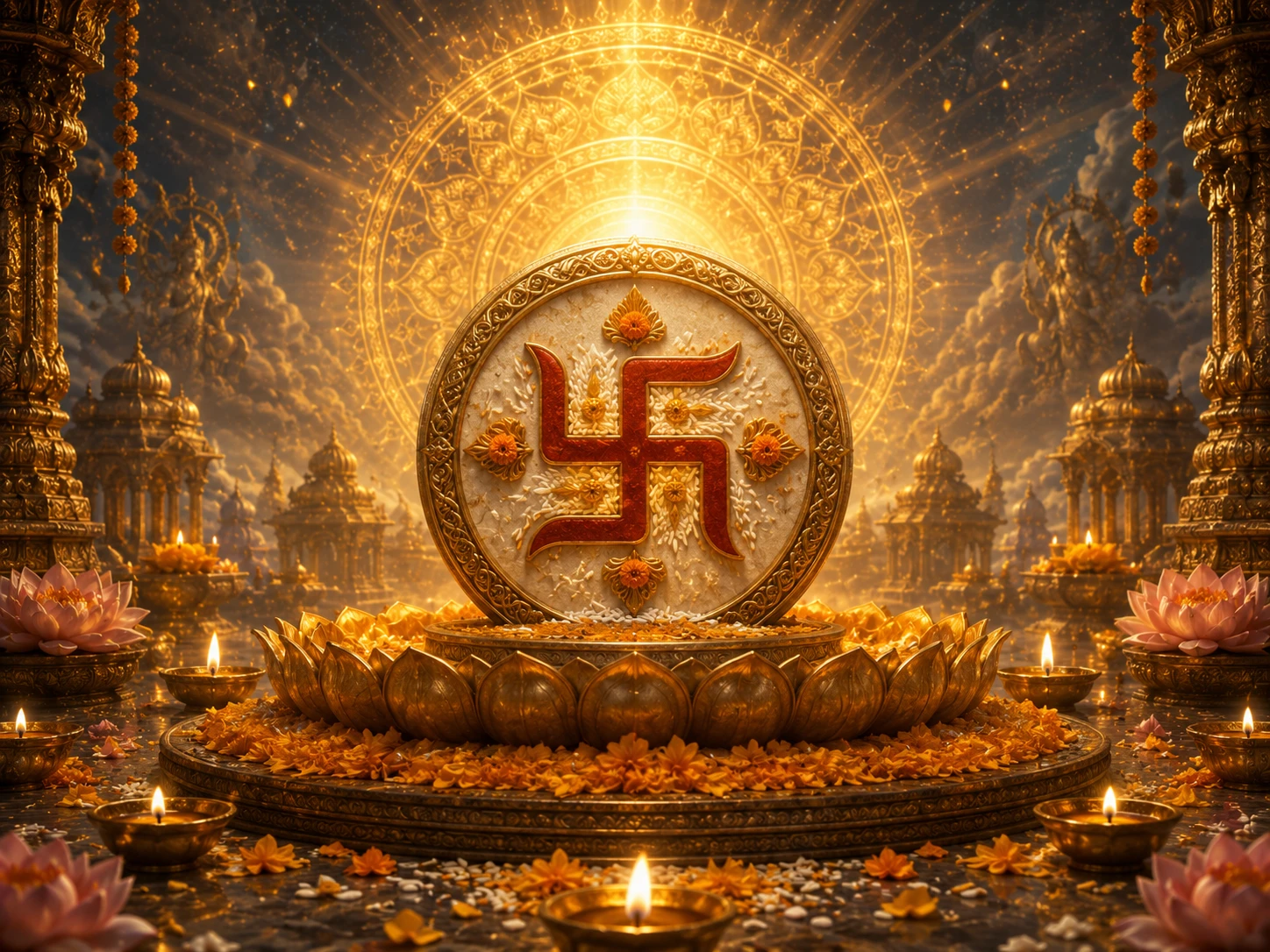
Swastika -- The Most Misunderstood Sacred Symbol on Earth
स्वस्तिक -- धरती का सबसे गलत समझा गया पवित्र चिह्न
If you grew up in an Indian household, you have seen the Swastika your entire life. Your mother drew it in kumkum on the doorframe during Diwali. Your grandmother marked it on the first page of new school notebooks. The pandit traced it on the kalash at your cousin's wedding. The accountant at your father's shop drew it on the cover of the new ledger on Dhanteras. The local sweet shop in your neighbourhood has one painted above its entrance, and has had it there since before your parents were born.
The Swastika is arguably the most frequently drawn sacred symbol in living Hindu practice. It is not archaic, not decorative, not optional. It is active infrastructure -- the mark placed at every threshold where something new begins, something old is sanctified, or something important needs protection.
And yet, if you post a photo of your Diwali rangoli featuring a Swastika on Instagram from your apartment in Pune, a well-meaning stranger in Berlin or Brooklyn may report it as hate speech. If you carry a Swastika pendant on the London Underground, you may receive hostile stares. If you explain to a colleague in a Toronto office that the symbol on your desk is not what they think it is, you may find yourself giving a thirty-minute history lesson that you should not have to give.
This is the extraordinary situation that Hindus, Buddhists, and Jains find themselves in: a symbol that has been sacred for at least five thousand years has been so thoroughly associated with a twelve-year European political regime (1933-1945) that the burden of proof now falls on the original owners. This article is not an apology. It is an excavation.
स्वस्ति न इन्द्रो वृद्धश्रवाः स्वस्ति नः पूषा विश्ववेदाः। स्वस्ति नस्ताक्षर्यो अरिष्टनेमिः स्वस्ति नो बृहस्पतिर्दधातु॥
svasti na indro vṛddhaśravāḥ svasti naḥ pūṣā viśvavedāḥ | svasti nas tārkṣaryo ariṣṭanemiḥ svasti no bṛhaspatir dadhātu ||
May Indra of great fame bring us well-being. May Pusha, the all-knowing, bring us well-being. May Tarkshya of unobstructed path bring us well-being. May Brihaspati bestow upon us well-being.
— Rig Veda, Mandala 1, Sukta 89, Mantra 6
The word Swastika comes from the Sanskrit root 'svasti' -- formed by combining 'su' (good, well, auspicious) and 'asti' (it is, it exists, there is). Svasti therefore means 'it is well' or 'may there be well-being.' The suffix '-ka' transforms it into a noun: the Swastika is literally 'the thing that brings well-being' or 'the mark of auspiciousness.'
The verse above, from Rig Veda 1.89.6, is one of the most frequently recited mantras in Vedic tradition. It invokes svasti -- well-being -- four times, calling upon four deities to bestow it. This mantra is chanted at the beginning of virtually every Vedic ceremony, from upanayana (sacred thread ceremony) to vivaha (marriage). The svasti invocation is also the opening prayer of the Mandukya Upanishad and several other Upanishads. The word svasti appears repeatedly across the Vedic corpus -- in the Rig Veda, the Yajur Veda, and the Atharva Veda.
The symbol itself -- a cross with four arms bent at right angles -- is among the oldest known symbols in human civilization. It appears on seals from the Indus Valley Civilization (3300-1300 BCE), making it at least 5,000 years old in the Indian context. But the Swastika is not exclusively Indian. It has been found in Neolithic-era pottery in Mesopotamia, in Bronze Age artifacts across Europe, in Native American art traditions (Navajo, Hopi), in pre-Buddhist Chinese culture, and in ancient Greek decorative arts. It may be one of the few symbols that arose independently across cultures, likely because the shape naturally emerges from basket-weaving patterns and from the observation of natural rotational phenomena -- spinning water, rotating stars, the motion of the sun across the sky.
In Hindu practice, the Swastika's four arms are loaded with symbolic meaning, and the tradition assigns multiple layers simultaneously. The four arms represent the four Vedas (Rig, Yajur, Sama, Atharva) -- the foundational scriptures from which all Hindu knowledge flows. They represent the four Purusharthas -- the four goals of human life: Dharma (righteous conduct), Artha (prosperity), Kama (pleasure and desire), and Moksha (liberation). They represent the four Ashramas -- the four stages of life: Brahmacharya (student), Grihastha (householder), Vanaprastha (retiree), and Sannyasa (renunciate). They represent the four Yugas -- Satya, Treta, Dvapara, and Kali -- the great cycle of cosmic time. And they represent the four cardinal directions, making the Swastika a symbol of universal reach.
This layering is not accidental. It is architecturally deliberate. Hindu symbolism operates through what you might call semantic compression -- a single visual form carrying multiple simultaneous meanings at different levels of understanding. A child sees the Swastika and knows 'this is auspicious, something good is happening here.' A pandit sees it and understands the Vedic, cosmological, and spiritual layers. Neither interpretation is wrong. Both are operating within the same symbol at different depths.
The Swastika is also intimately connected with Ganesha. The Ganesha Purana identifies the Swastika as a form of Ganesha himself, and in many traditions, drawing the Swastika IS invoking Ganesha -- the remover of obstacles, the lord of beginnings. This is why the Swastika appears at the start of every new venture: a new business ledger, a new home, a new academic year. When Mumbai's stock traders at the Bombay Stock Exchange draw Swastikas on Muhurat Trading day (the first trading session after Diwali), they are performing the exact same ritual their ancestors performed when starting a new season's trade routes two thousand years ago.
The right-facing Swastika (clockwise, with arms pointing right) is associated with Vishnu, the Sun, and creation -- it is the standard form used in daily worship. The left-facing version, called Sauvastika, is associated with Kali, tantric traditions, and the night -- it represents the dissolving, inward-turning aspect of cosmic energy. Both are valid. Neither is 'evil.' They are complementary faces of the same principle, like inhalation and exhalation.
The Fourfold Symbolism of the Swastika
| Layer | Arm 1 | Arm 2 | Arm 3 | Arm 4 |
|---|---|---|---|---|
| Four Vedas | Rig Veda | Yajur Veda | Sama Veda | Atharva Veda |
| Four Purusharthas | Dharma (righteous conduct) | Artha (prosperity) | Kama (desire and pleasure) | Moksha (liberation) |
| Four Ashramas | Brahmacharya (student) | Grihastha (householder) | Vanaprastha (retiree) | Sannyasa (renunciate) |
| Four Yugas | Satya Yuga (truth age) | Treta Yuga (three-quarter) | Dvapara Yuga (half) | Kali Yuga (iron age) |
| Four Directions | East (Indra) | South (Yama) | West (Varuna) | North (Kubera) |
These correspondences are drawn from multiple texts including the Padma Purana, Ganesha Purana, and the Grihya Sutras. The directional deity assignments follow the standard Ashtadikpala system.
Now the elephant in the room. The German Nazi Party adopted a tilted version of this ancient symbol as the emblem of their regime in the 1920s-1940s. What they used was the Hakenkreuz -- literally 'hooked cross' in German. It was rotated 45 degrees, set against a white circle on a red background, and associated with the pseudoscientific Aryan race theory that had nothing to do with the actual meaning of the Sanskrit word 'Arya' (noble, civilized).
The conflation of the Hindu Swastika with the Nazi Hakenkreuz is one of the most consequential cases of cultural misidentification in modern history. They are not the same symbol. The Hindu Swastika sits flat on its base. The Nazi Hakenkreuz is tilted at 45 degrees. The Hindu Swastika is drawn with dots between the arms and often decorated with kumkum and flowers. The Nazi version is stark, geometric, and always appears in the specific red-white-black colour scheme. Most importantly, the Hindu Swastika has been in continuous sacred use for over five thousand years. The Nazi regime lasted twelve years.
In 2008, the Second Hindu-Jewish Leadership Summit produced a joint declaration that explicitly acknowledged: 'Swastika is an ancient and greatly auspicious symbol of the Hindu tradition. It is inscribed on Hindu temples, ritual altars, entrances, and even account books. A distorted version of this sacred symbol was misappropriated by the Third Reich in Germany, and abused as an emblem under which heinous crimes were perpetrated against humanity, particularly the Jewish people.'
The Hindu American Foundation has led sustained efforts in the United States to educate schools, law enforcement, and media about the distinction. In 2023, the New York state legislature considered a bill requiring schools to teach the difference between the Hindu Swastika and the Nazi Hakenkreuz. Similar legislative efforts have emerged in California and New Jersey -- states with large Indian diaspora populations.
For Hindus living abroad, this is not abstract politics. It is daily life. The NRI mother in London who puts a Swastika on her front door during Navratri. The Jain family in Chicago whose temple features the symbol prominently. The Buddhist monastery in San Francisco where it appears on the altar. All of them navigate a world where their most ancient sacred mark has been redefined by someone else's twelve-year crime.
Back to India, where the Swastika never stopped being what it always was. Walk into any Indian home during Diwali -- from a chawl in Dharavi to a bungalow in Lutyens' Delhi -- and you will find the Swastika freshly drawn. The festival of lights begins with the Swastika because Diwali is fundamentally about new beginnings: the new financial year (in many traditional communities), the return of Rama to Ayodhya, the victory of light over darkness. The Swastika is the ceremonial seal that says: this space is now consecrated.
In Rajasthan, women draw elaborate Swastika motifs as part of the Mandana tradition of floor art -- geometric patterns that serve as both decoration and spiritual protection. In Gujarat, Swastika rangolis during Uttarayan (Makar Sankranti) mark the beginning of the sun's northward journey. In Tamil Nadu, the kolam tradition includes Swastika-based patterns during Pongal. In Maharashtra, the Swastika is drawn on the threshold of every new home, and real estate agents in Pune and Mumbai know that the griha-pravesh ceremony is incomplete without it.
The commercial world absorbed the Swastika naturally. Every new account book (bahi-khata) in a traditional Marwari business is opened with a Swastika. Jewellers in Jaipur's Johari Bazaar draw it on their safes. Autorickshaw drivers across India hang Swastika pendants from their rearview mirrors alongside Ganesha idols -- not as theology but as practical protection, the way a cricket captain wears the same gloves in every match because they 'work.'
The Archaeological Survey of India catalogues the Swastika across periods: Harappan seals (2500 BCE), Mauryan coins (300 BCE), Gupta-era temple carvings (400 CE), Chola bronzes (1000 CE), Mughal-era Hindu temples that survived iconoclasm, and colonial-era haveli doorways in Shekhawati. It is one of the few symbols with truly unbroken continuity across the entire span of Indian civilisation.
For UPSC aspirants, the Swastika appears in Art and Culture sections, Ancient Indian History, and the Ethics paper (in discussions of cultural sensitivity and symbol reclamation). For IIT Design entrance candidates, it is a case study in visual communication and layered meaning. For law students, the question of whether displaying the Swastika constitutes hate speech in Western jurisdictions versus its protected religious status in India is an active area of comparative constitutional law.
The Indus Valley Civilization seal discovered at Mohenjo-daro (circa 2500 BCE) bearing a Swastika is one of the oldest instances of the symbol in the archaeological record. But in 2023, researchers at the Rakhigarhi excavation site in Haryana -- the largest Indus Valley site in India -- found Swastika motifs on pottery fragments that may push the symbol's Indian origin even further back, possibly to 3000 BCE or earlier. The Swastika may literally be older than writing.
Draw the Sacred Swastika for Diwali
Draw the swastika at your threshold or on the puja thali with kumkum or turmeric paste, its arms turning clockwise, and place a dot in each quarter as many families do. Eternal Raga's Diwali article covers the festival's other practices.
Tags
Eternal Raga · शाश्वत राग
Institutional voice — scholarly articles on Sanatan Dharma
Deepen Your Understanding
अपनी समझ और गहरी करें
sacred symbols
Om -- The Primordial Sound That Contains the Universe
Every temple bell, every mantra, every meditation session begins and ends with Om. But what exactly IS Om? The Mandukya Upanishad claims this single syllable contains all of reality -- past, present, future, and whatever lies beyond time itself. Twelve verses. One sound. The entire map of consciousness.
sacred symbols
Diya -- The Sacred Lamp That Lights Every Hindu Threshold
A diya is not a candle. It is not 'mood lighting.' It is a philosophical argument made of clay, oil, and cotton -- the oldest continuous lighting tradition on Earth. When the Brihadaranyaka Upanishad prays 'Lead me from darkness to light,' the diya is the answer that arrives at every doorstep, every evening, in every Indian home that still remembers.
sacred symbols
108 -- The Sacred Number That Links Your Mala to the Solar System
Why does a japa mala have exactly 108 beads? Why do temples list 108 names for every deity? The answer involves astronomy, anatomy, music, and mathematics -- and a coincidence so precise it still stuns astrophysicists: the distance from Earth to the Sun is approximately 108 times the Sun's diameter.
sacred symbols
Sri Chakra -- The Sacred Geometry That Takes a Lifetime to Draw Perfectly
Nine interlocking triangles. Four pointing upward (Shiva). Five pointing downward (Shakti). Their intersection creates 43 smaller triangles that map the entire journey of consciousness from the material to the divine. The Sri Yantra is the most complex sacred geometric figure in any world tradition -- and mathematicians still argue about whether it can be drawn with perfect precision.
vedic sciences
Kaal Ganana -- The Hindu Measure of Time
From a single blink of the eye (Nimesha) to one Day of Brahma (4.32 billion years) -- explore the complete cosmic time hierarchy of Hindu cosmology, anchored in Vishnu Purana 1.3, with its remarkable parallels to modern science.
deities avatars
Ganesha -- The Elephant God Decoded
An elephant head on a child's body. A broken tusk in one hand and a sweet in the other. A mouse as a vehicle for the largest deity in the room. Nothing about Ganesha makes sense on the surface -- and everything makes sense once you decode the symbols. This is the deity India invokes before every exam, every business launch, and every WhatsApp group creation.
The Indus Valley Civilization seal discovered at Mohenjo-daro (circa 2500 BCE) bearing a Swastika is one of the oldest instances of the symbol in the archaeological record. But in 2023, researchers at the Rakhigarhi exca…
More in Sacred Symbols
Ashtamangala -- The Eight Auspicious Symbols of Hindu Tradition
13 min read
Bindu -- The Point from which Creation Emerges
12 min read
Gau -- Why the Cow Holds the Place She Does in Hindu Life
14 min readThe same translation error that turned '33 Koti' into '33 crore' in Hinduism also happened in Buddhism. The Chinese translation of Buddhist texts rendered 'Sapta Koti Buddha' (7 Supreme Buddhas) as '7 Crore Buddhas.' The…
Deities AvatarsCommunity Reflections
🕉️
Be the first to share your reflection.