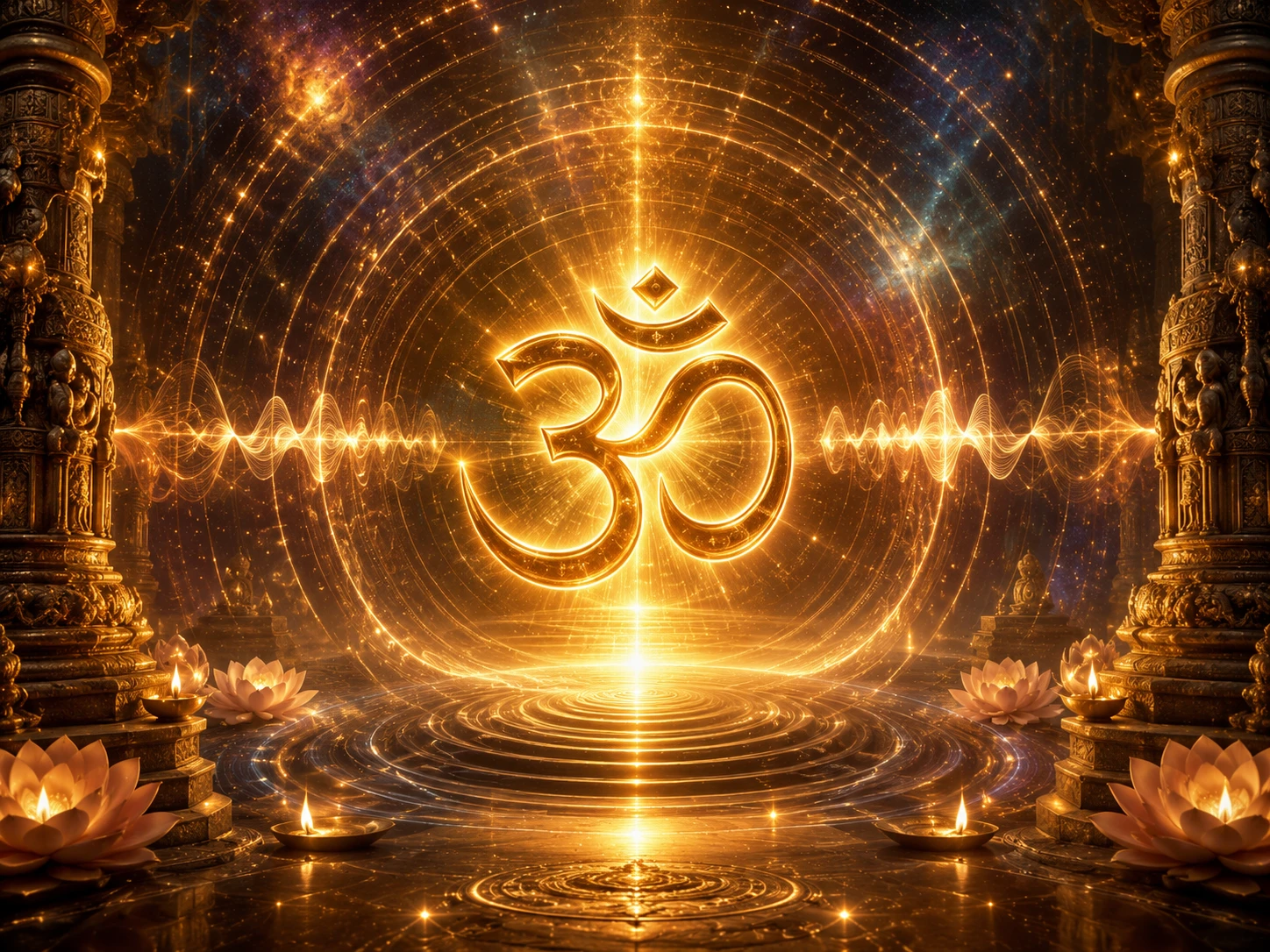
Om -- The Primordial Sound That Contains the Universe
ॐ -- वो आदि ध्वनि जिसमें पूरा ब्रह्माण्ड समाया है
You have heard Om a thousand times. In the morning aarti your grandmother played on her phone speaker. In the opening credits of a mythology serial. In the guided meditation app you downloaded during lockdown and used exactly twice. In the yoga class at your gym where the instructor says 'Om Shanti' and half the room mumbles along without knowing what either word means.
Om is the most recognised sound in Hinduism, and quite possibly the most misunderstood. It gets reduced to a 'spiritual vibe' -- a sonic wallpaper for wellness culture. Incense sticks, Buddha statues (wrong religion, but who's counting), and Om printed on tank tops at Sarojini Nagar. The symbol itself has become a design element, a tattoo favourite, a logo for everything from yoga studios in Koramangala to chai brands in Connaught Place.
But the actual philosophical tradition behind Om is one of the most compressed, rigorous, and radical pieces of metaphysics in human intellectual history. The Mandukya Upanishad -- just twelve verses, the shortest of all principal Upanishads -- makes a claim so enormous that it would take Western philosophy another two thousand years to even approach: that a single sound contains the complete structure of consciousness, reality, and everything beyond both.
This is not a feel-good platitude. This is a systematic map. And if you read it carefully, it is also a practice manual -- the original instruction set for what meditation is actually supposed to do.
ओमित्येतदक्षरमिदं सर्वं तस्योपव्याख्यानं भूतं भवद्भविष्यदिति सर्वमोङ्कार एव। यच्चान्यत्त्रिकालातीतं तदप्योङ्कार एव॥
om ity etad akṣaram idaṃ sarvaṃ tasyopavyākhyānaṃ bhūtaṃ bhavad bhaviṣyad iti sarvam oṅkāra eva | yac cānyat trikālātītaṃ tad apy oṅkāra eva ||
Om -- this syllable is all this. All that is past, present, and future is indeed Om. And whatever else there is beyond the threefold time, that too is Om alone.
— Mandukya Upanishad, Mantra 1 (Atharvaveda)
Read that verse again. It is not saying Om is sacred. It is not saying Om is important. It is saying Om IS everything. Past, present, future -- and then it goes further: whatever lies beyond time itself. This is not a religious claim in the way most people understand religion. This is an ontological claim -- a statement about the fundamental nature of existence.
The Mandukya Upanishad was considered so complete that the Muktika Upanishad records a conversation between Rama and Hanuman where Rama says: if you can understand the Mandukya alone, that is sufficient for liberation. No other Upanishad needed. Gaudapada, the guru of Shankaracharya's guru, wrote his famous Karika commentary on this text, and from that single act of philosophical analysis, the entire Advaita Vedanta tradition crystallised.
Twelve verses changed the history of Indian philosophy. And it all begins with one sound.
The genius of the Mandukya is its structure. It takes the syllable AUM and maps it onto the four states of consciousness that every human being cycles through every single day. This is not abstract theology. This is phenomenology -- the direct observation of experience.
The sound A (Akaara) maps to Vaishvanara -- the waking state. This is the state where you are right now, reading this article, aware of external objects through your senses. Your eyes are processing these words, your body is sitting in a chair or holding a phone, and you take this to be 'reality.' In the waking state, consciousness flows outward. You perceive, you react, you engage with the world. The Upanishad says this state has 'seven limbs and nineteen mouths' -- a technical description of the five sense organs, five motor organs, five pranas, and four aspects of the internal mind (manas, buddhi, chitta, ahankara).
The sound U (Ukaara) maps to Taijasa -- the dream state. When you fall asleep and dream, you enter a world that feels absolutely real while you are in it. You run from danger, you feel joy, you have conversations with people who are not there. The objects in your dream are not coming through your physical senses -- they are being generated internally by consciousness itself. The Upanishad calls this 'inner cognition' -- consciousness turned inward, creating its own world. Think about that: every night, your consciousness proves it does not need the physical world to generate experience.
The sound M (Makaara) maps to Prajna -- deep dreamless sleep. This is the state you pass through every night but cannot remember. There are no objects, no dreams, no thoughts, no self-awareness. And yet you wake up and say 'I slept well' -- meaning some witness was present even when the mind was completely off. The Upanishad calls this state a 'mass of consciousness' (prajnana-ghana) and says it is the 'doorway' (pradvara) to the other two states. This is philosophically explosive. It means that the foundation of both waking and dreaming reality is not activity but stillness.
And then comes the silence after M -- the fourth, which the Upanishad calls Turiya. Not a 'state' at all, because states come and go. Turiya is the awareness that persists through waking, dreaming, and deep sleep without being affected by any of them. It is the screen on which all three movies play. It cannot be described, cannot be grasped by the senses, cannot be spoken of -- and yet it is closer to you than your own thoughts, because it is the one who is thinking.
AUM and the Four States of Consciousness
| Sound | State | Sanskrit Name | Experience | Consciousness Direction | Vedantic Equivalent |
|---|---|---|---|---|---|
| A (Akaara) | Waking | Vaishvanara / Vishva | External objects via senses -- the 'real world' | Outward (bahih-prajna) | Virat (cosmic gross body) |
| U (Ukaara) | Dream | Taijasa | Internal objects generated by mind -- dreams feel real | Inward (antah-prajna) | Hiranyagarbha (cosmic subtle body) |
| M (Makaara) | Deep Sleep | Prajna | No objects, no dreams -- mass of undifferentiated consciousness | Neither outward nor inward | Ishvara (cosmic causal body) |
| Silence after M | The Fourth (Turiya) | Turiya / Chaturtha | Pure awareness -- the witness of all three states | Beyond direction -- the ground of all experience | Brahman (non-dual reality) |
Based on Mandukya Upanishad Mantras 3-7 and 9-12. The Virat-Hiranyagarbha-Ishvara mapping follows Gaudapada's Karika and Shankaracharya's Bhashya.
Now here is what makes the Mandukya Upanishad extraordinary among philosophical texts: it is not just theory. The AUM mapping is a meditation technique. When you chant Om slowly -- Aaaaaa-Uuuuuu-Mmmmmm -- and then rest in the silence that follows, you are literally rehearsing the journey from waking consciousness through dreaming and deep sleep to the witnessing awareness beyond all three.
This is not metaphor. Tibetan Buddhist traditions adapted this into their own mantra practices. Patanjali's Yoga Sutras (1.27-28) identify Om as the Ishvara-pranidhana -- the direct designator of the ultimate reality, and recommend its repetition and contemplation as a complete sadhana. The Bhagavad Gita (8.13) has Krishna say that one who departs the body while uttering the single syllable Om, thinking of Brahman, attains the supreme goal.
The physics is interesting too. Om is not a single frequency -- it is a composite sound. The A originates in the back of the throat (the gut resonance), U moves to the middle of the mouth (the chest resonance), and M closes at the lips (the head resonance). The full chant moves vibration through the entire body from root to crown. Modern acoustic research at IIT Kanpur and other institutions has shown that the frequency pattern of Om chanting (around 136.1 Hz) closely matches the fundamental frequency of the Earth's electromagnetic resonance known as the Schumann resonance. Whether this is coincidence or something deeper is debatable. What is not debatable is that Om chanting produces measurable physiological changes -- reduced cortisol, increased parasympathetic nervous system activity, and enhanced theta wave production in the brain, the same waves associated with deep meditative states.
The AIIMS Delhi Department of Physiology has published studies showing Om chanting activates the vagus nerve, which regulates heart rate, digestion, and the body's relaxation response. JEE and NEET aspirants in Kota coaching centres have started using Om chanting as a pre-exam calming technique -- not because they read the Mandukya Upanishad, but because their anxiety management workshops recommend it based on clinical evidence.
This is the beautiful circularity of Indian knowledge traditions: a 2,800-year-old Upanishad prescribes a practice. Modern neuroscience validates the practice. The practice works whether or not the practitioner understands the philosophy. But if they do understand the philosophy, the practice becomes something far more profound than stress reduction -- it becomes a systematic exploration of the nature of consciousness itself.
अमात्रश्चतुर्थोऽव्यवहार्यः प्रपञ्चोपशमः शिवोऽद्वैत एवमोङ्कार आत्मैव संविशत्यात्मनाऽऽत्मानं य एवं वेद॥
amātraś caturtho 'vyavahāryaḥ prapañcopaśamaḥ śivo 'dvaita evam oṅkāra ātmaiva saṃviśaty ātmanā''tmānaṃ ya evaṃ veda ||
The fourth is without measure, beyond transactional reality, the cessation of all phenomena, auspicious, non-dual. Thus Om is the Self indeed. One who knows this merges the self into the Self.
— Mandukya Upanishad, Mantra 12 (Atharvaveda)
Om is not only Vedantic. Its reach across Hindu traditions is total. In Shaivism, Omkara is identified with Shiva himself -- the Shiva Mahimna Stotram calls him the source of Pranava. In Vaishnavism, the Vishnu Sahasranama begins with Om, and the tradition holds that Om is the first vibration of Narayana's creative will. In Shakta traditions, the Devi is called Pranava-svarupini -- the one whose form IS Om. In Sikhism, the sacred text begins with 'Ik Onkar' -- one Om, one reality.
The Yoga tradition treats Om as the supreme bija (seed) mantra from which all other mantras derive their power. Om Namah Shivaya, Om Namo Narayanaya, Om Namo Bhagavate Vasudevaya -- every great mantra is prefixed by Om because Om is understood as the carrier frequency on which all specific mantras ride.
In temple architecture, the sanctum sanctorum (garbhagriha) is designed as a resonance chamber. The bells at the entrance, the conch blown during aarti, the chanting of mantras -- all of these produce overlapping sound frequencies that converge toward the harmonic signature of Om. The temples of Thanjavur, the Brihadeeshwara especially, were engineered by Chola architects with acoustic principles that amplify chanting. The Somnath Temple on Gujarat's coast gets its very name from Som-nath, 'Lord of the Moon' -- but the root syllable So is related to the Pranava tradition.
In the UPSC Civil Services examination, questions about the Mandukya Upanishad appear in the Philosophy optional paper. IIT research groups have published papers on cymatics -- the study of visible sound -- showing that Om chanting creates geometric patterns in water and sand that resemble traditional yantras. Whether this proves anything metaphysical is an open question. What it does prove is that the tradition's claim -- that sound creates form -- is at least physically demonstrable at the visible scale.
There is a reason Om is the first thing taught and the last thing uttered. Hindu death rituals include the chanting of Om at the moment of departure. The Bhagavad Gita's instruction is clear: the last thought at the moment of death determines the next journey of consciousness. And what thought could be more encompassing than the one that, according to the Mandukya, already contains everything?
For the NRI family in New Jersey who plays Om Jai Jagdish Hare every Thursday evening, Om is devotion. For the Shaiva ascetic at Manikarnika Ghat in Varanasi who chants it beside funeral pyres, Om is liberation. For the IIT professor studying its acoustic properties, Om is data. For the NEET aspirant using it as a breathing exercise before the biology paper, Om is a coping mechanism.
The Mandukya Upanishad would say all of them are correct. Because Om is all this.
The entire question of what Om 'really' means misunderstands the nature of the claim. Om does not mean something. Om is the structure of meaning itself. It is the sound that was there before language, before thought, before the universe differentiated into parts. The Big Bang, in Vedic terms, was not a bang at all. It was a vibration. Specifically, it was this vibration.
To chant Om is not to invoke an external deity. It is to align your own awareness with the fundamental frequency of existence. The mouth opens (A), the sound moves inward (U), the lips close (M), and then -- silence. In that silence, says the Mandukya, is everything you have ever been looking for.
NASA's Chandra X-ray Observatory detected sound waves emanating from a supermassive black hole in the Perseus galaxy cluster in 2003 -- the lowest note ever recorded, about 57 octaves below middle C. When Indian social media discovered this, #CosmicOm trended for three days. While the connection to the Vedic Pranava is poetic rather than scientific, the discovery that the universe literally hums with sound waves gave unexpected validation to an idea the Mandukya Upanishad stated 2,800 years ago: reality at its most fundamental level is vibratory.
Experience Om -- Guided Pranava Meditation
Begin with three rounds of audible AUM, then move to mental repetition, and rest in the silence that follows. The Three Parts of Om dharana on Eternal Raga sets out this practice step by step.
Eternal Raga · शाश्वत राग
Institutional voice — scholarly articles on Sanatan Dharma
Deepen Your Understanding
अपनी समझ और गहरी करें
sacred symbols
Sri Chakra -- The Sacred Geometry That Takes a Lifetime to Draw Perfectly
Nine interlocking triangles. Four pointing upward (Shiva). Five pointing downward (Shakti). Their intersection creates 43 smaller triangles that map the entire journey of consciousness from the material to the divine. The Sri Yantra is the most complex sacred geometric figure in any world tradition -- and mathematicians still argue about whether it can be drawn with perfect precision.
sacred symbols
Shankh -- The Sacred Conch That Declared War, Sanctifies Worship, and Purifies Water
The opening scene of the Bhagavad Gita is not a conversation. It is a sound -- five conch shells blown simultaneously on the battlefield of Kurukshetra. Krishna's Panchajanya, Arjuna's Devadatta, Bhima's Paundra. Before a single arrow flies, the war is declared by sound. The conch is Hinduism's battle cry, prayer bell, and water purifier -- all in one spiralling shell.
sacred symbols
108 -- The Sacred Number That Links Your Mala to the Solar System
Why does a japa mala have exactly 108 beads? Why do temples list 108 names for every deity? The answer involves astronomy, anatomy, music, and mathematics -- and a coincidence so precise it still stuns astrophysicists: the distance from Earth to the Sun is approximately 108 times the Sun's diameter.
tantra mantra yantra
Tantra, Mantra and Yantra -- The Three Pillars of Spiritual Practice
Tantra is the loom, Mantra is the thread, Yantra is the pattern. Together they form the complete technology of spiritual transformation that India gifted to the world -- and they are far more profound than popular culture imagines.
scriptural exegesis
Mandukya Upanishad -- 12 Verses That Map the Entire Landscape of Consciousness
Twelve verses. The shortest Upanishad. And yet Gaudapada built the entire edifice of Advaita philosophy on it, and Rama told Hanuman in the Muktika Upanishad that this one text alone is sufficient for liberation. The Mandukya Upanishad maps consciousness into four states -- waking, dreaming, deep sleep, and Turiya (the Fourth) -- and then shows that the syllable AUM contains all four. It is not a meditation manual. It is a complete theory of reality compressed into 12 sentences.
sacred symbols
Diya -- The Sacred Lamp That Lights Every Hindu Threshold
A diya is not a candle. It is not 'mood lighting.' It is a philosophical argument made of clay, oil, and cotton -- the oldest continuous lighting tradition on Earth. When the Brihadaranyaka Upanishad prays 'Lead me from darkness to light,' the diya is the answer that arrives at every doorstep, every evening, in every Indian home that still remembers.
NASA's Chandra X-ray Observatory detected sound waves emanating from a supermassive black hole in the Perseus galaxy cluster in 2003 -- the lowest note ever recorded, about 57 octaves below middle C. When Indian social m…
More in Sacred Symbols
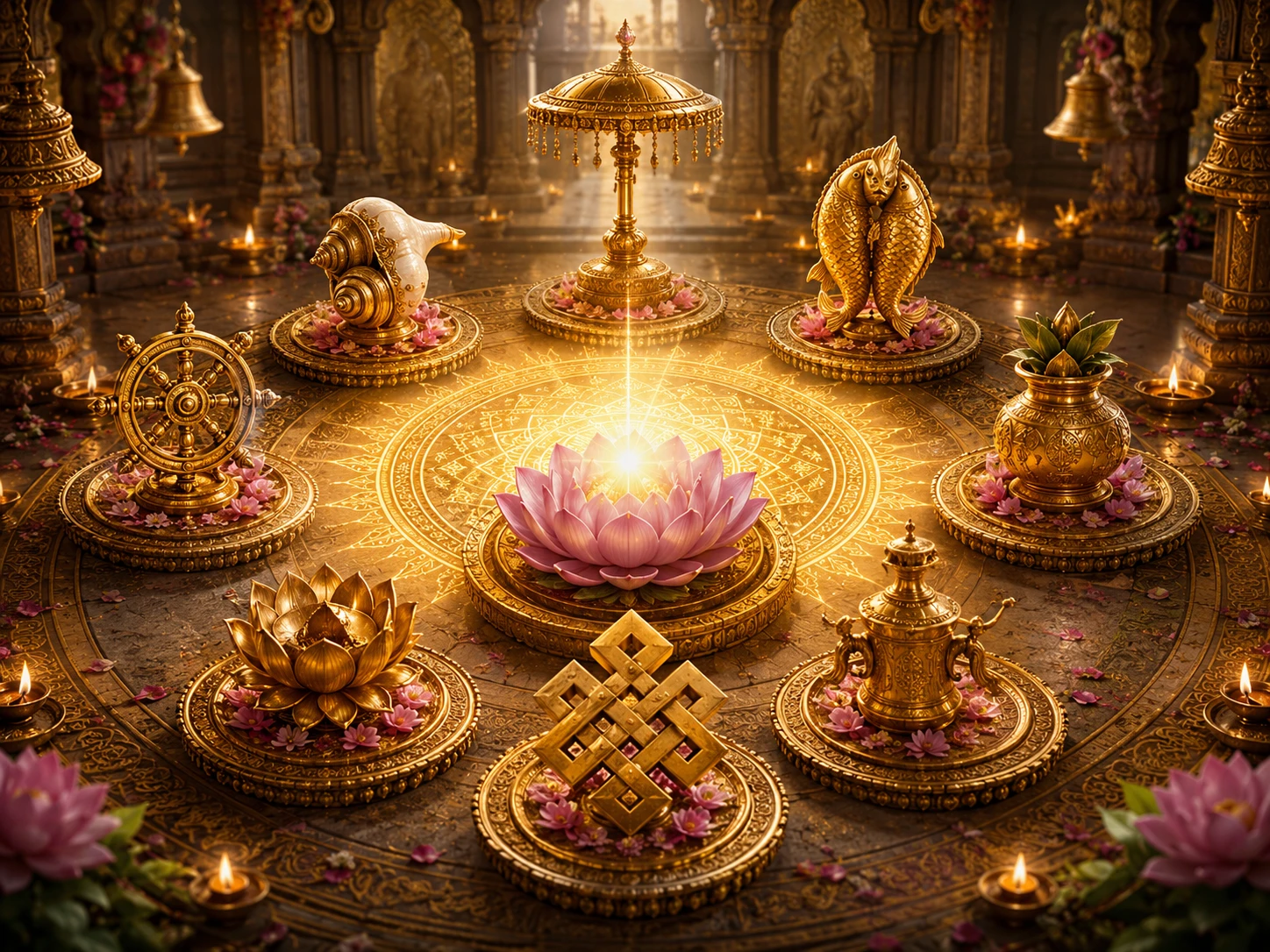
Ashtamangala -- The Eight Auspicious Symbols of Hindu Tradition
13 min read
Bindu -- The Point from which Creation Emerges
12 min read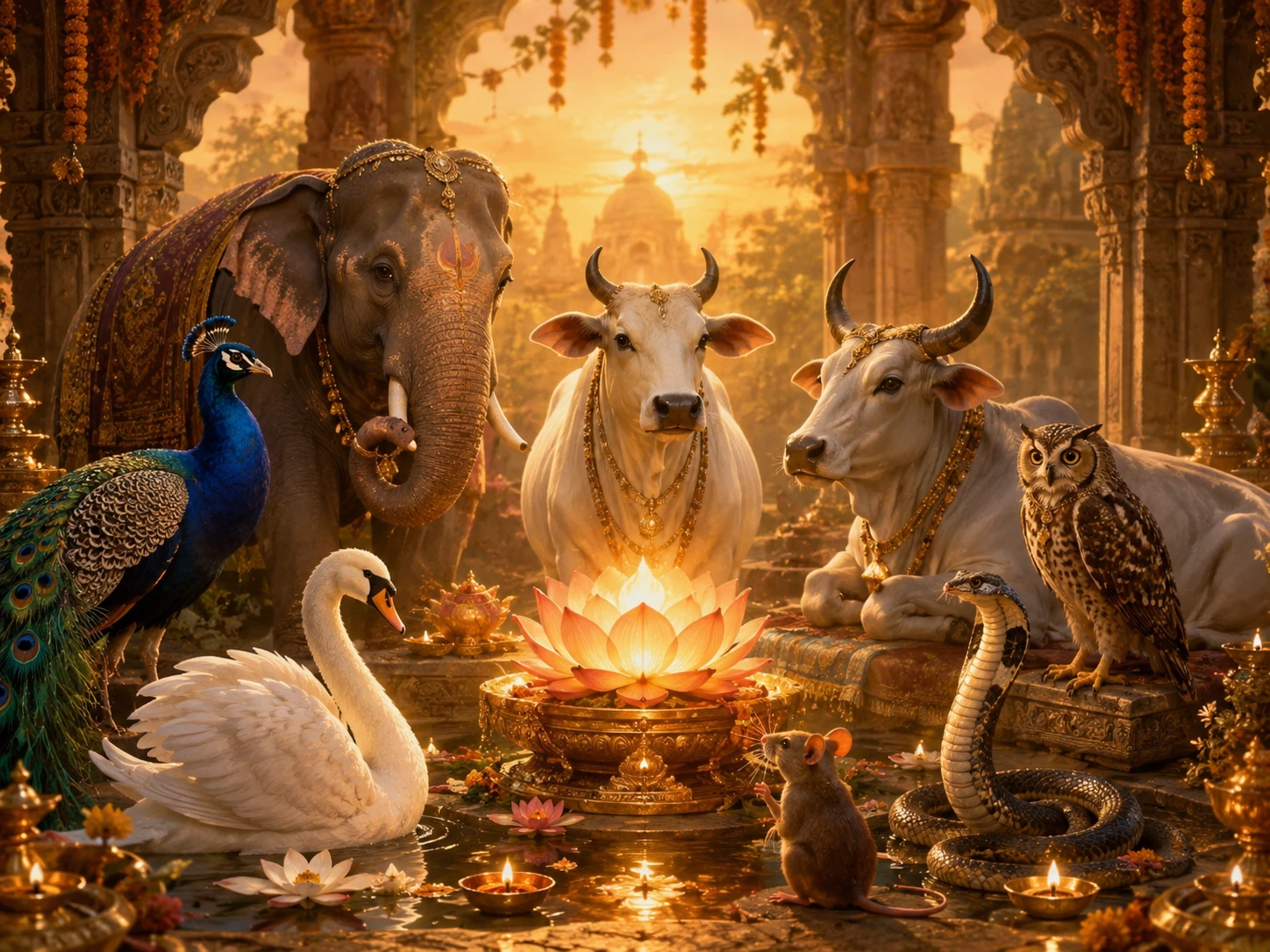
Gau -- Why the Cow Holds the Place She Does in Hindu Life
14 min readThe same translation error that turned '33 Koti' into '33 crore' in Hinduism also happened in Buddhism. The Chinese translation of Buddhist texts rendered 'Sapta Koti Buddha' (7 Supreme Buddhas) as '7 Crore Buddhas.' The…
Deities AvatarsCommunity Reflections
🕉️
Be the first to share your reflection.