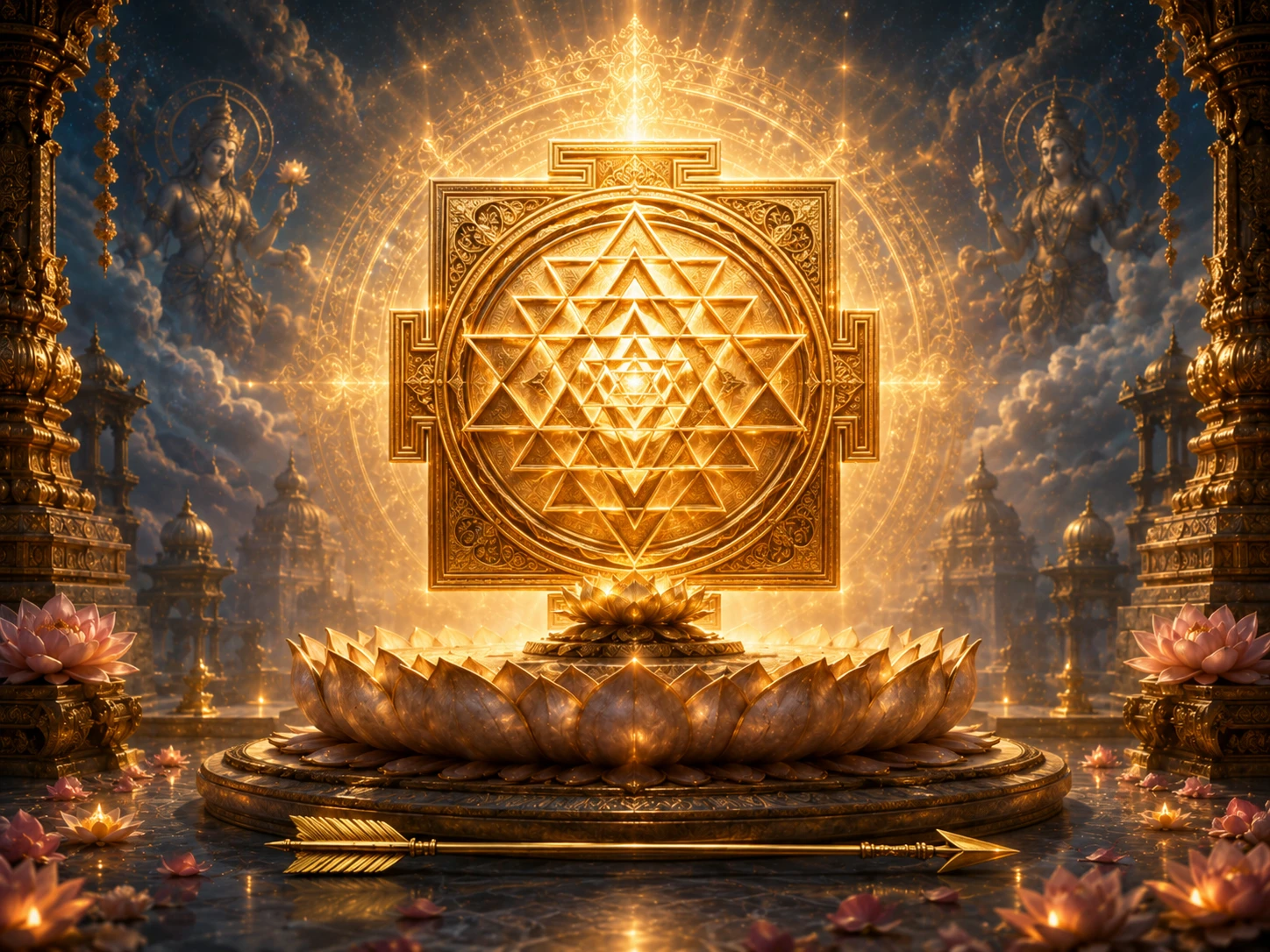
Sri Chakra -- The Sacred Geometry That Takes a Lifetime to Draw Perfectly
श्री चक्र -- वो पवित्र ज्यामिति जिसे पूर्ण बनाने में जीवन लग जाए
There is a geometric figure so complex that no human being has ever drawn it with mathematically perfect precision using only a compass and straightedge. It requires nine triangles -- four pointing upward, five pointing downward -- to interlock in such a way that they create exactly 43 smaller triangles, all enclosed within two concentric rings of lotus petals (one with 8, one with 16), which sit within a square frame with four gates. The central point -- the Bindu -- is not just the geometric centre. It is the origin of creation and the destination of dissolution. It is simultaneously the smallest possible point and the infinite.
This is the Sri Yantra, also called the Sri Chakra -- the supreme yantra of the Shakta tradition, the visual representation of the goddess Lalita Tripurasundari, and arguably the most sophisticated sacred geometric figure produced by any civilisation in human history. It is not decorative. It is not abstract art. It is a meditation device, a cosmological map, a mathematical puzzle, and a ritual object -- and each of these functions operates simultaneously.
If you have ever walked into a South Indian Devi temple -- Kanchi Kamakshi, Madurai Meenakshi, Varanasi's Annapurna -- and seen a metallic plate with an intricate geometric pattern placed before the deity, that was almost certainly a Sri Yantra. It sits at the heart of Shakta worship across India and Sri Lanka, and its influence extends into Buddhist and Jain tantric traditions as well. The Shankaracharya tradition attributes the Soundarya Lahari -- a 100-verse hymn to the goddess -- to Adi Shankaracharya himself, and its opening verse describes the union of Shiva and Shakti that the Sri Yantra embodies.
शिवः शक्त्या युक्तो यदि भवति शक्तः प्रभवितुम् न चेदेवं देवो न खलु कुशलः स्पन्दितुमपि। अतस्त्वामाराध्यां हरिहरविरिञ्चादिभिरपि प्रणन्तुं स्तोतुं वा कथमकृतपुण्यः प्रभवति॥
śivaḥ śaktyā yukto yadi bhavati śaktaḥ prabhavitum na ced evaṃ devo na khalu kuśalaḥ spanditum api | atas tvām ārādhyāṃ hari-hara-viriñcādibhir api praṇantuṃ stotuṃ vā katham akṛtapuṇyaḥ prabhavati ||
Only when united with Shakti does Shiva have the power to create. Without her, the god cannot even stir. How then can one who has not accumulated merit dare to salute or praise you, who are worshipped even by Vishnu, Shiva, and Brahma?
— Soundarya Lahari, Verse 1 (attributed to Adi Shankaracharya)
The nine triangles of the Sri Yantra are not arbitrary. The four upward-pointing triangles represent Shiva -- pure consciousness, the witnessing awareness, the masculine principle. The five downward-pointing triangles represent Shakti -- creative energy, dynamic power, the feminine principle. Their interlocking is the union of consciousness and energy, subject and object, awareness and manifestation. From this union, the entire manifest universe emerges.
The 43 triangles created by their intersection are organised into concentric layers called Avaranas (enclosures), each representing a progressively subtler level of reality. The outermost layer represents the gross physical world. The innermost is the Bindu -- the dimensionless point from which all creation springs and into which all creation dissolves. To meditate on the Sri Yantra is to trace the journey inward, from the material periphery to the transcendent centre. To worship it is to reverse the process -- invoking creative energy from the Bindu outward into manifestation.
The mathematics of the Sri Yantra has fascinated researchers. In 1987, a paper in the journal Current Science by B. Shankar Rao of the Indian Institute of Technology demonstrated that constructing a perfectly concentric Sri Yantra with all 43 triangles properly formed requires solving a system of nonlinear equations with no closed-form analytical solution. In other words, you cannot draw a perfect Sri Yantra with a compass and straightedge -- you can only approach perfection through iterative approximation. This has been confirmed by subsequent computational studies using optimisation algorithms. The traditional method -- drawing by hand through years of practice under a guru's guidance -- is itself an iterative optimisation process.
The 3D version of the Sri Yantra is called the Meru Yantra or Mahameru. It transforms the flat 2D pattern into a pyramidal form where the triangles become faceted surfaces rising to a peak at the Bindu. Meru Yantras carved from crystal (sphatik), gold, or silver are among the most prized ritual objects in Shakta temples. The Kamakshi Temple at Kanchipuram houses a Sri Chakra that is the primary object of worship -- the deity Kamakshi is, in theological terms, the Sri Yantra become flesh.
The Nine Avaranas (Enclosures) of the Sri Yantra
| Avarana # | Name | Shape | Significance |
|---|---|---|---|
| 1 (outermost) | Bhupura (Earth Square) | Square with 4 gates | The material world; the four directions; entry point |
| 2 | Shodashadala (16-petal lotus) | 16 lotus petals | Fulfilment of desires; 16 Kalas (phases) of the Moon |
| 3 | Ashtadala (8-petal lotus) | 8 lotus petals | Eight powers of speech; eight forms of Lakshmi |
| 4 | Chaturdasara (14 triangles) | Ring of 14 triangles | 14 worlds (Lokas); 14 principal Nadis |
| 5 | Bahirdasara (10 outer triangles) | Ring of 10 triangles | 10 vital breaths (Pranas); 10 aspects of fire |
| 6 | Antardasara (10 inner triangles) | Ring of 10 triangles | 10 aspects of protection; deeper subtle body |
| 7 | Ashtakona (8 triangles) | Ring of 8 triangles | Eight forms of the goddess; Ashta Siddhis |
| 8 | Trikona (primary triangle) | Single central triangle | The triple union -- Iccha (will), Jnana (knowledge), Kriya (action) |
| 9 (innermost) | Bindu | Dimensionless point | The goddess herself; source and dissolution; Turiya |
Nine Avaranas per the Devi Khadgamala Stotram and Tantraraja Tantra. Each Avarana has a presiding deity, a specific mantra, and a mudra. The complete Sri Chakra puja traverses all nine enclosures.
The Sri Yantra's influence extends far beyond temple worship. In Vastu Shastra, it is placed in homes and offices to harmonise spatial energy. In corporate India, it is not uncommon to find a small brass Sri Yantra in the office of a CEO in Worli or a tech lead in Whitefield -- placed discreetly on a shelf, sometimes with a small daily offering of kumkum, sometimes just as a 'good energy' object. The crossover between devotion and pragmatism is seamless because in the Indian mind, they were never separate.
In the academic world, the Sri Yantra has become a case study in computational geometry. A 2007 study at IIT Madras used genetic algorithms to generate optimal Sri Yantra configurations. A 2019 paper at the International Conference on Sacred Geometry explored the fractal properties of the figure -- the way the same triangular pattern repeats at different scales, resembling natural fractal structures like coastlines, ferns, and neural networks. The Sri Yantra may be the world's oldest known example of deliberate fractal design, predating Mandelbrot's formal discovery of fractals by at least a millennium.
For the UPSC aspirant, the Sri Yantra appears in Art and Culture questions about Indian geometric traditions and in Philosophy optional papers about Tantra. For the IIT student, it is a problem in nonlinear optimisation. For the NRI family in Fremont, California, who keeps a crystal Meru Yantra in the puja room alongside a photo of Kamakshi, it is the compressed form of everything they believe. For the grandmother in Madurai who traces the Sri Chakra on turmeric-smeared thresholds during Navaratri, it is simply what you draw when you want the goddess to come home.
The Bindu at the centre is the end of the journey inward and the beginning of the journey outward. It is the point where Shiva and Shakti are one -- where consciousness and energy have not yet separated into subject and object. Every triangle you cross to reach it is a layer of illusion you peel away. And when you arrive, there is nothing there -- nothing and everything, simultaneously. That is the Sri Yantra's final teaching: the centre of the most complex geometric figure ever devised is not a shape at all. It is the silence from which all shapes arise.
In 1987, a large Sri Yantra -- measuring approximately 13.3 miles across -- was discovered etched into the dry lakebed of a remote area in Oregon, USA. The lines were precisely ploughed into the alkaline soil, and no one has definitively determined who created it or how. The 'Oregon Sri Yantra' became an international mystery, with theories ranging from alien art to an elaborate prank by a group of artists. What is undisputed is the geometric accuracy: the proportions matched classical Indian Sri Yantra specifications closely enough that researchers initially assumed it had been computer-guided. It remains one of the most famous instances of Hindu sacred geometry appearing in an unexpected Western location.
Sri Yantra Meditation -- From Bhupura to Bindu
Sit before an image of the Sri Yantra and move your gaze slowly through its nine avaranas, from the square bhupura at the edge to the bindu at the centre, resting a few breaths in each. The Lalita Sahasranama, the hymn of the goddess of the Sri Chakra, is on Eternal Raga with each name's meaning.
Tags
Eternal Raga · शाश्वत राग
Institutional voice — scholarly articles on Sanatan Dharma
Deepen Your Understanding
अपनी समझ और गहरी करें
sacred symbols
Om -- The Primordial Sound That Contains the Universe
Every temple bell, every mantra, every meditation session begins and ends with Om. But what exactly IS Om? The Mandukya Upanishad claims this single syllable contains all of reality -- past, present, future, and whatever lies beyond time itself. Twelve verses. One sound. The entire map of consciousness.
tantra mantra yantra
Tantra, Mantra and Yantra -- The Three Pillars of Spiritual Practice
Tantra is the loom, Mantra is the thread, Yantra is the pattern. Together they form the complete technology of spiritual transformation that India gifted to the world -- and they are far more profound than popular culture imagines.
sacred symbols
108 -- The Sacred Number That Links Your Mala to the Solar System
Why does a japa mala have exactly 108 beads? Why do temples list 108 names for every deity? The answer involves astronomy, anatomy, music, and mathematics -- and a coincidence so precise it still stuns astrophysicists: the distance from Earth to the Sun is approximately 108 times the Sun's diameter.
sacred symbols
Swastika -- The Most Misunderstood Sacred Symbol on Earth
For over 5,000 years, the Swastika has meant 'all is well' in Hindu homes. It is drawn at births, weddings, Diwali, and on the first page of new account books. Then one European regime stole it, tilted it 45 degrees, and turned it into a symbol of genocide. The original meaning did not disappear. It was buried. Time to dig it up.
sacred symbols
Diya -- The Sacred Lamp That Lights Every Hindu Threshold
A diya is not a candle. It is not 'mood lighting.' It is a philosophical argument made of clay, oil, and cotton -- the oldest continuous lighting tradition on Earth. When the Brihadaranyaka Upanishad prays 'Lead me from darkness to light,' the diya is the answer that arrives at every doorstep, every evening, in every Indian home that still remembers.
sacred symbols
Shankh -- The Sacred Conch That Declared War, Sanctifies Worship, and Purifies Water
The opening scene of the Bhagavad Gita is not a conversation. It is a sound -- five conch shells blown simultaneously on the battlefield of Kurukshetra. Krishna's Panchajanya, Arjuna's Devadatta, Bhima's Paundra. Before a single arrow flies, the war is declared by sound. The conch is Hinduism's battle cry, prayer bell, and water purifier -- all in one spiralling shell.
In 1987, a large Sri Yantra -- measuring approximately 13.3 miles across -- was discovered etched into the dry lakebed of a remote area in Oregon, USA. The lines were precisely ploughed into the alkaline soil, and no one…
More in Sacred Symbols
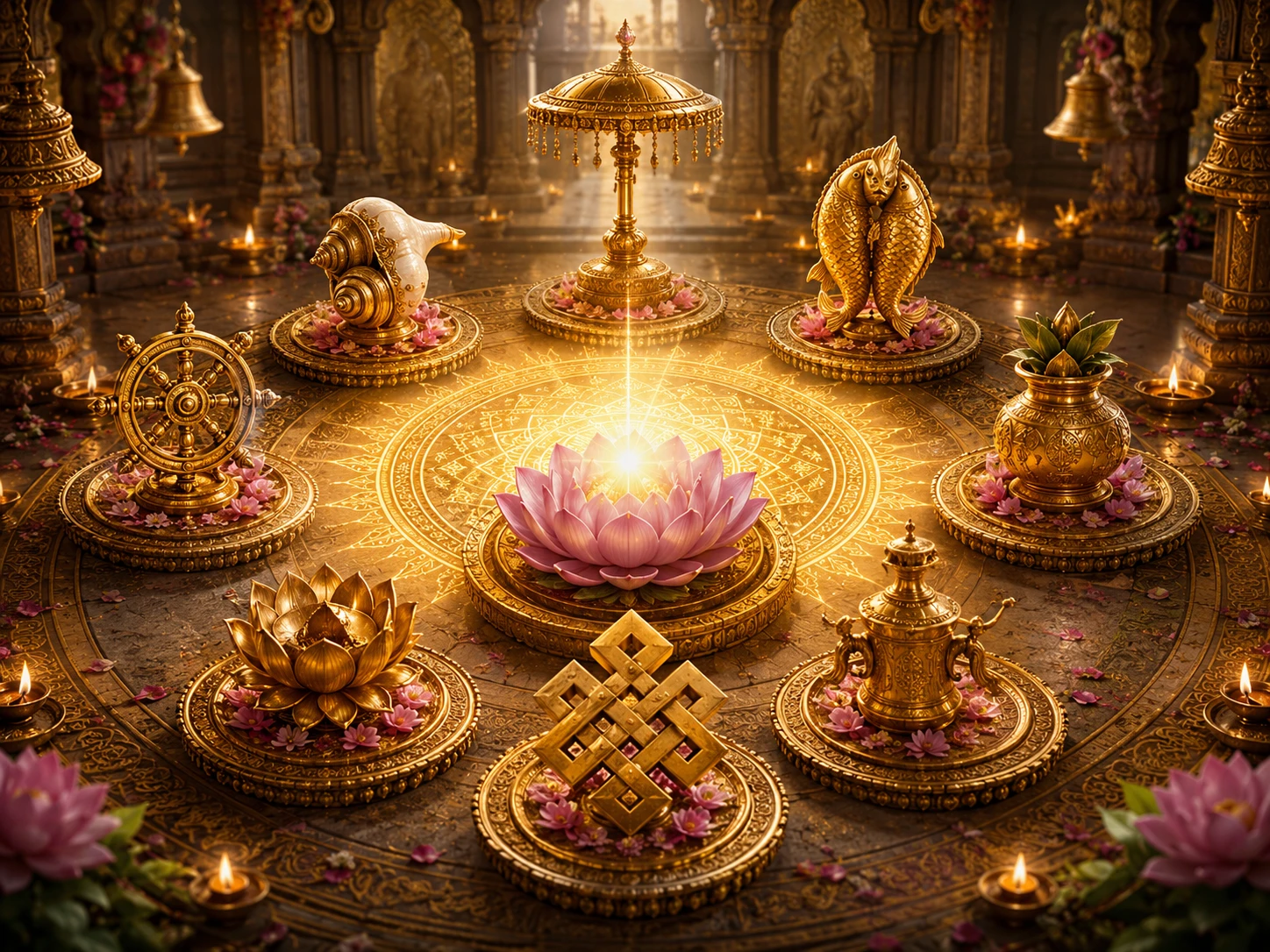
Ashtamangala -- The Eight Auspicious Symbols of Hindu Tradition
13 min read
Bindu -- The Point from which Creation Emerges
12 min read
Gau -- Why the Cow Holds the Place She Does in Hindu Life
14 min readThe same translation error that turned '33 Koti' into '33 crore' in Hinduism also happened in Buddhism. The Chinese translation of Buddhist texts rendered 'Sapta Koti Buddha' (7 Supreme Buddhas) as '7 Crore Buddhas.' The…
Deities AvatarsCommunity Reflections
🕉️
Be the first to share your reflection.