Samudra Manthan -- When Gods and Demons Ran a Joint Venture and the Universe Almost Died
समुद्र मंथन -- जब देवताओं और असुरों ने मिलकर startup चलाया और ब्रह्मांड लगभग खत्म हो गया
The setup reads like the pitch deck of the most ambitious joint venture in cosmic history. Indra, king of the Devas, had offended the sage Durvasa -- who cursed him with the loss of all fortune and power. The Devas, weakened and stripped of their glory, went to Vishnu for help. Vishnu's answer was not a war strategy. It was a business proposal: churn the ocean of milk (Kshirasagara) and extract the nectar of immortality (Amrita). But the project was too large for the Devas alone. They would need the Asuras as partners.
This is the first lesson of the Samudra Manthan, and it is counter-intuitive: sometimes you need your enemy to build something neither of you can build alone. The Devas and Asuras despised each other, but the ocean was too vast, the mountain too heavy, and the snake too powerful for either side to operate solo. This is the logic behind every uncomfortable corporate merger, every coalition government, every India-Pakistan cricket series where both teams need each other to fill the stadium.
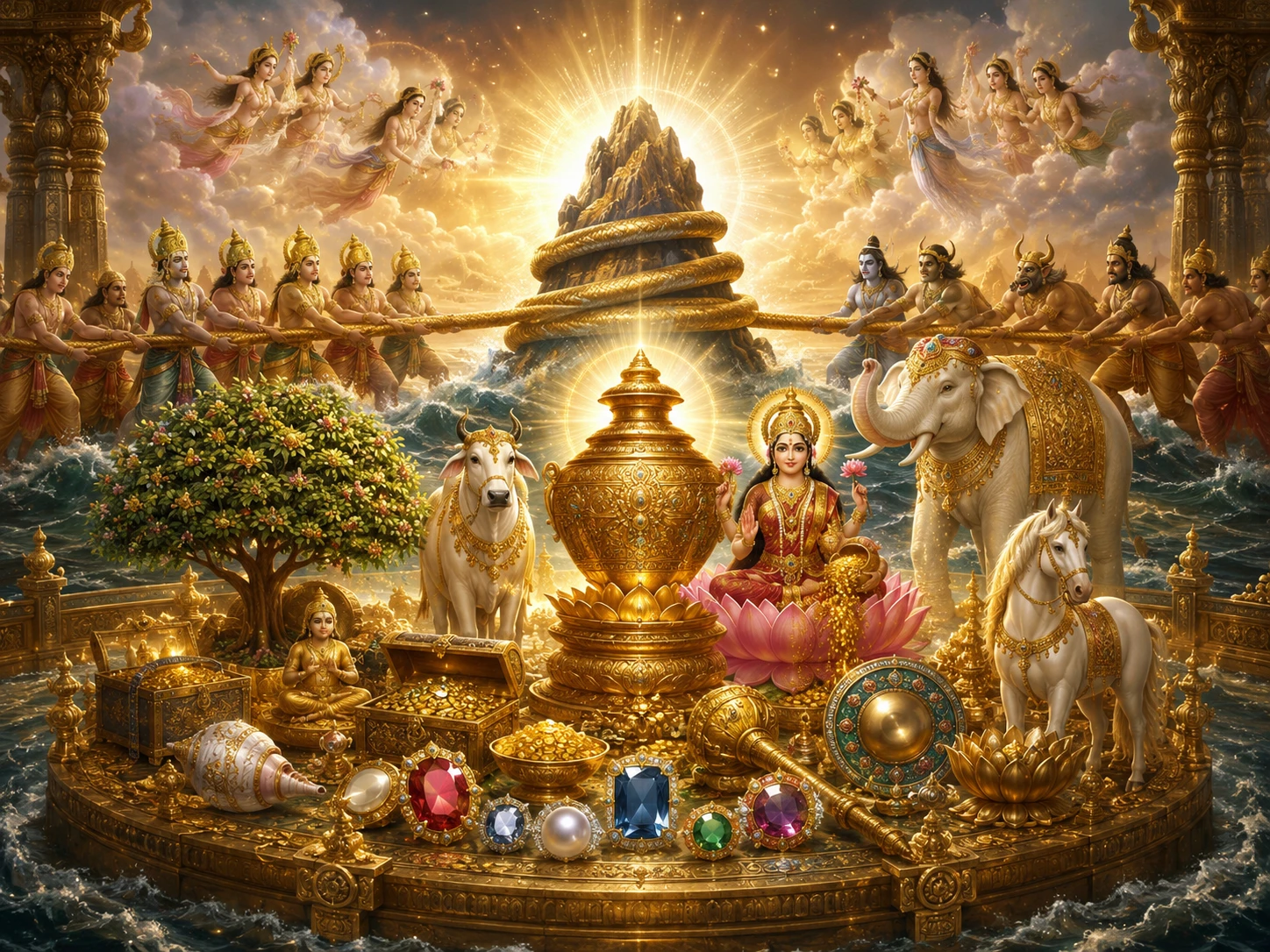
The engineering was extraordinary. Mount Mandara became the churning rod. Vasuki, the serpent king who adorns Shiva's neck, became the rope. The Asuras, on Vishnu's subtle suggestion, grabbed the head end (where the venom was) while the Devas held the tail. And Vishnu himself descended as the Kurma (tortoise) avatar to become the foundation -- the pivot on which the entire mountain rested as it spun.
The narrative appears in the Bhagavata Purana (Skandha 8, Chapters 5-12), the Vishnu Purana, and the Mahabharata's Adi Parva. The details vary between texts -- some list nine treasures, others fourteen -- but the core architecture is consistent: cooperation under pressure, crisis at the midpoint, divine intervention to resolve what human (and superhuman) effort cannot, and a final betrayal that requires yet another intervention.
For a generation raised on startup culture, the Samudra Manthan reads like a Series A pitch meeting gone spectacularly wrong -- and then, somehow, spectacularly right.
त्र्यम्बकं यजामहे सुगन्धिं पुष्टिवर्धनम् । उर्वारुकमिव बन्धनान्मृत्योर्मुक्षीय माऽमृतात् ॥
tryambakaṁ yajāmahe sugandhiṁ puṣṭi-vardhanam urvārukam iva bandhanān mṛtyor mukṣīya mā'mṛtāt
We worship the Three-Eyed One (Shiva) who is fragrant and nourishes all beings. As a cucumber is freed from its bond to the vine, may we be liberated from death -- not from immortality.
— Rig Veda 7.59.12 (Mahamrityunjaya Mantra -- the Vedic invocation to Shiva as conqueror of death, directly connected to the Neelakantha episode where Shiva conquers the halahala poison)
THE CRISIS: HALAHALA -- WHEN THE JOINT VENTURE PRODUCES POISON FIRST
Before any treasure emerged, the ocean released something nobody expected: Halahala -- a poison so lethal that its fumes alone began to suffocate all creation. The Devas panicked. The Asuras panicked. The joint venture was about to kill everyone involved.
This is the Samudra Manthan's most psychologically honest moment. Every great endeavour produces toxicity before it produces value. The first year of a startup is not profit -- it is sleepless nights, co-founder conflicts, and cash burn. The first months of a marriage are not bliss -- they are the collision of two lifestyles. The first semester at IIT is not triumph -- it is the crushing realization that everyone around you is also a topper. The ocean does not hand you amrita first. It hands you halahala. What you do with the poison determines whether you survive to collect the treasure.
No Deva or Asura could handle the halahala. They turned to Shiva. And Shiva did something that defines his character across all of Hindu theology: he drank the poison. Not because he was immune -- the Bhagavata Purana is clear that the poison was dangerous even to him. Parvati, his consort, pressed his throat to stop the poison from spreading beyond it, turning his throat blue. This is why Shiva is called Neelakantha -- the blue-throated one.
The Neelakantha episode is the single most referenced act of divine sacrifice in Hinduism. It is not Vishnu's strategic brilliance. It is not Brahma's creative power. It is Shiva's willingness to absorb the suffering that nobody else can bear, without complaint, without credit, without even swallowing it fully -- just holding it in his throat forever.
Every NDRF rescue worker pulling survivors out of flood debris in Uttarakhand, every unnamed army jawan standing at Siachen in minus-40 temperatures, every single mother working two jobs so her children can attend coaching in Kota -- they are all Neelakanthas. They hold the poison so someone else can reach the amrita.
THE 14 RATNAS: WHAT THE OCEAN GAVE
Once the halahala was absorbed by Shiva, the churning continued and the ocean began yielding its treasures. The Puranic lists vary, but the most commonly cited 14 Ratnas (sometimes counted slightly differently across Bhagavata Purana, Vishnu Purana, and Mahabharata) include:
Goddess Lakshmi (Sri) -- wealth, fortune, and auspiciousness incarnate. She chose Vishnu as her consort, establishing the Lakshmi-Narayana pair that remains central to Hindu devotion. Her emergence from the ocean is why Diwali is linked to both Lakshmi puja and the Samudra Manthan narrative.
Apsaras -- celestial beings of beauty and performing arts, who chose the Gandharvas as companions.
Varuni (Sura/Madira) -- the goddess of wine, taken by the Asuras.
Uchhaishravas -- the divine seven-headed white horse, given to the demon king Bali (in some versions, to Indra).
Airavata -- the magnificent white elephant with four tusks, taken by Indra as his mount, and considered the protector of the directions.
Kaustubha -- the most precious jewel in existence, worn by Vishnu on his chest.
Parijata -- the divine tree whose flowers never fade or wilt, taken to Indraloka.
Kamadhenu (Surabhi) -- the wish-fulfilling cow, given by Vishnu to the sages for ritual purposes.
Sharanga -- a powerful divine bow, claimed by Vishnu.
Chandra -- the moon, which Shiva placed upon his head, becoming Chandrashekhar.
Dhanvantari -- the divine physician, who emerged carrying a pot of Amrita. He is the founder of Ayurveda, and Dhanteras (two days before Diwali) celebrates his appearance.
Amrita -- the nectar of immortality, the stated purpose of the entire operation.
Halahala -- the cosmic poison consumed by Shiva.
Kalpavriksha -- the wish-fulfilling tree (in some Puranic lists, replacing Parijata or counted separately).
The list itself is a map of what civilizations need: health (Dhanvantari), wealth (Lakshmi), beauty (Apsaras), military power (Airavata, Uchhaishravas, Sharanga), spiritual nourishment (Kamadhenu), immortality (Amrita), and the capacity to absorb suffering (Shiva's act). Notice what came first: poison. Notice what came last: nectar. The architecture of the Samudra Manthan insists that you cannot get to the treasure without passing through the crisis.
The 14 Ratnas -- Who Got What and Why It Matters
| Ratna | Received By | Domain | Modern India Parallel |
|---|---|---|---|
| Halahala (Poison) | Shiva | Sacrifice / Crisis absorption | NDRF teams, army jawans, healthcare workers during COVID -- they absorb the poison so society survives |
| Lakshmi | Vishnu | Wealth, fortune, auspiciousness | Diwali Lakshmi Puja -- India's biggest annual celebration of prosperity. BSE opens with Lakshmi aarti on Muhurat Trading day |
| Dhanvantari + Amrita | Devas (via Vishnu's intervention) | Health and immortality | Ayurveda, AYUSH Ministry, Dhanteras gold-buying tradition. India's $50B pharma industry traces its mythic origins here |
| Uchhaishravas (Horse) | Bali / Indra | Speed, power, royal authority | Indian cavalry tradition. Marwari horse breed linked to Rajput military heritage |
| Airavata (Elephant) | Indra | Strength, direction-protection | Project Elephant by Indian govt. Kerala temple elephants in Thrissur Pooram |
| Kaustubha Mani | Vishnu | Supreme divine jewel | India's jewellery industry (Tanishq, GRT, Kalyan) -- world's 2nd largest gold consumer |
| Kamadhenu | Sages | Wish-fulfilment, ritual sustenance | India's dairy revolution (Amul, Operation Flood by Verghese Kurien) -- world's largest milk producer |
| Chandra (Moon) | Shiva | Time-keeping, beauty, tides | ISRO Chandrayaan missions -- literally reaching for the Chandra that Shiva wears |
| Mohini (Vishnu's form) | Strategic intervention | Deception for dharma | Game theory, strategic negotiation -- when equal distribution fails, reframe the rules |
Note: The Ratna count varies between 9 and 14 across Bhagavata Purana, Vishnu Purana, and Mahabharata. This table follows the most commonly cited composite list. Sharanga, Parijata, Apsaras, Varuni, and Kalpavriksha complete the traditional 14.
THE BETRAYAL AND THE SOLUTION: MOHINI AVATAR
The Samudra Manthan does not end with the treasures. It ends with a heist.
When Dhanvantari emerged with the pot of Amrita, the Asuras snatched it. The entire joint venture collapsed in an instant -- the Asuras had no intention of sharing the nectar. This is the moment every business partnership dreads: the partner who agreed to split equity 50-50 suddenly wants 100.
The Devas could not win by force -- the Asuras were equally powerful. So Vishnu intervened with something more effective than muscle: narrative control. He appeared as Mohini -- the most beautiful woman in existence -- and offered to distribute the Amrita fairly. The Asuras, enchanted, agreed to let her serve. Mohini seated the Devas and Asuras in two rows and systematically served all the Amrita to the Devas while keeping the Asuras distracted.
One Asura -- Svarbhanu (later known as Rahu and Ketu) -- saw through the deception, disguised himself as a Deva, and drank some Amrita. The Sun and Moon gods spotted him and alerted Vishnu, who severed his head with the Sudarshana Chakra. But because the nectar had already passed his throat, both parts survived -- the head became Rahu and the body became Ketu, the shadow planets that cause eclipses. This is why Rahu and Ketu are said to periodically 'swallow' the Sun and Moon -- they are taking revenge for the original betrayal.
The Mohini episode raises uncomfortable questions that the text does not shy away from. Was Vishnu's deception justified? The Asuras had done equal work. They had held the serpent's head, suffered its venom, and churned for just as long. By any standard of contractual fairness, they deserved half the Amrita. Vishnu's answer is implicit: the Asuras would have used immortality for adharmic purposes -- to oppress, to conquer, to destroy the cosmic order. Sometimes fairness of process must yield to fairness of outcome.
This is the moral logic behind India's reservation system, behind progressive taxation, behind any policy that distributes unequally because equal distribution would perpetuate injustice. The Samudra Manthan does not pretend this is clean. It shows a god using deception for a greater good -- and lets the reader wrestle with whether that is acceptable.
THE DEEPER READING: WHAT THE OCEAN IS REALLY ABOUT
Across commentarial traditions, the Samudra Manthan has been read as an allegory for inner transformation:
The ocean of milk is the mind -- vast, milky white, full of potential but needing to be churned. Mount Mandara is the spine or the will. Vasuki is the prana (breath). The Devas and Asuras are the positive and negative tendencies within every person. Kurma (the tortoise) is the withdrawal of the senses (pratyahara) -- the stable base without which no inner churning can happen.
The halahala is the pain that surfaces when you begin serious sadhana -- old traumas, buried anger, suppressed grief. Every meditator knows this: the first weeks of disciplined practice do not bring peace. They bring chaos. The mind's toxins surface before its treasures do. The Amrita is the nectar of self-realization that comes only after you have faced and absorbed the poison.
This kundalini-yogic reading is not a modern invention. The Shaiva Agamas and several Tantric commentaries explicitly map the Samudra Manthan onto the sushumna nadi activation sequence. In the Nath tradition, the Samudra Manthan is a code for the internal alchemical process that Gorakshanath and Matsyendranath taught.
For the modern Indian, there is an even simpler reading. Every Board exam, every JEE attempt, every UPSC cycle, every startup pivot, every immigration journey -- is a samudra manthan. You partner with forces you do not fully trust (coaching centres, VCs, immigration lawyers). The first thing that surfaces is poison (failure, rejection, self-doubt). Somebody has to absorb the poison (parents, mentors, therapists). And the amrita -- the result, the breakthrough, the visa, the offer letter -- comes only if you keep churning after the halahala.
Bangkok's main airport, Suvarnabhumi, features a massive Samudra Manthan sculpture at its entrance -- Devas and Asuras pulling Vasuki around Mount Mandara. Thailand, Cambodia, Laos, and Indonesia all inherited the Samudra Manthan narrative through centuries of Hindu-Buddhist cultural exchange. The bas-reliefs at Angkor Wat in Cambodia include one of the world's largest depictions of the churning, spanning 49 metres. Back in India, ISRO's Chandrayaan missions are literally reaching for the Chandra that emerged from the ocean -- and Amul, the world's largest dairy cooperative founded by Verghese Kurien, operationalized Kamadhenu's gift at industrial scale, making India the world's largest milk producer.
The Kumbh Mela -- the world's largest religious gathering with over 100 million attendees -- is traditionally linked to the Samudra Manthan. According to popular belief, drops of Amrita fell at four places (Prayagraj, Haridwar, Ujjain, Nashik) as the pot was carried. However, scholars including D.P. Dubey and Kama Maclean note that no ancient Puranic text actually mentions the spilling of Amrita at four places or connects it to the Kumbh Mela. The Kumbh-Manthan link appears to be a relatively recent tradition that was retrospectively anchored to scripture. This is a textbook example of how living traditions evolve -- the story grows because the community needs it to.
Churn Your Inner Ocean
The Samudra Manthan begins with a stable base (Kurma). Your inner churning begins with stillness. Practise eleven minutes of pranayama daily -- the Vasuki (breath) that turns your inner Mandara (spine). The nadi shodhana page on Eternal Raga is a good place to begin.
Tags
Eternal Raga · शाश्वत राग
Institutional voice — scholarly articles on Sanatan Dharma
Deepen Your Understanding
अपनी समझ और गहरी करें
deities avatars
Dashavatara -- Why Vishnu Comes Back Ten Times
Fish, tortoise, boar, half-lion, dwarf, axe-warrior, prince, cowherd, enlightened teacher, future horseman. The ten avatars of Vishnu are not random folklore. Read them in sequence and you get something startling -- a narrative that mirrors evolutionary biology, tracks the rise and fall of political systems, and argues that God does not sit above history but enters it, gets dirty, and does the work. The Dashavatara is Hinduism's answer to the question every civilisation asks: why does the world keep breaking, and who fixes it?
deities avatars
Narasimha -- The Avatar Who Broke Every Rule to Keep His Word
Hiranyakashipu thought he had hacked the universe. His boon covered every loophole -- no man, no animal, no weapon, no time, no place could kill him. He forgot one thing: God is not bound by the categories God created. Narasimha -- half-man, half-lion, appearing at twilight on a threshold with bare claws -- is Hinduism's most terrifying avatar and its most precise legal argument. The message is not that tyranny will be punished. The message is that tyranny's own logic contains its destruction.
deities avatars
Krishna Leela -- Why God Chose to Play
He stole butter, broke pots, lied to his mother's face, danced with married women under the full moon, and lifted an entire mountain on his little finger. The Bhagavata Purana's Tenth Skandha -- the most popular 4,000 verses in all of Hindu literature -- is not a biography. It is a theological argument that the Supreme Being's highest expression is not creation, destruction, or cosmic governance. It is play. Krishna Leela is the radical idea that God's truest nature is joy.
sacred artefacts
Divine Gems -- Syamantaka, Kaustubha, and Chintamani
Hindu mythology's most precious stones are not mere ornaments -- they are plot devices, moral tests, and cosmic forces. The Syamantaka Mani turned Krishna into a detective. The Kaustubha emerged from the Ocean of Milk to sit forever on Vishnu's chest. The Chintamani fulfils every wish -- and teaches why that might be the worst thing that could happen to you.
tantra mantra yantra
Om Namo Narayanaya -- The Eight-Syllable Key to Vishnu
Eight syllables. No complicated ritual. No prerequisite initiation for the basic form. Om Namo Narayanaya is the most accessible Vishnu mantra in existence -- chanted by Alvars in Tamil Nadu, ISKCON devotees in Manhattan, grandmothers in Tirupati queues, and software engineers in Bengaluru doing japa on their morning commute. But simplicity is not shallowness. The Ashtakshara Mantra encodes an entire theology of surrender, and the three schools of Vedanta have spent centuries arguing about what exactly 'Namo' means.
scriptural exegesis
Gita Chapter 11 -- Vishwaroop: When Arjuna Saw Everything and Could Not Bear It
Arjuna asks to see Krishna's true form. He gets what he asks for. Infinite mouths, infinite eyes, infinite arms, the entire universe being consumed. Warriors rushing into blazing mouths like moths into flame. Time itself as a devouring force. This is the chapter Oppenheimer quoted at Trinity. It is the Gita's most terrifying passage -- and its most honest statement about what happens when a human mind encounters infinity without a filter.
scriptural exegesis
Gita Chapter 18 -- Moksha Sannyasa Yoga: The Final Exam Where Krishna Says 'Do As You Wish'
78 verses. The longest chapter in the Gita. Krishna classifies everything -- knowledge, action, doer, intellect, happiness -- into three gunas, then drops the most radical verse in Indian scripture: abandon all dharmas and just surrender to Me. And then, in a move no dictator would ever make, he tells Arjuna: now do as you wish.
Bangkok's main airport, Suvarnabhumi, features a massive Samudra Manthan sculpture at its entrance -- Devas and Asuras pulling Vasuki around Mount Mandara. Thailand, Cambodia, Laos, and Indonesia all inherited the Samudr…
More in Scriptural Exegesis
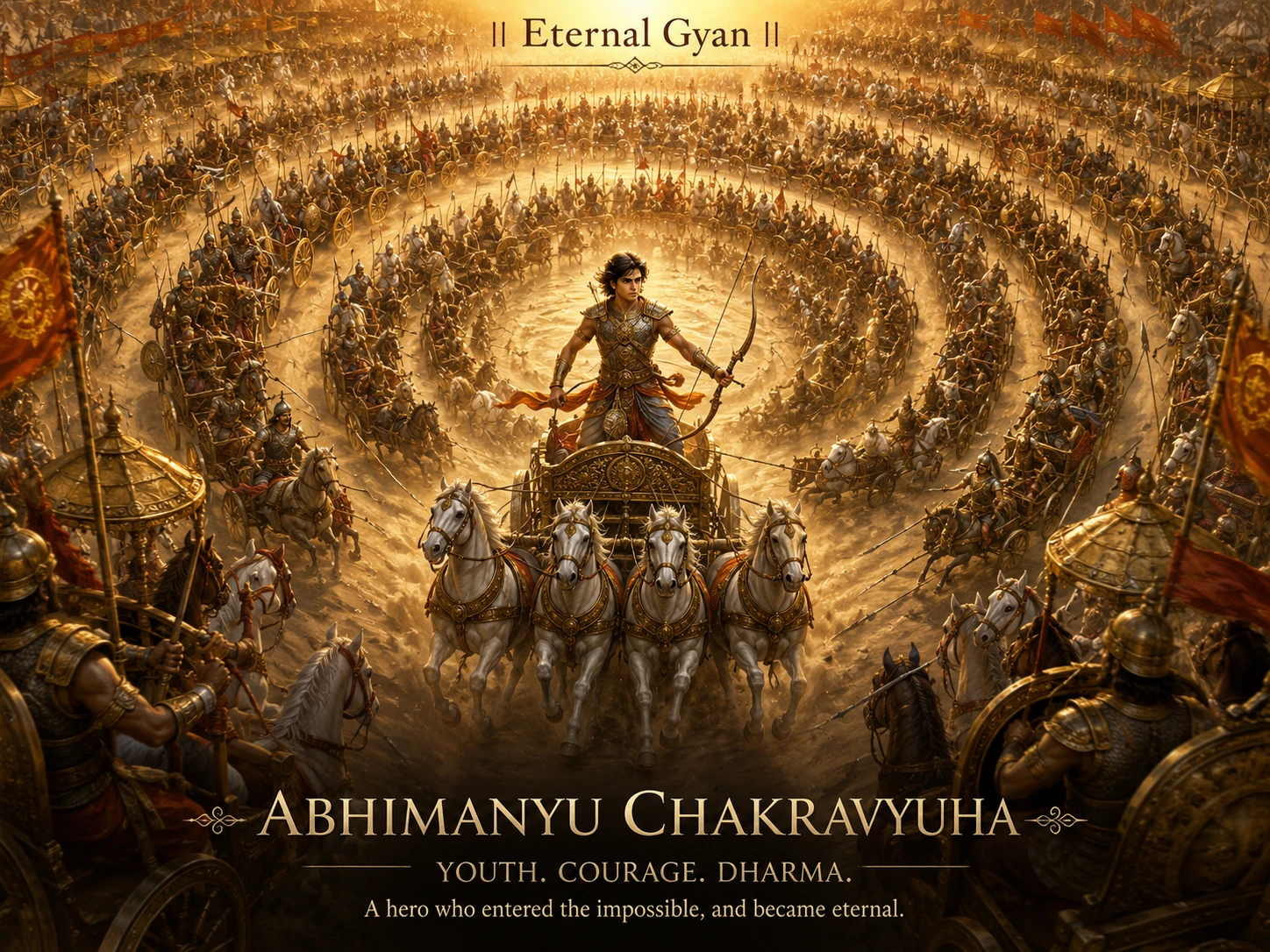
Abhimanyu and the Chakravyuha -- The Boy Who Knew How to Enter but Not How to Leave
14 min read
Adbhuta Ramayana -- The Ramayana Where Sita Becomes Kali
9 min read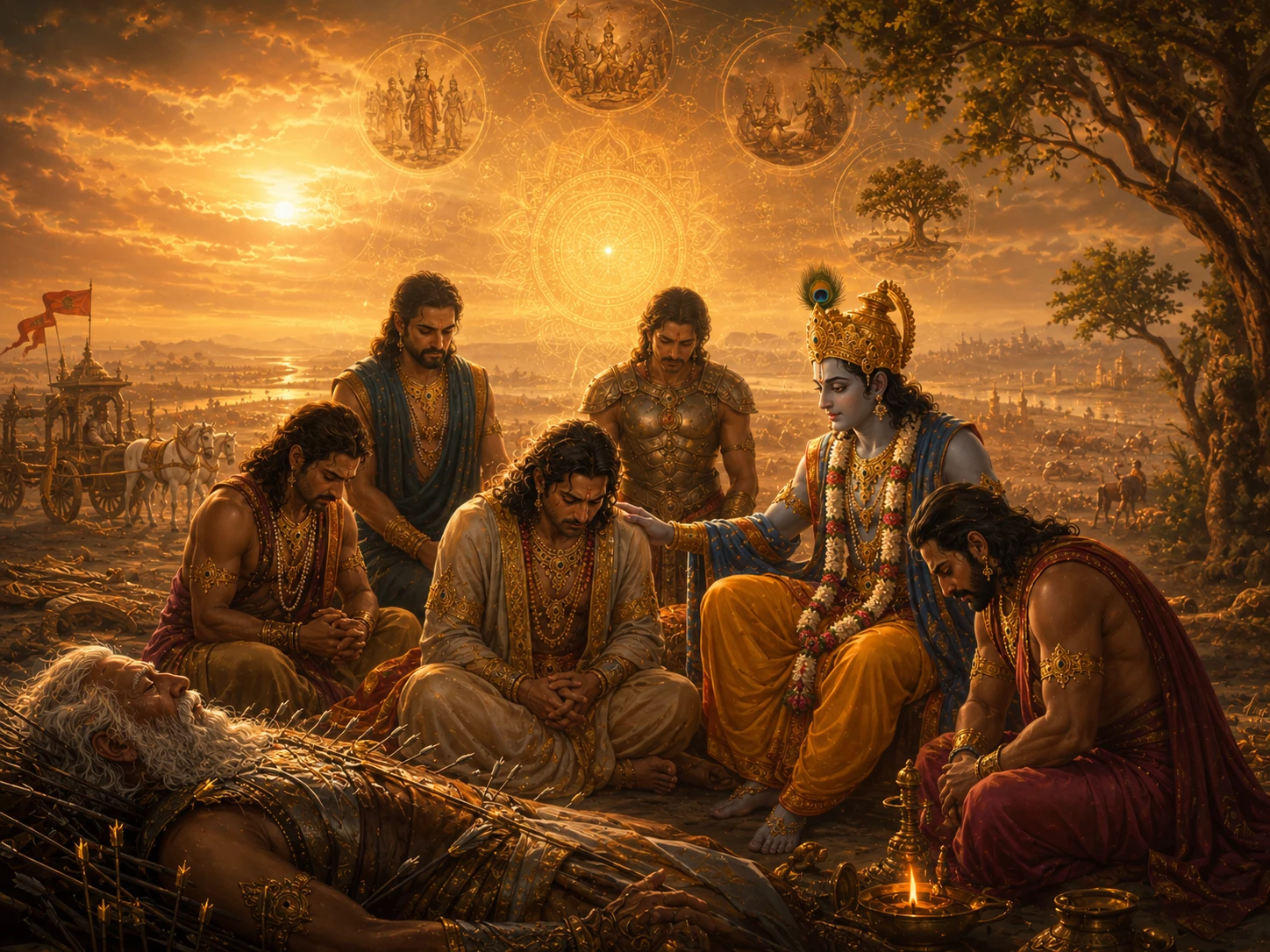
After Kurukshetra -- What Happened Next
14 min readThe same translation error that turned '33 Koti' into '33 crore' in Hinduism also happened in Buddhism. The Chinese translation of Buddhist texts rendered 'Sapta Koti Buddha' (7 Supreme Buddhas) as '7 Crore Buddhas.' The…
Deities AvatarsCommunity Reflections
🕉️
Be the first to share your reflection.