Panchang -- The Five-Limbed Hindu Calendar That Runs on the Moon and the Sun
पंचांग -- चन्द्रमा और सूर्य पर चलने वाला पाँच-अंगी हिन्दू कैलेण्डर
Every year, a few weeks before any major Hindu festival, the same scene plays out in Indian households. Someone -- usually a parent or grandparent -- opens a thin, densely printed booklet with a cover featuring a deity, a sunrise, and about fourteen different calendar systems crammed onto the front page. They flip through it, squinting at columns of numbers, Sanskrit abbreviations, and colour-coded boxes. They arrive at a date and declare: 'Griha Pravesh on the 14th. Before 10:47 AM. After that, no good.' The family adjusts its entire schedule around a specific 47-minute window determined by a calculation system that has been running, with continuous refinement, for at least 2,500 years.
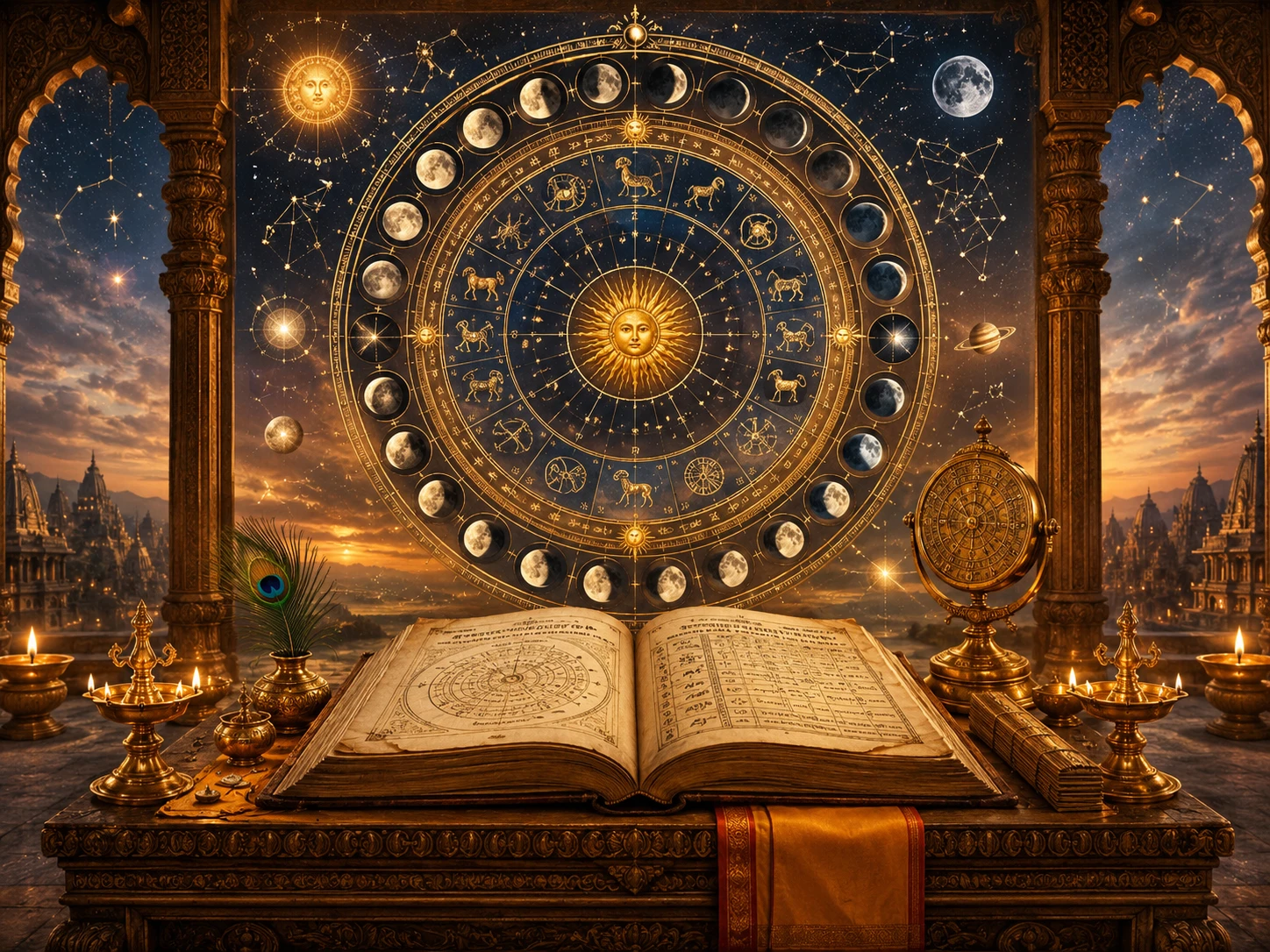
That booklet is the Panchang -- from the Sanskrit Pancha (five) and Anga (limb). It is a five-variable astronomical almanac that tracks the positions of the Sun, Moon, and stars to determine the quality of time at any given moment. It is simultaneously a calendar, an astronomical table, a festival scheduler, and an auspiciousness calculator. The Gregorian calendar tells you the date. The Panchang tells you what that date means.
The Panchang is not a relic. Drik Panchang (drikpanchang.com) gets over 100 million visits per year. AstroSage's Panchang app has tens of millions of downloads on Google Play. The Government of India's Rashtriya Panchang is published annually by the Positional Astronomy Centre under the Ministry of Earth Sciences. Every state-level government calendar in India -- from Kerala to Assam to Gujarat -- is cross-referenced with a regional Panchang. And in Kota coaching centres, students check Rahu Kaal timings before their test series because their mothers told them to, and arguing with mothers during JEE prep is a battle no one wins.
तिथिर्विष्णुस्तथा वारो नक्षत्रं विष्णुरेव च। योगश्च करणं चैव सर्वं विष्णुमयं जगत्॥
tithir viṣṇus tathā vāro nakṣatraṃ viṣṇur eva ca | yogaś ca karaṇaṃ caiva sarvaṃ viṣṇumayaṃ jagat ||
Tithi is Vishnu, Vara (weekday) is Vishnu, Nakshatra is Vishnu, Yoga and Karana too -- the entire world is pervaded by Vishnu.
— Vishnu Purana (traditional Panchang invocation verse, cited in Muhurta Chintamani)
The five limbs of the Panchang are Tithi, Vara, Nakshatra, Yoga, and Karana. Each tracks a different astronomical variable, and together they create a five-dimensional map of any moment in time.
Tithi (Lunar Day): A Tithi is defined by the angular separation between the Sun and the Moon. When the Moon moves 12 degrees ahead of the Sun, one Tithi is complete. There are 30 Tithis in a lunar month -- 15 in the bright half (Shukla Paksha, waxing Moon) and 15 in the dark half (Krishna Paksha, waning Moon). The 15th Tithi of Shukla Paksha is Purnima (full moon); the 15th of Krishna Paksha is Amavasya (new moon). Ekadashi -- the 11th Tithi of each Paksha -- is the major fasting day across Vaishnava traditions. Chaturthi (4th) is sacred to Ganesha. Trayodashi (13th) precedes Shivaratri.
Vara (Weekday): The seven days of the week, each governed by a planetary deity. Ravivara (Sunday/Sun), Somavara (Monday/Moon), Mangalavara (Tuesday/Mars), Budhavara (Wednesday/Mercury), Guruvara (Thursday/Jupiter), Shukravara (Friday/Venus), Shanivara (Saturday/Saturn). This planetary assignment is not arbitrary -- it follows the Chaldean order of planetary hours, an astronomical system shared across Hindu, Greek, and Mesopotamian traditions.
Nakshatra (Lunar Mansion): The Moon's position in one of 27 constellations, each spanning 13 degrees 20 minutes of the ecliptic. Your birth Nakshatra (Janma Nakshatra) is considered more fundamental than your Sun sign in Vedic astrology. The 27 Nakshatras multiplied by 4 Padas each give 108 -- connecting the Panchang to the sacred number of the mala.
Yoga (Luni-Solar Combination): Calculated by adding the longitudes of the Sun and Moon, then dividing by 13 degrees 20 minutes. There are 27 Yogas, each with a specific quality. Siddhi Yoga is excellent for starting ventures. Vyatipata is inauspicious. Amrita Siddhi Yoga -- the combination of specific Tithi, Vara, and Nakshatra -- is considered among the most auspicious timings available.
Karana (Half-Tithi): Each Tithi contains two Karanas, giving 60 Karanas per lunar month. There are 7 'moving' Karanas and 4 'fixed' Karanas, totalling 11 types. Vishti Karana (also called Bhadra) is considered highly inauspicious -- no significant activity should be initiated during it.
The Five Limbs of the Panchang
| Limb (Anga) | Sanskrit | What It Tracks | Number of Types | Key Example |
|---|---|---|---|---|
| Tithi | तिथि | Angular distance between Sun and Moon (12 degrees per Tithi) | 30 per lunar month (15 Shukla + 15 Krishna) | Ekadashi (11th) -- major Vaishnava fast day |
| Vara | वार | Weekday governed by planetary deity | 7 (Ravi, Soma, Mangala, Budha, Guru, Shukra, Shani) | Mangalvara (Tuesday) -- Hanuman worship day |
| Nakshatra | नक्षत्र | Moon's position in 27 lunar mansions (13 deg 20 min each) | 27 Nakshatras x 4 Padas = 108 | Rohini -- Krishna's birth Nakshatra |
| Yoga | योग | Sum of Sun and Moon longitudes divided by 13 deg 20 min | 27 Yogas (Vishkambha to Vaidhriti) | Siddhi Yoga -- auspicious for new ventures |
| Karana | करण | Half of a Tithi (6 degree Sun-Moon separation) | 11 types (7 Chara + 4 Sthira) making 60 per month | Vishti / Bhadra -- highly inauspicious |
All five elements are computed from real astronomical positions of the Sun and Moon. The Surya Siddhanta and Grahalaghava provide the mathematical formulae used by traditional Panchang makers.
The practical power of the Panchang lies in Muhurat -- the selection of auspicious timing. A Muhurat is a window of time where the five limbs align favourably for a specific activity. Different activities have different Muhurat requirements. A wedding requires a different celestial alignment than a house-warming, which differs from starting a business, which differs from travel.
This is not casual superstition. It is a structured decision-support system that has been refined over millennia. The Muhurta Chintamani, the Kala Prakashika, and the Dharmasindhu are classical texts that provide detailed algorithms for Muhurat selection. Modern Panchang software -- like the Drik Panchang engine, the Jagannath Hora software used by professional astrologers, and the government's Rashtriya Panchang calculations -- implements these algorithms computationally, using the Swiss Ephemeris or Indian Astronomical Ephemeris for planetary positions.
The real-estate industry in India runs on Muhurat. No builder in Mumbai launches a project without consulting the Panchang for the bhumi-pujan (ground-breaking ceremony). No Marwari business family in Kolkata opens accounts without checking the Muhurat on Dhanteras. The Bombay Stock Exchange's Muhurat Trading session on Diwali -- the first trading session of the Hindu new year -- is a nationally televised event where billions of rupees change hands in a window determined by Panchang calculations.
For the UPSC aspirant, the Panchang appears in Ancient Indian History (Vedanga Jyotisha as one of the six Vedangas), Indian Culture (festival calendar systems), and Science and Technology (indigenous astronomical traditions). For the IIT aspirant, the underlying mathematics -- angular velocity calculations, spherical trigonometry, and periodic functions -- are directly relevant to physics and engineering.
The Panchang is not superstition wearing astronomy's clothes. It is astronomy wearing devotion's clothes. The calculations are real. The positions are verifiable. What you do with the information -- whether you treat it as cosmic guidance or cultural tradition -- is your choice. But the instrument itself is one of the most sophisticated timekeeping systems ever devised by any civilisation.
India has over 30 regional Panchang variants -- from the Vikram Samvat calendar (used in North India and Nepal, currently year 2083), to the Saka calendar (the official national civil calendar, starting from 78 CE), to the Tamil Panchangam (based on the solar Surya Siddhanta system), to the Malayalam Kolla Varsham calendar of Kerala. Despite their differences in epoch, month names, and computational methods, all of them share the same five-limb Panchang architecture. The Indian Calendar Reform Committee of 1957, headed by astrophysicist Meghnad Saha, attempted to unify them but ultimately recommended the Saka calendar for civil use while respecting regional Panchangs for religious purposes -- a characteristically Indian solution of unity through diversity.
Today's Panchang -- the Five Limbs
Check today's tithi, nakshatra, yoga, karana and vara on the Eternal Raga Panchang, along with sunrise, Rahu Kaal, Abhijit muhurta and festivals. The timings are calculated for Pune; in your own city they shift with the local sunrise.
Eternal Raga · शाश्वत राग
Institutional voice — scholarly articles on Sanatan Dharma
Deepen Your Understanding
अपनी समझ और गहरी करें
vedic sciences
Surya Siddhanta -- The Ancient Astronomy Text That Got the Year Right to 1.4 Seconds
Before Copernicus, before Galileo, before the telescope existed -- an Indian text calculated the tropical year as 365.2421756 days. The modern value is 365.2421904. The difference is 1.4 seconds per year. The Surya Siddhanta also described gravity, computed planetary diameters within 1% accuracy, and invented the sine function. It did all this in Sanskrit verse.
vedic sciences
Kaal Ganana -- The Hindu Measure of Time
From a single blink of the eye (Nimesha) to one Day of Brahma (4.32 billion years) -- explore the complete cosmic time hierarchy of Hindu cosmology, anchored in Vishnu Purana 1.3, with its remarkable parallels to modern science.
sacred symbols
108 -- The Sacred Number That Links Your Mala to the Solar System
Why does a japa mala have exactly 108 beads? Why do temples list 108 names for every deity? The answer involves astronomy, anatomy, music, and mathematics -- and a coincidence so precise it still stuns astrophysicists: the distance from Earth to the Sun is approximately 108 times the Sun's diameter.
vedic sciences
Vedic Mathematics -- 16 Sutras, One Shankaracharya, and a Controversy That Won't Die
In 1965, a posthumous book by Shankaracharya Bharati Krishna Tirthaji claimed that 16 Sanskrit sutras could solve all of mathematics -- from basic arithmetic to calculus. The techniques are brilliant. The 'Vedic' label is contested. The debate reveals everything about how modern India negotiates between civilisational pride and academic rigour.
sacred symbols
Om -- The Primordial Sound That Contains the Universe
Every temple bell, every mantra, every meditation session begins and ends with Om. But what exactly IS Om? The Mandukya Upanishad claims this single syllable contains all of reality -- past, present, future, and whatever lies beyond time itself. Twelve verses. One sound. The entire map of consciousness.
sacred symbols
Diya -- The Sacred Lamp That Lights Every Hindu Threshold
A diya is not a candle. It is not 'mood lighting.' It is a philosophical argument made of clay, oil, and cotton -- the oldest continuous lighting tradition on Earth. When the Brihadaranyaka Upanishad prays 'Lead me from darkness to light,' the diya is the answer that arrives at every doorstep, every evening, in every Indian home that still remembers.
India has over 30 regional Panchang variants -- from the Vikram Samvat calendar (used in North India and Nepal, currently year 2083), to the Saka calendar (the official national civil calendar, starting from 78 CE), to t…
More in Vedic Sciences
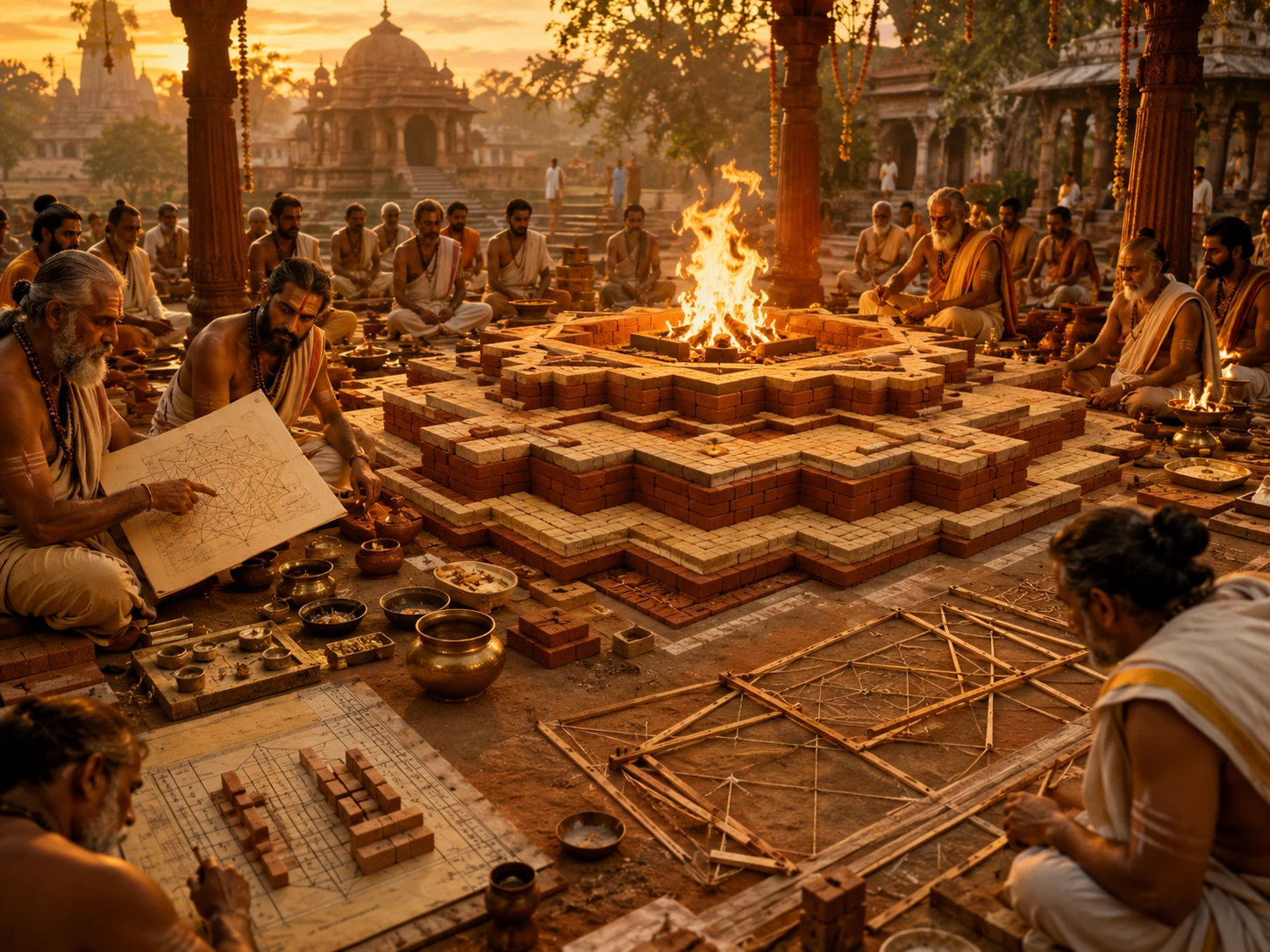
Agnichayana -- The Falcon-Shaped Fire Altar That Survived 3,000 Years
12 min read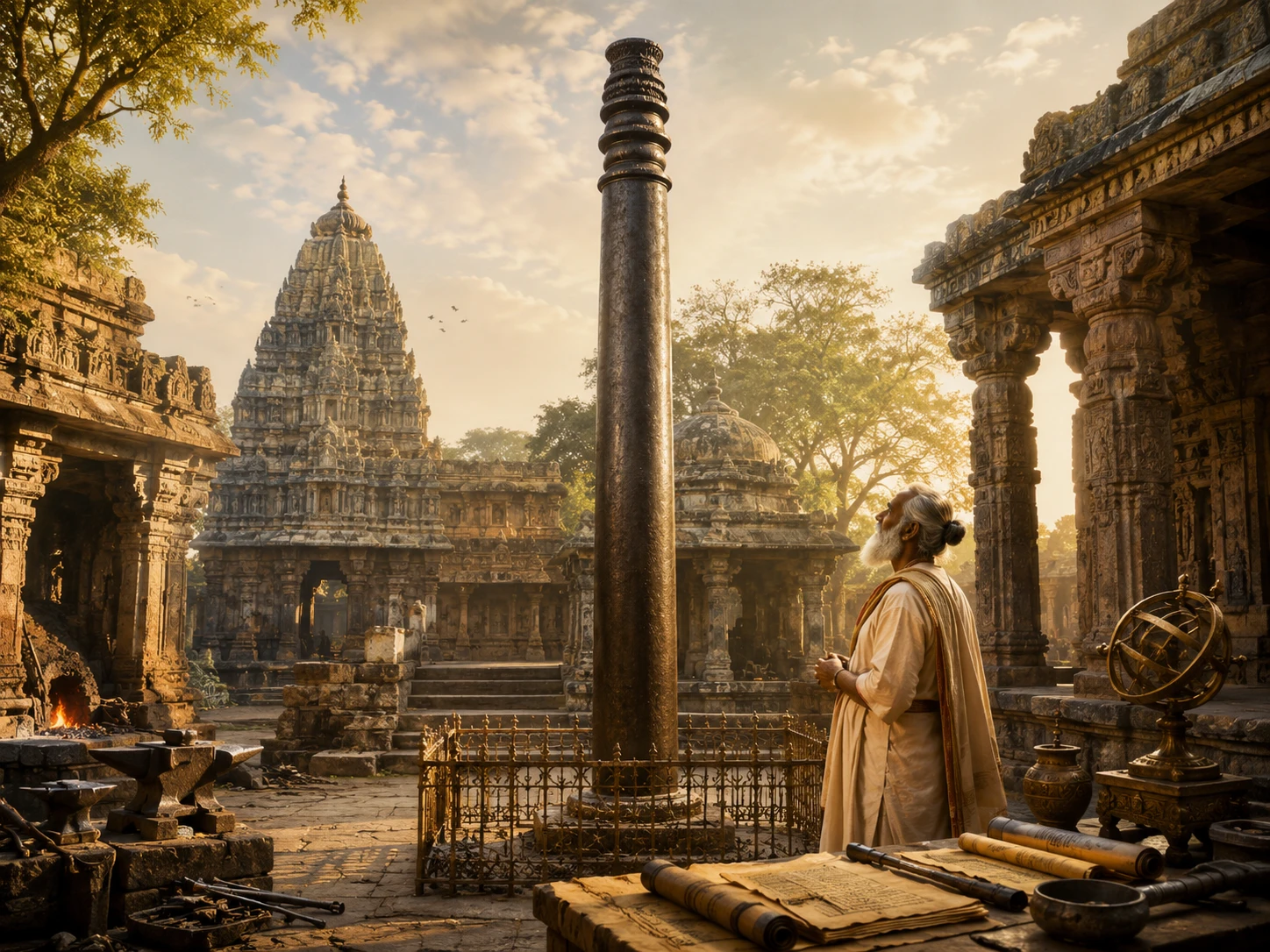
Ancient Indian Metallurgy -- The Iron Pillar That Refuses to Rust
13 min readAryabhata -- The Astronomer Who Said the Earth Turns
3 min readThe same translation error that turned '33 Koti' into '33 crore' in Hinduism also happened in Buddhism. The Chinese translation of Buddhist texts rendered 'Sapta Koti Buddha' (7 Supreme Buddhas) as '7 Crore Buddhas.' The…
Deities AvatarsCommunity Reflections
🕉️
Be the first to share your reflection.
Related across Eternal Raga