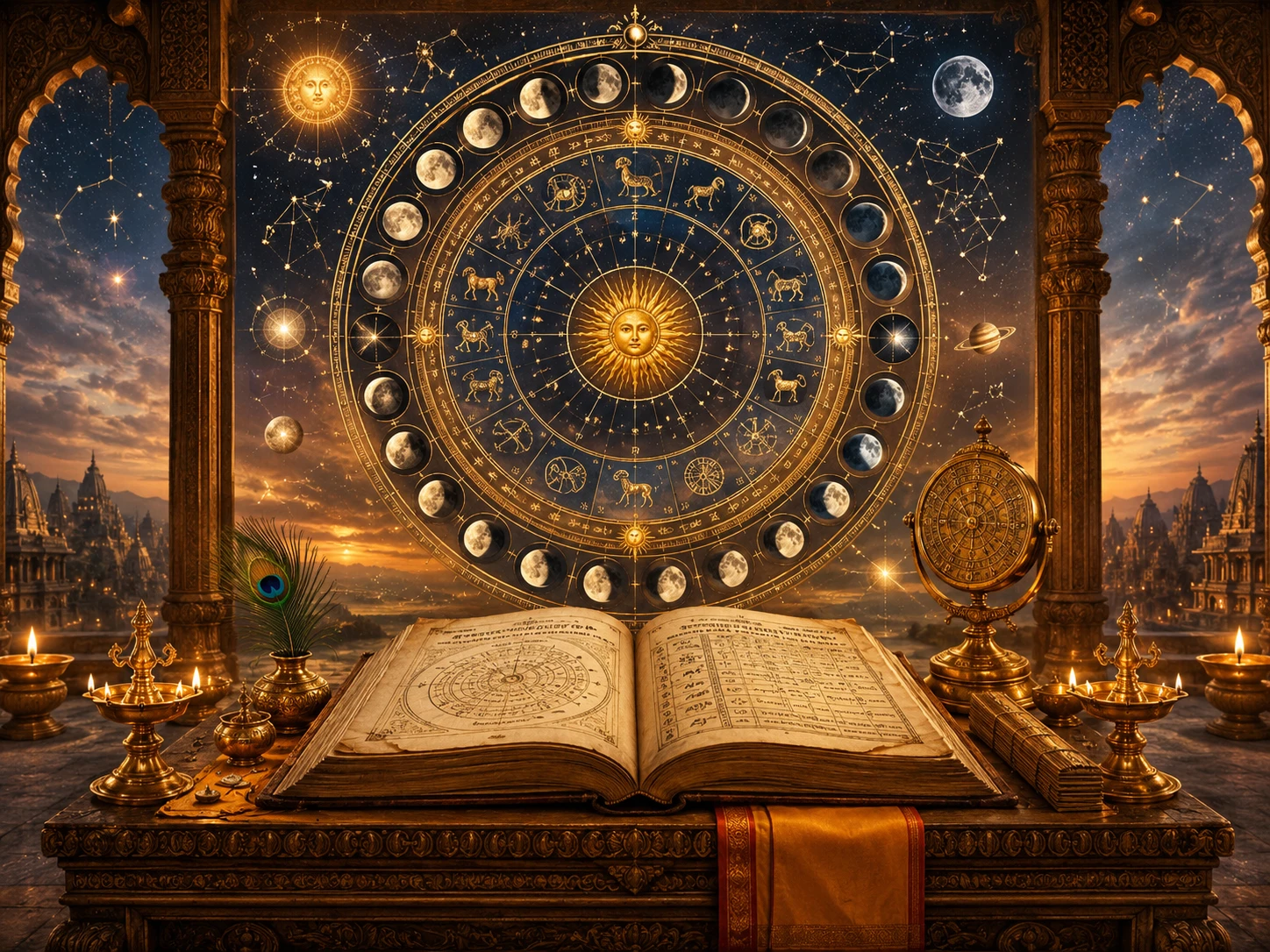
The Five Limbs of Panchang -- Tithi, Vara, Nakshatra, Yoga, Karana
पंचांग के पाँच अंग -- तिथि, वार, नक्षत्र, योग, करण
Ask any grandmother in Ujjain whether tomorrow is a good day for starting a new business, and she will not answer from instinct. She will reach for the panchang on the puja room shelf. Ask her what a panchang is, and she will say it is the calendar. Ask her why it is called panchang, and she will tell you: because it has five limbs.
The word comes from pancha (five) and anga (limb), and it is not decorative nomenclature. The Hindu calendar is not one thing. It is five separate astronomical cycles running in parallel, each tracking a different relationship between the Sun and the Moon, and a single calendar page lists all five for the day. Tithi tracks the Moon's angular distance from the Sun. Vara tracks the Sun's own daily cycle. Nakshatra tracks the Moon's position against the background stars. Yoga combines the Sun's and the Moon's motions. Karana splits the tithi into halves. Five limbs, five clocks, running at five different speeds, every one of them watching the same two celestial objects from a different angle.
This is why a Hindu festival never falls on the same Gregorian date twice. It is also why a single panchang entry in the Ujjain grandmother's almanac contains more calendrical information than an entire month of her smartphone's Google Calendar. The calendar was never just about dates. It was always about timing, and timing in this tradition requires knowing all five limbs at once.
What follows is a walk through each of them, in the order they are traditionally recited.
तिथिर्विष्णुस्तथा वारो नक्षत्रं विष्णुरेव च। योगश्च करणं चैव सर्वं विष्णुमयं जगत्॥
tithir viṣṇus tathā vāro nakṣatraṁ viṣṇur eva ca yogaś ca karaṇaṁ caiva sarvaṁ viṣṇu-mayaṁ jagat
Tithi is Vishnu, so too is Vara, and Nakshatra is Vishnu himself. Yoga and Karana as well -- the entire universe is pervaded by Vishnu.
— Traditional Sankalp verse (Smriti tradition)
Tithi is the first and most important limb. A tithi is the time the Moon takes to pull exactly twelve degrees ahead of the Sun in the sky -- no more, no less. Since the Moon moves faster than the Sun, it gains twelve degrees over the course of roughly twenty-four hours, but not exactly twenty-four. Sometimes a tithi is twenty hours long. Sometimes it is twenty-six. This unevenness is why Hindu festivals sometimes start at 3 AM, sometimes at 10 PM, sometimes in the middle of the afternoon -- the tithi begins whenever the Moon hits the twelve-degree mark, not whenever human beings have finished their breakfast.
There are thirty tithis in a lunar month, fifteen in each paksha. They run Pratipada (first), Dvitiya, Tritiya, Chaturthi, Panchami, Shashthi, Saptami, Ashtami, Navami, Dashami, Ekadashi, Dvadashi, Trayodashi, Chaturdashi, and the fifteenth -- which is Purnima in Shukla Paksha and Amavasya in Krishna Paksha. The numbering resets at each paksha, which is why a Hindu scripture specifying a ritual date always names both the paksha and the tithi: Krishna Ashtami for Janmashtami, Shukla Chaturthi for Ganesh Chaturthi, and so on.
Certain tithis carry fixed sacred weight. Chaturthi belongs to Ganesha. Shashthi belongs to Kartikeya. Ashtami (both pakshas) is powerful for Devi worship. Navami belongs to Rama. Ekadashi is the universal fasting day observed by Vaishnavas, Shaivas, Shaktas, and even many non-sectarian households. Trayodashi belongs to Shiva. Amavasya belongs to the ancestors. Purnima is the general auspicious night. This is why your mother might casually say 'aaj ekadashi hai, pani ka upvaas karna hai' without needing to explain which fast or why -- the tithi itself carries the instructions.
The second limb is Vara, which is simply the weekday. This is the one limb the Hindu calendar shares directly with the rest of the world. Seven days, each ruled by one of the seven classical celestial bodies: Ravi (Sunday, Sun), Soma (Monday, Moon), Mangala (Tuesday, Mars), Budha (Wednesday, Mercury), Guru or Brihaspati (Thursday, Jupiter), Shukra (Friday, Venus), and Shani (Saturday, Saturn). Every other major calendar in the world names the weekdays after the same seven bodies in the same order -- Latin in Romance languages, Old Norse in English, Aramaic in Arabic-speaking countries. Whether the order originated in India, Babylon, or somewhere in between is a historical question scholars still debate. What is certain is that the pan-Eurasian pattern is too tight to be coincidence.
Each vara carries its own character. Tuesday (Mangalvar) is for Hanuman and Durga worship because Mangala is a warrior deity. Wednesday (Budhvar) is considered favourable for intellectual pursuits and new ventures. Thursday (Guruvar, or Brihaspati-var) is for teacher-honour, for Sai Baba devotees in Shirdi, and for Ayyappa pilgrims. Friday (Shukravar) is for Lakshmi and Santoshi Mata. Saturday (Shanivar) is for Shani worship and the removal of shadow-afflictions. Sunday (Ravivar) is for Surya. Monday (Somvar) is for Shiva.
This is why a college student at Symbiosis Pune who fasts on Tuesdays does not need to explain the choice to her hostel-mates. The vara carries its own liturgy. This is also why certain combinations are avoided -- Mangalvar plus Krishna Chaturdashi, for example, is called Angaraki Chaturthi and treated as unusually powerful, because Mangala (red, fiery) aligns with Chaturthi (Ganesha's tithi) to double the effect.
The third limb is Nakshatra, the Moon's position against the fixed background of stars. The zodiacal belt is divided into twenty-seven equal sections of thirteen degrees twenty minutes each, and the Moon spends approximately one day in each. These twenty-seven nakshatras are not the twelve Western zodiac signs. They pre-date them by at least a thousand years and are the original Indian system for tracking lunar motion.
The sequence begins with Ashwini (the Horsemen, stars near Aries) and runs through Bharani, Krittika (the Pleiades, where Kartikeya was raised), Rohini (Aldebaran, Krishna's favourite nakshatra), Mrigashira, Ardra, Punarvasu, Pushya, Ashlesha, Magha, Purva Phalguni, Uttara Phalguni, Hasta, Chitra (where Spica shines, the namesake for the month Chaitra), Swati, Vishakha, Anuradha, Jyeshtha, Moola, Purva Ashadha, Uttara Ashadha, Shravana (the month of Monsoon fasting), Dhanishta, Shatabhisha, Purva Bhadrapada, Uttara Bhadrapada, and ends with Revati.
Every child born into a traditional Hindu family is given a birth nakshatra at the time of delivery, and this nakshatra determines the first letter of the formal name, the gotra affiliations, the compatibility calculations for marriage, and the annual shraddha offerings that happen after the person's death. A young bride in a Tamil household is not called by her legal name by her mother-in-law. She is addressed by her birth-nakshatra name. This is why the question 'tumhara janma-nakshatra kya hai' still has force in Indian conversation, from Bangalore tech workers at a matrimonial site to Varanasi astrologers consulting a client in their Ashi Ghat shop.
The fourth limb is Yoga. The word here does not mean postures or meditation -- it means combination. Yoga is calculated by adding the longitudes of the Sun and the Moon and dividing the result into twenty-seven equal sections of thirteen degrees twenty minutes each. The result is a luni-solar combination that cycles through twenty-seven named yogas: Vishkambha, Priti, Ayushman, Saubhagya, Shobhana, Atiganda, Sukarma, Dhriti, Shula, Ganda, Vriddhi, Dhruva, Vyaghata, Harshana, Vajra, Siddhi, Vyatipata, Variyan, Parigha, Shiva, Siddha, Sadhya, Shubha, Shukla, Brahma, Indra, and Vaidhriti.
Of the twenty-seven yogas, nine are considered inauspicious: Vishkambha (first 75 minutes only), Atiganda, Shula, Ganda, Vyaghata, Vajra, Vyatipata, Parigha (first 150 minutes only), and Vaidhriti. An auspicious yoga like Siddhi combined with a favourable tithi and a calm nakshatra produces the classic sarvarthasiddhi muhurta, a window powerful enough that weddings, business openings, and house inaugurations get queued up years in advance to fall on exactly such combinations.
The point of yoga as a limb is not superstition. It is recognition that the Sun-Moon combined position is a different observable from either the Sun's position alone or the Moon's position alone. A modern astronomer reading a Hindu panchang can independently verify the yoga for a given day by computing the sum of ecliptic longitudes and checking which 13°20' segment it falls in. The computation is fully deterministic, just like computing the angle between the minute hand and the hour hand of a clock. Yoga is not mystical. It is arithmetic. What the tradition adds is a layer of semantic meaning on top of the arithmetic, the way a modern calendar adds 'payday' on top of the 30th of the month.
The fifth and final limb is Karana. A karana is simply half a tithi. When the Moon has moved six degrees ahead of the Sun, a new karana begins. When it has moved twelve degrees, the tithi ends and a new tithi and a new karana both begin simultaneously. So every tithi contains exactly two karanas -- one running for the first half of the tithi, the other for the second half.
But the list of karana names does not have thirty entries (two per tithi across fifteen tithis). It has eleven. Seven of them (Bava, Balava, Kaulava, Taitila, Garija, Vanija, Vishti) rotate in sequence through the active portion of the month. Four (Shakuni, Chatushpada, Naga, Kimstughna) are fixed and appear only around Amavasya -- the dead period of the lunar month. Vishti, also called Bhadra, is the only karana considered strictly inauspicious, the one your grandmother will not let you start a new task during. If Bhadra is on, even a small auspicious act gets postponed by half a day.
Karana matters especially for muhurta. A wedding might be scheduled on a Shukla Dvadashi of Magha with Uttara Phalguni nakshatra and Saubhagya yoga, and still be shifted by a few hours to avoid Vishti karana overlapping with the pheras. This is the level of precision a panchang enables. It is not just which day is auspicious. It is which three-hour window within which day is optimally aligned across all five limbs.
This is also why a handwritten old-school panchang, the kind printed by Drik Siddhanta or Lahiri in tiny Devanagari rows, looks dense to modern eyes. Every day gets a column with all five limbs tracked to the minute, showing exactly when each one shifts to the next. Your grandmother is not reading poetry on that page. She is reading astronomical data.
The Five Limbs at a Glance
| Limb | अंग | What it measures | Cycle length | Governs |
|---|---|---|---|---|
| Tithi | तिथि | Moon's angular distance from Sun (12° per tithi) / सूर्य से चन्द्र की कोणीय दूरी (प्रति तिथि 12°) | 30 per month / प्रति मास 30 | Festival dates, fasting / त्योहार, व्रत |
| Vara | वार | Solar day cycle / सौर दिन चक्र | 7 per week / प्रति सप्ताह 7 | Daily deity worship / दैनिक देवोपासना |
| Nakshatra | नक्षत्र | Moon's position in 27 lunar mansions / चन्द्र की 27 मण्डलों में स्थिति | 27 per month / प्रति मास 27 | Birth name, horoscope / जन्म नाम, कुण्डली |
| Yoga | योग | Sum of Sun and Moon longitudes, divided into 27 parts / सूर्य-चन्द्र देशान्तर योग, 27 भागों में | 27 per month / प्रति मास 27 | Muhurta quality / मुहूर्त गुण |
| Karana | करण | Half a tithi (6° Moon-Sun gain) / आधी तिथि (6° चन्द्र-सूर्य अन्तर) | 60 per month (11 named types) / प्रति मास 60 (11 नामित प्रकार) | Hour-level precision / घण्टे-स्तर की परिशुद्धता |
All five limbs must align favourably for a full muhurta. This is why fewer than 30 days in a year qualify as ideal for major ceremonies like weddings and temple consecrations.
The Drik Panchang app and website serve over 40 million users annually, most of them under 35. The same astronomical tradition that Varahamihira codified in the 6th century is now being read on Android phones in Bangalore PG hostels, on iPhones in Gurgaon offices, and on browsers at IIT Madras. The only changes are the medium and the timezone-auto-detect feature. The five angas Varahamihira tabulated by hand are now computed in milliseconds and rendered in HTML. The panchang is probably the oldest astronomical dataset still in active daily use anywhere in the world.
न तिथ्या विना मासः स्यान्न वारेण विना दिनम्। नक्षत्रयोगकरणैर्विना पंचाङ्गमेव न॥
na tithyā vinā māsaḥ syān na vāreṇa vinā dinam nakṣatra-yoga-karaṇair vinā pañcāṅgam eva na
Without tithi there is no month, without vara there is no day. Without nakshatra, yoga, and karana, there is simply no panchang at all.
— Jyotisha Tattva (Smriti compendium)
The practical test of the panchang is not in books but in how India actually moves through its year. Consider a single week in a Tamil household in Mylapore. Monday morning the grandmother asks the daughter-in-law to fast because it is Shravana nakshatra, sacred to Vishnu. Tuesday evening the son prepares abhishekam materials because tomorrow is Hanuman Jayanti on Chaitra Purnima. Wednesday the family goes to the Kapaleeshwarar temple because Ashlesha nakshatra is the day for naga worship and there is a small nagaraja shrine on the west wall. Thursday the father observes Guru Vandana because Brihaspati rules the day. Friday is Shukla Ekadashi, so the entire household fasts until sunrise Saturday. Saturday evening the son offers sesame oil at a Shani shrine. Sunday is Surya arghya at dawn. Every one of these observances is driven by one of the five limbs, and the family has never consciously learned the system. They inherited it.
The panchang is also what differentiates a Hindu wedding date-selection from a casual save-the-date. When a couple in Bangalore gets engaged and starts looking for a wedding date, the first call is not to the caterer or the photographer. It is to the family purohit. He opens the panchang, looks at the grooms's birth nakshatra and the bride's birth nakshatra, checks which months are auspicious for that pairing, which tithis within those months are favourable, which varas within those tithis, which nakshatras are currently transiting, which yogas are active, and which karanas dominate each candidate window. The result is usually three or four acceptable dates within a six-month range. This is why Indian wedding seasons are concentrated in specific windows -- Margashirsha to Magha, and May to mid-June -- and why those windows get booked out in banquet halls and trousseau shops years in advance.
Behind every 'auspicious date' in an invitation card is a calculation of five variables running in parallel. Nobody says this out loud. The panchang just produces a date, and the date gets printed, and the family gets married. The calculation is invisible the way the electricity reaching a light bulb is invisible. But the infrastructure is there, and it is ancient, and it still works.
The panchang is not one document. It is a family of related documents, each following the same five-limb framework but with regional adjustments and different calendrical schools. Five of these merit naming.
The Drik Panchang, based on the drishya or observed positions of celestial bodies, uses modern astronomical ephemerides and is the most computationally accurate. This is what you get on most panchang apps today. The Vakya Panchang, based on traditional Vakya Ganita formulas handed down in Kerala and Tamil Nadu, uses shorthand verse-based calculations perfected over centuries. It sometimes differs from Drik by a day or two for obscure nakshatras. The Lahiri Panchang, based on the ayanamsha calibration published by N.C. Lahiri and officially adopted by the Indian government in 1955, is the default for most Vedic astrologers. The Raman Panchang, named after B.V. Raman, uses a slightly different ayanamsha value and has a loyal following. The Krishnamurti Paddhati Panchang, developed by K.S. Krishnamurti in Tamil Nadu in the 20th century, subdivides each nakshatra further into nine sub-lords for higher precision in horary astrology.
Regional variation is also real. The Vikram Samvat calendar used in North India and the Shalivahan Shaka calendar used in Maharashtra and the Deccan run offset by fifty-seven years in the year count, though their tithi and nakshatra calculations match. Bengal uses a separate system for the Bengali month names (Boishakh, Joishtho, Ashadh, Shrabon, Bhadro, Ashshin, Kartik, Agrohayon, Poush, Magh, Falgun, Choitro), which is why a Bengali Durga Puja date is expressed differently from a Hindi heartland Navratri even though they refer to the same week. Kerala uses the Malayalam Kollam Varsham. Tamil Nadu uses the Tamil year beginning in mid-April with Chithirai. All of these calendars use the five limbs. The wrapping -- the year name, the month name, the epoch -- varies by region. The astronomical content does not.
What this means in practice is that a Gujarati family celebrating Diwali on Amavasya of Kartik and a Tamil family celebrating the same Amavasya as the darkest night of the year for Lakshmi Puja are reading the same tithi on the same day. They disagree about which year it is and what the month is called. They agree on which tithi. The Hindu calendrical world is organised around the five limbs, and the panchang in whatever regional form is the artefact that makes that organisation visible every day.
The historical layering behind the panchang is worth a moment. The earliest dated Indian astronomical text, the Vedanga Jyotisha of Lagadha (composed somewhere between 1400 BCE and 500 BCE), already tracks tithi, nakshatra, and the seasonal cycle. The five-limbed structure in its mature form is stabilised by Varahamihira in the 6th century CE, particularly in his Panchasiddhantika, which compares five earlier astronomical schools (Paitamaha, Vasishtha, Romaka, Paulisha, and Surya) and extracts the best computational methods from each. Varahamihira's Brihat Samhita and Brihat Jataka become the standard references for the panchang-maker for the next thousand years.
From Varahamihira the tradition branches. In Kerala, a mathematical school starting with Madhava of Sangamagrama in the 14th century develops infinite-series methods that anticipate aspects of modern calculus. These methods are used to refine the astronomical tables that feed the panchang. In Maharashtra, a parallel tradition of almanac printing develops around Pune and Nashik. In Benares, the pandit community maintains continuous panchang production through the Mughal period and into the British. In Chennai, the Kumbakonam mutt keeps the Tamil Vakya tradition alive. Every major centre of Hindu scholarship has a living panchang lineage.
The 20th century brought standardisation. The Indian Calendar Reform Committee of 1952, chaired by astrophysicist Meghnad Saha, formalised a unified national calendar with the Shaka epoch. The Lahiri ayanamsha became the official reference. The Rashtriya Panchang is printed annually by the Positional Astronomy Centre in Kolkata. This is the calendar that drives government holidays, bank closures, and the Indian Railways timetable for festival-season surge services. It is Varahamihira updated for IST.
What has not changed across any of this layering is the five-limb framework. Vedanga Jyotisha had it in embryonic form. Varahamihira crystallised it. Meghnad Saha preserved it. Drik Siddhanta apps compute it. The tradition is old enough to have survived Harshavardhan, Akbar, and the British Raj, and robust enough to fit on a smartphone screen. The five angas -- tithi, vara, nakshatra, yoga, karana -- are the skeleton that kept the tradition coherent across every era. Take any one of them away and the panchang falls apart. Keep all five and every Hindu festival, every muhurta, every janmadin, every death anniversary, and every temple opening keeps its place in the cosmic calendar.
Check Today's Panchang
The Eternal Raga Panchang shows all five limbs for the day, with the time each tithi, nakshatra, yoga and karana ends, calculated for Pune. Open it and see what kind of day this one is.
Eternal Raga · शाश्वत राग
Institutional voice — scholarly articles on Sanatan Dharma
Deepen Your Understanding
अपनी समझ और गहरी करें
vedic sciences
Panchang -- The Five-Limbed Hindu Calendar That Runs on the Moon and the Sun
Your phone uses the Gregorian calendar. Your grandmother uses the Panchang. One tracks the Sun. The other tracks the Sun AND the Moon AND the stars AND something called Yoga AND something called Karana. Five moving parts, one unified system -- and it determines every wedding date, every festival, and every 'shubh muhurat' in a billion Hindu lives.
vedic sciences
Vedanga Jyotisha -- The Oldest Indian Calendar Science and the Eye of the Veda
Before Aryabhata, before the Surya Siddhanta, before the elaborate planetary models of classical Indian astronomy, there was a small text of 36 verses (Rig Veda recension) or 44 verses (Yajur Veda recension) that laid the foundation for everything. The Vedanga Jyotisha, attributed to the sage Lagadha and dated to roughly 1400-1200 BCE, is the oldest surviving Indian text on astronomy and calendrical science. It is not a stargazer's manual. It is a ritual engineer's handbook -- designed to answer one critical question: when exactly should the Vedic sacrifices be performed? From that question emerged the entire Indian tradition of tracking the sun, moon, and stars.
vedic sciences
Jyotish Shastra -- The Vedic System of Astronomy and Astrology That India Never Stopped Using
Every year, millions of Indian marriages are fixed only after the kundali matches. ISRO times its satellite launches on muhurtas. JEE students wear navagraha rings. Real-estate agents check Rahu-Ketu transits before closing deals. Whether you believe in it or not, Jyotish Shastra -- the Vedic science of light, time, and celestial influence -- is the most actively practised ancient knowledge system in India today. It spans 9 Grahas, 12 Rashis, 27 Nakshatras, and 2,500 years of continuous mathematical and observational tradition. This article explains the system as the texts describe it -- not as a prediction engine, but as a framework for understanding time, cycles, and the relationship between the cosmos and human life.
vedic sciences
Kaal Ganana -- The Hindu Measure of Time
From a single blink of the eye (Nimesha) to one Day of Brahma (4.32 billion years) -- explore the complete cosmic time hierarchy of Hindu cosmology, anchored in Vishnu Purana 1.3, with its remarkable parallels to modern science.
vedic sciences
Surya Siddhanta -- The Ancient Astronomy Text That Got the Year Right to 1.4 Seconds
Before Copernicus, before Galileo, before the telescope existed -- an Indian text calculated the tropical year as 365.2421756 days. The modern value is 365.2421904. The difference is 1.4 seconds per year. The Surya Siddhanta also described gravity, computed planetary diameters within 1% accuracy, and invented the sine function. It did all this in Sanskrit verse.
vedic sciences
The 27 Nakshatras and Their Junction Stars -- Bharat's Lunar Map of the Sky
Long before Greenwich drew a line through London, the Rishis of Bharat had already divided the ecliptic into 27 precise segments of 13 degrees 20 minutes each, anchoring each to a brightest star called the Yogatara. The Surya Siddhanta catalogued their positions with an accuracy that modern astronomy still respects.
The Drik Panchang app and website serve over 40 million users annually, most of them under 35. The same astronomical tradition that Varahamihira codified in the 6th century is now being read on Android phones in Bangalor…
More in Vedic Sciences
Agnichayana -- The Falcon-Shaped Fire Altar That Survived 3,000 Years
12 min read
Ancient Indian Metallurgy -- The Iron Pillar That Refuses to Rust
13 min readAryabhata -- The Astronomer Who Said the Earth Turns
3 min readThe same translation error that turned '33 Koti' into '33 crore' in Hinduism also happened in Buddhism. The Chinese translation of Buddhist texts rendered 'Sapta Koti Buddha' (7 Supreme Buddhas) as '7 Crore Buddhas.' The…
Deities AvatarsCommunity Reflections
🕉️
Be the first to share your reflection.
Related across Eternal Raga