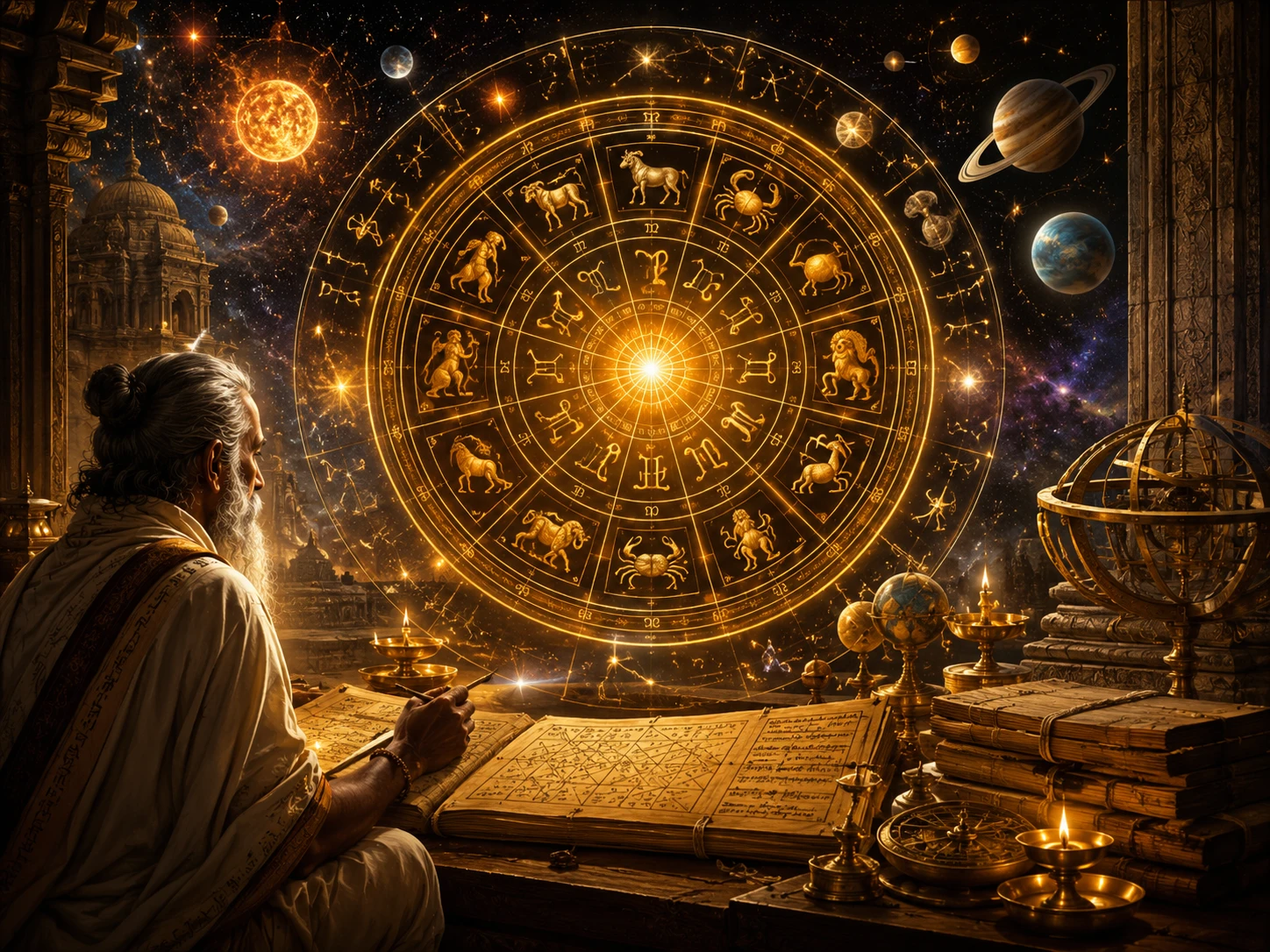
Jyotish Shastra -- The Vedic System of Astronomy and Astrology That India Never Stopped Using
ज्योतिष शास्त्र -- खगोल और ज्योतिष की वैदिक प्रणाली जिसे भारत ने कभी छोड़ा नहीं
Jyotish (jyotiṣa -- literally 'science of light' or 'science of celestial bodies') is one of the six Vedangas -- the limbs of the Veda -- and is traditionally called the 'eye of the Veda' because it provides the calendar and astronomical framework necessary for performing Vedic rituals at the correct time. In its original form, Jyotish was primarily positional astronomy -- tracking the movements of the sun, moon, and planets to determine the right moments for sacrifices, agricultural activities, and royal ceremonies. Over two millennia, it evolved into two parallel streams: Siddhanta Jyotish (mathematical astronomy) and Phalita Jyotish (predictive astrology). The first gave India its greatest astronomers -- Aryabhata, Varahamihira, Brahmagupta, Bhaskara II. The second gave India its most widespread living tradition -- the kundali (birth chart), the panchang (almanac), and the muhurta (auspicious timing) system.
The foundational text for predictive Jyotish is the Brihat Parashara Hora Shastra, attributed to the sage Parashara (Vyasa's father). For astronomical Jyotish, the key texts include the Surya Siddhanta, Aryabhatiya, Brihat Samhita by Varahamihira, and the Siddhanta Shiromani by Bhaskara II. Varahamihira's Brihat Samhita (6th century CE) is particularly significant because it bridges astronomy and applied Jyotish -- covering planetary computation, weather prediction, earthquake forecasting, gemology, architecture (Vastu), and even crop management.
The system operates on three foundational pillars: 9 Grahas (celestial bodies), 12 Rashis (zodiac signs), and 27 Nakshatras (lunar mansions). These three frameworks overlap to create the matrix from which a kundali (birth chart) is drawn. Every Indian who has ever had a horoscope made -- which includes the vast majority of Hindu, Jain, and many Sikh families -- has their life mapped on this grid.
वेदस्य चक्षुरखिलस्य महज्ज्योतिषम्। मुहूर्तादिकमाख्याय येन वेदोदितं कृतम्॥
vedasya cakṣur akhilasya mahaj jyotiṣam | muhūrtādikam ākhyāya yena vedoditaṁ kṛtam ||
Jyotish is the eye of the entire Veda -- the great science of light through which muhurtas and other time-reckonings prescribed by the Veda are accomplished.
— Traditional Vedanga Jyotisha invocation (attributed to Lagadha)
The Navagraha -- Nine Celestial Bodies of Jyotish
| Graha | Sanskrit | Celestial Body | Nature | Governs | Gem | Day |
|---|---|---|---|---|---|---|
| Surya | सूर्य | Sun | Krura (harsh) | Soul, authority, father, government | Ruby (Manikya) | Sunday (Ravivara) |
| Chandra | चन्द्र | Moon | Saumya (gentle) | Mind, emotions, mother, fluids | Pearl (Moti) | Monday (Somavara) |
| Mangala | मंगल | Mars | Krura | Energy, courage, siblings, land | Red Coral (Moonga) | Tuesday (Mangalavara) |
| Budha | बुध | Mercury | Context-dependent | Intellect, communication, commerce | Emerald (Panna) | Wednesday (Budhavara) |
| Guru | गुरु | Jupiter | Saumya | Wisdom, expansion, teacher, children | Yellow Sapphire (Pukhraj) | Thursday (Guruvara) |
| Shukra | शुक्र | Venus | Saumya | Love, beauty, wealth, art, marriage | Diamond (Heera) | Friday (Shukravara) |
| Shani | शनि | Saturn | Krura | Discipline, karma, delay, longevity | Blue Sapphire (Neelam) | Saturday (Shanivara) |
| Rahu | राहु | North lunar node (shadow) | Krura | Obsession, foreign, unconventional, technology | Hessonite (Gomed) | N/A |
| Ketu | केतु | South lunar node (shadow) | Krura | Detachment, moksha, past-life karma, spirituality | Cat's Eye (Lehsunia) | N/A |
Rahu and Ketu are not physical celestial bodies. They are the mathematical points where the moon's orbital plane intersects the ecliptic -- the ascending and descending lunar nodes. Indian astronomers identified these points for eclipse prediction. In Jyotish, they were personified as shadow planets (chhaya grahas) with powerful karmic influence.
The 12 Rashis (zodiac signs) of Jyotish correspond roughly to the Western zodiac but with one critical difference: Jyotish uses the sidereal zodiac (based on fixed star positions), while Western astrology uses the tropical zodiac (based on the vernal equinox). Due to the precession of equinoxes (ayanamsha), the two systems have drifted apart by approximately 24 degrees -- meaning your Jyotish rashi may be one sign earlier than your Western sun sign. If you are a Taurus in Western astrology, you may be Mesha (Aries) in Jyotish. This is not an error in either system -- it is a consequence of choosing different reference frames.
The 27 Nakshatras (lunar mansions) are Jyotish's most distinctive contribution and have no equivalent in Western astrology. They divide the ecliptic into 27 segments of 13°20' each, based on the moon's position. Each Nakshatra has a presiding deity, a symbol, and a specific quality. Your Nakshatra at birth determines your 'birth star' -- the basis of the naming convention in many Indian families (the first syllable of the name is chosen from the Nakshatra's assigned sounds). This is why a pandit at a naming ceremony consults the Panchang before suggesting the baby's name.
The honest assessment of Jyotish requires separating three layers. Layer 1: the astronomical observations (planetary positions, eclipses, calendar) -- these are mathematically precise and historically validated. Aryabhata in the 5th century CE calculated the earth's rotation period to within seconds of the modern value. Layer 2: the correlational framework (which Graha in which Rashi produces which effect) -- this is the core of predictive Jyotish, extensively practised but not validated by controlled scientific studies. Layer 3: the commercial industry (TV astrologers, gemstone sellers, dosh-removal rituals) -- this is where fraud thrives. A UPSC aspirant in Mukherjee Nagar or a startup founder in HSR Layout deserves to know the difference.
ISRO has officially acknowledged consulting panchangs and muhurtas for launch timing -- not as superstition but as part of the cultural integration of its mission planning process. The Chandrayaan-3 lunar landing on August 23, 2023, occurred on a day considered auspicious in the Hindu calendar. Maharaja Sawai Jai Singh II built five astronomical observatories (Jantar Mantar) in the 18th century -- in Delhi, Jaipur, Ujjain, Mathura, and Varanasi -- to refine Jyotish calculations using architectural-scale instruments, some of which remain the world's largest sundials. The 27-Nakshatra system predates the 12-sign zodiac in Indian astronomy -- evidence from Vedic texts suggests that Nakshatras were the original framework and Rashis were adopted later, possibly through contact with Babylonian and Greek astronomy. India's gem industry (Jaipur is the world's largest gem-cutting centre) is directly fuelled by Jyotish -- the Navaratna (nine gems) tradition links specific gemstones to the nine Grahas.
Explore the Navagraha on Eternal Raga
The Navagraha -- the nine celestial influences of Jyotish -- are central to Hindu temple worship and personal practice. Explore the Navagraha article and related temple traditions in Eternal Gyan.
Tags
Eternal Raga · शाश्वत राग
Institutional voice — scholarly articles on Sanatan Dharma
Deepen Your Understanding
अपनी समझ और गहरी करें
deities avatars
Navagraha -- The Nine Planetary Deities Who Govern Your Horoscope and Your Life
Before every job interview, before every wedding, before buying a house or starting a business -- millions of Indians check their Navagraha positions. These nine celestial deities -- the Sun, Moon, Mars, Mercury, Jupiter, Venus, Saturn, and the shadow planets Rahu and Ketu -- constitute the most practically influential theological system in Hinduism. Whether you believe in astrology or not, the Navagraha are shaping Indian culture around you.
vedic sciences
Vedanga Jyotisha -- The Oldest Indian Calendar Science and the Eye of the Veda
Before Aryabhata, before the Surya Siddhanta, before the elaborate planetary models of classical Indian astronomy, there was a small text of 36 verses (Rig Veda recension) or 44 verses (Yajur Veda recension) that laid the foundation for everything. The Vedanga Jyotisha, attributed to the sage Lagadha and dated to roughly 1400-1200 BCE, is the oldest surviving Indian text on astronomy and calendrical science. It is not a stargazer's manual. It is a ritual engineer's handbook -- designed to answer one critical question: when exactly should the Vedic sacrifices be performed? From that question emerged the entire Indian tradition of tracking the sun, moon, and stars.
vedic sciences
Surya Siddhanta -- The Ancient Astronomy Text That Got the Year Right to 1.4 Seconds
Before Copernicus, before Galileo, before the telescope existed -- an Indian text calculated the tropical year as 365.2421756 days. The modern value is 365.2421904. The difference is 1.4 seconds per year. The Surya Siddhanta also described gravity, computed planetary diameters within 1% accuracy, and invented the sine function. It did all this in Sanskrit verse.
vedic sciences
Panchang -- The Five-Limbed Hindu Calendar That Runs on the Moon and the Sun
Your phone uses the Gregorian calendar. Your grandmother uses the Panchang. One tracks the Sun. The other tracks the Sun AND the Moon AND the stars AND something called Yoga AND something called Karana. Five moving parts, one unified system -- and it determines every wedding date, every festival, and every 'shubh muhurat' in a billion Hindu lives.
vedic sciences
Kaal Ganana -- The Hindu Measure of Time
From a single blink of the eye (Nimesha) to one Day of Brahma (4.32 billion years) -- explore the complete cosmic time hierarchy of Hindu cosmology, anchored in Vishnu Purana 1.3, with its remarkable parallels to modern science.
vedic sciences
Shad Vedangas -- The Six Limbs of the Veda
The Vedas are not a single book you can pick up and read. They are a living system with six auxiliary sciences -- phonetics, metre, grammar, etymology, astronomy, and ritual procedure -- that function like limbs of a body. Without them, the Vedas are a voice without a mouth, a path without eyes. Here is the operating manual India's knowledge system ran on for three thousand years.
vedic sciences
How Vedic Astronomers Mapped the Planets -- Before Telescopes, Before Copernicus
A thousand years before Copernicus proposed that the earth moves, Aryabhata wrote in Pataliputra: the earth rotates on its own axis daily, and the apparent motion of the stars is an illusion caused by that rotation. He calculated the sidereal year to within 3 minutes and 20 seconds of the modern value. The Surya Siddhanta described planetary orbits using epicyclic models. Varahamihira compiled five competing astronomical schools into one text. And Sawai Jai Singh built stone observatories so massive they are still the world's largest sundials. Indian astronomy was not folklore. It was precision science -- conducted in Sanskrit, computed by hand, and accurate enough to predict eclipses centuries in advance.
ISRO has officially acknowledged consulting panchangs and muhurtas for launch timing -- not as superstition but as part of the cultural integration of its mission planning process. The Chandrayaan-3 lunar landing on Augu…
More in Vedic Sciences

Agnichayana -- The Falcon-Shaped Fire Altar That Survived 3,000 Years
12 min read
Ancient Indian Metallurgy -- The Iron Pillar That Refuses to Rust
13 min readAryabhata -- The Astronomer Who Said the Earth Turns
3 min readThe same translation error that turned '33 Koti' into '33 crore' in Hinduism also happened in Buddhism. The Chinese translation of Buddhist texts rendered 'Sapta Koti Buddha' (7 Supreme Buddhas) as '7 Crore Buddhas.' The…
Deities AvatarsCommunity Reflections
🕉️
Be the first to share your reflection.