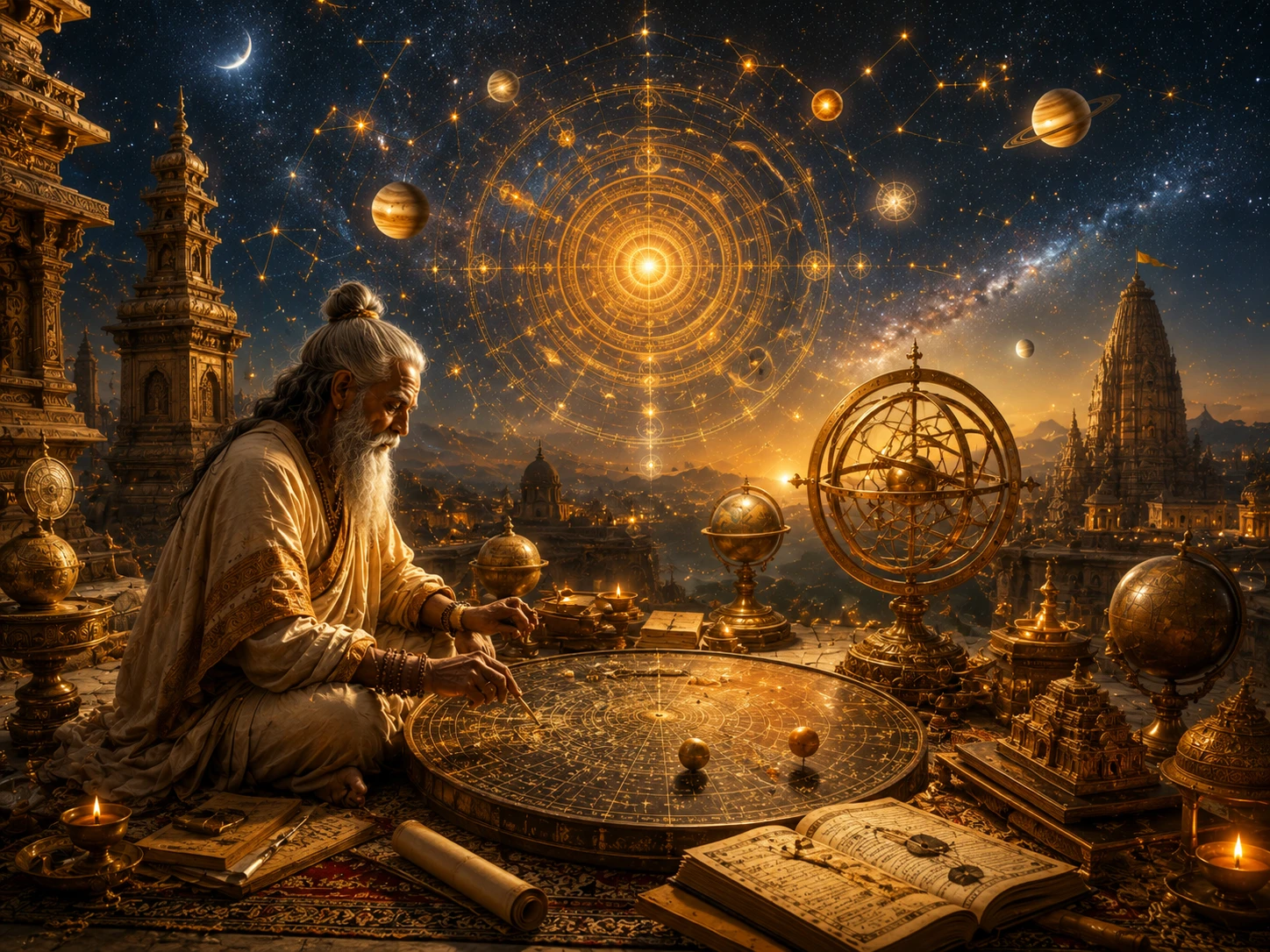
How Vedic Astronomers Mapped the Planets -- Before Telescopes, Before Copernicus
वैदिक खगोलविदों ने ग्रह कैसे मानचित्रित किए -- दूरबीन से पहले, कॉपरनिकस से पहले
Indian astronomy (Jyotish Siddhanta) is one of the most mathematically rigorous astronomical traditions in the pre-telescopic world. It spans over 2,000 years -- from the calendar computations of the Vedanga Jyotisha (circa 1400-1200 BCE) through the sophisticated planetary models of the Siddhantic period (5th-12th century CE) to the monumental stone observatories of Sawai Jai Singh II (18th century). During its golden age, Indian astronomers achieved results that predated or paralleled major European discoveries by centuries: earth's rotation (Aryabhata, 499 CE -- Copernicus, 1543 CE), accurate measurement of the sidereal year, eclipse prediction algorithms, trigonometric tables, and planetary position calculations accurate enough for navigational and calendrical purposes.
The key texts form a clear lineage. The Surya Siddhanta (date disputed -- elements from 4th-5th century CE, with later revisions) is the most influential, providing computational methods for planetary positions, eclipses, and cosmological time cycles. The Aryabhatiya (499 CE) by Aryabhata revolutionised the field with its assertion that the earth rotates daily, its accurate calculation of pi, its sine tables, and its solution to indeterminate equations. The Pancha Siddhantika (575 CE) by Varahamihira compiled five earlier astronomical schools -- Surya, Paulisha, Romaka, Vasishtha, and Paitamaha -- into a comparative survey, preserving traditions that might otherwise have been lost. The Siddhanta Shiromani (1150 CE) by Bhaskara II represents the final peak of classical Indian mathematical astronomy.
What distinguishes Indian astronomy from Greek and Babylonian traditions is its computational emphasis. Indian astronomers developed sophisticated algorithmic methods to calculate planetary positions without geometric constructions. Their approach was closer to what we would today call computational science -- step-by-step procedures that could be executed by any trained calculator, producing results for any date past or future.
अनुलोमगतिर्नौस्थः पश्यत्यचलं विलोमगम्। यद्वत् अचलानि भानि तद्वत् समपश्चिमगानि लङ्कायाम्॥
anuloma-gatir nau-sthaḥ paśyaty acalaṁ viloma-gam | yadvat acalāni bhāni tadvat sama-paścima-gāni laṅkāyām ||
Just as a person in a moving boat sees stationary objects on the shore moving in the opposite direction, so do the fixed stars appear to move westward for an observer at Lanka (the equator).
— Aryabhatiya, Golapada 9 (Aryabhata, 499 CE)
Aryabhata's boat analogy in Golapada verse 9 is one of the clearest pre-modern articulations of the earth's rotation. He is saying: the stars are not moving. You are. The apparent westward motion of the stars is an optical illusion caused by the earth spinning eastward on its axis. This was written in 499 CE -- over a thousand years before Copernicus's De Revolutionibus (1543 CE). To be precise, Aryabhata did not claim a heliocentric system. He maintained a geocentric framework where the earth rotates but remains at the centre. But the rotation assertion itself was revolutionary, and it was stated with a clarity that leaves no room for ambiguity.
His calculations were extraordinarily precise. He computed the sidereal rotation of the earth as 23 hours, 56 minutes, and 4.1 seconds (modern value: 23:56:4.091). His sidereal year was 365 days, 6 hours, 12 minutes, 30 seconds -- an error of 3 minutes 20 seconds over a full year. He calculated pi as 3.1416, accurate to four decimal places, and may have recognized its irrationality.
The Surya Siddhanta, the most widely used astronomical text in India for over a millennium, provides computational methods for the mean and true positions of all visible planets. Its planetary models use epicyclic and eccentric-circle geometry similar to (but independently developed from) the Ptolemaic system. The text includes methods for predicting lunar and solar eclipses, calculating the moon's latitude and parallax, and determining the angular diameters of the sun and moon. Indian astronomers could predict eclipses to within hours -- a capability that had direct practical impact on religious calendar management and, later, on Mughal and British administrative records.
Sawai Jai Singh II of Jaipur, in the early 18th century, built five massive astronomical observatories (Jantar Mantar) at Delhi, Jaipur, Ujjain, Mathura, and Varanasi. The Jaipur Jantar Mantar contains the Samrat Yantra -- a sundial 27 metres tall, still the world's largest stone sundial, capable of measuring time to 2-second accuracy. These were not decorative follies. They were precision instruments designed to refine the Indian Panchang and correct accumulated errors in the Surya Siddhanta's tables. Jai Singh's observatories represent the final expression of the pre-telescopic Indian astronomical tradition -- built at the very moment when European telescopic astronomy was about to make naked-eye observation obsolete.
Key Indian Astronomers and Their Contributions
| Astronomer | Period | Key Text | Major Contribution |
|---|---|---|---|
| Lagadha | ~1400-1200 BCE | Vedanga Jyotisha | Earliest Indian astronomical text; luni-solar calendar; 5-year yuga cycle |
| Aryabhata | 476-550 CE | Aryabhatiya (499 CE) | Earth rotates daily; sidereal year accurate to 3 min 20 sec; pi = 3.1416; sine tables; indeterminate equations |
| Varahamihira | 505-587 CE | Pancha Siddhantika; Brihat Samhita | Compiled 5 astronomical schools; integrated astronomy with meteorology, gemology, architecture |
| Brahmagupta | 598-668 CE | Brahmasphutasiddhanta | Zero as number; negative numbers; gravity intuition ('bodies fall toward earth'); improved planetary models |
| Bhaskara I | 600-680 CE | Mahabhaskariya; Aryabhatiya-bhashya | Rational sine approximation formula; expanded Aryabhata's methods |
| Bhaskara II | 1114-1185 CE | Siddhanta Shiromani; Lilavati | Calculus-adjacent concepts (instantaneous motion); comprehensive mathematical astronomy |
| Sawai Jai Singh II | 1688-1743 CE | Zij-i Muhammad Shahi; 5 Jantar Mantars | World's largest stone observatories; refined Surya Siddhanta tables; compared Indian, Islamic, European systems |
Indian astronomy maintained continuous computational accuracy for over 1,500 years. The Surya Siddhanta's planetary tables were used to compute the Indian Panchang until the 20th century. Many Hindu festivals are still dated using algorithms derived from these Siddhantic texts.
Aryabhata's assertion that the earth rotates was so controversial that even his greatest admirer, Brahmagupta (writing 130 years later), criticised him for it -- calling the idea 'absurd.' It took European astronomy another millennium to reach the same conclusion independently. The Jaipur Jantar Mantar's Samrat Yantra (27-metre sundial) can tell the time to within 2 seconds -- using no electricity, no moving parts, just shadows on stone. ISRO's first satellite was named 'Aryabhata' (1975). The Indian government's Mars Orbiter Mission (Mangalyaan, 2014) used orbital mechanics algorithms that trace directly back to the epicyclic computation methods described in the Surya Siddhanta. The Nakshatras system -- 27 lunar mansions used in Indian astronomy -- predates the 12-sign zodiac in Indian tradition and has been used continuously for over 3,000 years for agricultural, navigational, and calendrical purposes.
Explore the Surya Siddhanta on Eternal Raga
The Surya Siddhanta is the foundational text of Indian mathematical astronomy. Explore its computational methods and cosmological framework in the dedicated Eternal Gyan article.
Tags
Eternal Raga · शाश्वत राग
Institutional voice — scholarly articles on Sanatan Dharma
Deepen Your Understanding
अपनी समझ और गहरी करें
vedic sciences
Surya Siddhanta -- The Ancient Astronomy Text That Got the Year Right to 1.4 Seconds
Before Copernicus, before Galileo, before the telescope existed -- an Indian text calculated the tropical year as 365.2421756 days. The modern value is 365.2421904. The difference is 1.4 seconds per year. The Surya Siddhanta also described gravity, computed planetary diameters within 1% accuracy, and invented the sine function. It did all this in Sanskrit verse.
vedic sciences
Kaal Ganana -- The Hindu Measure of Time
From a single blink of the eye (Nimesha) to one Day of Brahma (4.32 billion years) -- explore the complete cosmic time hierarchy of Hindu cosmology, anchored in Vishnu Purana 1.3, with its remarkable parallels to modern science.
vedic sciences
The Invention of Zero -- India's Gift That Made Modern Civilisation Possible
Without zero, there is no binary code, no computers, no GPS, no banking system, no physics equation that works. The number that represents nothing is the single most important invention in the history of mathematics -- and it came from India. Not as a sudden discovery but as a centuries-long evolution: from a philosophical concept of 'shunya' (void) in Sanskrit thought, to a placeholder dot in the Bakhshali manuscript, to Aryabhata's positional number system, to Brahmagupta's formal arithmetic rules for zero in 628 CE. From India it travelled through Arab scholars to Europe, replacing Roman numerals and igniting the Scientific Revolution. This is the story of how nothing changed everything.
vedic sciences
Vedanga Jyotisha -- The Oldest Indian Calendar Science and the Eye of the Veda
Before Aryabhata, before the Surya Siddhanta, before the elaborate planetary models of classical Indian astronomy, there was a small text of 36 verses (Rig Veda recension) or 44 verses (Yajur Veda recension) that laid the foundation for everything. The Vedanga Jyotisha, attributed to the sage Lagadha and dated to roughly 1400-1200 BCE, is the oldest surviving Indian text on astronomy and calendrical science. It is not a stargazer's manual. It is a ritual engineer's handbook -- designed to answer one critical question: when exactly should the Vedic sacrifices be performed? From that question emerged the entire Indian tradition of tracking the sun, moon, and stars.
vedic sciences
Jyotish Shastra -- The Vedic System of Astronomy and Astrology That India Never Stopped Using
Every year, millions of Indian marriages are fixed only after the kundali matches. ISRO times its satellite launches on muhurtas. JEE students wear navagraha rings. Real-estate agents check Rahu-Ketu transits before closing deals. Whether you believe in it or not, Jyotish Shastra -- the Vedic science of light, time, and celestial influence -- is the most actively practised ancient knowledge system in India today. It spans 9 Grahas, 12 Rashis, 27 Nakshatras, and 2,500 years of continuous mathematical and observational tradition. This article explains the system as the texts describe it -- not as a prediction engine, but as a framework for understanding time, cycles, and the relationship between the cosmos and human life.
vedic sciences
Shad Vedangas -- The Six Limbs of the Veda
The Vedas are not a single book you can pick up and read. They are a living system with six auxiliary sciences -- phonetics, metre, grammar, etymology, astronomy, and ritual procedure -- that function like limbs of a body. Without them, the Vedas are a voice without a mouth, a path without eyes. Here is the operating manual India's knowledge system ran on for three thousand years.
vedic sciences
Panchang -- The Five-Limbed Hindu Calendar That Runs on the Moon and the Sun
Your phone uses the Gregorian calendar. Your grandmother uses the Panchang. One tracks the Sun. The other tracks the Sun AND the Moon AND the stars AND something called Yoga AND something called Karana. Five moving parts, one unified system -- and it determines every wedding date, every festival, and every 'shubh muhurat' in a billion Hindu lives.
Aryabhata's assertion that the earth rotates was so controversial that even his greatest admirer, Brahmagupta (writing 130 years later), criticised him for it -- calling the idea 'absurd.' It took European astronomy anot…
More in Vedic Sciences

Agnichayana -- The Falcon-Shaped Fire Altar That Survived 3,000 Years
12 min read
Ancient Indian Metallurgy -- The Iron Pillar That Refuses to Rust
13 min readAryabhata -- The Astronomer Who Said the Earth Turns
3 min readThe same translation error that turned '33 Koti' into '33 crore' in Hinduism also happened in Buddhism. The Chinese translation of Buddhist texts rendered 'Sapta Koti Buddha' (7 Supreme Buddhas) as '7 Crore Buddhas.' The…
Deities AvatarsCommunity Reflections
🕉️
Be the first to share your reflection.