
Upavedas -- The Four Applied Sciences of Hindu Tradition
उपवेद -- हिन्दू परम्परा के चार अनुप्रयुक्त विज्ञान
The term Upaveda (upa -- subsidiary, near; veda -- knowledge) refers to the applied knowledge systems that are attached to the four main Vedas. If the Vedas are the theoretical physics, the Upavedas are the engineering departments. They take the philosophical principles of the Vedas and convert them into practical disciplines -- medicine, warfare, performing arts, and architecture. The classification is recorded in the Charanavyuha, an ancient Sanskrit index of Vedic schools, and referenced across Puranic and Dharmashastra literature.
The standard enumeration recognises four Upavedas, though the exact list varies between traditions. The most widely accepted classification assigns: Ayurveda (the science of life/medicine) to the Rigveda (or Atharvaveda, depending on the school -- Sushruta associates it with Atharvaveda); Dhanurveda (the science of archery and warfare) to the Yajurveda; Gandharvaveda (the science of music, dance, and performing arts) to the Samaveda; and Sthapatyaveda (the science of architecture and construction) to the Atharvaveda. Some schools substitute Arthashastra (political economy and statecraft) for Sthapatyaveda as the fourth Upaveda.
What makes the Upaveda classification significant is its intellectual architecture. It says that a civilisation does not live by philosophy alone. It needs doctors to heal bodies, soldiers to defend borders, artists to nourish souls, and builders to create spaces for living and worship. The Hindu tradition classified all of these as sacred knowledge -- not secular trades but extensions of the Veda itself. A doctor practising Ayurveda was not merely treating a patient; he was enacting the Rigveda's concern for life. A warrior trained in Dhanurveda was not merely fighting; he was upholding the Yajurveda's principle of sacrifice through action. This integration of the practical and the sacred is one of the defining features of Indian civilisational thought.
आयुर्वेदो धनुर्वेदो गान्धर्वश्चेति ते त्रयः। स्थापत्यं चतुर्थं च उपवेदाः प्रकीर्तिताः॥
āyurvedo dhanurvedo gāndharvaś ceti te trayaḥ | sthāpatyaṁ caturthaṁ ca upavedāḥ prakīrtitāḥ ||
Ayurveda, Dhanurveda, Gandharvaveda -- these three, and Sthapatyaveda as the fourth, are declared as the Upavedas.
— Charanavyuha (traditional enumeration of Vedic schools)
The Four Upavedas -- Applied Sciences of the Vedic Tradition
| Upaveda | Sanskrit | Domain | Parent Veda | Key Texts | Living Legacy |
|---|---|---|---|---|---|
| Ayurveda | आयुर्वेद | Medicine, health, longevity | Rigveda / Atharvaveda | Charaka Samhita, Sushruta Samhita, Ashtanga Hridaya | AYUSH Ministry; Patanjali, Dabur, Himalaya brands; global wellness industry |
| Dhanurveda | धनुर्वेद | Warfare, archery, martial arts | Yajurveda | Agni Purana (Ch 248-251); Dhanurveda Samhita; Shukraniti | Kalaripayattu (Kerala); Silambam (Tamil Nadu); Indian Army traditions; NDA training |
| Gandharvaveda | गान्धर्ववेद | Music, dance, drama, aesthetics | Samaveda | Natyashastra (Bharata Muni); Sangita Ratnakara (Sharngadeva) | Hindustani and Carnatic classical music; Bharatanatyam; Bollywood; Indian Idol |
| Sthapatyaveda | स्थापत्यवेद | Architecture, construction, sculpture | Atharvaveda | Mayamata; Manasara; Vastu Shastra texts; Samarangana Sutradhara | Temple architecture; Vastu-compliant homes; Chandigarh city plan; IIIT Hyderabad's heritage computing |
Some traditions list Arthashastra (Kautilya's political economy) as the fourth Upaveda instead of Sthapatyaveda. The Mahabharata and Natyashastra call themselves the 'fifth Veda,' further extending the Upaveda concept beyond the canonical four.
Each Upaveda has produced a living tradition that continues to shape modern India. Ayurveda is the most visible -- India's AYUSH Ministry (established 2014) oversees Ayurvedic education, research, and regulation. Companies like Patanjali, Dabur, and Himalaya have built multi-billion-dollar businesses on Ayurvedic products. AIIMS and NIMHANS conduct clinical research on Ayurvedic protocols. The global wellness industry -- from turmeric lattes in Brooklyn to Panchakarma retreats in Rishikesh -- runs on Ayurvedic principles.
Dhanurveda survives in India's martial arts traditions. Kalaripayattu from Kerala -- often called the world's oldest martial art -- traces its lineage to Dhanurveda principles. Silambam from Tamil Nadu, Gatka from Punjab, and Thang-Ta from Manipur all carry elements of the Dhanurveda framework. The Indian military's officer training at the National Defence Academy (NDA) in Khadakwasla includes study of ancient Indian tactical formations described in Dhanurveda texts.
Gandharvaveda is the foundation of India's classical music tradition. The seven svaras (Sa Re Ga Ma Pa Dha Ni) derive from Samaveda chanting. Bharata Muni's Natyashastra (circa 2nd century BCE - 2nd century CE) -- the world's oldest surviving treatise on performing arts -- codified rasa theory, raga classification, and theatrical convention. Indian Idol, Bollywood film music, and the global success of AR Rahman all sit on a foundation that traces back to the Samaveda's musical notation system.
Sthapatyaveda produced the architectural traditions that built Khajuraho, Konark, Meenakshi Amman, and Angkor Wat. The Vastu Shastra manuals, the Shilpa Shastras (sculpture treatises), and the temple design systems of both Nagara (North Indian) and Dravida (South Indian) traditions all derive from Sthapatyaveda principles. When IIT students today study sustainable architecture or when ISRO designs satellite clean rooms, they are working in a lineage that -- whether they know it or not -- connects to the Upaveda tradition of sacred building science.
The Natyashastra by Bharata Muni -- the Gandharvaveda's most important surviving text -- contains the world's first systematic theory of audience emotional response (Rasa theory), predating Aristotle's Poetics in scope and detail. It describes 8 primary rasas (emotional flavours) that every performance should evoke. The Mahabharata and the Ramayana both call themselves the 'fifth Veda,' extending the Upaveda concept into epic literature. Kalaripayattu, Kerala's Dhanurveda-derived martial art, has been shown in clinical studies to improve proprioception, reaction time, and joint stability -- leading to its adoption in physiotherapy programmes at medical centres in Kerala and Karnataka. The Sushruta Samhita, Ayurveda's surgical text, describes over 300 surgical procedures including rhinoplasty (nose reconstruction), cataract surgery, and caesarean section -- techniques that were not independently developed in Europe until the 18th-19th century.
Explore the Vedic Knowledge System on Eternal Raga
The Upavedas connect the theoretical Vedas to the practical world. Explore how Ayurveda, music, architecture, and martial arts all trace back to the same Vedic source in the Eternal Gyan Vedic Sciences section.
Tags
Eternal Raga · शाश्वत राग
Institutional voice — scholarly articles on Sanatan Dharma
Deepen Your Understanding
अपनी समझ और गहरी करें
vedic sciences
Ayurveda -- The 3,000-Year-Old Science That Knows Your Body Type Before You Do
Long before personalised medicine became a Silicon Valley buzzword, the Charaka Samhita classified every human being into one of seven constitutional types based on three biological forces -- Vata, Pitta, and Kapha. Modern genomic studies at CSIR-IGIB have found that these ancient types correlate with distinct gene expression profiles. Ayurveda did not guess. It observed.
vedic sciences
Vastu Shastra -- The Ancient Science of Architecture That India Still Builds By
Before Frank Lloyd Wright talked about buildings harmonising with nature, before Le Corbusier designed Chandigarh, and before LEED green-building certifications existed, Indian architects were writing Sanskrit manuals on how to align a house with sunlight, wind, water, and the earth's magnetic field. Vastu Shastra -- literally 'the science of dwelling' -- is not superstition wrapped in incense. At its core, it is an empirical framework for orienting buildings so that natural light, ventilation, and thermal comfort work in the occupants' favour. The problem is that centuries of misapplication have buried the science under astrology, pseudoscience, and real-estate marketing. This article separates the architecture from the astrology.
vedic sciences
Shad Vedangas -- The Six Limbs of the Veda
The Vedas are not a single book you can pick up and read. They are a living system with six auxiliary sciences -- phonetics, metre, grammar, etymology, astronomy, and ritual procedure -- that function like limbs of a body. Without them, the Vedas are a voice without a mouth, a path without eyes. Here is the operating manual India's knowledge system ran on for three thousand years.
vedic sciences
Charaka vs Sushruta -- The Two Founders of Ayurveda and Why India Had Both Internal Medicine and Surgery 2,000 Years Ago
Charaka wrote the textbook on diagnosing disease. Sushruta wrote the textbook on cutting it out. Together, the Charaka Samhita and Sushruta Samhita represent one of the most complete medical systems of the ancient world -- covering everything from pulse diagnosis and herbal pharmacology to rhinoplasty, cataract surgery, and caesarean section. One text founded internal medicine. The other founded surgery. And both were written in India over 2,000 years ago, centuries before comparable texts appeared in Greece or Rome. This article puts the two traditions side by side and asks: what did ancient India actually know about healing the human body?
vedic sciences
Gandharvaveda -- The Science of Music and Sound
The forgotten Upaveda of the Sama Veda treats music as a path to liberation. From the seven swaras to Nada Brahma, Gandharvaveda is the textbook behind every Hindustani raga, every Carnatic kriti, and every bhajan you have ever sung along to.
vedic sciences
Sthapatyaveda -- The Science of Building and Sacred Space
The fourth Upaveda treats space the way Gandharvaveda treats sound: as something with a structure, a deity, and a method. From Akshardham Delhi to a Pune flat with a tulsi corner, the same Sthapatyaveda principles are at work.
vedic sciences
The Science Behind Yoga -- From Patanjali's 196 Sutras to NIMHANS Brain Scans
Yoga is the most successful cultural export in Indian history -- practised by over 300 million people worldwide. But what most people call 'yoga' is only the third limb (asana) of an eight-limbed system that Patanjali designed as a complete technology for mastering the mind. The Yoga Sutras do not mention a single pose by name. They define yoga in four words: 'yogash chitta vritti nirodhah' -- yoga is the cessation of the fluctuations of the mind. This article traces yoga from its Vedic roots through Patanjali's systematic framework to the neuroscience labs at AIIMS and NIMHANS that are now proving what the sutras described 2,000 years ago -- that sustained practice physically rewires the brain.
The Natyashastra by Bharata Muni -- the Gandharvaveda's most important surviving text -- contains the world's first systematic theory of audience emotional response (Rasa theory), predating Aristotle's Poetics in scope a…
More in Vedic Sciences
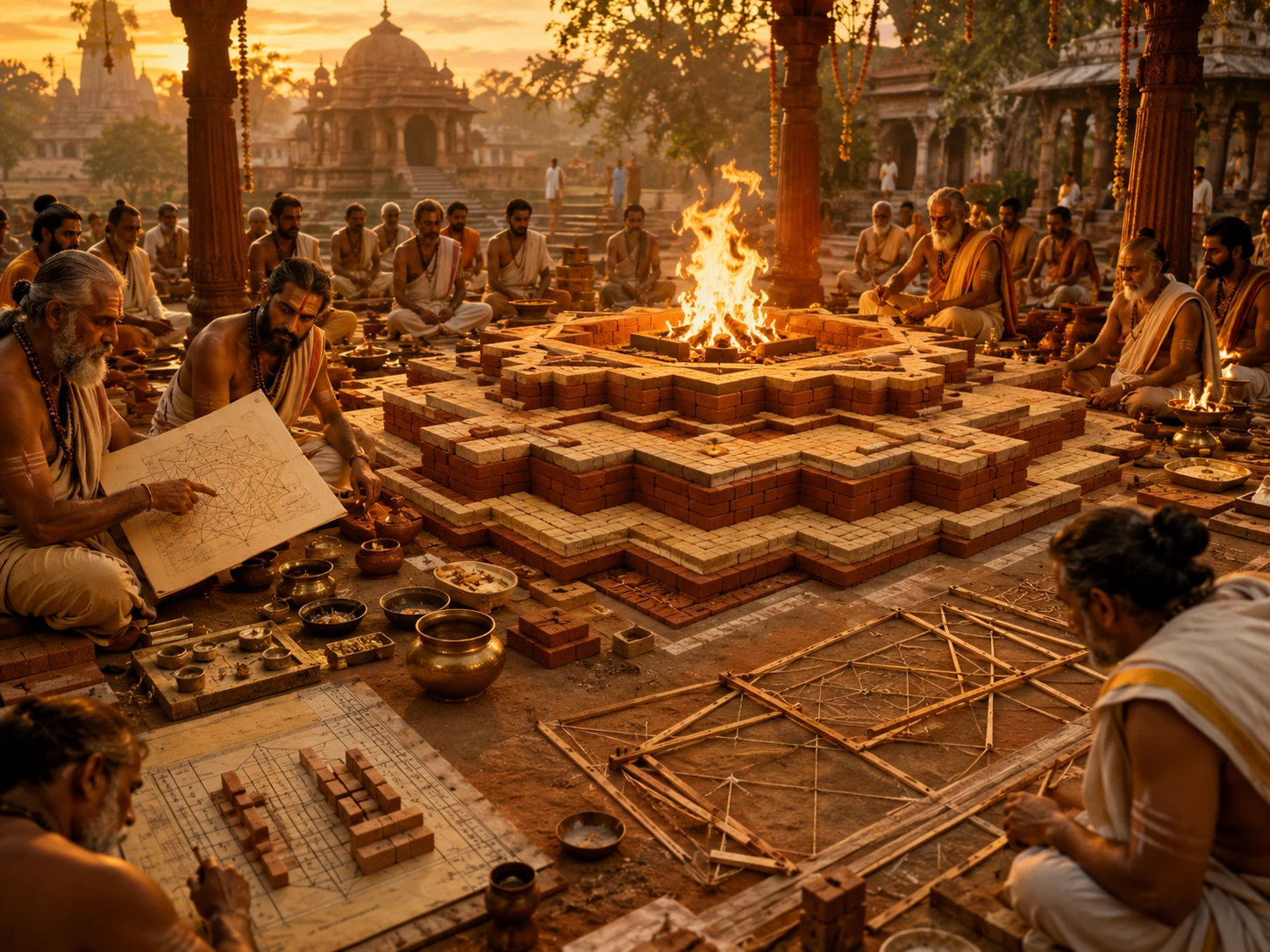
Agnichayana -- The Falcon-Shaped Fire Altar That Survived 3,000 Years
12 min read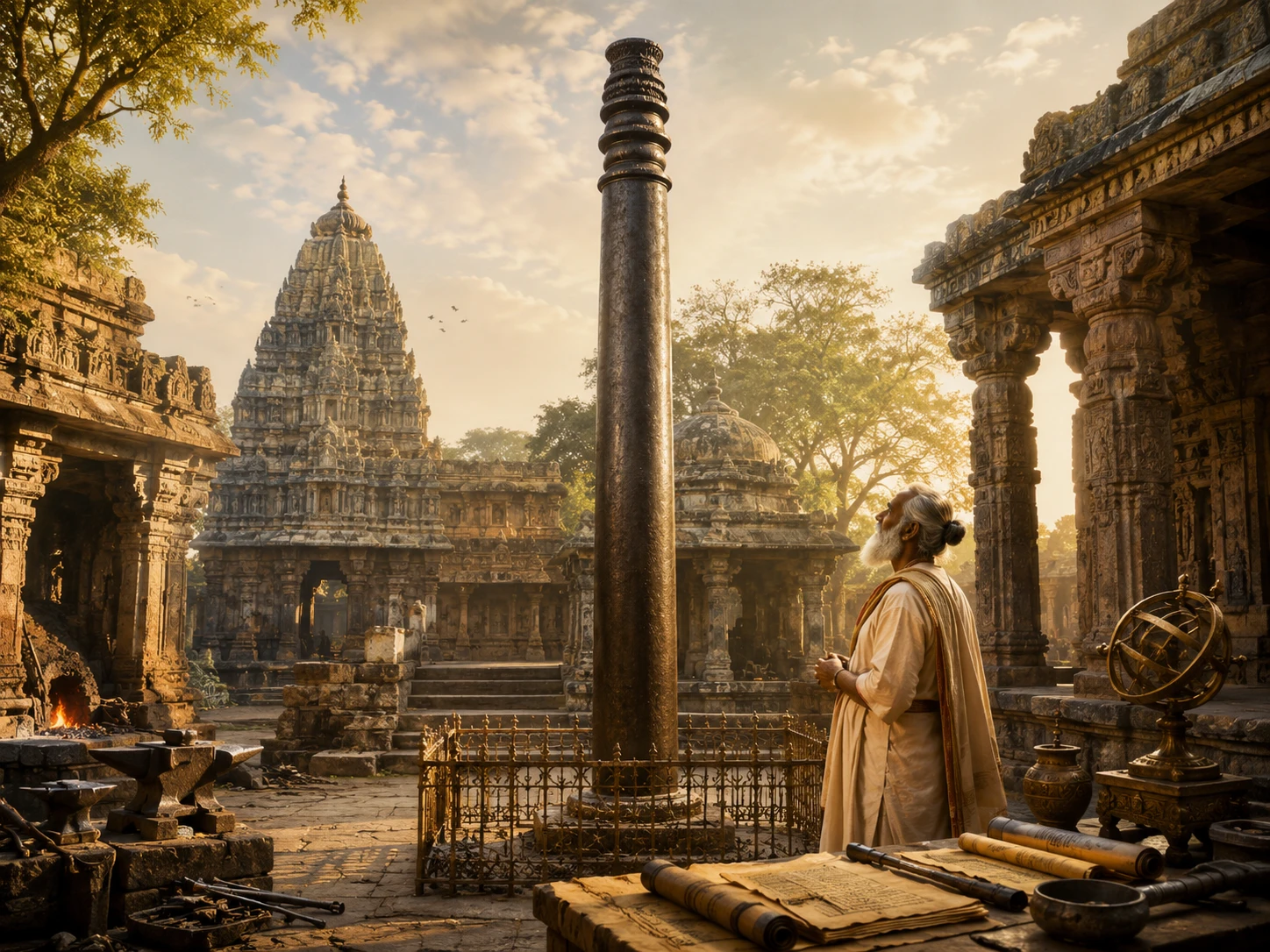
Ancient Indian Metallurgy -- The Iron Pillar That Refuses to Rust
13 min readAryabhata -- The Astronomer Who Said the Earth Turns
3 min readThe same translation error that turned '33 Koti' into '33 crore' in Hinduism also happened in Buddhism. The Chinese translation of Buddhist texts rendered 'Sapta Koti Buddha' (7 Supreme Buddhas) as '7 Crore Buddhas.' The…
Deities AvatarsCommunity Reflections
🕉️
Be the first to share your reflection.