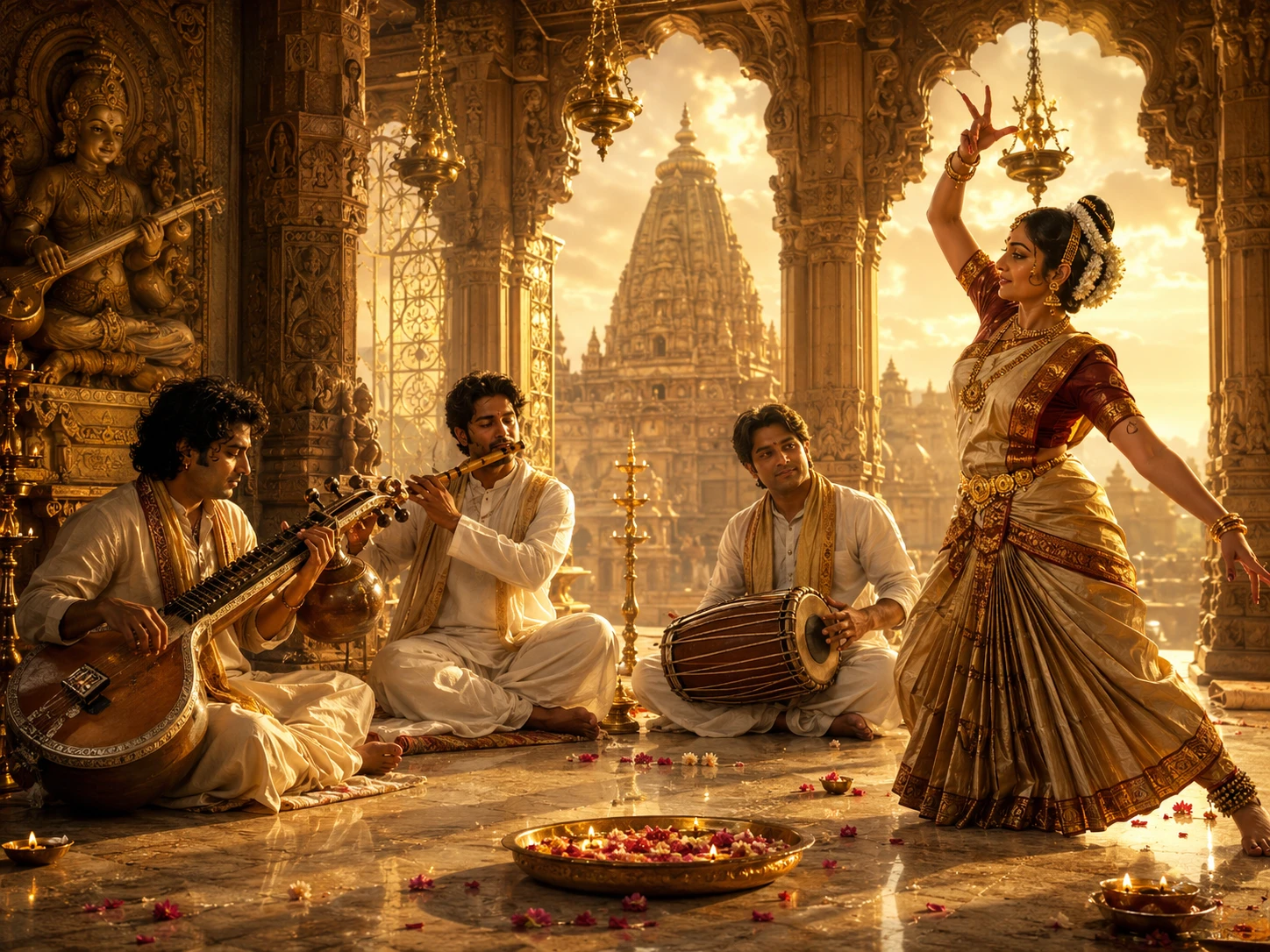
Gandharvaveda -- The Science of Music and Sound
गन्धर्ववेद -- संगीत और ध्वनि का विज्ञान
Long before A. R. Rahman won his first Oscar, long before Coke Studio brought folk traditions into LED-lit studios, long before any maestro tuned a tanpura at Saptak in Ahmedabad -- there was a science. Not a sentiment, not a hobby, not even an art in the casual modern sense. A science. A complete, internally consistent body of knowledge about how sound enters the body, how breath becomes pitch, how pitch becomes melody, and how melody, in the right hands, becomes a path to liberation. The ancient name for this science is Gandharvaveda.
Gandharvaveda is one of the four Upavedas, the supplementary Vedas that took specific aspects of Vedic knowledge and developed them into specialised disciplines. It is traditionally attached to the Sama Veda -- and that is no accident. The Sama Veda is itself the most musical of the four Vedas, with its mantras meant to be sung, not merely recited. Gandharvaveda took this seed of musical chanting and grew it into a forest: vocal music, instrumental music, dance, theatre, the philosophy of sound, and the metaphysics of inner listening.
The word Gandharva refers to celestial musicians who, in Puranic tradition, perform in Indra's court. Their singing is said to be so refined that mortal music is only its echo. To call a science Gandharvaveda is to claim a high lineage: this knowledge does not begin in human cleverness. It begins in cosmic vibration, comes down through divine performers, and finds its way -- imperfectly, partially -- onto the strings of a sitar in Banaras, the throat of a Khayal singer in Pune, the harmonium of a kirtan group in Mathura.
वीणावादनतत्त्वज्ञः श्रुतिजातिविशारदः। तालज्ञश्चाप्रयासेन मोक्षमार्गं नियच्छति॥
vīṇāvādana-tattvajñaḥ śruti-jāti-viśāradaḥ tālajñaścāprayāsena mokṣa-mārgaṃ niyacchati
One who truly knows the playing of the veena, who is expert in shrutis and jatis, who knows the rhythms -- such a one walks the path to moksha without effort.
— Yajnavalkya Smriti 3.115
This single verse is the manifesto of Gandharvaveda. It does not say that music is pleasant, or that it relieves stress, or that it accompanies devotion. It says something far stronger: a true musician is already on the path to liberation. The technical terms here matter. Vina-vadana is not just plucking strings -- it is the inner physics of how sound is born from contact between finger, string, and resonant gourd. Shruti is the microtonal interval, the difference between a note slightly too high and a note that lands exactly where the mind opens. Jati is the ancient classification of melodic forms that later evolved into raga. Tala is rhythmic time -- the pulse that turns sound into structure.
Master these four, the verse says, and moksha is not a distant goal. It is a side effect.
The philosophical foundation under all of this is Nada Brahma -- the doctrine that sound itself is the supreme reality. Nada is divided into two kinds: Anahata (unstruck, primordial sound that pervades the cosmos) and Ahata (struck, audible sound produced by physical contact). The Sangita Ratnakara of Sharngadeva, the thirteenth-century encyclopaedia of Indian music composed in the Yadava capital of Devagiri, opens with this distinction. All audible music is Ahata, but every Ahata Nada that hits a trained ear is a doorway back to Anahata. The musician is not entertaining the audience. The musician is reminding them of a sound they have always carried but stopped hearing.
The Four Upavedas -- Where Gandharvaveda Sits
| Upaveda | उपवेद | Parent Veda | Domain | Key Texts |
|---|---|---|---|---|
| Ayurveda | आयुर्वेद | Rig Veda (or Atharva) | Medicine and longevity | Charaka Samhita, Sushruta Samhita |
| Dhanurveda | धनुर्वेद | Yajur Veda | Warfare and weapons | Dhanurveda Samhita, Agni Purana |
| Gandharvaveda | गन्धर्ववेद | Sama Veda | Music, dance, theatre | Natyashastra, Sangita Ratnakara |
| Sthapatyaveda | स्थापत्यवेद | Atharva Veda | Architecture, town planning | Mayamatam, Manasara |
The pairing of Gandharvaveda with Sama Veda reflects an old insight: the Veda that is sung is the one that bears the seed of musical science.
The seven swaras of Indian music -- Sa, Re, Ga, Ma, Pa, Dha, Ni -- are full names: Shadja, Rishabha, Gandhara, Madhyama, Panchama, Dhaivata, Nishada. Sangita Ratnakara assigns each swara an animal whose natural cry resembles it. Shadja is the peacock, Rishabha the bull, Gandhara the goat, Madhyama the heron, Panchama the cuckoo, Dhaivata the horse, Nishada the elephant. So when a Hindustani vocalist holds a long Pa in raga Yaman, the tradition itself is reminding him: this is the cry of a kokila in a Bengal monsoon.
Gandharvaveda divides music into three streams that together form Sangita: Gita (vocal music, the human voice), Vadya (instrumental music), and Nritya (dance and movement). The three are inseparable in classical thought. A pure Gita performance with no Vadya at all is rare; a Vadya performance imitates and answers the voice; Nritya is what happens when both find a body that cannot sit still. Bharata Muni's Natyashastra, composed somewhere between the second century BCE and the second century CE, is the foundational text that holds all three together under the name Natya. To watch a Bharatanatyam recital at Kalakshetra in Chennai is to see this trinity intact, working as one.
Within Gita, two sub-streams developed: Marga Sangita (the canonical, scripture-bound music meant for ritual and meditation) and Desi Sangita (regional, popular music born of folk traditions). The genius of Indian classical music is that the line between Marga and Desi has never been a wall. Matanga's Brihaddeshi (around the eighth or ninth century) was the first treatise to recognise Desi music with full dignity, treating regional ragas not as inferior cousins of Vedic chant but as legitimate paths to the same goal. This is why a Punjabi qawwali at Hazrat Nizamuddin's dargah in Delhi and a Carnatic kriti at the Music Academy in Chennai are, in the deepest classical sense, two dialects of the same language.
न तज्ज्ञानं न तच्छिल्पं न सा विद्या न सा कला। न योगो न च तत्कर्म नाट्येऽस्मिन्यन्न दृश्यते॥
na tajjñānaṃ na tacchilpaṃ na sā vidyā na sā kalā na yogo na ca tatkarma nāṭye'sminyanna dṛśyate
There is no knowledge, no craft, no science, no art, no yoga, and no action that is not seen in this Natya.
— Natyashastra 1.116 (Bharata Muni)
Bharata's claim is staggering. He is not saying Natya contains many subjects. He is saying that anything human beings can know, do, feel, think, or aspire to -- politics, war, love, grief, ritual, parenting, betrayal, devotion -- finds a place in this synthesis of music, dance, and drama. Read the Natyashastra and the structure becomes clear. Six chapters are devoted to vocal and instrumental music, including the original Sanskrit theory of harmony and modes. Several chapters codify rasa, the eight (later nine) emotional flavours that performance is meant to evoke. Other chapters lay down stage design, makeup, costume, and the ethics of the actor's life. The Natyashastra is, in modern terms, simultaneously a music textbook, a screenwriting manual, a director's handbook, and a philosophical treatise on aesthetics.
What happened to Gandharvaveda in the medieval period is one of the more remarkable acts of intellectual stewardship in Hindu civilisation. As Persianate music traditions arrived in North India under the Sultanates and the Mughals, the science did not fight back. It absorbed, adapted, and reorganised. Amir Khusrau in the thirteenth-century Delhi sultanate is credited with shaping the Khayal tradition and several instruments, all firmly within the Gandharvaveda framework of swaras and talas. Tansen at Akbar's court in the sixteenth century was a Hindustani vocalist trained in this lineage, even as he drew on Sufi influences. The Hindustani-Carnatic split that we now consider obvious crystallised in this period, but both branches share the same trunk: Bharata, Matanga, Sharngadeva.
The other indispensable doctrine inside Gandharvaveda is rasa, the theory of aesthetic emotion. Bharata's Natyashastra introduces it as the sap or essence that performance is meant to extract and serve to the audience. The original eight rasas -- shringara (love or beauty), hasya (laughter), karuna (compassion), raudra (fury), vira (heroism), bhayanaka (fear), bibhatsa (disgust), adbhuta (wonder) -- were later joined by a ninth, shanta (peace), in the writings of Abhinavagupta in tenth-century Kashmir. The full nine, together called the navarasa, govern not only theatrical performance but raga selection. Each raga in classical Indian music is associated with one or two dominant rasas. Yaman, the calm evening raga that opens countless Hindustani concerts, leans toward shanta and shringara. Malkauld, the late-night raga of meditation, holds a particular weight of vira and adbhuta. Bhairavi, the raga of dawn, carries karuna and shanta. The performer's task is not only to render the raga technically but to arouse its rasa in the listener -- a task that, on a good night at the Saptak Festival, makes a packed Ahmedabad hall fall silent in a way that has nothing to do with politeness.
What finally turns this whole inheritance into something every modern Indian touches daily is film music. From the time of K. L. Saigal in the 1930s through the long Lata Mangeshkar era to the contemporary work of A. R. Rahman, Shankar-Ehsaan-Loy, Pritam, and the entire south Indian film industry, the song-craft of Indian cinema has stood squarely on classical foundations. The melodic structure of a Bollywood ghazal is raga structure. The rhythmic underlay is tala. The relationship between melodic phrase and emotional state is rasa theory. When a young engineer in Hyderabad plays an Ilaiyaraaja or Rahman composition during a long drive on the Outer Ring Road, she is, without analysing it, receiving a transmission that goes back through Tansen, through Sharngadeva, through Matanga, through Bharata, all the way to the Sama Veda's earliest mantra-singing. Gandharvaveda is the deepest piping in the soundtrack of contemporary Indian life.
The Seven Swaras and Their Roots
| Swara | Full Sanskrit Name | Animal Cry (Sangita Ratnakara) | Common Modern Use |
|---|---|---|---|
| Sa | Shadja (षड्ज) | Peacock | The fixed tonic of every raga |
| Re | Rishabha (ऋषभ) | Bull | Sets the mood of dawn ragas like Bhairav |
| Ga | Gandhara (गान्धार) | Goat | Carries the emotional centre of Yaman |
| Ma | Madhyama (मध्यम) | Heron | The pivot in evening ragas like Marwa |
| Pa | Panchama (पञ्चम) | Cuckoo | Stable consonance, never altered |
| Dha | Dhaivata (धैवत) | Horse | The colour of late-night ragas like Bageshri |
| Ni | Nishada (निषाद) | Elephant | Tension before resolving back to Sa |
The animal mappings are not zoology -- they are mnemonic. A trained student internalised which natural cry sat at which pitch and could recall it on demand.
When Coke Studio India opened its 2023 season with a fusion of Punjabi folk and Carnatic vocal, it was reactivating a much older idea. Sharngadeva had said in the thirteenth century that Marga and Desi music are not opposites -- they are two ends of the same string. The fusion that feels modern on Spotify is a return, not a revolution. Even AR Rahman's training, before the synthesisers arrived, was rooted in Carnatic vocal practice -- a direct descendant of Gandharvaveda's Gita stream.
Step into a working music gharana today and you can feel Gandharvaveda still alive in its plumbing. The Mewati gharana of Pandit Jasraj, the Kirana gharana that produced Bhimsen Joshi, the Gwalior gharana, the Patiala gharana -- each is a living transmission system that operates on the same principles Bharata wrote down two thousand years ago. The student sits at the guru's feet. The first year is spent learning to land Sa cleanly. The second year is spent in shrutis. Years three to ten are about ragas. Somewhere along the way, the student notices that her breathing has changed, her sleep has changed, the way she listens to traffic in Mumbai has changed. The science was always doing more than teaching her music. It was rewiring the relationship between her breath, her ear, and her attention.
For a young Indian today, Gandharvaveda is closer than it looks. If you have ever felt a knot in the chest dissolve during the first taan of a Hariharan ghazal, you have brushed against Anahata Nada. If you have argued with a friend in Bengaluru about which version of Vande Mataram is more authentic, you are inside the Marga-Desi debate that Matanga first formalised. If your grandmother in Kolhapur insists you sing Hanuman Chalisa in the right tune before exam season, she is, without naming it, applying the Yajnavalkya Smriti verse with which this article began. The veena, the shrutis, and the talas are not just on the stage. They are quietly running through the bloodstream of Indian life.
What no introduction to Gandharvaveda can skip is the parallel science of tala, the architecture of musical time. If swara handles pitch, tala handles the precise mathematical division of duration. The Sangita Ratnakara devotes an entire chapter to it, and Bharata's Natyashastra had laid the ground centuries earlier. The seven primary talas of the South Indian tradition -- Dhruva, Matya, Rupaka, Jhampa, Triputa, Atta, Eka -- each consist of a defined sequence of beats organised into matras (units), kalas (sections), and avartas (cycles). The Hindustani system uses different talas: Teentaal of sixteen beats, Ektaal of twelve, Jhaptaal of ten, Rupak of seven. The principle, however, is the same. The tabla player and the mridangam player are not just keeping time. They are performing a precisely codified mathematical structure that the tradition has been refining since at least Bharata's day. When a young Zakir Hussain holds a sam after a complex tihai at a Saptak concert in Ahmedabad, he is doing what Sharngadeva would have called the perfection of avarta -- bringing the cycle back to its origin point with mathematical exactness.
Within the Carnatic stream, three eighteenth-century composers stand at the centre of any survey: Tyagaraja, Muthuswami Dikshitar, and Syama Sastri, the so-called Trinity. They lived in roughly overlapping decades in and around Tiruvarur in Tamil Nadu, and between them they composed several thousand kritis -- structured devotional pieces in defined ragas with specific lyrical content, usually addressed to a particular deity at a particular temple. Almost the entire performed Carnatic repertoire even today goes back to one of the three or to their immediate disciples. Their compositions are works of philology, theology, and music theory simultaneously, often coding raga names, deity names, and authorial signatures into Sanskrit verse so dense that scholars at the Madras Music Academy still produce books decoding them. The Margazhi season every December in Chennai, when hundreds of sabhas hold concurrent kutcheris from morning to night, is essentially an annual reactivation of this Trinity's body of work.
The Hindustani gharana system is structurally different. A gharana is a stylistic lineage that traces from a founding ustad through a defined chain of disciples, each of whom passes on a particular approach to khayal singing or instrumental performance. The major gharanas of khayal -- Gwalior, Agra, Kirana, Patiala, Mewati, Jaipur-Atrauli -- each have signature methods of voice production, ornamentation, and raga elaboration. A trained ear identifies, within seconds of a performance, whether a singer is from the slow, contemplative Kirana style of Bhimsen Joshi or the fast, ornament-heavy Patiala style associated with Bade Ghulam Ali Khan. These are not arbitrary preferences. Each gharana has codified pedagogical reasons for its choices, traceable through Hindustani lineage charts that often reach back to Tansen at Akbar's court. The ITC Sangeet Research Academy in Kolkata maintains living archives of several of these lineages and continues to train scholarship students in the gurukula style. Gandharvaveda thus survives not only in the texts but in human memory, voice by voice, taught for hundreds of generations from one open mouth to one open ear.
The Shri Yantra of Goddess Lalita Tripura Sundari is sometimes called the geometric form of the Pranava (Om), but Sangita Ratnakara goes further -- it maps the swaras themselves to chakras of the body. Sa to Muladhara, Re to Svadhisthana, Ga to Manipura, and so on up to Ni at the Ajna. When you sing a full Sa-Pa octave, the tradition says you have travelled, in sound, from the base of the spine to the third eye.
It is worth saying plainly what Gandharvaveda is not. It is not a claim that Indian music is older than every other tradition. It is not a claim that any specific raga can cure any specific disease, however attractive that idea is on Instagram reels. It is not a museum exhibit. It is a living, internally consistent science of sound, breath, and attention -- one that has co-evolved with Hindu spiritual practice for at least two and a half thousand years and that still produces, every year, classical performers, bhakti singers, film composers, and the next generation of students sitting cross-legged before a tanpura at sunrise. To know even a little of it is to listen to Indian music differently. Every time the tabla resolves to sam after a long taan, every time a Carnatic alap touches a shruti the human voice has no business reaching, you are inside an experiment that the rishis began and that has, remarkably, not yet ended.
Where Gandharvaveda lives most quietly today is in daily devotional practice. Every morning aarti at every Hindu temple in India, from the Tirumala Tirupati Devasthanam at four-thirty in the morning to the small Hanuman shrine in a Pune housing colony, follows codified raga structures that go straight back to the Sangita Ratnakara. The morning aarti opens with bhairav family ragas, the evening with yaman or kalyan family, and a temple priest who has not had a single day of formal music training will, over the course of his career, have internalised the rasa-raga-time discipline simply by performing it twelve times a day for thirty years. Bhajans at a Mata ki chowki in Delhi, kirtans at the ISKCON temples on a Sunday afternoon, the abhang gatherings of Pandharpur during Ashadhi Ekadashi, the qawwalis at Ajmer Sharif and Nizamuddin Dargah on a Thursday night -- all of these are working applications of Gandharvaveda principles, sustained by communities that may not name the science but live inside it. The Eternal Raga app's bhajan section, like every serious devotional music platform, is a downstream channel for the same flow that began in the Sama Veda's earliest mantra-singing and that has not, in three thousand years, paused for breath.
Among the older forms of Hindustani classical music, the most austere and meditative is dhrupad. Dhrupad predates khayal by several centuries; it is what was sung in the courts of Akbar and the Mughal-era temples of Vrindavan, and it is the form closest in structure to the original sama-gana of the Sama Veda. A dhrupad performance opens with an unhurried alap that can last forty minutes or longer, in which the singer maps the architecture of the raga note by note without the urgency of rhythm. Only after the raga has been fully drawn does the pakhawaj enter, and a composition (called a bandish) in chautal of twelve beats is rendered. The Dagar tradition, kept alive across most of the twentieth century by the late Ustad Zia Mohiuddin Dagar and his brother Ustad Zia Fariduddin Dagar, is the most rigorous surviving lineage. The Gundecha Brothers in Bhopal, trained in this lineage, run the Dhrupad Sansthan that has produced a new generation of Indian and foreign students. Dhrupad demands of the listener what no other Indian music quite demands: the patience to follow a single sustained note for several minutes, hearing inside it the entire raga's potential, before any rhythmic resolution arrives.
Behind both dhrupad and khayal sits a deeper philosophical claim, encoded in the term Nada Brahma -- sound-as-Brahman. The Sangita Ratnakara, in its opening invocations, identifies the syllable AUM as the primal vibration from which all other sound, and from which all manifest creation, emerges. A musician in this view is not producing sound. She is participating in a continuous cosmic vibration that has no beginning. The tanpura's drone, often dismissed by listeners as background, is in this view the audible representation of that primal vibration -- the unchanging substrate against which the moving raga unfolds. This is why Indian classical performers spend the first ten or fifteen minutes of any concert simply tuning the tanpura and listening; they are not preparing to make music, they are entering the music that is already underway. The Nada Yoga schools at the Bharatiya Vidya Bhavan and at Banaras Hindu University teach this listening as a contemplative practice in its own right, distinct from any performance training. To approach Indian classical music seriously is, eventually, to discover that the discipline is also a soteriology -- that the same training that produces a polished performer is also, by another route, a path.
Sing a Bhajan in Its Raag
Choose a bhajan whose raag you know -- Yaman in the evening, Bhairav at dawn -- and sing it slowly, listening for the raag's characteristic notes as you go. Eternal Raga's mantra library gives the words and meaning of many bhajans, aartis and stotras to sing.
Tags
Eternal Raga · शाश्वत राग
Institutional voice — scholarly articles on Sanatan Dharma
Deepen Your Understanding
अपनी समझ और गहरी करें
vedic sciences
Sthapatyaveda -- The Science of Building and Sacred Space
The fourth Upaveda treats space the way Gandharvaveda treats sound: as something with a structure, a deity, and a method. From Akshardham Delhi to a Pune flat with a tulsi corner, the same Sthapatyaveda principles are at work.
scriptural exegesis
The Four Vedas -- An Overview of Hinduism's Oldest Scriptures
Rig, Yajur, Sama and Atharva: what each Veda contains, how every Veda is layered from hymns to Upanishads, why the Vedas are called shruti, "what was heard", and how they were carried for thousands of years without being written down.
vedic sciences
The Natyashastra -- Bharata's Fifth Veda of Drama, Dance and Rasa
An ancient handbook of theatre that covers everything from the shape of the stage to the movement of an eyebrow -- and gave India its central idea of art, rasa. What the Natyashastra is, its story of how drama was made from the four Vedas, and why every classical dance still traces itself to it.
philosophy darshana
Om -- The Sound That Contains the Universe
Om is not a chant. It is not a religious symbol. According to the Mandukya Upanishad, it is the complete map of consciousness itself -- past, present, future, and whatever lies beyond all three. Twelve verses. Four states. One syllable. This is the most concentrated philosophical text in human history, and it fits on a single page.
sacred symbols
Sri Chakra -- The Sacred Geometry That Takes a Lifetime to Draw Perfectly
Nine interlocking triangles. Four pointing upward (Shiva). Five pointing downward (Shakti). Their intersection creates 43 smaller triangles that map the entire journey of consciousness from the material to the divine. The Sri Yantra is the most complex sacred geometric figure in any world tradition -- and mathematicians still argue about whether it can be drawn with perfect precision.
The seven swaras of Indian music -- Sa, Re, Ga, Ma, Pa, Dha, Ni -- are full names: Shadja, Rishabha, Gandhara, Madhyama, Panchama, Dhaivata, Nishada. Sangita Ratnakara assigns each swara an animal whose natural cry resem…
More in Vedic Sciences
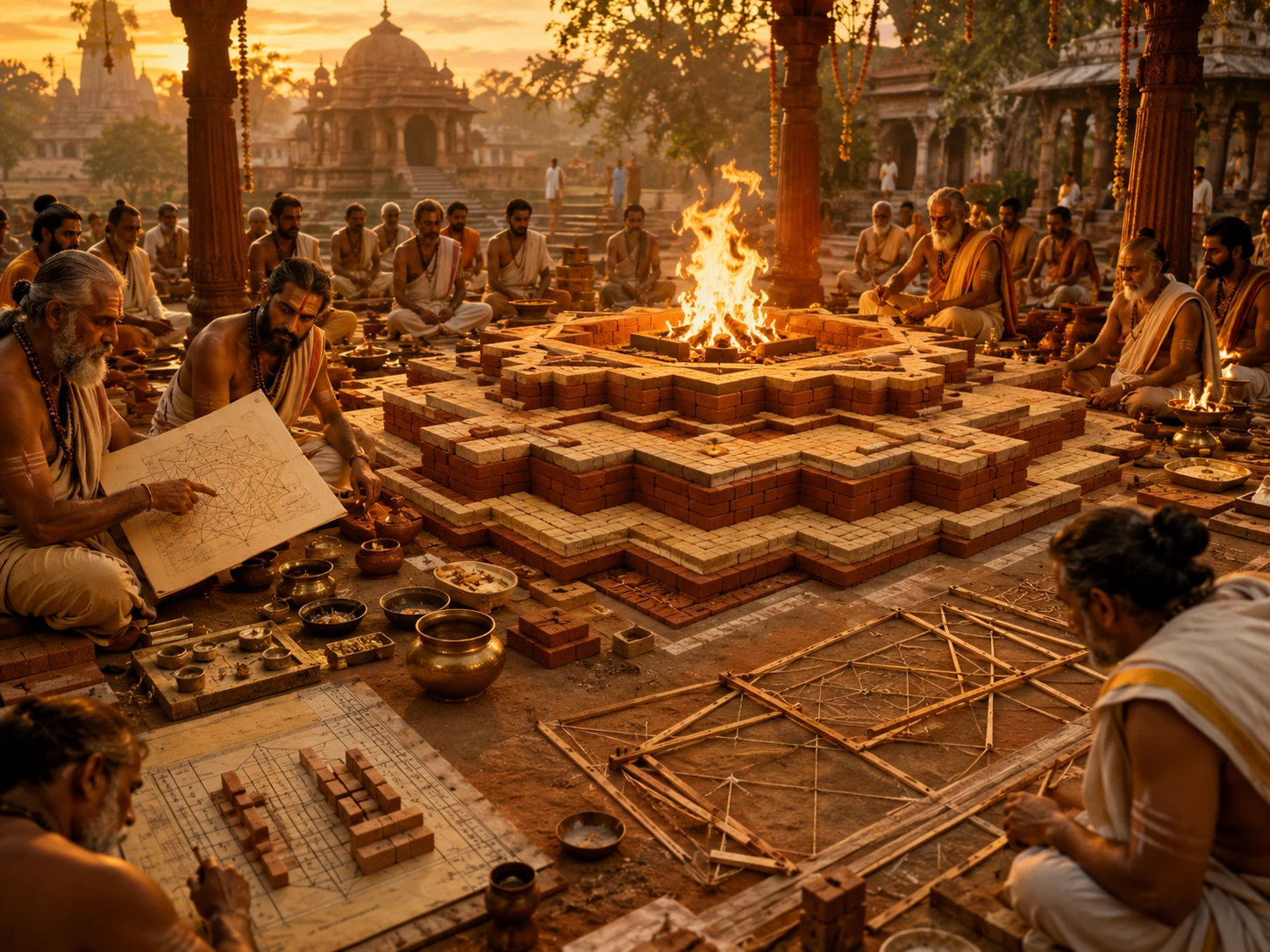
Agnichayana -- The Falcon-Shaped Fire Altar That Survived 3,000 Years
12 min read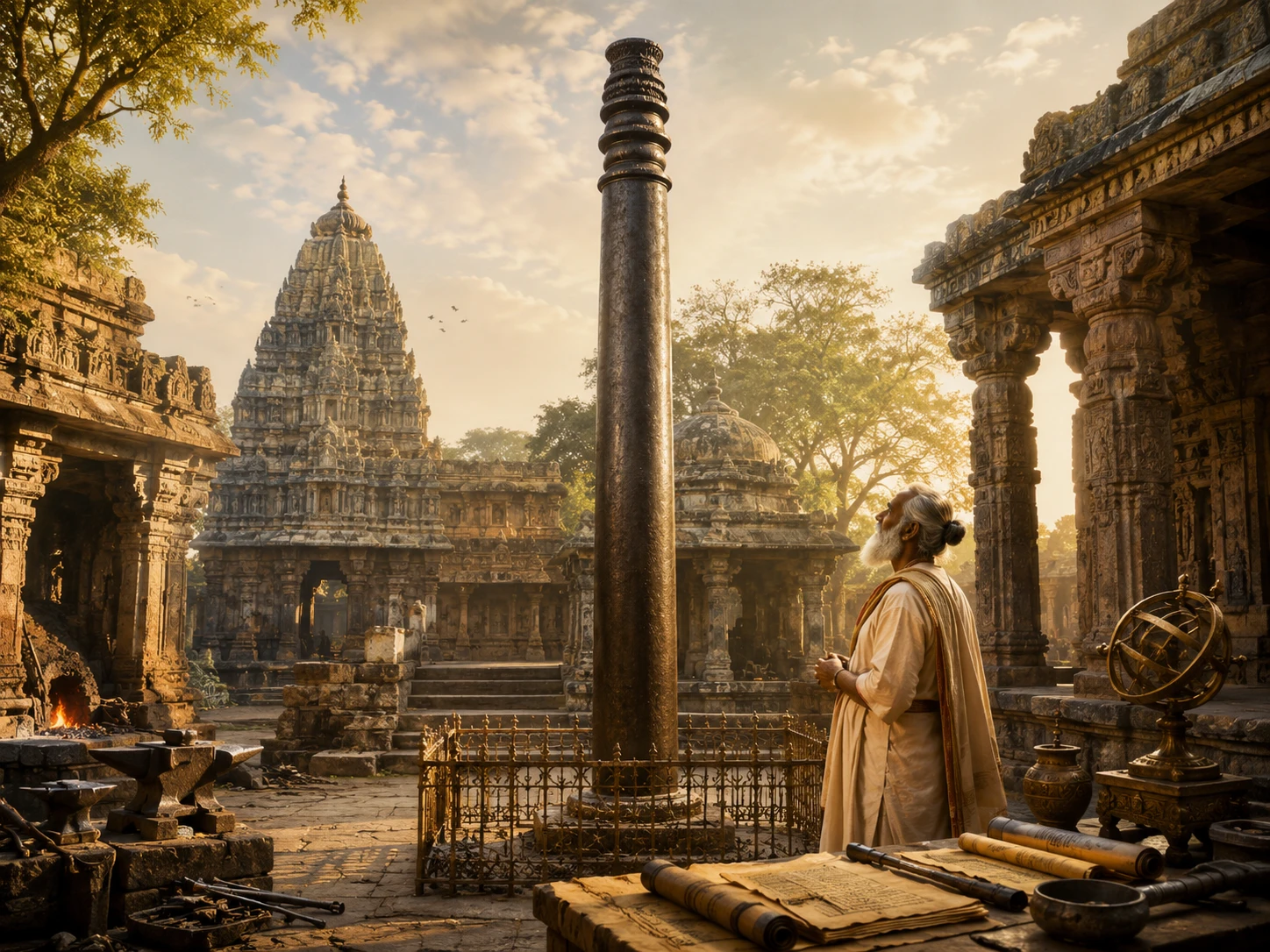
Ancient Indian Metallurgy -- The Iron Pillar That Refuses to Rust
13 min readAryabhata -- The Astronomer Who Said the Earth Turns
3 min readThe same translation error that turned '33 Koti' into '33 crore' in Hinduism also happened in Buddhism. The Chinese translation of Buddhist texts rendered 'Sapta Koti Buddha' (7 Supreme Buddhas) as '7 Crore Buddhas.' The…
Deities AvatarsCommunity Reflections
🕉️
Be the first to share your reflection.