
Sthapatyaveda -- The Science of Building and Sacred Space
स्थापत्यवेद -- भवन और पवित्र अन्तरिक्ष का विज्ञान
Stand for a moment in front of Akshardham in Delhi. Then close your eyes and remember the Brihadeeswara temple in Thanjavur, the Khajuraho group in Madhya Pradesh, the Konark sun temple in Odisha, the Ram Mandir in Ayodhya consecrated in 2024, the Padmanabhaswamy temple in Thiruvananthapuram. They look different. They feel different. But the underlying grammar that allows them all to work as sacred space comes from a single discipline: Sthapatyaveda.
Sthapatyaveda is the fourth and most physically tangible of the Upavedas. It is traditionally attached to the Atharva Veda, and like its parent it covers wider ground than the title suggests. The word Sthapatya itself comes from sthapati -- the master architect, the one who establishes -- and the discipline includes architecture, sculpture, town planning, hydraulics, road design, fortification, and the preparation of sacred ground. In its mature form it is what we today loosely call Vastu Shastra, but Vastu Shastra in everyday Indian conversation has shrunk to a few rules about kitchen direction and the placement of mirrors. The original Sthapatyaveda is much larger and much more interesting.
Its central claim is simple and unfamiliar. Space is not empty. Space has a structure. Space has a presiding being -- the Vastu Purusha -- and any human attempt to settle, build, or worship on a piece of ground enters into a relationship with that being. Building is therefore never a purely technical act. It is always also a ritual act. The mason who lays the first stone of a temple in Tiruchirapalli and the contractor who pours the foundation of an apartment block in Gurugram are working, whether they realise it or not, on the same chessboard.
इहैव ध्रुवां नि मिनोमि शालां क्षेमे तिष्ठाति घृतमुक्षमाणा। तां त्वा शाले सर्ववीराः सुवीरा अरिष्टवीरा उप संचरेम॥
ihaiva dhruvāṃ ni mināmi śālāṃ kṣeme tiṣṭhāti ghṛtamukṣamāṇā tāṃ tvā śāle sarvavīrāḥ suvīrā ariṣṭavīrā upa saṃcarema
Right here I firmly establish this house. May it stand secure, anointed with ghee. May we, with all our heroes, with brave heroes, with unhurt heroes, walk into you, O dwelling.
— Atharva Veda 3.12.1 (Shala Sukta)
This single verse from the Atharva Veda's Shala Sukta is the seed from which Sthapatyaveda eventually grew into a forest of texts. Notice what the verse does. It does not measure plots or specify wood thickness. It performs an act of dedication. The first nail is not hammered. The first prayer is offered. The house is not raised against the land. It is gently established within it, with permission. The Atharva Veda contains several such Vastoshpatya hymns, addressed to Vastoshpati -- the lord of dwelling. From these ritual roots, by the early centuries of the common era, full architectural manuals had emerged.
The core text most cited today is the Mayamatam, attributed to the legendary architect Maya Danava, traditionally placed in the South Indian Shaiva tradition. The Manasara, of comparable status, is a comprehensive treatise on iconography and temple-building. The Samarangana Sutradhara, attributed to King Bhoja of Dhara in the eleventh century, is a remarkable encyclopaedia that ranges from village layout to mechanical contrivances, including a famous chapter on yantras (machines) that has fascinated historians of technology. Vishvakarma's Vastushastra, attached to the divine architect Vishvakarma himself, supplies the theological frame. Together with regional manuals like the Mayamuni Vastushastra and the Aparajita Pricchha, these texts form the working corpus of Sthapatyaveda.
Core Texts of Sthapatyaveda
| Text | Approx Date | Tradition | Distinctive Focus |
|---|---|---|---|
| Atharva Veda Vastoshpatya Suktas | Pre-1000 BCE | Vedic ritual | Foundation hymns and dwelling consecration |
| Mayamatam | 5th -- 7th century CE | South Indian Shaiva | Temple, sculpture, iconography |
| Manasara | 5th -- 7th century CE | Pan-Indian | Comprehensive 70-chapter manual on building |
| Brihat Samhita (Vastu chapters) | 6th century CE | Varahamihira's astronomy | Vastu within a wider astronomical setting |
| Samarangana Sutradhara | 11th century CE | Paramara court of Bhoja | Town planning, palaces, machines (yantras) |
| Aparajita Pricchha | 12th century CE | Western India | Practical questions in dialogue form |
Each text retains its own emphasis, but all share the same Vastu Purusha Mandala foundation. Regional schools layered local materials and climate over a common grammar.
Akshardham temple in Delhi, completed in 2005, was built using stone-on-stone construction methods drawn directly from Sthapatyaveda manuals. No steel reinforcement runs through its main mandapa. Its architects worked with the Pramukh Swami Maharaj's instruction that the temple should be built strictly per Maharshi Vishvakarma's prescriptions. The Guinness World Record it now holds for the largest comprehensive Hindu temple complex was, in a sense, set with a thirteenth-century manual.
At the heart of Sthapatyaveda sits a single diagram: the Vastu Purusha Mandala. The mandala is a square divided most often into 64 (8x8) or 81 (9x9) smaller squares called padas. In each pada presides a specific deity, and across the body of the mandala lies the Vastu Purusha himself -- a cosmic being pinned face-down with his head usually in the northeast and his feet in the southwest. The Matsya Purana tells the origin myth in vivid detail. A vast, hungry being once threatened to consume creation. The devas pinned him to the earth, each holding down one of his limbs. Brahma named him Vastu Purusha and decreed that any human who builds on the earth must offer worship to the deities holding him down. That is why the puja before laying a foundation -- the bhumi pujan that politicians, IT companies, and Mumbai builders all perform -- still involves an offering to all the devatas of the directions.
The practical consequence of this myth is the directional grammar of Sthapatyaveda. The northeast pada is sacred to Ishana, a form of Shiva, and is reserved for the household shrine, the puja room, water sources, and meditation spaces. The southeast belongs to Agni, lord of fire, and houses the kitchen. The southwest is the domain of Pitru, the ancestors, and gets the heaviest construction -- master bedroom, treasury, central pillar. The northwest, governed by Vayu, is light and movable -- guest rooms, storage. None of this is arbitrary. It is what falls out when you take the body-map of Vastu Purusha and overlay it on the daily life of a household.
वास्तोष्पते प्रति जानीह्यस्मान्त्स्वावेशो अनमीवो भवा नः। यत्त्वेमहे प्रति तन्नो जुषस्व शं नो भव द्विपदे शं चतुष्पदे॥
vāstoṣpate prati jānīhyasmān svāveśo anamīvo bhavā naḥ yat tvemahe prati tanno juṣasva śaṃ no bhava dvipade śaṃ catuṣpade
O Vastoshpati, lord of the dwelling, recognise us. Be welcoming, free from disease, to us. Whatever we ask of you, grant it. Be auspicious to our two-footed and four-footed beings.
— Rig Veda 7.54.1 (also recited in Atharva Veda traditions)
Above the household, Sthapatyaveda extends to the temple, and the temple is where its philosophy becomes most visible. By the early medieval period, three broad temple styles had crystallised across the subcontinent: Nagara in the north, Dravida in the south, and Vesara as a hybrid in the Deccan. The Nagara style, visible at Khajuraho and Konark, is built on a square plan that progressively becomes a curvilinear shikhara -- a tower that resembles a mountain peak and culminates in an amalaka, a crowning ribbed disc. The Dravida style, at its grandest in Brihadeeswara at Thanjavur, builds in tiers, each diminishing storey a horizontal band, with a stepped pyramidal vimana above the sanctum. Vesara, seen in the Hoysala temples of Belur and Halebid, fuses the two impulses into something that feels at once compact and elaborate.
What unites them all is the body-temple analogy at the centre of Sthapatyaveda. The garbhagriha (literally womb-house) is the deity's sanctum, deliberately small and dark, the still centre of the structure. Around it run circumambulation paths. Above it rises the shikhara or vimana -- the cosmic spine. The entire temple is read as a body, and the devotee who walks from gateway to garbhagriha is symbolically walking from feet to crown of a divine being. This is not metaphor laid on top of architecture. It is architecture designed to be a metaphor.
Within the Nagara temple style of north India, several distinct sub-traditions developed regional flavours over the centuries. The Maru-Gurjara style of Rajasthan and Gujarat, exemplified by the Dilwara Jain temples on Mount Abu, perfected delicate marble lacework that has never been matched anywhere else in stone. The Kalinga style of Odisha, visible at the Lingaraja temple in Bhubaneswar and the colossal Sun Temple at Konark, developed a characteristic curvilinear shikhara whose contour follows a precise mathematical curve called the rekha-deul. The Latina style, the most widespread, governs much of central and northern India including Khajuraho. The Hoysala temples in Karnataka -- Belur, Halebid, and Somanathapura -- represent a distinct Vesara hybrid where soapstone allowed almost paper-like sculptural detail without losing structural integrity over eight centuries. Each sub-style is treated in the Sthapatyaveda manuals not as a deviation but as a legitimate dialect of the same architectural language, much as Hindustani gharanas are dialects of one music.
In the contemporary period, several major Indian architects have explicitly drawn on Sthapatyaveda. Balkrishna Doshi, India's first Pritzker Prize winner in 2018, designed the Aranya Low-Cost Housing in Indore using courtyard and orientation principles drawn directly from traditional Vastu, while still meeting modern affordable-housing budgets and World Bank specifications. Charles Correa, who passed away in 2015, repeatedly drew on the Vastu Purusha Mandala in projects ranging from the Kanchanjunga Apartments in Mumbai to the Jawahar Kala Kendra in Jaipur, the latter being a near-explicit nine-square mandala in concrete. Raj Rewal applied courtyard-and-mandala thinking to the State Trading Corporation building in Delhi. The Sangath studio of Doshi in Ahmedabad, where he himself worked until his death in 2023, sits on a Vastu-aligned plan and is studied today by architecture students from CEPT, SPA Delhi, and IIT Roorkee. None of this is nostalgia. It is technical inheritance applied to twenty-first-century problems of urban density, climate stress, and human dignity in the home -- problems that the original sthapatis would have recognised, if not in their specific shape, then in their fundamental nature.
The Three Temple Styles
| Feature | Nagara (North) | Dravida (South) | Vesara (Deccan) |
|---|---|---|---|
| Tower above sanctum | Curvilinear shikhara | Stepped pyramidal vimana | Hybrid, often star-shaped base |
| Plan | Square with projections | Square with concentric prakaras | Stellate or polygonal |
| Crown | Amalaka and kalasha | Octagonal shikhara on top tier | Often Nagara-style amalaka |
| Boundary wall | Modest or absent | Massive prakara walls and gopurams | Light, sculptural |
| Best examples | Khajuraho, Konark, Lingaraja | Brihadeeswara, Meenakshi, Madurai | Belur, Halebid, Lakkundi |
All three styles are codified within Sthapatyaveda manuals, but local materials and climate produced very different feels -- the granite massiveness of Thanjavur and the soapstone delicacy of Belur are both legitimate descendants of the same Vastu grammar.
IIT Roorkee, IIT Kharagpur, and the School of Planning and Architecture in Delhi all run formal courses in Vastu Shastra and traditional Indian architecture. Engineering students study load distribution in Dravida vimanas, the modular pada system of the Mandala, and the climate-responsive design of stepwells like Rani ki Vav in Patan. What gets dismissed in WhatsApp forwards as superstition is taught at university level as historical engineering.
What is happening in Sthapatyaveda today is unusual and worth watching. After a long colonial sleep during which the discipline was treated as folklore, the last forty years have seen a serious revival. BAPS Swaminarayan temples across Houston, London, Abu Dhabi, and now most prominently the BAPS Hindu Mandir in Abu Dhabi consecrated in 2024, are all built using Sthapatyaveda principles, with stone shipped to construction sites from Rajasthan and carved by Indian shilpis trained in the lineage of Sompura families that have built temples for over a thousand years. The Sompuras of Pindwara are the same lineage that worked on Somnath after independence and are now central to the construction of the Ram Mandir in Ayodhya.
At the same time, the everyday Vastu industry has expanded into something the original texts would barely recognise. There are Vastu apps for flat-hunting in Bengaluru. There are TV consultants who promise to fix your career by moving your bed. There are property listings on 99acres that mention Vastu compliance as a selling point. The honest reading is that not all of this is rooted in serious Sthapatyaveda. Some of it is genuine application, some is a popular adaptation, some is straightforward marketing. The texts are old and well-developed enough to support sober use. They cannot, however, be made responsible for every claim that floats in their name.
Beyond temples, the most physically tangible legacy of Sthapatyaveda is the stepwell, a structure unique to the Indian subcontinent and almost unknown elsewhere in pre-modern world architecture. Rani ki Vav at Patan in Gujarat, built in the eleventh century by Queen Udayamati of the Solanki dynasty in memory of her husband Bhima I, descends seven storeys into the earth in inverted-temple fashion, with sculptural galleries on every level. UNESCO inscribed it as a World Heritage Site in 2014, and the Reserve Bank of India put it on the new hundred-rupee note. Adalaj ni Vav, near Ahmedabad, takes the same logic in five storeys; Chand Baori in Abhaneri, Rajasthan, drops thirteen storeys with three thousand five hundred symmetrical steps, the deepest stepwell in India. These are not decorative monuments. They are working hydraulic architecture, designed by sthapatis in conformity with Sthapatyaveda principles to keep water cool and accessible through the brutal Indian summer. The temperature at the bottom of Rani ki Vav remains five to six degrees lower than the surface even in May. This is climate-responsive design that the Aga Khan Trust for Culture has been studying for two decades, and that contemporary Indian architects like Yatin Pandya in Ahmedabad and the Anangpur Rural Living Lab outside Delhi have explicitly applied to modern low-energy buildings.
The town planning side of Sthapatyaveda is similarly elaborate. The Mayamatam dedicates several chapters to grama-vinyasa, the layout of villages, and pura-vinyasa, the layout of cities. Eight basic patterns are codified: Dandaka (linear), Sarvatobhadra (square with central temple and four-direction streets), Nandyavarta, Padmaka (lotus pattern), Swastika, Prastara, Karmuka (bow-shaped, for coastal towns), and Chaturmukha. Each pattern has prescribed locations for the temple, the ruler's residence, the market, the brahmin quarter, the artisan quarters, and the cremation ground. Surveys of historical Indian cities -- Madurai, Kanchipuram, Srirangam, Jaipur -- have shown remarkable correspondence with these codified patterns, often centuries after the manuals were written. Madurai is built around the Meenakshi temple in concentric rectangles named after the months of the year, a Sarvatobhadra mandala in stone. Srirangam in Tamil Nadu has the world's largest functioning Hindu temple complex precisely because it was laid out as seven concentric prakaras (enclosure walls), each one a working public street, all radiating from the central sanctum.
Jaipur is perhaps the most famous example of a planned Vastu city in the modern era. It was designed by Vidyadhar Bhattacharya, court architect to Sawai Jai Singh II, in 1727, when Jai Singh decided to move his capital from the cramped hilltop fort of Amber to a new city on the plain. Vidyadhar laid the city as a three-by-three grid of nine rectangular blocks around a central palace complex, each block named after one of the nine planets and each opening through monumental gates onto wide, straight streets. The city is, in literal terms, a Vastu Purusha Mandala built large enough to walk through. The pink colour was added almost a century and a half later, in 1876, when Maharaja Ram Singh ordered the city painted to welcome the Prince of Wales. The Mandala plan, however, has not changed in three hundred years, and tourists who walk from Hawa Mahal to City Palace to Jantar Mantar are walking, without knowing it, through a Sthapatyaveda diagram that an eighteenth-century court architect drew on a scale most contemporary Indian master plans would not even attempt.
When the foundation stone of the Ram Mandir at Ayodhya was laid in August 2020, the puja included offerings to the deities of all eight directions, with soil brought from rivers and pilgrimage sites across India. The architect of record is the Sompura family of Ahmedabad, whose patriarch Chandrakant Sompura had worked on the original design decades earlier. The Mandir is being built without iron or steel reinforcement in the main structure, following classical Sthapatyaveda methods of stone-on-stone bonding -- meant to last a thousand years.
Sthapatyaveda, in the end, is the science of making space hospitable. Hospitable to the body that lives in it, to the deity that may be invited into it, to the ancestor whose memory leans on it, to the sleep and study and conversation that fill it. Whether you are walking around the Brihadeeswara temple on a winter morning, examining the floor plan of a Pune flat with a Sompura-trained consultant, or simply lighting a diya in the northeast corner of a hostel room in IIT Bombay before an exam, you are touching, in different intensities, the same discipline. It does not demand belief. It only asks attention. The discipline that began in a verse of the Atharva Veda asking the dwelling itself to recognise its inhabitants is, three thousand years later, still asking the same thing -- and still occasionally being answered.
What can a contemporary Indian without an architectural degree actually take from Sthapatyaveda? More than the average WhatsApp Vastu forward suggests. The first practical inheritance is orientation. Sleeping with the head pointing south is not magic; the geomagnetic field arguments associated with it remain disputed, but the simpler observation that placing the bed against the southwest wall, the heaviest pada in the Vastu Purusha Mandala, produces a quieter sleep is borne out by anyone who has tried it. The second is daylight. Eastern light entering a kitchen, southern light entering an open verandah, northern light entering a study -- the Mayamatam's directional assignments correspond, almost without overlap, to the daylight properties contemporary architects derive from sun-path analysis. The third is the puja corner. Even the busiest urban household, in a Mumbai studio apartment with no spare room, can locate a small clean shelf in the northeast corner; the very act of designating that direction reactivates a five-thousand-year continuity of devotional space-marking that no design course teaches. The fourth, and perhaps most important, is the sense that the home is itself a being. The visitor at the door is offered water, not because of cleverness, but because the house is alive and the house has duties. That instinct survives in a hundred quiet ways across India, in the Gujarati tradition of stepping over the threshold with the right foot, in the Tamil practice of drawing a kolam every morning at the doorway, in the Bengali practice of welcoming guests with sandesh and water at the gate. Each is, in some sense, a fragment of the same Sthapatyaveda that built the Konark sun temple. The vocabulary is humbler. The grammar is identical.
The patron deity of Sthapatyaveda is Vishvakarma, the divine architect of the Puranic universe, often called the celestial sthapati. Vishvakarma Jayanti, observed annually on the seventeenth of September across most of India, is one of the few traditional festivals dedicated specifically to a craft profession; on that day machinery is washed and decorated in factories from Bhilai to Bengaluru, tools are placed before a Vishvakarma murti in workshops, and the architectural and engineering communities collectively claim him as ancestor. The lineage of human sthapatis -- families that have practised temple construction continuously across many generations -- is more visible today than at any point in the last two centuries. The Sompura family of Gujarat traces its lineage back over eight hundred years, has built or restored hundreds of major temples across India, and was the principal architectural firm responsible for the Ram Mandir in Ayodhya, formally consecrated in January 2024. Chandrakant Sompura, who designed the Ayodhya temple, has spoken in interviews about how every dimension of the structure follows the proportional rules of the Manasara, modified for modern engineering codes but otherwise unchanged.
A still more striking case is the Iraivan Temple in Kauai, Hawaii, currently the only all-stone hand-carved Hindu temple under construction outside India. The temple's chief architect was Ganapati Sthapati of Mahabalipuram, whose family had been temple builders in Tamil Nadu for generations and who was, until his death in 2011, considered the foremost living authority on Sthapatyaveda. He drew the Iraivan Temple in 1990 according to the Mayamatam, sourced specific blue granite from Bengaluru, trained more than seventy stone-carvers in traditional shilpa methods, and shipped the carved blocks to Hawaii for assembly. The work, still underway, is a working laboratory of Sthapatyaveda continuing into the present. The BAPS Hindu Mandir in Abu Dhabi, formally consecrated in February 2024, is another case where Indian sthapati lineages applied traditional principles to a project of complete novelty -- a temple in the Arabian Peninsula built without iron reinforcement, in an environment of extreme heat, by craftsmen trained in the unbroken transmission that began in the workshops of medieval Saurashtra. The texts of Sthapatyaveda are alive in a way few other ancient technical sciences can claim. They are quite literally still building.
Visit Temples on Eternal Raga
Read Eternal Raga's temple guides for India's great temples, then look at each one's tower: the curved shikhara of the Nagara style, the stepped vimana of the Dravida, or the blend of the two in Vesara. On your next visit, name the style before you enter.
Tags
Eternal Raga · शाश्वत राग
Institutional voice — scholarly articles on Sanatan Dharma
Deepen Your Understanding
अपनी समझ और गहरी करें
vedic sciences
Gandharvaveda -- The Science of Music and Sound
The forgotten Upaveda of the Sama Veda treats music as a path to liberation. From the seven swaras to Nada Brahma, Gandharvaveda is the textbook behind every Hindustani raga, every Carnatic kriti, and every bhajan you have ever sung along to.
scriptural exegesis
The Four Vedas -- An Overview of Hinduism's Oldest Scriptures
Rig, Yajur, Sama and Atharva: what each Veda contains, how every Veda is layered from hymns to Upanishads, why the Vedas are called shruti, "what was heard", and how they were carried for thousands of years without being written down.
vedic sciences
Vastu Shastra -- The Ancient Science of Architecture That India Still Builds By
Before Frank Lloyd Wright talked about buildings harmonising with nature, before Le Corbusier designed Chandigarh, and before LEED green-building certifications existed, Indian architects were writing Sanskrit manuals on how to align a house with sunlight, wind, water, and the earth's magnetic field. Vastu Shastra -- literally 'the science of dwelling' -- is not superstition wrapped in incense. At its core, it is an empirical framework for orienting buildings so that natural light, ventilation, and thermal comfort work in the occupants' favour. The problem is that centuries of misapplication have buried the science under astrology, pseudoscience, and real-estate marketing. This article separates the architecture from the astrology.
sacred symbols
Temple Architecture Symbolism -- Why Every Hindu Temple Is a Human Body, a Mountain, and the Universe
The dark womb-room at the centre. The tower rising above it like a spine. The gateway that frames the divine like an eye. A Hindu temple is not a building where you go to see God. It IS the body of God -- designed on a mandala grid, proportioned by sacred mathematics, and oriented to catch the first ray of the rising sun.
divine arsenal
The Cosmic Forge -- Vishwakarma, Divine Engineer
Every divine weapon. Every celestial city. Every flying chariot. They all have the same maker. Vishwakarma -- the architect of the gods -- built Lanka for Kubera, Dwarka for Krishna, Indraprastha for the Pandavas, and forged every weapon in the divine arsenal. He is the patron deity of Indian engineers, craftsmen, and factory workers, worshipped annually on Vishwakarma Puja with the tools of modern industry laid at his feet.
Akshardham temple in Delhi, completed in 2005, was built using stone-on-stone construction methods drawn directly from Sthapatyaveda manuals. No steel reinforcement runs through its main mandapa. Its architects worked wi…
More in Vedic Sciences
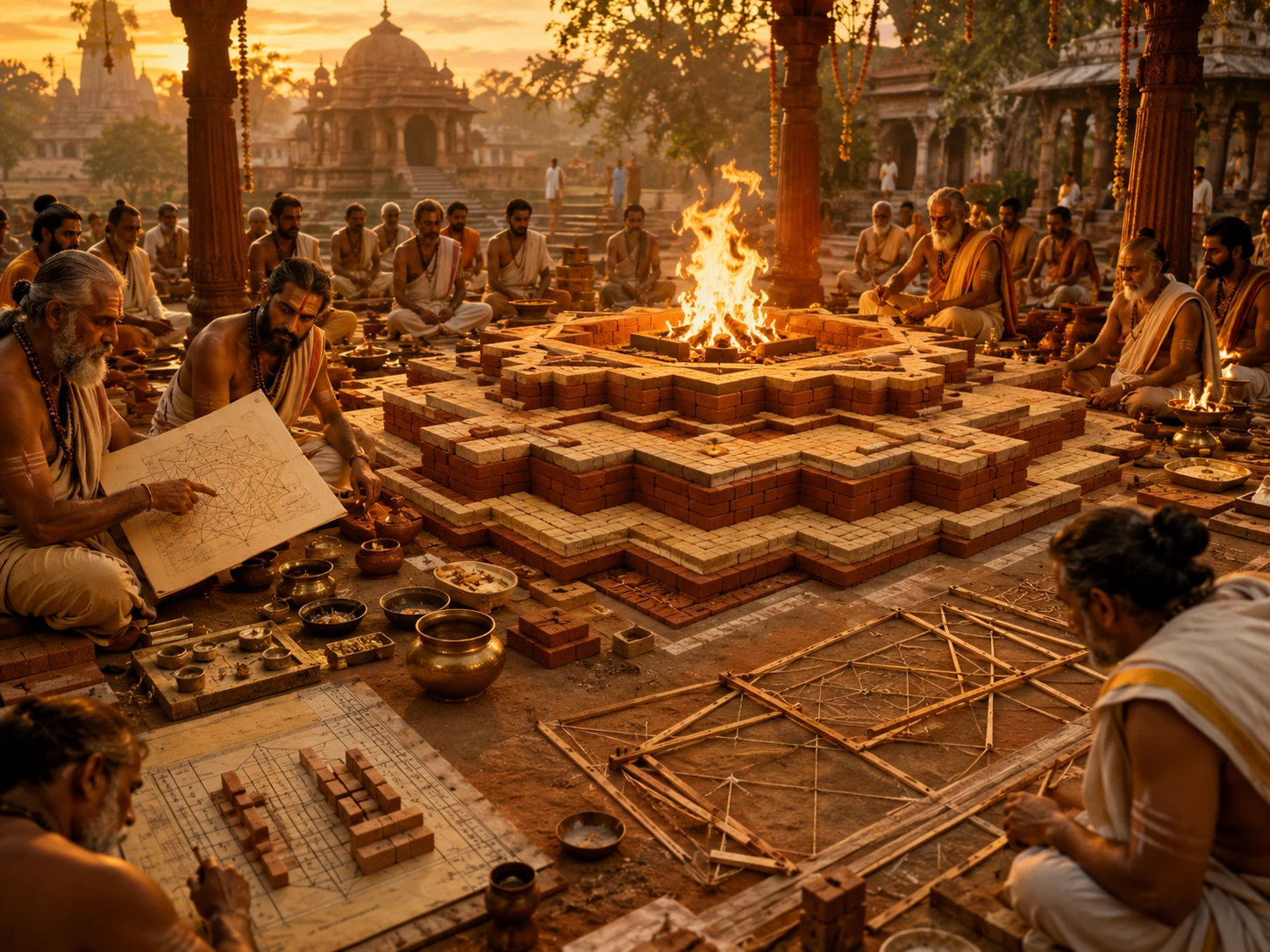
Agnichayana -- The Falcon-Shaped Fire Altar That Survived 3,000 Years
12 min read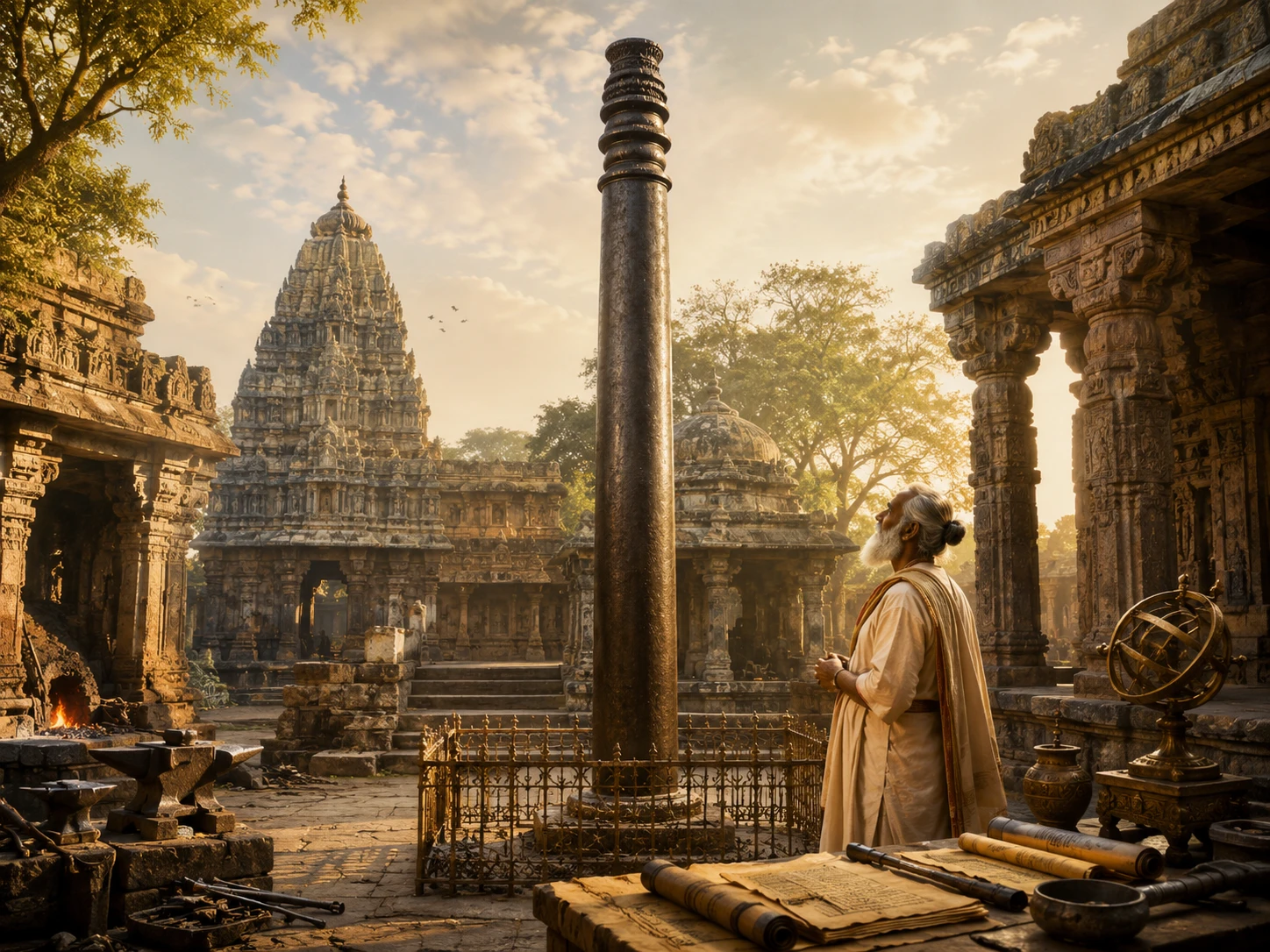
Ancient Indian Metallurgy -- The Iron Pillar That Refuses to Rust
13 min readAryabhata -- The Astronomer Who Said the Earth Turns
3 min readThe same translation error that turned '33 Koti' into '33 crore' in Hinduism also happened in Buddhism. The Chinese translation of Buddhist texts rendered 'Sapta Koti Buddha' (7 Supreme Buddhas) as '7 Crore Buddhas.' The…
Deities AvatarsCommunity Reflections
🕉️
Be the first to share your reflection.