
Vastu Shastra -- The Ancient Science of Architecture That India Still Builds By
वास्तु शास्त्र -- वास्तुकला का वह प्राचीन विज्ञान जिससे भारत आज भी निर्माण करता है
Vastu Shastra (vāstu śāstra -- literally 'science of dwelling') is the traditional Hindu system of architecture, spatial design, and urban planning. It is rooted in Vedic-era thinking and codified in Sanskrit treatises spanning over 1,500 years -- from references in the Rigveda and Atharvaveda to comprehensive manuals like the Mayamata (circa 10th-11th century CE), Manasara (5th century CE or earlier), Brihat Samhita by Varahamihira (6th century CE), and Samarangana Sutradhara by King Bhoja (11th century CE). These are not mystical pamphlets. They are technical texts with chapters on site selection, soil testing, foundation laying, room proportions, ventilation design, water drainage, and temple construction.
The fundamental premise of Vastu is straightforward: a building is not an isolated object. It exists within a web of natural forces -- solar radiation, prevailing winds, gravitational pull, magnetic fields, seasonal cycles, and water flow. A well-designed building works with these forces. A poorly designed building fights them. The occupants of the first feel comfortable, healthy, and productive. The occupants of the second feel drained, uncomfortable, and stressed -- not because of supernatural energy but because of bad design.
This is where the modern controversy begins. Over the centuries, Vastu Shastra has been overlaid with astrological correlations, numerological prescriptions, and ritualistic add-ons that have nothing to do with the original architectural texts. Scholar Vibhuti Chakrabarti, who has critically translated historic Vastu literature, notes that contemporary 'Vastu consultants' often include 'quacks, priests, and astrologers' who market superstition under the name of Vastu Vidya. The real-estate industry in Bangalore, Mumbai, and Delhi-NCR routinely uses 'Vastu-compliant' as a selling point -- often meaning little more than a northeast corner left open and a puja room in a specific location. This article focuses on what the texts actually say.
वास्तोष्पते प्रतिजानीह्यस्मान् स्वावेशो अनमीवो भवा नः। यत्त्वेमहे प्रतितन्नो जुषस्व शं नो भव द्विपदे शं चतुष्पदे॥
vāstoṣpate pratijānīhy asmān svāveśo anamīvo bhavā naḥ | yat tvemahe prati tan no juṣasva śaṁ no bhava dvipade śaṁ catuṣpade ||
O Vastospati (Lord of the dwelling), acknowledge us. May our dwelling be free from disease and full of fortune. Accept our offerings and be auspicious to both bipeds and quadrupeds.
— Rigveda 7.54.1
The central organising concept of Vastu Shastra is the Vastu Purusha Mandala -- a symbolic square grid that represents the cosmic person (Purusha) lying face-down on the building site. The grid is divided into 64 or 81 cells (padas), each governed by a specific deity. The head of the Purusha faces northeast (Ishanya -- the zone of Shiva, purity, and divine energy). The feet point southwest (Nairritya -- the zone of the demon Nirrti, heaviness, and stability). The right shoulder is northwest (Vayu -- wind), and the left shoulder is southeast (Agni -- fire).
This is not arbitrary mythology. When you strip the deity names and read the directional assignments in terms of natural phenomena, the system is remarkably functional. Northeast-facing openings maximise morning sunlight, which is rich in UV-A and beneficial for vitamin D synthesis and circadian rhythm regulation. Southeast placement of the kitchen aligns with prevailing wind patterns in the Indian subcontinent, ensuring smoke dispersal. Southwest as the heaviest zone corresponds to the structural need for load-bearing walls and thick construction to buffer afternoon heat. Northwest ventilation takes advantage of cross-breeze patterns in tropical climates.
The five elements (Pancha Mahabhuta) -- earth (prithvi), water (jala), fire (agni), air (vayu), and space (akasha) -- provide the elemental framework. Each zone of the building is associated with an element: northeast with water, southeast with fire, southwest with earth, northwest with air, and the central Brahmasthana with space (kept open as a courtyard or void). Modern green architecture calls this 'passive design' -- using the building's orientation and form to achieve comfort without mechanical systems. Vastu was doing passive design two millennia before the term existed.
The key texts form a rich library. The Manasara (5,400+ verses, 70 chapters) covers everything from town planning to iconography. The Mayamata emphasises mathematical precision -- connecting building proportions to musical harmonics. The Brihat Samhita by Varahamihira integrates Vastu with astronomy and meteorology. The Samarangana Sutradhara by King Bhoja is an 83-chapter encyclopaedia covering architecture, mechanical devices, and even automata. These are not single-author pamphlets -- they are cumulative engineering manuals refined over centuries.
The Eight Directions in Vastu -- Deities, Elements, and Modern Science
| Direction | Sanskrit Name | Governing Deity | Element | Vastu Prescription | Scientific Rationale |
|---|---|---|---|---|---|
| North | Uttara | Kubera (wealth) | Water | Open spaces, living room, valuables | North-facing rooms get diffused, non-glare light throughout the day |
| East | Purva | Indra (power) | Space | Main entrance, prayer room | Morning sun exposure -- UV-A, circadian rhythm, vitamin D |
| South | Dakshina | Yama (death) | Earth | Heavy construction, master bedroom | Blocks harsh afternoon sun; thermal mass absorbs and releases heat |
| West | Paschima | Varuna (water) | Air | Children's room, study | Evening light; buffer from hot western sun with thick walls |
| Northeast | Ishanya | Shiva (purity) | Water | Water tank, puja room, open | Maximum morning sunlight; lowest thermal load; Vastu's most 'sattvic' zone |
| Southeast | Agneya | Agni (fire) | Fire | Kitchen, electrical | Prevailing SE winds in India carry smoke away; fire near water source |
| Southwest | Nairritya | Nirrti (stability) | Earth | Heaviest rooms, storage, overhead tank | Maximum structural mass; blocks afternoon heat; anchors the building |
| Northwest | Vayavya | Vayu (wind) | Air | Guest room, garage, granary | Cross-ventilation zone; stores perishables in the coolest breeze path |
Not every Vastu prescription has a validated scientific explanation. The directional assignments work best for the Indian subcontinent's latitude (8-37°N) and monsoon climate. Applying the same rules to, say, Scandinavia or southern hemisphere locations without adaptation is architecturally unsound.
The honest conversation about Vastu requires acknowledging both what works and what does not. Research from IIT Kharagpur, Cardiff University, and CEPT Ahmedabad has found measurable correlations between Vastu-aligned buildings and improved natural ventilation, thermal comfort, and daylighting quality. The Infosys campus in Mysore -- designed by architect Hafeez Contractor -- is a LEED Platinum-certified building that also follows traditional Vastu directional guidelines. The correlation is not accidental: many Vastu principles map directly onto passive solar design, a well-established field in modern sustainable architecture.
What does not hold up is the overlay of astrology, gemstones, colour prescriptions, and punitive claims ('if your toilet is in the northeast, you will face financial ruin'). The original texts discuss proportions, orientations, and materials. They do not prescribe doom for non-compliance. The punitive dimension was added by later practitioners who merged Vastu with Jyotish (astrology) and created a fear-based consulting industry. For the young Indian professional buying a flat in Whitefield or Gurgaon, the honest advice is: Vastu's directional principles about sunlight, ventilation, and spatial flow are architecturally sound and worth considering. The astrological add-ons -- lucky colours, Vastu dosh remedies, specific room placements tied to birth charts -- are not part of the original science and should be treated with scepticism.
The Vastu Purusha Mandala -- the 9x9 grid of 81 padas -- is the same geometric framework used to design the ground plan of major Hindu temples including Kandariya Mahadeva at Khajuraho, Brihadeshwara at Thanjavur, and Angkor Wat in Cambodia. The Rigveda hymn to Vastospati (7.54.1) is one of the oldest surviving references to architectural blessing in any civilisation. The city of Jaipur, built by Maharaja Sawai Jai Singh II in 1727, was designed on a Vastu-inspired grid plan -- making it one of the earliest planned cities in modern India. IIT Kharagpur's Department of Architecture has an active research programme studying the thermal performance of traditional Vastu-aligned houses versus modern apartments, finding that traditional designs achieve 2-4°C lower indoor temperatures without air conditioning.
Explore Sacred Architecture on Eternal Raga
Vastu Shastra is one of the applied sciences of Hindu tradition. The Vedic Sciences section of Eternal Gyan explores how temple design, home architecture and town planning connect to Vedic principles.
Tags
Eternal Raga · शाश्वत राग
Institutional voice — scholarly articles on Sanatan Dharma
Deepen Your Understanding
अपनी समझ और गहरी करें
vedic sciences
Upavedas -- The Four Applied Sciences of Hindu Tradition
The Vedas gave India its philosophy and rituals. The Upavedas gave India its professions. Four applied knowledge systems -- Ayurveda (medicine), Dhanurveda (warfare), Gandharvaveda (music and performing arts), and Sthapatyaveda (architecture) -- were classified as subsidiary Vedas, each attached to one of the four main Vedas. They represent the Hindu tradition's insistence that sacred knowledge must produce practical results: a healed body, a defended nation, a beautiful performance, a well-built home. Together, the Upavedas form the intellectual infrastructure of pre-modern Indian civilisation -- from the surgeon's scalpel to the architect's blueprint to the musician's raga.
vedic sciences
Sacred City Planning -- How Hindu Scriptures Designed Cities Before the World Had Zoning Laws
Ancient India did not stumble into urban planning. The Ramayana describes Ayodhya's seven-storey buildings and water-sprinkled highways 3,000 years before Haussmann redesigned Paris. The Arthashastra lays out road widths, waste zones, and water reservoirs with the precision of a modern municipal manual. And the Manasara Shilpa Shastra names eight distinct city grid patterns -- each with a Sanskrit name, a geometric logic, and a moat system. This is not archaeology. This is scripture.
vedic sciences
Shulba Sutras -- Geometry of Sacred Altars
Centuries before Pythagoras was born, a Vedic priest named Baudhayana wrote a rule about rectangles, diagonals, and areas that would later bear a Greek mathematician's name. The Shulba Sutras are where Indian mathematics began -- not in a classroom, but at a fire altar, with a rope and a stake, solving geometry because the gods demanded precision.
vedic sciences
Panini and Ashtadhyayi -- The Science of Sanskrit Grammar
In the 5th century BCE, a man in Gandhara wrote approximately 4,000 rules that could generate every valid sentence in Sanskrit. No exceptions. No ambiguity. His system anticipated formal grammar, programming languages, and natural language processing by two and a half millennia. His name was Panini, and his Ashtadhyayi is not a grammar book -- it is an algorithm.
vedic sciences
Jyotish Shastra -- The Vedic System of Astronomy and Astrology That India Never Stopped Using
Every year, millions of Indian marriages are fixed only after the kundali matches. ISRO times its satellite launches on muhurtas. JEE students wear navagraha rings. Real-estate agents check Rahu-Ketu transits before closing deals. Whether you believe in it or not, Jyotish Shastra -- the Vedic science of light, time, and celestial influence -- is the most actively practised ancient knowledge system in India today. It spans 9 Grahas, 12 Rashis, 27 Nakshatras, and 2,500 years of continuous mathematical and observational tradition. This article explains the system as the texts describe it -- not as a prediction engine, but as a framework for understanding time, cycles, and the relationship between the cosmos and human life.
vedic sciences
Shad Vedangas -- The Six Limbs of the Veda
The Vedas are not a single book you can pick up and read. They are a living system with six auxiliary sciences -- phonetics, metre, grammar, etymology, astronomy, and ritual procedure -- that function like limbs of a body. Without them, the Vedas are a voice without a mouth, a path without eyes. Here is the operating manual India's knowledge system ran on for three thousand years.
vedic sciences
Ayurveda -- The 3,000-Year-Old Science That Knows Your Body Type Before You Do
Long before personalised medicine became a Silicon Valley buzzword, the Charaka Samhita classified every human being into one of seven constitutional types based on three biological forces -- Vata, Pitta, and Kapha. Modern genomic studies at CSIR-IGIB have found that these ancient types correlate with distinct gene expression profiles. Ayurveda did not guess. It observed.
The Vastu Purusha Mandala -- the 9x9 grid of 81 padas -- is the same geometric framework used to design the ground plan of major Hindu temples including Kandariya Mahadeva at Khajuraho, Brihadeshwara at Thanjavur, and An…
More in Vedic Sciences
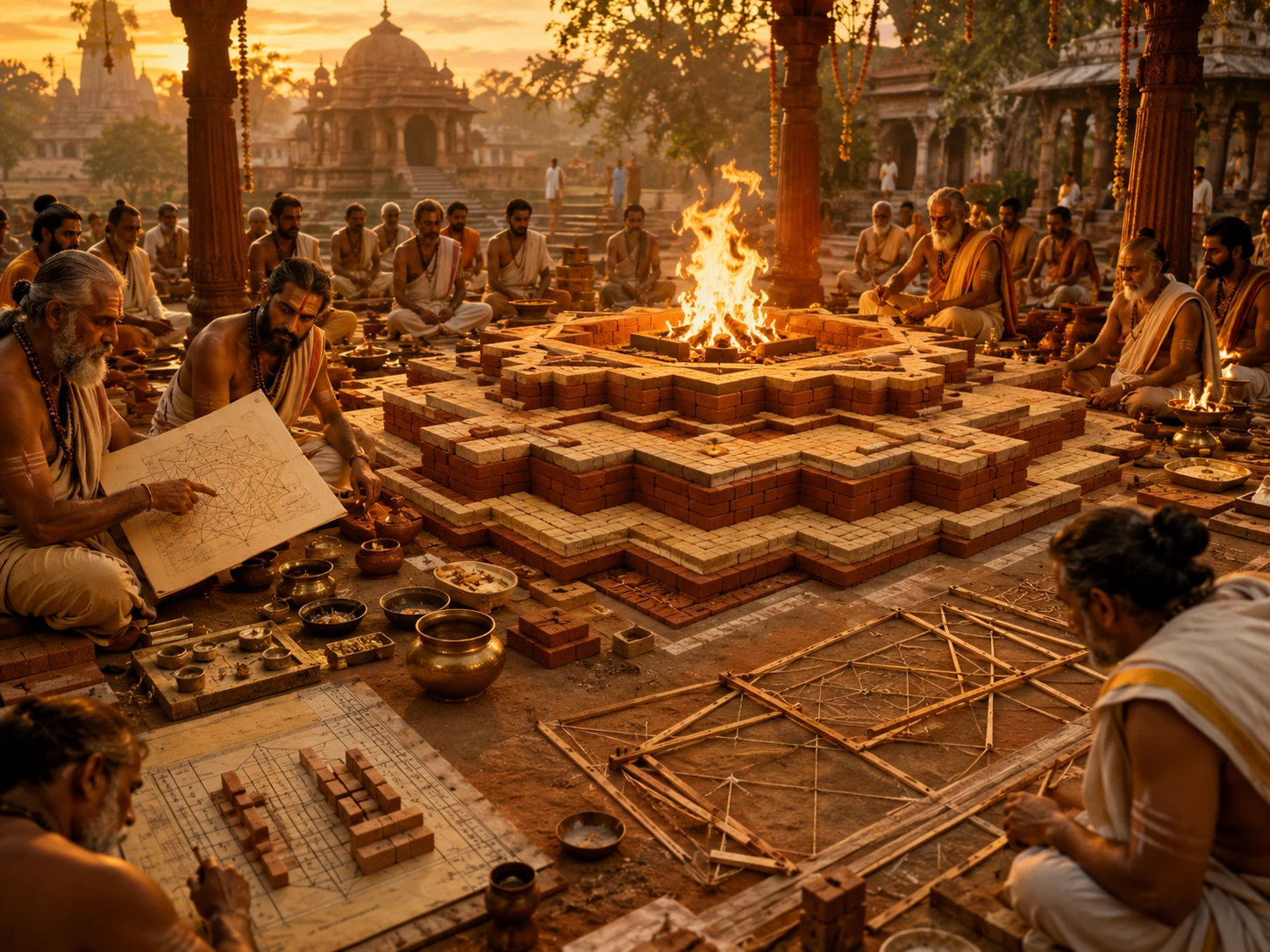
Agnichayana -- The Falcon-Shaped Fire Altar That Survived 3,000 Years
12 min read
Ancient Indian Metallurgy -- The Iron Pillar That Refuses to Rust
13 min readAryabhata -- The Astronomer Who Said the Earth Turns
3 min readThe same translation error that turned '33 Koti' into '33 crore' in Hinduism also happened in Buddhism. The Chinese translation of Buddhist texts rendered 'Sapta Koti Buddha' (7 Supreme Buddhas) as '7 Crore Buddhas.' The…
Deities AvatarsCommunity Reflections
🕉️
Be the first to share your reflection.