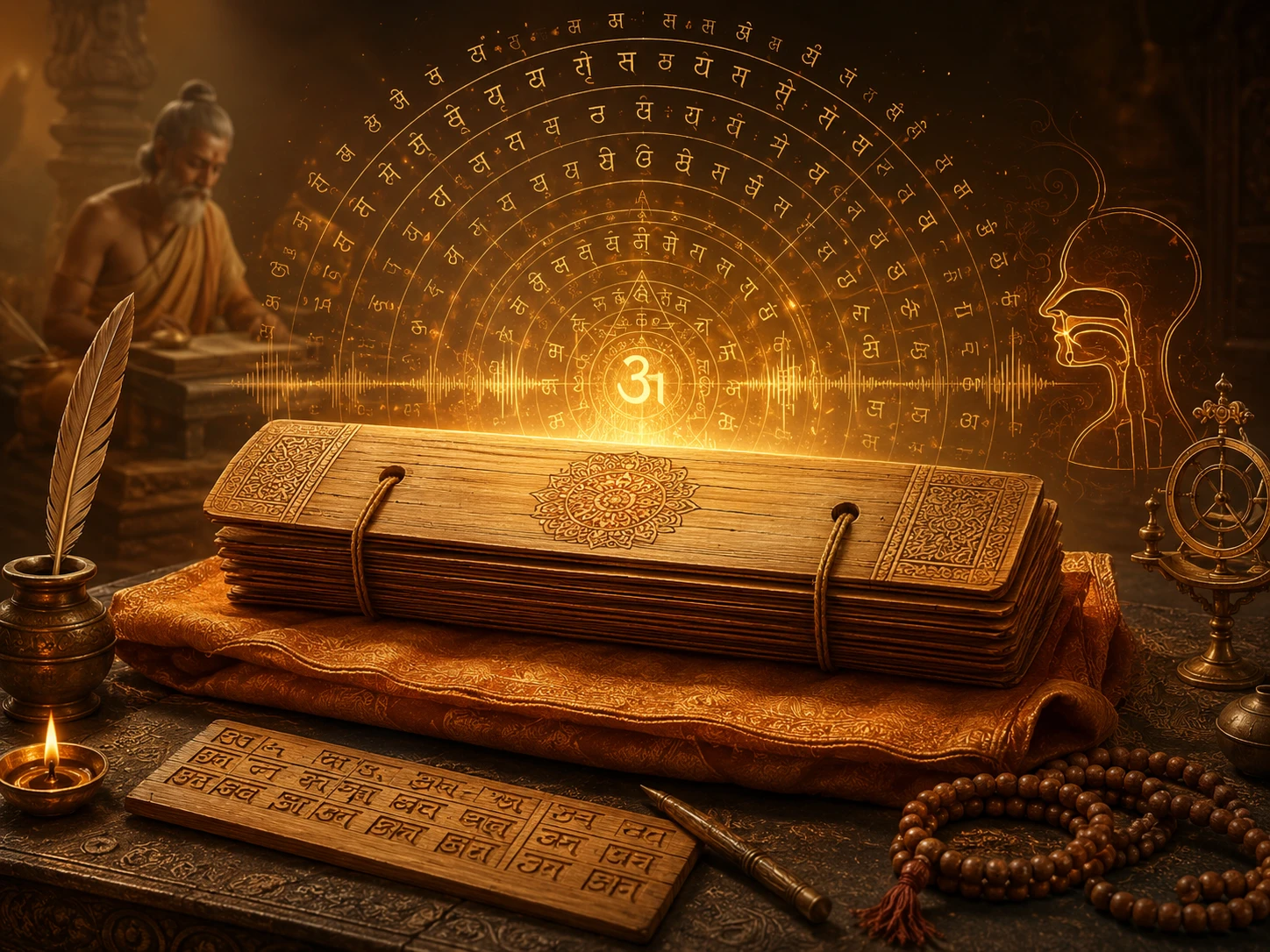
Panini and Ashtadhyayi -- The Science of Sanskrit Grammar
पाणिनि और अष्टाध्यायी -- संस्कृत व्याकरण का विज्ञान
Open any textbook on the history of linguistics and you will find a curious fact: the field's founding father is not European. He is not from the Enlightenment. He did not write in Greek, Latin, or English. The man most linguists acknowledge as the first descriptive and generative grammarian in human history was born in Shalatula, a village near Taxila in ancient Gandhara (present-day northwestern Pakistan), sometime between the 6th and 4th centuries BCE. His name was Panini.
His work, the Ashtadhyayi -- literally 'Eight Chapters' -- consists of approximately 3,959 sutras (some recensions count slightly more or fewer) distributed across 32 sections. Each sutra is a compressed rule, often just a few syllables long, that describes how Sanskrit words are formed, modified, and combined. The entire text can be recited in about two hours. But unpacking its logic has occupied scholars for over two thousand years and counting.
What makes the Ashtadhyayi extraordinary is not that it describes Sanskrit grammar. Several grammarians existed before Panini -- he himself cites at least ten predecessors including Yaska, Shakalya, and Sphotayana. What makes it extraordinary is how it describes grammar. The Ashtadhyayi does not merely list rules. It is a formal system -- a self-contained, internally consistent machine that takes root words and affixes as input and produces grammatically correct words and sentences as output. It uses meta-rules (rules about rules), definitions (samjna sutras), operational rules (vidhi sutras), and domain-scoping rules (adhikara sutras) in a layered architecture that computer scientists would instantly recognise as a production system.
Britannica notes that the Ashtadhyayi has been likened to a Turing machine -- the abstract mathematical model that defines the logical structure of any computer. This is not hyperbole. Panini invented variables, recursion, and context-sensitive rule application twenty-five centuries before any of those terms existed in Western thought.
अइउण्। ऋऌक्। एओङ्। ऐऔच्। हयवरट्। लण्। ञमङणनम्। झभञ्। घढधष्। जबगडदश्। खफछठथचटतव्। कपय्। शषसर्। हल्॥
a i u ṇ | ṛ ḷ k | e o ṅ | ai au c | ha ya va ra ṭ | la ṇ | ña ma ṅa ṇa na m | jha bha ñ | gha ḍha dha ṣ | ja ba ga ḍa da ś | kha pha cha ṭha tha ca ṭa ta v | ka pa y | śa ṣa sa r | ha l ||
These are the fourteen Maheshvara Sutras -- the phonemic inventory of Sanskrit organised by Panini into pratyahara-capable groups. Tradition holds that these sounds emerged from the beats of Shiva's damaru (drum). Each line ends with a 'marker' letter (anubandha) that allows Panini to refer to entire groups of sounds with a single two-syllable abbreviation.
— Maheshvara Sutras (Shiva Sutras), prefixed to Panini's Ashtadhyayi
The Architecture of the Ashtadhyayi
The Ashtadhyayi is built on three foundation texts. The Maheshvara Sutras (Shiva Sutras) are 14 lines that organise every sound in Sanskrit into a notational system. Using a technique called pratyahara, Panini can refer to any subset of sounds with just two syllables -- the starting sound and the ending marker. The pratyahara 'aC', for example, covers all vowels. 'haL' covers all consonants. This is the world's first indexing system for phonemes, and it works exactly like array slicing in a programming language.
The Dhatupatha is a list of approximately 2,000 verb roots (dhatu), each annotated with its meaning and conjugation class. It is the raw material -- the database -- that the Ashtadhyayi's rules operate on.
The Ganapatha is a list of nominal stems grouped by shared grammatical behaviour. When Panini's rules say 'words belonging to group X behave as follows', the Ganapatha is where group X is defined.
The 3,959 sutras themselves fall into several types. Samjna sutras define technical terms (like a header file in C). Paribhasha sutras are meta-rules that tell you how to read other rules (like a compiler's parsing directives). Vidhi sutras are operational rules that actually transform input into output (like functions). Adhikara sutras set the scope for a group of following rules (like a namespace or module declaration). And Atidesha sutras transfer the properties of one element to another (like inheritance in object-oriented programming).
The intellectual density is staggering. The sutra 'vriddhir adaic' -- three syllables -- defines the set of 'vriddhi' vowels as the sounds a, ai, and au. Every subsequent rule that references vriddhi inherits this definition automatically. There is no redundancy. No repetition. Every syllable earns its place.
The tradition that followed Panini produced two monumental commentaries: the Varttikas of Katyayana (roughly 3rd century BCE), which refine and occasionally correct Panini's rules; and the Mahabhashya of Patanjali (roughly 2nd century BCE), which is the most comprehensive commentary and is itself considered one of the greatest works of Sanskrit scholarship. Together, Panini, Katyayana, and Patanjali are known as the 'Muni Traya' -- the Three Sages of grammar.
Panini's Ashtadhyayi vs Modern Computing Concepts
| Panini's Concept | Sanskrit Term | Modern Computing Parallel | Example |
|---|---|---|---|
| Phoneme indexing via pratyahara | प्रत्याहार | Array slicing / regex character classes | 'aC' = all vowels; similar to [aeiou] in regex |
| Technical term definition | संज्ञा सूत्र | Header files / type definitions | 'vriddhi' defined once, used everywhere |
| Meta-rules for interpretation | परिभाषा सूत्र | Compiler directives / parsing rules | Rules for resolving conflicts between sutras |
| Operational transformation rules | विधि सूत्र | Functions / production rules | Add suffix '-tva' to form abstract nouns |
| Scope-setting rules | अधिकार सूत्र | Namespace / module scope | 'In the domain of verb forms...' applies to next N rules |
| Property inheritance | अतिदेश सूत्र | OOP inheritance / duck typing | A substitute inherits properties of the original |
| Marker letters (anubandha) | अनुबन्ध / इत् | Metadata tags / annotations | Silent letters that encode grammatical properties |
| Root + affix system | धातु + प्रत्यय | Morphological parser / tokenizer | Root 'gam' + suffix '-ta' = 'gata' (gone) |
These parallels are not analogies. They are structural isomorphisms identified by linguists and computer scientists including Kiparsky, Staal, and Cardona.
Panini's Legacy in the Modern World
When Ferdinand de Saussure, the father of modern Western linguistics, studied Sanskrit in the 1870s, he was directly exposed to the Paninian grammatical tradition. The structural approach that Saussure brought to European linguistics -- the idea that language is a system of interrelated signs -- has deep roots in the Indian grammatical tradition. Noam Chomsky's transformational-generative grammar, which revolutionised linguistics in the 1950s, shares structural principles with Panini's system, though Chomsky developed his theory independently.
In computer science, Panini's influence is more explicit. The Backus-Naur Form (BNF), used universally to define programming language syntax, works on the same principle as Panini's sutras -- compressed rules that generate valid strings from a defined grammar. When Google, OpenAI, or Anthropic build language models, the foundational concept -- that language can be described by formal rules operating on a finite set of elements -- is a concept Panini formalised first.
In India, Panini's legacy runs deeper than academia. The tradition of vyakarana-shastra (grammatical science) was one of the most prestigious intellectual disciplines for two millennia. To be called a vaiyakarana (grammarian) was a mark of the highest scholarship. The tradition influenced not just Sanskrit but all major Indian languages -- Hindi, Marathi, Tamil, Telugu, Kannada -- whose grammars were modelled on Paninian principles. Even today, students of Sanskrit in any Indian university begin with the Ashtadhyayi.
For a young coder in Bengaluru writing a context-free grammar for a new DSL, or a JEE aspirant in Kota trying to parse a complex sentence in an English comprehension passage, or a UPSC aspirant in Delhi memorising the Vedangas for GS Paper 1 -- Panini is not ancient history. He is the original architect of the idea that language has structure, that structure can be described by rules, and that rules can generate infinite possibilities from finite components. That is not grammar. That is computer science. And Panini got there first.
Panini's Ashtadhyayi contains the earliest known use of the 'zero' or 'null' element in a formal system. His rule 'tasya lopah' (1.3.9) -- meaning 'there is deletion (lopa) of that' -- describes how marker letters are elided in the final output. This concept of a 'null transformation' -- something that exists in the system but disappears in the result -- is structurally identical to the null pointer in programming and the zero morpheme in modern morphology. Some scholars credit Panini with the conceptual groundwork for the mathematical zero that Brahmagupta would formalise centuries later.
Chant the Maheshvara Sutras
The fourteen Maheshvara Sutras, beginning a-i-u-ṇ, are the phonemic alphabet that Panini's grammar is built on, said to have sounded from Shiva's drum. Chant them aloud, one sutra to a breath. They open the Ashtadhyayi on Eternal Raga, with Sanskrit and translation.
Tags
Eternal Raga · शाश्वत राग
Institutional voice — scholarly articles on Sanatan Dharma
Deepen Your Understanding
अपनी समझ और गहरी करें
vedic sciences
Shad Vedangas -- The Six Limbs of the Veda
The Vedas are not a single book you can pick up and read. They are a living system with six auxiliary sciences -- phonetics, metre, grammar, etymology, astronomy, and ritual procedure -- that function like limbs of a body. Without them, the Vedas are a voice without a mouth, a path without eyes. Here is the operating manual India's knowledge system ran on for three thousand years.
vedic sciences
Shulba Sutras -- Geometry of Sacred Altars
Centuries before Pythagoras was born, a Vedic priest named Baudhayana wrote a rule about rectangles, diagonals, and areas that would later bear a Greek mathematician's name. The Shulba Sutras are where Indian mathematics began -- not in a classroom, but at a fire altar, with a rope and a stake, solving geometry because the gods demanded precision.
vedic sciences
Kaal Ganana -- The Hindu Measure of Time
From a single blink of the eye (Nimesha) to one Day of Brahma (4.32 billion years) -- explore the complete cosmic time hierarchy of Hindu cosmology, anchored in Vishnu Purana 1.3, with its remarkable parallels to modern science.
scriptural exegesis
Shastra Vriksha -- The Complete Map of Hindu Scriptures
Vedas, Upanishads, Puranas, Gita -- everyone has heard these names, but almost nobody knows how they connect to each other. Shastra Vriksha is the GPS of Hindu scripture -- a single interactive tree that maps every major text, from the root of the four Vedas to the 126 catalogued Gitas, and finally makes the whole system click.
philosophy darshana
Atman and Brahman -- The Self and the Absolute
The Upanishads make a claim so radical that 3,000 years have not dulled its edge: the individual self (Atman) and the ultimate reality of the universe (Brahman) are not two different things. They are one. Every school of Hindu philosophy is essentially an argument about what this identity means.
philosophy darshana
Yoga Darshana -- Patanjali's Science of the Mind
Before yoga became a global fitness trend worth $80 billion, it was India's most rigorous system of psychology. Patanjali's 196 sutras are not about touching your toes -- they are about rewiring your mind. Here is the philosophy the world forgot when it turned yoga into exercise.
Panini's Ashtadhyayi contains the earliest known use of the 'zero' or 'null' element in a formal system. His rule 'tasya lopah' (1.3.9) -- meaning 'there is deletion (lopa) of that' -- describes how marker letters are el…
More in Vedic Sciences

Agnichayana -- The Falcon-Shaped Fire Altar That Survived 3,000 Years
12 min read
Ancient Indian Metallurgy -- The Iron Pillar That Refuses to Rust
13 min readAryabhata -- The Astronomer Who Said the Earth Turns
3 min readThe same translation error that turned '33 Koti' into '33 crore' in Hinduism also happened in Buddhism. The Chinese translation of Buddhist texts rendered 'Sapta Koti Buddha' (7 Supreme Buddhas) as '7 Crore Buddhas.' The…
Deities AvatarsCommunity Reflections
🕉️
Be the first to share your reflection.