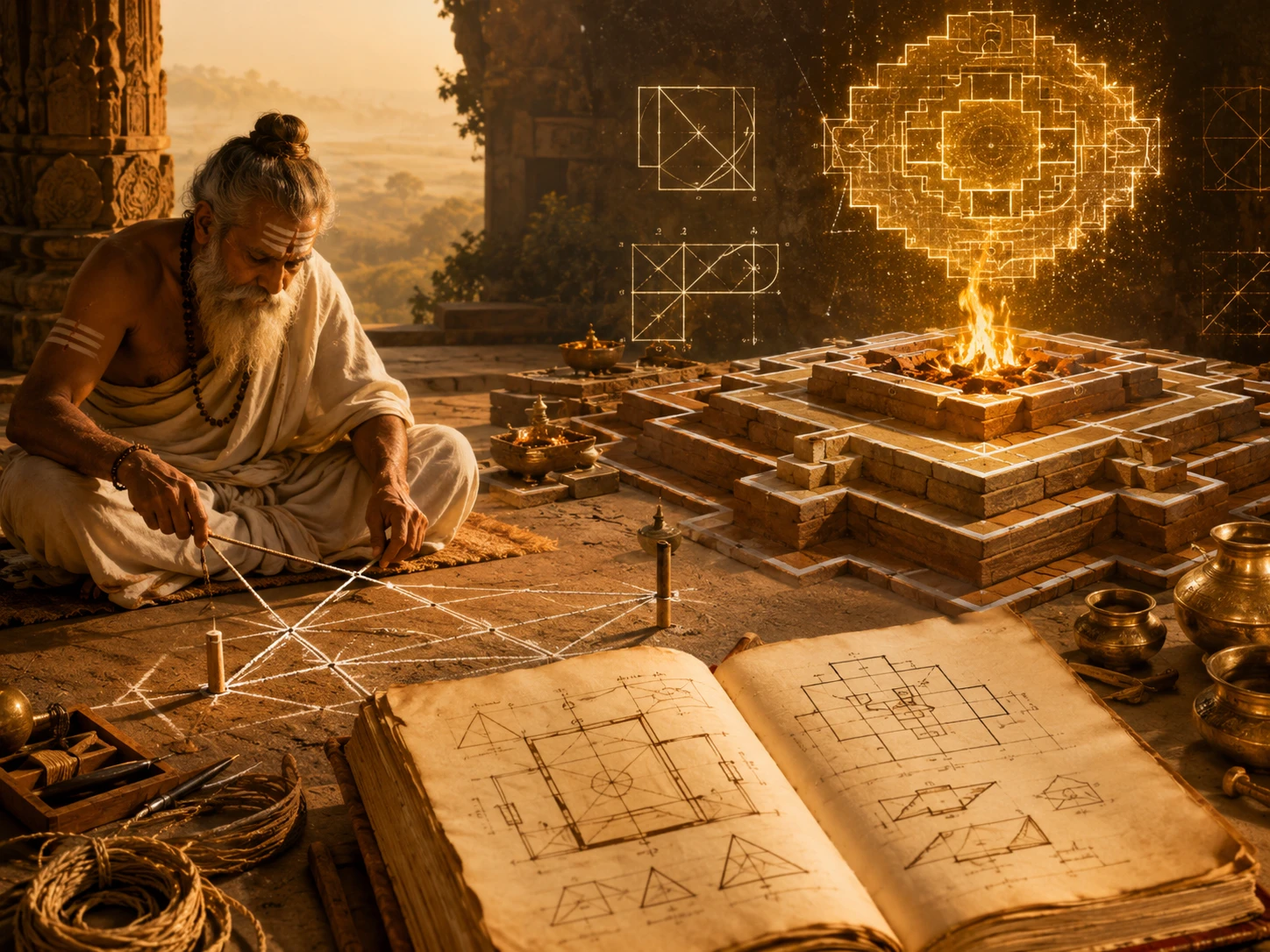
Shulba Sutras -- Geometry of Sacred Altars
शुल्ब सूत्र -- पवित्र वेदियों की ज्यामिति
Here is a question that should bother every student who has ever sat through a geometry class in an Indian school: why is it called the Pythagorean theorem?
Pythagoras of Samos, the Greek mathematician and philosopher, lived approximately 570 to 495 BCE. His theorem -- that in a right-angled triangle, the square of the hypotenuse equals the sum of the squares of the other two sides -- is one of the most fundamental results in all of mathematics. It is taught in every school on the planet. It appears in every competitive exam from the 10th-board level to JEE Advanced. And it bears his name.
But Baudhayana, a Vedic priest and mathematician, stated the same result in his Shulba Sutra sometime between 800 and 600 BCE -- that is, at least a century before Pythagoras, and possibly three centuries before. The text is not hidden. The verse is not ambiguous. And the context is extraordinary: Baudhayana was not doing abstract mathematics. He was building fire altars for Vedic rituals, and the geometry emerged because the rituals demanded exact shapes and areas.
The Shulba Sutras (from 'shulba' meaning rope or cord) are a group of texts belonging to the Kalpa Vedanga -- the branch of Vedic auxiliary sciences that deals with ritual procedure. They are part of the larger Shrauta Sutras, which govern the performance of major Vedic sacrifices. The four mathematically significant Shulba Sutras are attributed to Baudhayana, Apastamba, Katyayana, and Manava. Their language is late Vedic Sanskrit, placing them firmly in the first millennium BCE.
What makes the Shulba Sutras remarkable is not just that they contain early mathematical results. It is that they contain these results as applied engineering. Every theorem, every construction, every approximation in these texts exists because a specific ritual required a specific altar of a specific shape and area -- and getting it wrong was not a mathematical error but a religious failure.
दीर्घचतुरस्रस्याक्ष्णया रज्जुः पार्श्वमानी तिर्यग्मानी च यत्पृथग्भूते कुरुतस्तदुभयं करोति॥
dīrghacatursrasyākṣṇayā rajjuḥ pārśvamānī tiryagmānī ca yatpṛthagbhūte kurutastadubhayaṃ karoti ||
The diagonal rope (akshnya rajju) of a rectangle produces by itself both the areas that the vertical side (parshvamani) and the horizontal side (tiryagmani) produce separately.
— Baudhayana Shulba Sutra, 1.48
Decoding Baudhayana's Statement
Let us unpack the verse word by word. Dirghachaturasra means rectangle (literally 'long four-sided'). Akshnya rajju means diagonal rope. Parshvamani is the vertical side. Tiryagmani is the horizontal side. Prithagbhute means 'separately' or 'independently'. Kuruta means 'produces'. Tadubhayam karoti means 'it does both'.
The statement says: the square on the diagonal of a rectangle equals the sum of the squares on its two sides. This is the Pythagorean theorem -- stated in the language of rope-and-stake geometry, not as an abstract formula, but as a construction procedure for altar builders.
Baudhayana goes further. He also states the specific case for a square: 'The cord stretched across the diagonal of a square produces an area double the size of the original square.' This is the isosceles right triangle case -- the diagonal of a unit square is the square root of 2.
And then comes one of the most extraordinary results in ancient mathematics. Baudhayana gives an approximation of the square root of 2:
The square root of 2 is approximately 1 + 1/3 + 1/(3 times 4) - 1/(3 times 4 times 34)
This equals approximately 1.4142156, which is accurate to five decimal places. The modern value is 1.4142135. The error is about 0.000002 -- an astonishing level of precision for a text from the 8th century BCE.
The Shulba Sutras also contain extensive lists of Pythagorean triples -- sets of three integers that satisfy the theorem. Apastamba's Shulba Sutra lists the triples (3,4,5), (5,12,13), (8,15,17), (12,16,20), and (12,35,37), among others. These were used for constructing right angles during altar building -- you stretch ropes of these lengths to form a precise 90-degree angle.
Did Baudhayana discover the theorem independently, or did it diffuse from Mesopotamia, where similar results appear in Babylonian clay tablets from 1800 BCE? Scholars disagree. What is not in dispute is that the Shulba Sutras contain the earliest known explicit verbal statement of the theorem in any civilisation, and they apply it systematically to a wide range of geometric constructions.
The Four Major Shulba Sutras
| Author | Approximate Date | Veda Affiliation | Key Mathematical Contributions |
|---|---|---|---|
| Baudhayana | 800-600 BCE (oldest) | Krishna Yajurveda (Taittiriya) | Pythagorean theorem statement; sqrt(2) to 5 decimals; square-to-circle transformation; geometric constructions |
| Apastamba | 600-400 BCE | Krishna Yajurveda (Taittiriya) | Refined Pythagorean triples (3-4-5, 5-12-13, 8-15-17, etc.); practical right-angle construction methods |
| Katyayana | 400-200 BCE (after Panini) | Shukla Yajurveda | General statement of theorem with 'kshetrajnanam' (area-knowledge) tag; circle-squaring approximations |
| Manava | 700-500 BCE | Krishna Yajurveda | Altar construction methods; approximate pi values ranging from 2.99 to 3.2 |
All four texts serve the same ritual purpose: providing exact geometric constructions for Vedic fire altars of prescribed shapes and areas.
Ritual Geometry -- When Shape Was Destiny
The Shulba Sutras were not academic exercises. Every geometric construction in them was driven by a specific ritual requirement. The Vedic tradition held that the shape of a fire altar determined the nature of the divine gift received by the sacrificer. A falcon-shaped altar (shyenachiti) was prescribed for one who desires heaven. A tortoise-shaped altar (kurmachiti) for one seeking the world of Brahman. A rhombus-shaped altar for one who wishes to destroy enemies. A circular altar for general prosperity.
The construction rules are astonishingly precise. The total area of the altar had to be maintained exactly even when the shape changed. If you wanted a falcon altar of 7.5 square purushas (a standard Vedic unit), you needed to construct a complex bird shape -- with body, wings, and tail -- whose total area was exactly 7.5 square purushas. Not approximately. Exactly. And the Shulba Sutras tell you how to do it with nothing but a rope (shulba), stakes (shanku), and geometric reasoning.
This is where the Pythagorean theorem became essential. To construct right angles accurately, you need the relationship between the sides and diagonal of a rectangle. To transform a square into a circle of equal area (or vice versa), you need approximations of pi and sqrt(2). To double the area of an altar without changing its shape, you need to scale it by sqrt(2). Every one of these needs drove the development of the geometric results we find in the Sutras.
Archaeological evidence supports the practice. A large falcon-shaped fire altar dating to the 2nd century BCE was discovered in excavations at Kausambi. In parts of southern India, particularly in Kerala, the tradition of agnicayana (fire-altar ritual) survived into the 20th century, providing a living link to the geometric practices described in the Shulba Sutras.
Why This Matters Today
The Shulba Sutras challenge two common assumptions. First, they challenge the assumption that mathematics began in Greece. Indian mathematics has a Vedic-period origin that is independent, sophisticated, and applied. Baudhayana's work predates not just Pythagoras but also Euclid by several centuries. Second, they challenge the assumption that ancient Indian science was 'spiritual' rather than 'rigorous'. The Shulba Sutras are as rigorous as any applied mathematics text. They state results, provide construction procedures, list numerical cases, and give approximations with quantifiable accuracy.
For a JEE aspirant in Kota, the Shulba Sutras are a reminder that the geometry problems in your exam paper have Indian roots that go back three millennia. The next time you apply the Pythagorean theorem in a coordinate geometry problem, you are using a result that an Indian priest figured out while building a fire altar in the shape of a falcon -- because the gods demanded precision, and precision demanded mathematics.
For a civil engineer or architect, the Shulba Sutras are an early example of construction mathematics -- geometry driven by structural requirements, not theoretical curiosity. For a UPSC aspirant, they are a crucial piece of India's scientific heritage that deserves the same respect as Aryabhata and Brahmagupta.
The rope has been measured. The altar has been built. The theorem endures.
Baudhayana's approximation of the square root of 2 -- computed as 1 + 1/3 + 1/(3x4) - 1/(3x4x34), yielding 1.4142156 -- is accurate to five decimal places and is the most precise such approximation from the ancient world. For comparison, the Babylonians (c. 1800 BCE) achieved accuracy to about six decimal places using a different method on the Yale tablet YBC 7289. Baudhayana's method, however, is algorithmically different and expressed as a series of fractions that can be extended indefinitely -- essentially an early form of what mathematicians now call a convergent series.
Explore Vedic Sciences on Eternal Raga
Dive deeper into the mathematical and scientific heritage of the Vedas. Explore the Eternal Gyan Vedic Sciences section for more articles on Kaal Ganana, Shad Vedangas, and Panini's Ashtadhyayi.
Tags
Eternal Raga · शाश्वत राग
Institutional voice — scholarly articles on Sanatan Dharma
Deepen Your Understanding
अपनी समझ और गहरी करें
vedic sciences
Shad Vedangas -- The Six Limbs of the Veda
The Vedas are not a single book you can pick up and read. They are a living system with six auxiliary sciences -- phonetics, metre, grammar, etymology, astronomy, and ritual procedure -- that function like limbs of a body. Without them, the Vedas are a voice without a mouth, a path without eyes. Here is the operating manual India's knowledge system ran on for three thousand years.
vedic sciences
Panini and Ashtadhyayi -- The Science of Sanskrit Grammar
In the 5th century BCE, a man in Gandhara wrote approximately 4,000 rules that could generate every valid sentence in Sanskrit. No exceptions. No ambiguity. His system anticipated formal grammar, programming languages, and natural language processing by two and a half millennia. His name was Panini, and his Ashtadhyayi is not a grammar book -- it is an algorithm.
vedic sciences
Kaal Ganana -- The Hindu Measure of Time
From a single blink of the eye (Nimesha) to one Day of Brahma (4.32 billion years) -- explore the complete cosmic time hierarchy of Hindu cosmology, anchored in Vishnu Purana 1.3, with its remarkable parallels to modern science.
scriptural exegesis
Shastra Vriksha -- The Complete Map of Hindu Scriptures
Vedas, Upanishads, Puranas, Gita -- everyone has heard these names, but almost nobody knows how they connect to each other. Shastra Vriksha is the GPS of Hindu scripture -- a single interactive tree that maps every major text, from the root of the four Vedas to the 126 catalogued Gitas, and finally makes the whole system click.
philosophy darshana
Atman and Brahman -- The Self and the Absolute
The Upanishads make a claim so radical that 3,000 years have not dulled its edge: the individual self (Atman) and the ultimate reality of the universe (Brahman) are not two different things. They are one. Every school of Hindu philosophy is essentially an argument about what this identity means.
philosophy darshana
Yoga Darshana -- Patanjali's Science of the Mind
Before yoga became a global fitness trend worth $80 billion, it was India's most rigorous system of psychology. Patanjali's 196 sutras are not about touching your toes -- they are about rewiring your mind. Here is the philosophy the world forgot when it turned yoga into exercise.
Baudhayana's approximation of the square root of 2 -- computed as 1 + 1/3 + 1/(3x4) - 1/(3x4x34), yielding 1.4142156 -- is accurate to five decimal places and is the most precise such approximation from the ancient world…
More in Vedic Sciences

Agnichayana -- The Falcon-Shaped Fire Altar That Survived 3,000 Years
12 min read
Ancient Indian Metallurgy -- The Iron Pillar That Refuses to Rust
13 min readAryabhata -- The Astronomer Who Said the Earth Turns
3 min readThe same translation error that turned '33 Koti' into '33 crore' in Hinduism also happened in Buddhism. The Chinese translation of Buddhist texts rendered 'Sapta Koti Buddha' (7 Supreme Buddhas) as '7 Crore Buddhas.' The…
Deities AvatarsCommunity Reflections
🕉️
Be the first to share your reflection.