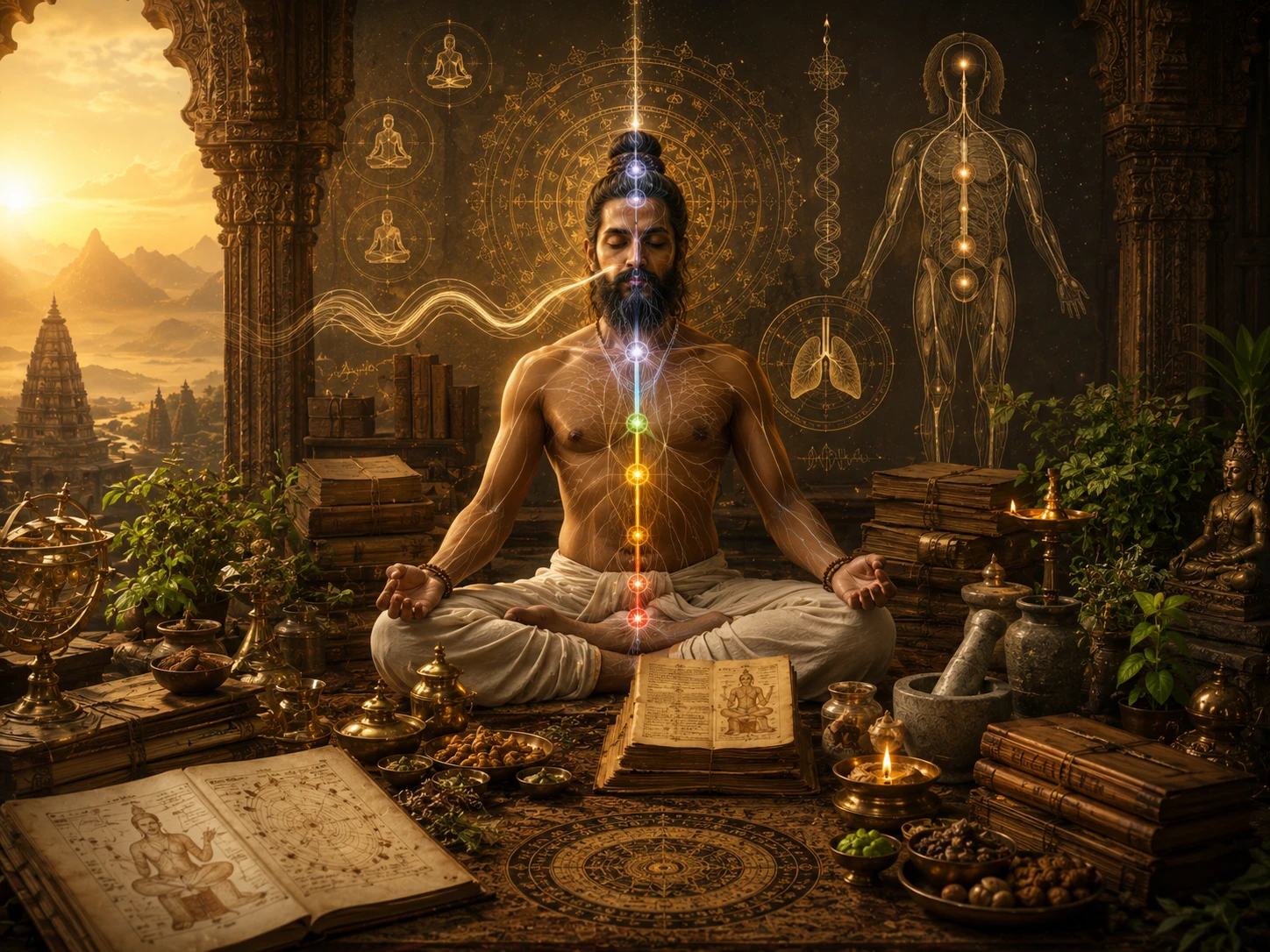
The Science Behind Yoga -- From Patanjali's 196 Sutras to NIMHANS Brain Scans
योग के पीछे का विज्ञान -- पतंजलि के 196 सूत्रों से NIMHANS के ब्रेन स्कैन तक
The word 'yoga' comes from the Sanskrit root 'yuj' -- to yoke, to unite, to join. In its earliest Vedic usage, it referred to the yoking of horses to a chariot. By the time of the Katha Upanishad (circa 5th century BCE), it had been repurposed as a metaphor for disciplining the senses -- the charioteer (intellect) controlling the horses (senses) that pull the chariot (body) carrying the Self. By the time Patanjali compiled the Yoga Sutras (circa 2nd century BCE to 4th century CE -- dating is debated), the word had acquired its technical meaning: a systematic methodology for stilling the mind and realising the Self.
Patanjali's Yoga Sutras consist of 196 aphorisms (sutras) divided into four chapters (padas): Samadhi Pada (on concentration and the nature of yoga), Sadhana Pada (on practice), Vibhuti Pada (on powers and accomplishments), and Kaivalya Pada (on liberation). The text is extraordinarily compressed. Each sutra is a seed -- designed to be memorised, chanted, and then unpacked through commentary. The entire text can be printed on about 10 pages. The commentaries fill libraries.
The defining statement is Sutra 1.2: 'yogash chitta vritti nirodhah' -- yoga is the cessation of the modifications of the mind-field. This is not a description of physical postures. It is a definition of a mental state. The entire eight-limbed system that follows -- the Ashtanga framework -- exists to bring about this cessation. Asana (physical posture) is one tool among eight. Pranayama (breath regulation) is another. The final three -- Dharana (concentration), Dhyana (meditation), and Samadhi (absorption) -- are the inner core. Most of what the global yoga industry teaches is limb three of eight. The remaining seven limbs are where the science actually is.
योगश्चित्तवृत्तिनिरोधः॥
yogaś citta-vṛtti-nirodhaḥ ||
Yoga is the cessation (nirodha) of the modifications (vritti) of the mind-field (chitta).
— Yoga Sutras of Patanjali, 1.2
The Eight Limbs of Yoga (Ashtanga) -- The Complete System
| Limb | Sanskrit | English | What It Trains | Modern Parallel |
|---|---|---|---|---|
| 1 | Yama | Ethical restraints | Social conduct: non-violence, truth, non-stealing, celibacy/continence, non-possessiveness | Professional ethics codes; corporate governance principles |
| 2 | Niyama | Personal observances | Self-discipline: cleanliness, contentment, austerity, self-study, surrender to the divine | Morning routines; journaling; self-improvement protocols |
| 3 | Asana | Physical posture | Body: stability and comfort in seated position; strength and flexibility | The global yoga-studio industry -- 90% of what people call 'yoga' |
| 4 | Pranayama | Breath regulation | Autonomic nervous system: extending and controlling the breath cycle | Box breathing (Navy SEALs); Wim Hof method; NIMHANS research on vagal tone |
| 5 | Pratyahara | Sense withdrawal | Sensory processing: detaching attention from external sensory inputs | Digital detox; deep-focus protocols; sensory deprivation tanks |
| 6 | Dharana | Concentration | Attention: fixing the mind on a single point -- mantra, flame, breath | Flow state research (Csikszentmihalyi); attention training in cognitive psychology |
| 7 | Dhyana | Meditation | Sustained awareness: unbroken flow of attention toward the object of concentration | Mindfulness-based stress reduction (MBSR); Vipassana; AIIMS meditation studies |
| 8 | Samadhi | Absorption | Consciousness: complete absorption where the meditator, meditation, and object merge | Peak experience (Maslow); non-dual awareness states studied in contemplative neuroscience |
Patanjali's system is progressive -- each limb prepares the practitioner for the next. Attempting Samadhi without the ethical foundation of Yama-Niyama, the physical stability of Asana, and the breath mastery of Pranayama is like attempting to run a marathon without training. The sequence is the science.
The neuroscience validation of yoga is no longer speculative. NIMHANS Bengaluru has published over 200 peer-reviewed papers on yoga's measurable effects. AIIMS Delhi runs a Department of Integrative Medicine that includes yoga-based protocols for hypertension, diabetes, and anxiety. Harvard Medical School's research on meditation-induced neuroplasticity has shown that eight weeks of mindfulness practice increases grey matter density in the hippocampus (memory and learning) and decreases it in the amygdala (fear and stress response). Sara Lazar's 2011 study at Massachusetts General Hospital found that meditators had thicker cortical regions associated with attention, interoception, and sensory processing.
Pranayama -- the fourth limb -- has been the most extensively studied. Slow-breathing pranayama techniques (like Nadi Shodhana / alternate nostril breathing) increase heart rate variability (HRV), a key marker of autonomic nervous system health. High HRV is associated with emotional resilience, better decision-making, and lower cardiovascular risk. The mechanism: controlled slow breathing stimulates the vagus nerve, shifting the autonomic nervous system from sympathetic ('fight or flight') to parasympathetic ('rest and digest') dominance. This is exactly what Patanjali described 2,000 years ago -- that pranayama calms the mind by regulating the breath -- stated in the vocabulary of neuroscience rather than Sanskrit.
The International Day of Yoga (June 21), declared by the United Nations in 2014 following Indian Prime Minister Narendra Modi's proposal, is now observed in over 170 countries. India's yoga industry is valued at over $35 billion globally. Yet the irony remains: most of the global yoga economy is built on Limb 3 (asana) and fragments of Limb 4 (pranayama), while Patanjali's actual text spends far more space on the ethical, psychological, and contemplative dimensions. For a JEE student in Kota struggling with anxiety, a startup founder in Koramangala facing burnout, or an NRI in Toronto dealing with identity displacement -- Patanjali's remaining limbs may be more relevant than any Headspace subscription.
Patanjali's Yoga Sutras do not describe a single named asana (posture). The only instruction about asana is Sutra 2.46: 'sthira sukham asanam' -- the posture should be steady and comfortable. The elaborate catalogue of poses (Surya Namaskar, Shirshasana, etc.) comes from later Hatha Yoga texts like the Hatha Yoga Pradipika (15th century CE) and the Gheranda Samhita (17th century CE). The UN International Day of Yoga is celebrated on June 21 -- the summer solstice -- the longest day of the year in the northern hemisphere and a date with deep significance in yogic tradition, as the sun begins its southward journey (Dakshinayana). NIMHANS Bengaluru has found that long-term yoga practitioners show measurably increased cortical thickness in the prefrontal cortex -- the brain region responsible for decision-making, impulse control, and emotional regulation. India's Ministry of AYUSH (Ayurveda, Yoga, Unani, Siddha, Homeopathy) was created in 2014 specifically to promote traditional health systems, with yoga as its flagship programme.
Start Your Yoga Practice on Eternal Raga
Patanjali's system begins with breath and awareness, not flexibility. Eternal Raga's Meditate section has step-by-step pranayama pages and dharana practices -- the fourth and sixth limbs of Ashtanga Yoga.
Tags
Eternal Raga · शाश्वत राग
Institutional voice — scholarly articles on Sanatan Dharma
Deepen Your Understanding
अपनी समझ और गहरी करें
scriptural exegesis
Gita Chapter 6 -- Dhyana Yoga -- The Honest Guide to Meditation
Chapter 6 is where the Gita gets brutally practical about meditation. Krishna describes the technique -- posture, gaze, breath, mental stillness -- and Arjuna immediately responds with perhaps the most relatable line in all of scripture: 'The mind is restless, turbulent, strong, and obstinate -- controlling it is harder than controlling the wind.' Krishna does not disagree. He says yes, the mind is impossible to tame -- except through practice and detachment. This chapter is 2,500 years old, and it reads like a therapy session between a frustrated student and a patient teacher.
vedic sciences
Ayurveda -- The 3,000-Year-Old Science That Knows Your Body Type Before You Do
Long before personalised medicine became a Silicon Valley buzzword, the Charaka Samhita classified every human being into one of seven constitutional types based on three biological forces -- Vata, Pitta, and Kapha. Modern genomic studies at CSIR-IGIB have found that these ancient types correlate with distinct gene expression profiles. Ayurveda did not guess. It observed.
scriptural exegesis
Katha Upanishad -- Nachiketa and Yama
A teenage boy walks into the house of Death, waits three days without food, and then proceeds to negotiate the universe's deepest secret out of Yama himself. The Katha Upanishad is not a dusty scripture -- it is the original startup pitch where a kid with zero leverage outplayed the CEO of the afterlife.
philosophy darshana
The Six Darshanas -- India's Original Intellectual Operating Systems
Long before Greek philosophy had its first argument, India had six complete philosophical systems -- each with its own logic, metaphysics, epistemology, and liberation path. Nyaya built formal logic. Vaisheshika invented atomic theory. Samkhya mapped consciousness. Yoga engineered the mind. Mimamsa decoded ritual. Vedanta asked the final question. Together, they are the most comprehensive intellectual framework any civilisation has produced.
scriptural exegesis
Gita Chapter 14 -- Three Gunas -- The Operating System You Never Knew You Were Running
Everything you think, feel, and do is running on one of three modes: Sattva (clarity), Rajas (restless drive), or Tamas (inertia). You did not choose them. They chose you -- through your food, your sleep cycle, the people you spend time with, and the habits you have compounded over lifetimes. Chapter 14 of the Gita is the most precise psychological framework in ancient literature. It explains why you feel inspired at 5 AM and sluggish at 3 PM, why some people are driven by ambition and others by apathy, and -- most importantly -- how to transcend all three.
vedic sciences
Shad Vedangas -- The Six Limbs of the Veda
The Vedas are not a single book you can pick up and read. They are a living system with six auxiliary sciences -- phonetics, metre, grammar, etymology, astronomy, and ritual procedure -- that function like limbs of a body. Without them, the Vedas are a voice without a mouth, a path without eyes. Here is the operating manual India's knowledge system ran on for three thousand years.
tantra mantra yantra
Tantra, Mantra and Yantra -- The Three Pillars of Spiritual Practice
Tantra is the loom, Mantra is the thread, Yantra is the pattern. Together they form the complete technology of spiritual transformation that India gifted to the world -- and they are far more profound than popular culture imagines.
Patanjali's Yoga Sutras do not describe a single named asana (posture). The only instruction about asana is Sutra 2.46: 'sthira sukham asanam' -- the posture should be steady and comfortable. The elaborate catalogue of p…
More in Vedic Sciences

Agnichayana -- The Falcon-Shaped Fire Altar That Survived 3,000 Years
12 min read
Ancient Indian Metallurgy -- The Iron Pillar That Refuses to Rust
13 min readAryabhata -- The Astronomer Who Said the Earth Turns
3 min readThe same translation error that turned '33 Koti' into '33 crore' in Hinduism also happened in Buddhism. The Chinese translation of Buddhist texts rendered 'Sapta Koti Buddha' (7 Supreme Buddhas) as '7 Crore Buddhas.' The…
Deities AvatarsCommunity Reflections
🕉️
Be the first to share your reflection.