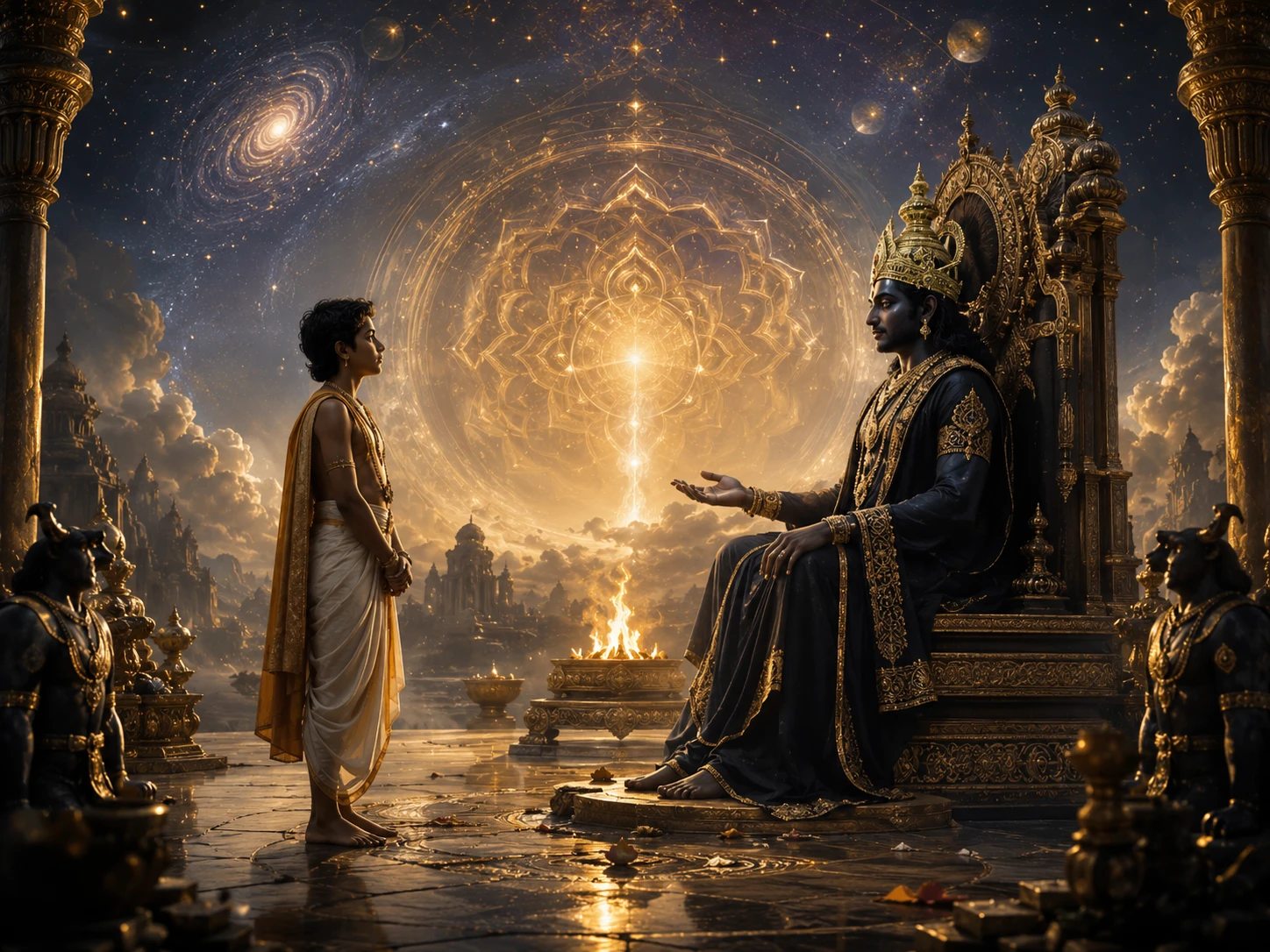
Katha Upanishad -- Nachiketa and Yama
कठोपनिषद् -- नचिकेता और यम
There is a reason the Katha Upanishad sits at number three in the Muktika canon of 108 Upanishads and why Swami Vivekananda called it one of the most beautiful texts in the entire Vedic corpus. It is not a treatise. It is a drama -- a story of a boy named Nachiketa who literally walks into the house of Death and refuses to leave without answers.
The text belongs to the Katha shakha of the Krishna Yajurveda. It is divided into two Adhyayas (chapters), each split into three Vallis (sections) -- six Vallis total. The word 'Valli' itself means a creeper that grows independently yet clings to a larger tree, which is exactly how the Upanishad relates to the Vedic corpus: rooted in ritual, yet reaching toward pure philosophy.
But strip away the academic framing and what you get is essentially this: a father makes a terrible mistake during a Vedic sacrifice. His son calls him out. The father, in a rage, says 'I give you to Death.' The son, instead of crying or rebelling, actually goes. He sits at Yama's door for three days. And then he negotiates three boons that form the backbone of Indian metaphysics.
If you have ever sat in a UPSC coaching centre in Old Rajinder Nagar at 6 AM, surrounded by students who have given up comfort for a shot at something larger -- you already understand Nachiketa's energy. He traded the entire material world for a single question about what happens after death. That is the spirit the Katha Upanishad celebrates.
The backstory is essential. Nachiketa's father, Vajashravasa (also called Gautama in some recensions), performed the Vishvajit sacrifice -- a ritual that requires the performer to donate everything he owns. But Vajashravasa gamed the system. He donated cows that were old, barren, blind, and lame -- animals that had already given their last milk, eaten their last grass. The Taittiriya Brahmana (3.11.8) records an earlier version of this story, but in that version, liberation comes from performing the sacrifice correctly. The Katha Upanishad changes the game entirely: liberation comes from knowledge, not ritual.
Nachiketa, watching his father's hypocrisy, asked three times: 'Father, to whom will you give me?' The question was not naive. It was a moral challenge -- if you claim to be giving everything, then give everything, including your son. Vajashravasa, irritated beyond limit, blurted out: 'I give you to Yama.' And Nachiketa, instead of treating this as an empty threat, took it literally.
Paul Deussen, the German Indologist, noted that the name 'Nachiketa' itself carries embedded wordplay. 'Na-kshiti' means that which does not decay. 'Na-ciketa' means 'I do not know' or 'he does not know.' Both meanings thread through the story -- a boy who does not decay in the face of Death, and who admits he does not know, which is why he goes seeking.
When Nachiketa arrived at Yama's abode, Yama was not home. The boy waited three days and three nights without eating or drinking. In Vedic culture, an unfed guest is a catastrophe -- the host accrues terrible karmic debt. Verse 1.1.9 records this fact directly. When Yama returned and discovered a Brahmin boy had been fasting at his doorstep, he was horrified. He offered three boons, one for each night Nachiketa went hungry.
The first boon was personal: let my father recognise me when I return, let him be calm and free of anger. Yama granted this immediately (verse 1.1.11). The second boon was ritual: teach me the Nachiketa Fire sacrifice, the sacred fire that leads to heaven. Yama taught the entire ritual -- the arrangement of bricks, the nature of fire as a symbol of world-creation. Nachiketa repeated everything perfectly. Yama was so impressed he declared that this fire would henceforth be named after Nachiketa.
But it is the third boon that makes this Upanishad immortal. Nachiketa asked, in verse 1.1.20: when a person dies, some say the self continues to exist, others say it does not. Teach me the truth. This question -- does consciousness survive death? -- is the question that separates philosophy from ritual, that separates the Upanishads from the Brahmanas, that separates GenZ anxiety about 'is this all there is' from the Instagram feed they are scrolling through at 2 AM.
येयं प्रेते विचिकित्सा मनुष्ये अस्तीत्येके नायमस्तीति चैके। एतद्विद्यामनुशिष्टस्त्वयाऽहं वराणामेष वरस्तृतीयः॥
yeyaṃ prete vicikitsā manuṣye astītyeke nāyamastīti caike | etadvidyāmanuśiṣṭastvayā'haṃ varāṇāmeṣa varastṛtīyaḥ ||
There is this doubt about a man who has departed -- some say he exists, others say he does not. I wish to be instructed by you in this knowledge. This is the third of my boons.
— Katha Upanishad 1.1.20
Yama's response to the third boon is not immediate. He does something extraordinary for a deity -- he hesitates. He tells Nachiketa that even the gods have doubted this question. He offers alternatives: a hundred years of life, sons and grandsons, elephants, gold, horses, vast kingdoms, beautiful women skilled in music and riding chariots. The temptation scene (verses 1.1.23-27) is the Vedic equivalent of every recruitment offer that has ever tried to buy out someone's deepest purpose.
Nachiketa's refusal is devastating in its clarity. He says: these pleasures last only until tomorrow, and they wear out the vital powers of life. How fleeting is everything on earth. Keep your horses and chariots, your dancing and music. No mortal has ever been made happy by wealth.
This is the Shreya-Preya distinction that becomes the philosophical heart of the Upanishad. In Valli 2 (verse 1.2.1-2), Yama explains that two paths diverge before every human being: Shreya (the path of lasting good) and Preya (the path of immediate pleasure). The wise choose Shreya. The foolish chase Preya. This is not abstract philosophy -- this is the choice every JEE aspirant faces between scrolling reels and solving one more problem set. It is the choice every startup founder faces between venture capital vanity and genuine product-market fit. It is the choice between the dopamine hit and the dharmic life.
Satisfied that Nachiketa is worthy, Yama finally teaches the secret of the Atman. The Self was never born and will never die. It is beyond cause and effect, eternal and immutable. When the body dies, the Self does not die. It is subtler than the subtlest, greater than the greatest, hidden in the cave of every creature's heart.
अन्यच्छ्रेयोऽन्यदुतैव प्रेयस्ते उभे नानार्थे पुरुषं सिनीतः। तयोः श्रेय आददानस्य साधु भवति हीयतेऽर्थाद्य उ प्रेयो वृणीते॥
anyacchreyo'nyadutaiva preyaste ubhe nānārthe puruṣaṃ sinītaḥ | tayoḥ śreya ādadānasya sādhu bhavati hīyate'rthādya u preyo vṛṇīte ||
The good (Shreya) is one thing and the pleasant (Preya) is quite another. Both these, serving different purposes, bind a person. It goes well with the one who chooses the good. The one who chooses the pleasant misses the true goal.
— Katha Upanishad 1.2.1
न जायते म्रियते वा विपश्चिन्नायं कुतश्चिन्न बभूव कश्चित्। अजो नित्यः शाश्वतोऽयं पुराणो न हन्यते हन्यमाने शरीरे॥
na jāyate mriyate vā vipaścinnāyaṃ kutaścinna babhūva kaścit | ajo nityaḥ śāśvato'yaṃ purāṇo na hanyate hanyamāne śarīre ||
The wise Self is neither born nor does it die. It did not come from anywhere, nor did anything come from it. Unborn, eternal, everlasting, primeval -- it is not slain when the body is slain.
— Katha Upanishad 1.2.18
If that verse sounds familiar, it should. The Bhagavad Gita (2.20) quotes it almost verbatim when Krishna teaches Arjuna on the battlefield of Kurukshetra. The Katha Upanishad is one of the direct source texts for the Gita -- and understanding this lineage changes how you read both. When Krishna tells Arjuna 'the Self is never born nor does it die,' he is channelling Yama's words to Nachiketa, separated by perhaps centuries but carrying the same philosophical charge.
The Upanishad does not stop at metaphysics. In the later Vallis (particularly Valli 3, verses 3-13), Yama introduces the famous chariot metaphor that became foundational for Indian psychology. The body is the chariot. The Atman is the rider. The intellect (Buddhi) is the charioteer. The mind (Manas) is the reins. The senses are the horses. The objects of sense are the roads. When the charioteer is alert and the horses are controlled, the rider reaches the destination safely. When the charioteer sleeps and the horses run wild, the chariot crashes.
This metaphor was not just philosophy -- it was practical advice for governance, for self-discipline, for the management of desire. Plato's chariot allegory in Phaedrus (circa 370 BCE) describes a strikingly similar image, though scholars debate direct influence. What is certain is that by the time the Katha Upanishad was composed (estimated 5th to 1st century BCE), Indian thinkers had already developed a sophisticated model of the mind as a vehicle that requires active control.
The Katha Upanishad also introduces the concept of Om as the supreme syllable (verse 1.2.15-17) -- the Word that all scriptures glorify, all austerities express. Realising Om, says Yama, one finds complete fulfilment. This teaching became central to later Yoga traditions, particularly Patanjali's Yoga Sutras where Om is identified with Ishvara.
The Three Boons of Nachiketa
| Boon | Request | Yama's Response | Philosophical Domain | वरदान | माँग | यम का उत्तर | दार्शनिक क्षेत्र |
|---|---|---|---|---|---|---|---|
| First | Restore my father's peace and recognition upon my return | Granted immediately -- Vajashravasa will greet Nachiketa with love | Ethics and filial duty (Dharma) | प्रथम | लौटने पर पिता शान्त हों, मुझे पहचानें | तुरन्त दिया -- वाजश्रवस प्रेम से मिलेंगे | नैतिकता और पुत्र-धर्म |
| Second | Teach me the Nachiketa Fire sacrifice that leads to heaven | Taught the full ritual -- arrangement of bricks, symbolism of fire, world-creation | Ritual knowledge (Karma Kanda) | द्वितीय | नाचिकेत अग्नि विद्या सिखाओ जो स्वर्ग का मार्ग खोले | पूरी विधि सिखाई -- ईंटों की रचना, अग्नि का प्रतीकवाद | कर्मकाण्ड ज्ञान |
| Third | What happens after death -- does the Self continue to exist or not? | After testing Nachiketa with temptations, taught the nature of eternal Atman | Metaphysics (Jnana Kanda) | तृतीय | मृत्यु के बाद आत्मा रहती है या नहीं? | प्रलोभनों से परीक्षा के बाद शाश्वत आत्मा का स्वरूप सिखाया | आध्यात्म (ज्ञान काण्ड) |
The three boons mirror a progression from worldly attachment to ritual duty to ultimate liberation -- the same arc that structures the Vedic corpus itself (Samhita to Brahmana to Upanishad).
The Katha Upanishad's verse 1.2.18 ('The Self is never born nor does it die') is quoted almost word-for-word in the Bhagavad Gita 2.20. This makes it one of the oldest traceable source citations in Indian philosophical literature -- a direct textual lineage spanning centuries. Swami Vivekananda's 1893 Chicago address drew heavily from the Katha Upanishad's teachings on the indestructible Atman, making this text one of the first Hindu scriptures to reach a global audience. In 2020, ISRO named a student satellite programme 'Nachiketa' in honour of the boy who asked questions that even gods feared to answer.
The Katha Upanishad's influence on Indian civilisation is not a historical footnote -- it is a living current. The Shreya-Preya framework is taught in UPSC ethics papers. The chariot metaphor appears in Class 11-12 philosophy textbooks across CBSE schools. Swami Chinmayananda's Chinmaya Mission uses the Katha Upanishad as one of its foundational teaching texts. The Ramakrishna Mission's study circles in Belur Math begin many students' Vedantic journey with this very text.
But perhaps the most powerful modern resonance is this: in a world that optimises for engagement metrics, attention spans, and dopamine hits, the Katha Upanishad says there exists a path that is not pleasant but is genuinely good. In an era where every app, every algorithm, every notification is designed to pull you toward Preya, Nachiketa's refusal to take the easy boon remains the most radical act of self-sovereignty in Indian literature.
The boy who went to Death's house and came back with the secret of the Self did not return with a magic weapon or an army. He returned with knowledge. And the Katha Upanishad's final assertion -- that Nachiketa, having gained this knowledge from Yama, became free from the cycle of birth and death -- remains the ultimate promise of Vedantic philosophy: not that you will never die, but that you were never the thing that dies.
Meditate on the Atman with Om
The Katha Upanishad names Om the supreme support for realising the Atman (1.2.15-17). Chant it slowly, then let it fade into silence, and rest as the one who hears it. The Three Parts of Om dharana on Eternal Raga sets out the practice, and the Katha Upanishad itself is on the site too.
Tags
Eternal Raga · शाश्वत राग
Institutional voice — scholarly articles on Sanatan Dharma
Deepen Your Understanding
अपनी समझ और गहरी करें
scriptural exegesis
Chandogya Upanishad -- Tat Tvam Asi
A 24-year-old returns from 12 years of Vedic study, bloated with pride and stuffed with textbook knowledge, only to have his father demolish his certainty with nine repetitions of three words: Tat Tvam Asi -- You Are That. The Chandogya Upanishad is the text that broke the wall between God and you.
scriptural exegesis
Gita Chapter 4 -- Jnana Karma Sannyasa Yoga
Chapter 4 of the Bhagavad Gita contains the most quoted verse in all of Hinduism -- 'Yada Yada Hi Dharmasya' -- and the most radical claim Krishna ever made: that He incarnates across ages whenever dharma declines. But this chapter is not just about avatars. It is a masterclass in how knowledge transforms action from bondage into liberation.
philosophy darshana
The Four Mahavakyas -- Upanishadic Sentences That Changed Civilisation
Four sentences. Twelve words of Sanskrit. Three thousand years of commentary. The Mahavakyas are the most compressed, most powerful, and most debated statements in all of Indian philosophy. Each one claims that the individual self and the ultimate reality of the universe are not two different things. And each one has been interpreted to mean something completely different by every major school of Vedanta.
vedic sciences
Kaal Ganana -- The Hindu Measure of Time
From a single blink of the eye (Nimesha) to one Day of Brahma (4.32 billion years) -- explore the complete cosmic time hierarchy of Hindu cosmology, anchored in Vishnu Purana 1.3, with its remarkable parallels to modern science.
scriptural exegesis
Pandavas in Hell -- The Shocking Finale of the Mahabharata
The Mahabharata does not end with victory. It ends with the heroes falling dead on a Himalayan climb, the villains seated in heaven, and the one righteous king demanding to be sent to hell. The Swargarohana Parva is the most unsettling, most philosophically radical, and most misunderstood finale in all of world literature.
scriptural exegesis
7 Chiranjeevis -- The Immortals of Hindu Tradition
Seven beings who will not die until the end of this cosmic age. One is cursed to wander in agony. One rules the underworld. One compiled every scripture you have ever read. One is the most worshipped deity in India. The Chiranjeevis are not a mythology trivia list -- they are a map of how immortality works in Hindu thought, and why it is not always a blessing.
The Katha Upanishad's verse 1.2.18 ('The Self is never born nor does it die') is quoted almost word-for-word in the Bhagavad Gita 2.20. This makes it one of the oldest traceable source citations in Indian philosophical l…
More in Scriptural Exegesis
Abhimanyu and the Chakravyuha -- The Boy Who Knew How to Enter but Not How to Leave
14 min read
Adbhuta Ramayana -- The Ramayana Where Sita Becomes Kali
9 min read
After Kurukshetra -- What Happened Next
14 min readThe same translation error that turned '33 Koti' into '33 crore' in Hinduism also happened in Buddhism. The Chinese translation of Buddhist texts rendered 'Sapta Koti Buddha' (7 Supreme Buddhas) as '7 Crore Buddhas.' The…
Deities AvatarsCommunity Reflections
🕉️
Be the first to share your reflection.