Pandavas in Hell -- The Shocking Finale of the Mahabharata
पाण्डव नरक में -- महाभारत का चौंकाने वाला अन्त
If you have only watched the Mahabharata on television or read children's retellings, you probably think the story ends with the Pandavas winning the war, Yudhishthira crowned king, and everyone living happily ever after. That is not how it ends. Not even close.
The Mahabharata's actual ending -- spanning the Mahaprasthanika Parva (Book 17, 'The Great Journey') and the Swargarohana Parva (Book 18, 'The Ascent to Heaven') -- is one of the most brutal, philosophically challenging, and emotionally devastating sequences in world literature. The heroes die one by one on a Himalayan mountainside. The villains are found seated comfortably in heaven. And the last man standing -- Yudhishthira, Dharmaraja himself -- is shown a vision of hell so terrible that he renounces heaven and demands to suffer alongside his family.
It is the kind of ending that would get rejected by any modern publisher. No resolution. No triumph. No catharsis. Only a series of gut-punching revelations about karma, dharma, and the nature of cosmic justice -- revelations that most readers find deeply uncomfortable. Which is exactly the point.
The Mahaprasthanika Parva has just three chapters. The Swargarohana Parva has five (in the BORI Critical Edition). Together they contain fewer than 250 shlokas. It is the shortest ending to the longest epic -- and it carries the heaviest philosophical payload.
स्वर्गोऽयं नेह वैराणि भवन्ति मनुजाधिप।
svargo'yaṃ neha vairāṇi bhavanti manujādhipa |
This is heaven, O King -- here there are no enmities.
— Swargarohana Parva, Mahabharata Book 18 (Narada to Yudhishthira)
The Great Journey -- Who Falls and Why
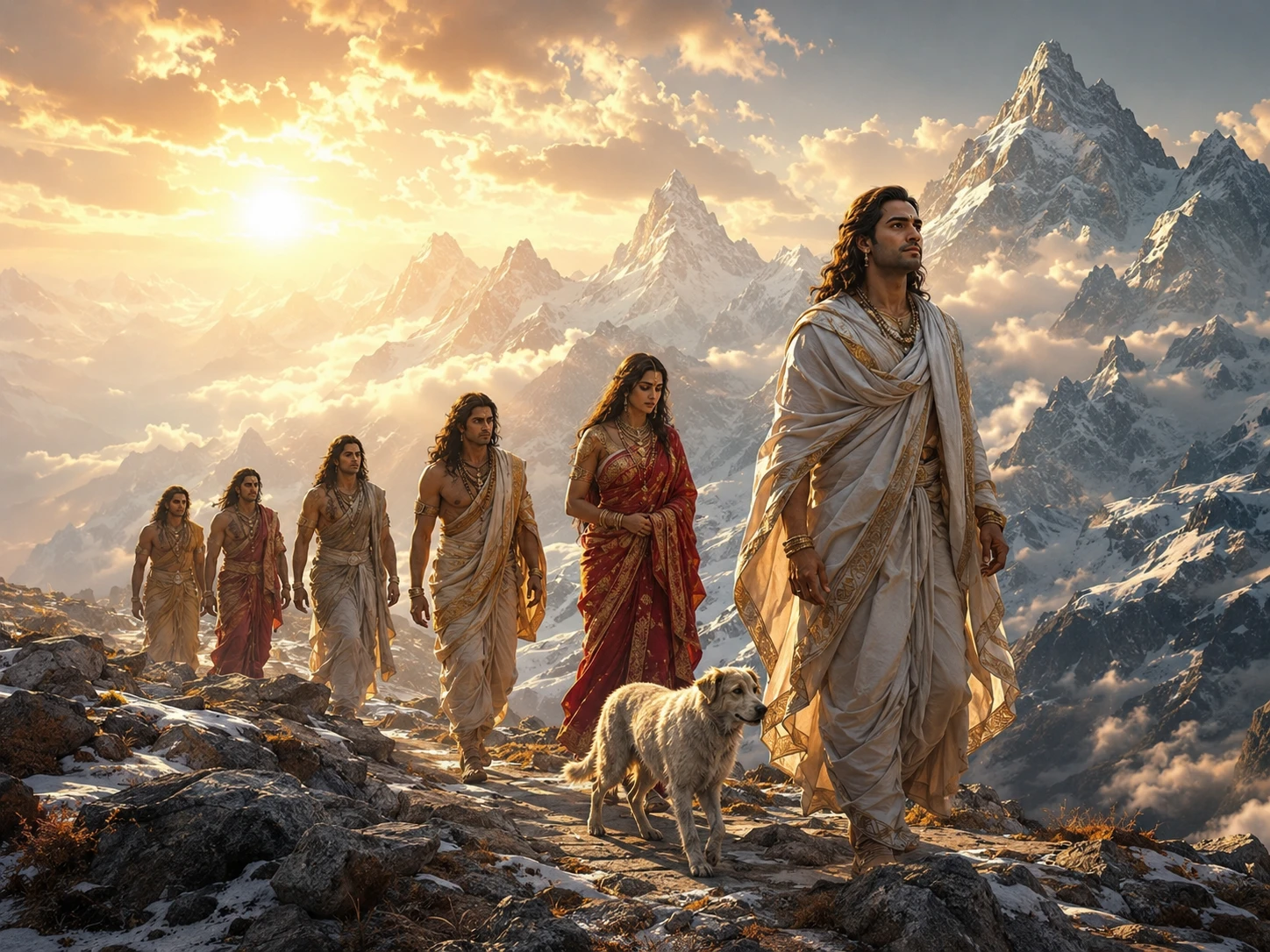
After ruling Hastinapura for 36 years, after receiving the news of Krishna's death and the destruction of the Yadava clan (Mausala Parva), and on the advice of Vyasa, the Pandavas decide to renounce their kingdom. Yudhishthira crowns Parikshit -- Arjuna's grandson through Abhimanyu -- as king of Hastinapura. The Yadava prince Vajra is crowned at Indraprastha. Then the five brothers and Draupadi, having given up everything, set out on their final pilgrimage -- eastward first, then northward toward the Himalayas, toward Mount Meru, whose peak is believed to be the gateway to heaven.
A stray dog joins them on the road and becomes their silent companion for the rest of the journey.
As they begin climbing, one by one, the Pandavas fall. Each death is explained by Yudhishthira -- and each explanation is a devastating character assessment.
Draupadi falls first. Bhima asks why. Yudhishthira says: though she was devoted to all five brothers equally, she had excessive partiality for Arjuna. That partiality was her flaw.
Sahadeva falls next. His flaw: intellectual pride. He considered no one his equal in wisdom.
Nakula falls. His flaw: vanity about his physical beauty. He believed no one in the world was more handsome.
Arjuna falls. His flaw: martial pride. He had boasted that he would destroy all enemies in a single day, and his confidence in his own invincibility was a form of ego.
Bhima falls last. His flaw: gluttony and excessive appetite. He ate without regard for whether others had enough.
Yudhishthira does not look back. He does not stop. He has renounced everything -- including grief. Only the dog remains.
This sequence is devastating because these are not villains. These are the heroes of the story. And the Mahabharata is telling you, in its final chapters, that heroism does not exempt you from the consequences of your flaws. Every Pandava carried a shadow. Every virtue had a price.
Why Each Pandava Fell -- The Flaw Behind the Hero
| Order of Fall | Character | Stated Flaw | Modern Parallel |
|---|---|---|---|
| 1st | Draupadi | Excessive partiality for Arjuna despite being wife to all five equally | Favouritism in relationships; unequal emotional investment |
| 2nd | Sahadeva | Intellectual arrogance; considered none his equal in wisdom | The know-it-all colleague; academic elitism; LinkedIn thought leaders |
| 3rd | Nakula | Vanity about physical beauty; narcissism | Instagram culture; appearance-obsession; selfie addiction |
| 4th | Arjuna | Martial pride; boasted of invincibility; overconfidence in skill | Star performer syndrome; 'I carry the team' mentality in startups/cricket |
| 5th | Bhima | Gluttony; ate excessively without considering others' hunger | Overconsumption; resource hoarding; eating without awareness |
| Survived | Yudhishthira | No fatal flaw -- but carried one sin: the half-lie to kill Drona | White lies; strategic deception; 'the end justifies the means' thinking |
The Mahabharata does not assign 'evil' flaws. These are ordinary human weaknesses -- pride, vanity, favouritism, appetite. The text says: even small imperfections carry weight on the final climb.
The Dog, the Chariot, and the Three Tests of Dharma
Yudhishthira reaches the summit of Mount Meru. Indra appears with his celestial chariot and invites him to ascend to heaven. Yudhishthira's first question is about his brothers and Draupadi. Indra assures him they have preceded him. Then Yudhishthira asks if the dog can come. Indra refuses. Heaven has no place for dogs.
Yudhishthira refuses to go. He says: this dog has been my faithful companion through the entire journey. To abandon a loyal being for personal reward would be a sin greater than any merit I have earned. 'I will not go to heaven at the cost of betraying one who trusts me.'
The dog transforms. It is Dharma himself -- Yudhishthira's divine father -- who has been testing his son for the third and final time. The first test was at the lake in the forest (Yaksha Prashna, Vana Parva), where Yudhishthira answered the Yaksha's riddles and revived his brothers. The second test was this journey itself. The third was the dog.
Yudhishthira enters heaven. And the first person he sees is Duryodhana -- radiant, enthroned, surrounded by celestial beings.
This is the moment that breaks most readers. The man who engineered the disrobing of Draupadi, who poisoned Bhima, who burned the house of lac, who refused to give even five villages for peace -- this man is in heaven? And the Pandavas, who fought for dharma, who suffered thirteen years of exile, who sacrificed everything -- they are nowhere to be seen?
Narada explains: Duryodhana died as a Kshatriya on the battlefield, fulfilling his warrior dharma. That single act of dying in battle -- regardless of his other sins -- earned him a place in heaven. 'This is heaven, O King -- here there are no enmities.'
Yudhishthira demands to see his family. He is led through a dark, foul passage to a place of suffering. There he hears the voices of Draupadi, Bhima, Arjuna, Nakula, Sahadeva, Karna, and others -- all crying out in pain. Yudhishthira is shattered. He declares: 'I will stay here. Send me no further. If my loved ones are here, then this is where I belong.'
The illusion shatters. Dharma appears again. This was the final test -- not of knowledge, not of loyalty, but of love. Yudhishthira's willingness to choose hell for the sake of those he loved proved him worthy of the highest heaven. The Pandavas, Draupadi, and all the worthy warriors are reunited in Vaikuntha. Yudhishthira bathes in the celestial Ganga, sheds his mortal body, and enters eternal bliss.
But the sting remains. The Mahabharata's final message is not comfort. It is a warning: everyone visits hell, even the righteous. No one's account is perfectly clean. And the only thing that redeems you in the end is not your victories, not your power, not your knowledge -- but your willingness to stand by those you love, even when it costs you everything.
Yudhishthira's refusal to abandon the dog is the earliest known literary argument for animal rights in world literature. He explicitly states that betraying a loyal creature for personal gain is a sin -- a position that modern animal ethics philosophers like Peter Singer would recognise. The dog turning out to be Dharma in disguise adds another layer: the text suggests that dharma itself walks beside you in forms you do not recognise, testing whether your principles hold when no one of importance is watching. The Indian Pariah Dog -- the breed most scholars believe is described -- is considered by geneticists to be one of the oldest and most genetically pure domesticated dog breeds in the world.
Reflect on Dharma -- Meditate with Eternal Raga
The Swargarohana Parva is about stripping away everything except dharma. Sit for ten minutes in silent reflection on what you would carry on your own final climb. The Meditate section has practices to settle the mind first.
Tags
Eternal Raga · शाश्वत राग
Institutional voice — scholarly articles on Sanatan Dharma
Deepen Your Understanding
अपनी समझ और गहरी करें
scriptural exegesis
After Kurukshetra -- What Happened Next
The war ended. The Pandavas won. And then everything fell apart. Krishna's clan destroyed itself in a drunken brawl. Dwaraka sank into the sea. Arjuna's divine powers vanished. And the five brothers who fought the greatest war in history walked into the Himalayas to die. The Mahabharata's post-war chapters are darker, stranger, and more relevant than the war itself.
scriptural exegesis
Parikshit to Janamejaya -- The Pandava Dynasty After the War and Why the Mahabharata Was Told
The child who survived a divine weapon in the womb became the king who united a shattered kingdom. His son, consumed by vengeance for his father's death by snakebite, launched a sacrifice to burn every serpent in the world -- and it was at that sacrifice that a sage named Vaishampayana narrated the entire Mahabharata for the first time. Without Parikshit's miraculous survival, there is no Pandava dynasty. Without Janamejaya's rage, there is no Mahabharata as we know it. These two generations are the reason the story exists.
scriptural exegesis
Yaksha Prashna -- Questions at the Lake
Four brothers lie dead beside an enchanted lake. One brother remains. A voice from the water asks 124 questions about dharma, death, happiness, and the self. Yudhishthira's answers in Vana Parva remain the most sophisticated ethical examination in all of Sanskrit literature.
scriptural exegesis
Karna's Tragedy -- The Sun's Forgotten Son
Born with divine armor, abandoned at birth, raised by a charioteer, humiliated for his caste, cursed by his teacher, and killed while defenseless -- Karna's story is not the Mahabharata's subplot. It is the Mahabharata's conscience. Every system that failed him is a system that still fails people today.
scriptural exegesis
Bhishma's Terrible Vow
A crown prince gave up the throne, love, marriage, and children -- forever -- so his father could marry a fisherwoman. That single vow made Bhishma immortal in name and set the entire Mahabharata into motion. Was it the noblest sacrifice in literature, or the most catastrophic?
philosophy darshana
Rama vs Krishna -- Two Faces of Dharma, One Question for Your Life
Rama followed every rule and lost his wife. Krishna broke every rule and won the war. Both are Vishnu. Both upheld Dharma. So who was right? The answer might be the most important thing Hindu philosophy has to say to a world that thinks morality is simple.
Yudhishthira's refusal to abandon the dog is the earliest known literary argument for animal rights in world literature. He explicitly states that betraying a loyal creature for personal gain is a sin -- a position that …
More in Scriptural Exegesis
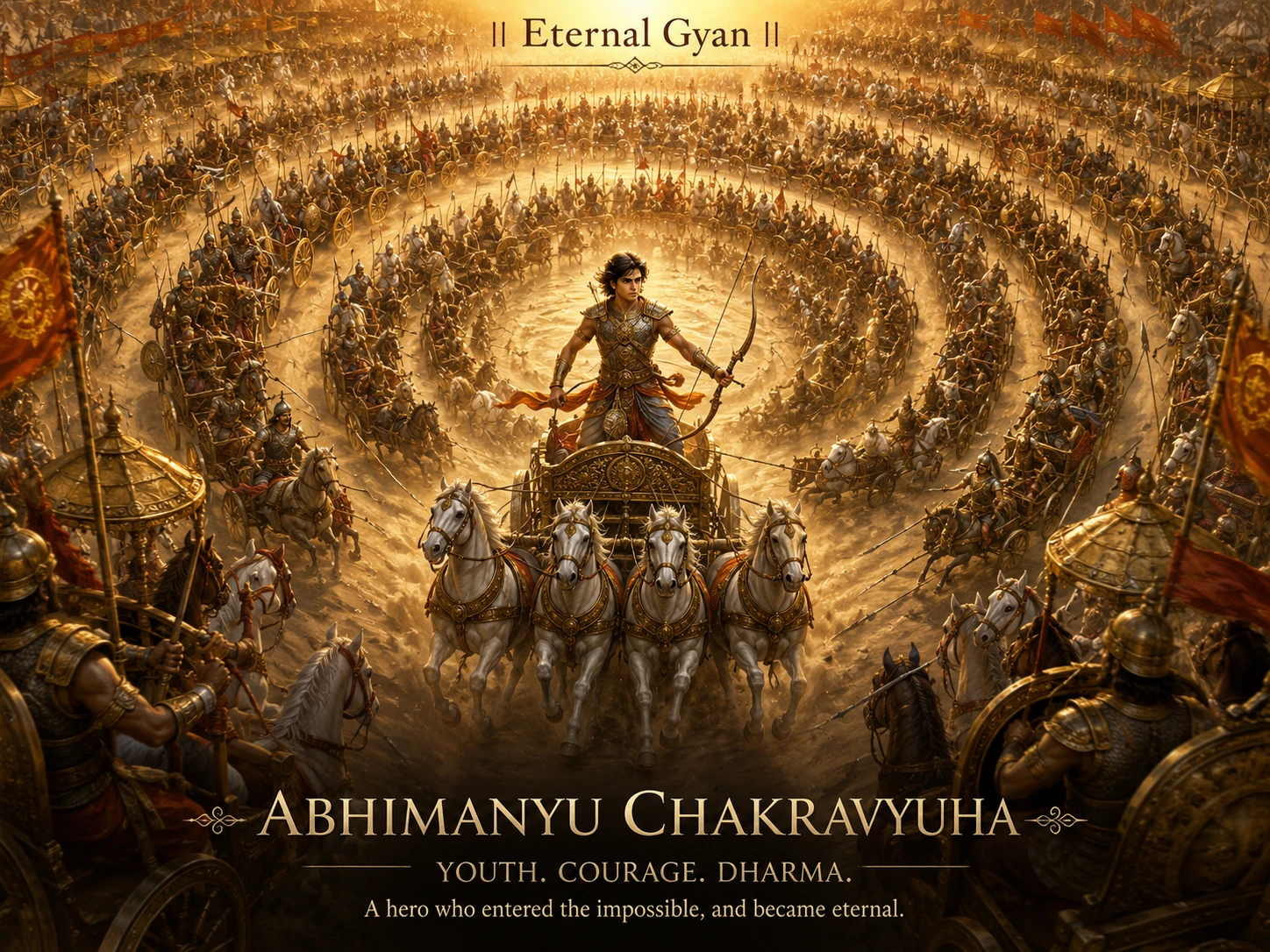
Abhimanyu and the Chakravyuha -- The Boy Who Knew How to Enter but Not How to Leave
14 min read
Adbhuta Ramayana -- The Ramayana Where Sita Becomes Kali
9 min read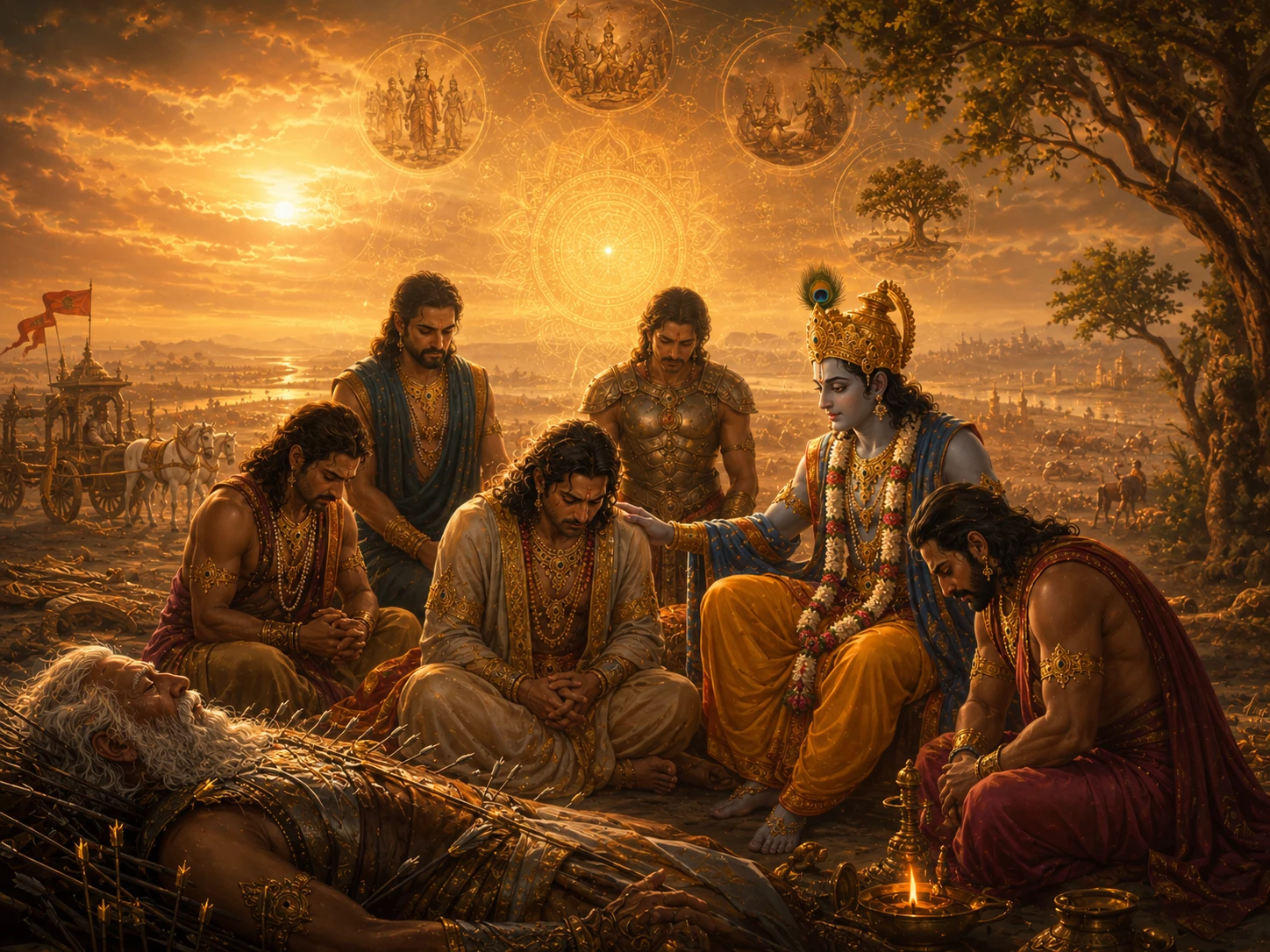
After Kurukshetra -- What Happened Next
14 min readThe same translation error that turned '33 Koti' into '33 crore' in Hinduism also happened in Buddhism. The Chinese translation of Buddhist texts rendered 'Sapta Koti Buddha' (7 Supreme Buddhas) as '7 Crore Buddhas.' The…
Deities AvatarsCommunity Reflections
🕉️
Be the first to share your reflection.