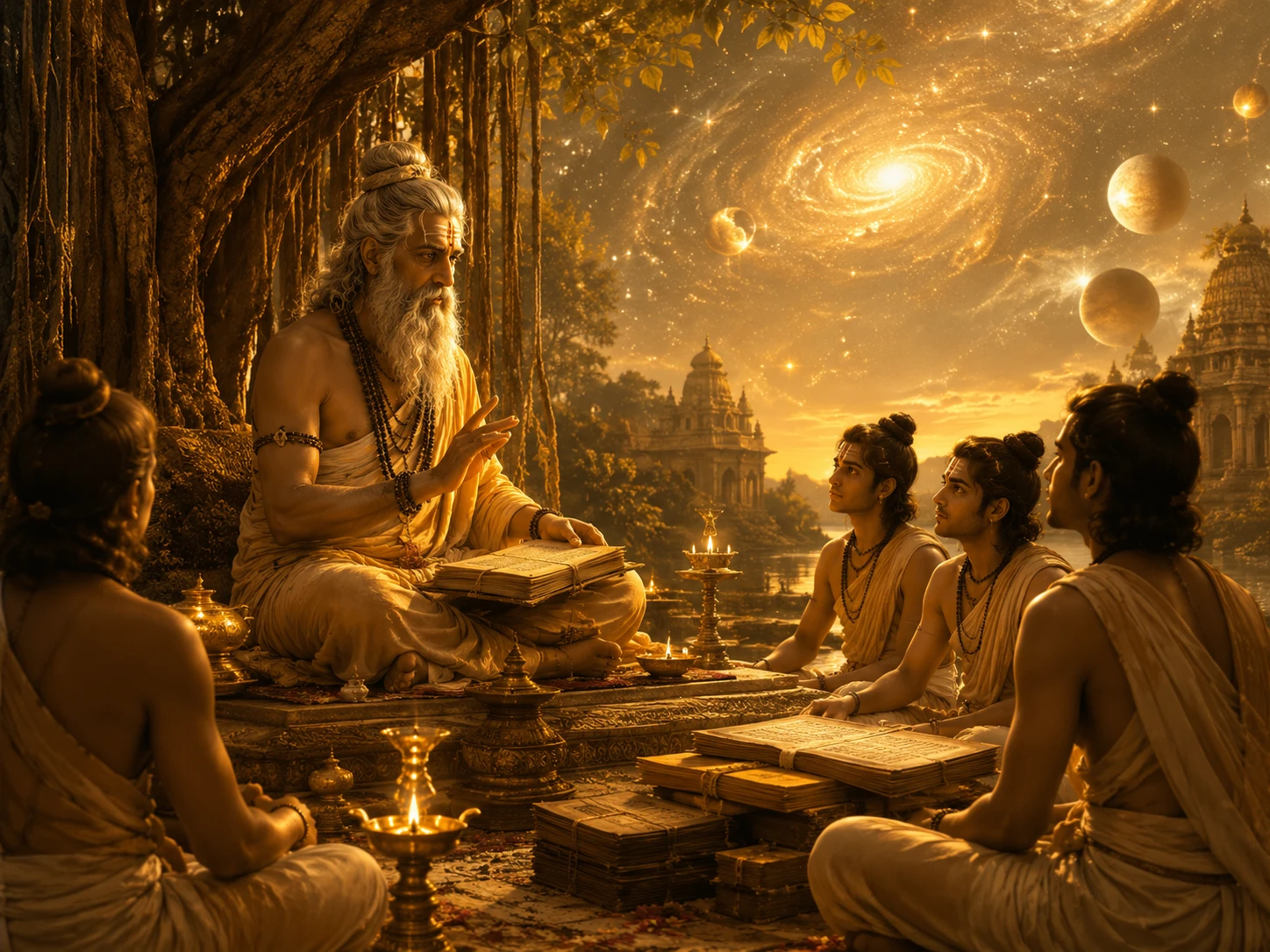
Rama vs Krishna -- Two Faces of Dharma, One Question for Your Life
राम बनाम कृष्ण -- धर्म के दो चेहरे, तुम्हारे जीवन के लिए एक सवाल
Here is a question no coaching class in Kota, no MBA programme at IIM, and no corporate leadership seminar will ever ask you -- but should.
You are the most qualified person for a position. It is rightfully yours. But your father, in a moment of weakness, makes a promise to someone else that you will step aside. No law compels you to honour this promise. No court will enforce it. Your own mother begs you not to go. What do you do?
Rama went. He went into the forest for fourteen years, gave up a throne, a kingdom, and eventually his wife -- because his father's word, once given, could not be broken. Not by anyone. Not even by the person the promise harmed most.
Now consider a different scenario. You are on a battlefield. Your enemy is the greatest warrior alive, but he is momentarily unarmed -- his chariot wheel is stuck in mud and he is bending down to lift it. Every rule of warfare says you must wait. He invokes the code of honour. Your own conscience hesitates. But you know that if he picks up that wheel, he will kill your friend, and the war for justice will be lost. What do you do?
Krishna told Arjuna to shoot. Right then. Right there. While Karna was unarmed, helpless, and invoking the very rules Krishna was about to break.
Both are Vishnu incarnate. Both upheld Dharma. Both are worshipped by the same civilisation. But their methods are not just different -- they are opposite. And understanding why is arguably the most important thing Hindu philosophy offers to a world that thinks morality is black and white.
This is not a theological debate. It is the most practical question any young Indian can ask. Because India in 2026 is a society that simultaneously celebrates rule-following (Aadhaar compliance, GST filing, digital KYC) and rule-bending (jugaad culture, managing bureaucracy through personal networks, navigating reservation politics). Understanding the Rama-Krishna tension is not about choosing a favourite avatar. It is about understanding the operating system of Indian civilisation itself.
यदा यदा हि धर्मस्य ग्लानिर्भवति भारत। अभ्युत्थानमधर्मस्य तदात्मानं सृजाम्यहम्॥
yadā yadā hi dharmasya glānir bhavati bhārata | abhyutthānam adharmasya tadātmānaṃ sṛjāmy aham ||
Whenever there is a decline of Dharma and a rise of Adharma, O Bharata, then I manifest Myself.
— Bhagavad Gita 4.7
The Framework -- Maryada vs Leela
Hindu tradition gives Rama and Krishna two distinct titles that encode their entire philosophy.
Rama is Maryada Purushottam -- the Supreme Being who lives within boundaries. 'Maryada' means limit, code, boundary, propriety. Rama's entire life is a demonstration of what happens when a person -- even God himself -- submits completely to the rules. He is Ek Vachani (one word -- never breaks a promise), Ek Patni (one wife -- never wavers in loyalty), Ek Baani (one arrow -- never misses). His dharma is structural. It flows from fixed principles: a son obeys his father, a king serves his people, a husband protects his wife, a warrior fights with honour. When two duties conflict, Rama always chooses the higher structural duty even at devastating personal cost.
Krishna is Leela Purushottam -- the Supreme Being who plays. 'Leela' means divine play, cosmic sport. Krishna's life is a demonstration of what happens when a person -- even God himself -- prioritises the outcome over the method. He has 16,108 wives (because 16,100 women needed rescue, and marriage was the only way to restore their social honour). He runs from a battlefield (earning the name Ranchod -- 'one who left the battlefield' -- because retreating saved his people's lives). He lies, manipulates, and bends rules -- always in service of a larger justice that the rules themselves cannot deliver.
Rama is the Constitution. Krishna is the Supreme Court that interprets it when the letter of the law fails the spirit.
Neither is wrong. Neither is complete alone. And the tradition's genius is that it gave humanity both -- not as competing options, but as complementary tools for different ages.
Rama's Code vs Krishna's Play -- A Side-by-Side
| Dimension | Rama (Maryada) | Krishna (Leela) |
|---|---|---|
| Core principle | Follow the rule, regardless of outcome. Dharma is the code itself. | Achieve the just outcome, regardless of method. Dharma is the result. |
| On marriage | Ek Patni. One wife. Absolute fidelity even after Sita's exile. | 16,108 wives. Every marriage was an act of rescue and social rehabilitation. |
| On promises | Honoured father Dasharatha's word to Kaikeyi even though it cost him 14 years and his kingdom. | Promised not to lift weapons in Kurukshetra -- then picked up the Sudarshana Chakra when Bhishma's arrows threatened Arjuna. |
| On warfare | Killed Vali from behind a tree -- considered his most ethically debated act. Justified it as Kshatriya duty toward Sugriva. | Orchestrated killing of unarmed Karna, concealed Ashwatthama lie, arranged Jayadratha's sunset illusion. Multiple rule-breaks, each justified by larger dharma. |
| On kingship | Sent pregnant Sita to the forest because a washerman questioned her chastity. Raj Dharma (duty to public trust) overrode personal love. | Never became king. Served as Dwaraka's administrator and Arjuna's charioteer. Led from beside, never from above. |
| Yuga context | Treta Yuga. Society was more orderly, Dharma stood on 3 of 4 legs. Rules could be trusted. | Dwapara Yuga. Society was declining, Dharma stood on 2 legs. Rules were being weaponised by the unrighteous. |
| Leadership style | Paatradhari -- the ideal role. Lead by perfect example. | Sutradhar -- the director behind the scenes. Lead by empowering others. |
| Modern analogy | Constitutional governance. Institutional integrity. Rule of law. 'Follow the process.' | Startup disruption. Strategic flexibility. Whistleblower ethics. 'Do what works, then fix the rules.' |
The popular saying captures this perfectly: 'Jaisa Ram kare waisa karo, jaisa Krishna kahe waisa karo' -- Live like Rama lives, act as Krishna advises. Your personal life should follow Rama's code. Your strategic decisions should follow Krishna's wisdom.
The Cases That Test Both
Four episodes from the epics expose the razor's edge between these two approaches.
Case 1: Sita's Exile. Rama's most controversial act. A washerman in Ayodhya doubts Sita's chastity after her time in Ravana's captivity. Rama, as king, banishes his pregnant wife to the forest -- not because he doubts her, but because public trust in the crown matters more than private happiness. This is Maryada at its most brutal. Raj Dharma (king's duty to the people's trust) overrides Pati Dharma (husband's duty to his wife). The code demands it. Rama obeys. And pays for it every remaining day of his life.
Now ask: what would Krishna have done? Almost certainly, he would have kept Sita and found a way to address the washerman's doubt without sacrificing her. He might have staged a public trial, used divine revelation, or simply challenged the social norm itself. Krishna never allows structural rules to crush the vulnerable. When 16,100 women were ostracised by society after Narakasura's captivity, Krishna married all of them -- not because he needed 16,100 wives, but because marriage was the only mechanism that restored their social standing. Krishna hacks the system. Rama submits to it.
Case 2: Karna's Death. Karna, the greatest warrior on the Kaurava side, is momentarily stuck -- his chariot wheel is buried in mud. He invokes the rules of righteous warfare: you do not attack an unarmed opponent. Arjuna hesitates. Krishna does not. He reminds Arjuna of every rule Karna himself broke -- his silence during Draupadi's disrobing, his participation in the unlawful killing of Abhimanyu, his collusion in the rigged dice game. Then he delivers the line that defines his philosophy: 'Where was Dharma when you needed it? Now shoot.'
Ask: what would Rama have done? He would almost certainly have waited. In the Ramayana, Rama gives Ravana an entire night to reconsider after defeating him in battle. Rama fights by the code, even when the code disadvantages him. But the Mahabharata is not the Ramayana. In a world where the villains have already weaponised the rules -- using legal dice games to steal kingdoms and procedural silence to enable assault -- following the rules to the letter means handing victory to those who exploit them.
Notice that in every one of these cases, the 'wrong' choice is also the 'understandable' choice. Rama banishing Sita is wrong -- but he did it because he believed a king's public duty supersedes personal love. Yudhishthira gambling is wrong -- but he was trapped by a dharmic obligation to accept a challenge from a fellow Kshatriya. Krishna lying about Ashwatthama is wrong -- but Drona was committing slaughter that would have made the war unwinnable. The Mahabharata's genius is that it never makes moral dilemmas easy. Every 'correct' answer has a cost. Every 'wrong' answer has a reason. This is why a JEE Physics topper and a Philosophy PhD student can both be humbled by the same text.
Case 3: The Ashwatthama Lie. On the 15th day of the Kurukshetra war, Drona is slaughtering the Pandava army. He is invincible as long as he fights. Krishna knows only one thing can make Drona lay down his weapons: the news of his son Ashwatthama's death. But Ashwatthama is alive. Krishna's solution: have Bhima kill an elephant also named Ashwatthama, then get Yudhishthira -- the one man who has never lied -- to confirm the death. Yudhishthira says, 'Ashwatthama is dead' -- and then adds in a whisper, 'the elephant.' Krishna blows the Panchajanya conch at that precise moment, drowning out the qualification. Drona, believing his son dead, drops his weapons in grief. And is killed.
This is Krishna at his most morally uncomfortable. He orchestrated a lie from the lips of the most truthful man alive, exploited a father's love for his son, and engineered a killing during a moment of grief. No rule of warfare permits this. But Drona -- fighting for the side that cheated at dice, disrobed a queen in open court, and denied five brothers even five villages -- was killing hundreds of soldiers every hour. The 'ethical' choice of waiting would have meant hundreds more dead by sundown.
Rama would never have done this. His code does not permit deception, even for victory. But Rama also never faced a Drona -- a righteous man fighting for the wrong side, whose invincibility could only be broken by breaking his heart.
Case 4: Running from the Battlefield. Krishna is also called Ranchod -- 'one who left the battlefield.' When Jarasandha attacked Mathura for the 17th time, Krishna evacuated his people to Dwarka rather than fight a battle that would have killed thousands. He chose the mockery of being called a coward over the glory of a victory purchased with his people's blood.
Rama would never run. His code demands that a Kshatriya face every battle. But Krishna understood something Rama's code does not account for: sometimes the bravest thing a leader can do is refuse to fight.
The Yuga Theory -- Why the Same God Needed Different Methods
Hindu tradition does not merely present Rama and Krishna as two personalities. It places them in two different cosmic ages -- and this placement is the key to understanding why the same Vishnu behaves so differently in two incarnations.
Rama incarnates in Treta Yuga, the second age of the cosmic cycle. In Treta Yuga, Dharma stands on three legs (out of four). Society is still fundamentally orderly. Institutions mostly function. Kings mostly rule justly. The system has cracks, but the system itself is reliable. In such a world, following the rules generally produces just outcomes. A king who upholds the law will find that the law upholds justice. This is why Rama follows rules. He does not need to bend them -- because the rules still work.
Krishna incarnates in Dwapara Yuga, the third age. Dharma stands on only two legs. The social order is visibly decaying. Institutions are corrupted. The throne of Hastinapur is occupied by a blind king who cannot see injustice, surrounded by ministers who choose not to. Duryodhana has weaponized every rule in the book -- he won the dice game 'legally,' he denied the Pandavas their kingdom 'legally,' and Draupadi's humiliation happened in a court that followed 'proper procedure.' In such a world, following the rules does not produce justice -- it produces legalized oppression. This is why Krishna bends rules. He does not do it for sport. He does it because the rules themselves have been captured by adharma.
Now consider the implication for Kali Yuga -- the age tradition says we live in now, where Dharma totters on a single leg. If Treta Yuga needed Rama's rule-following and Dwapara Yuga needed Krishna's rule-bending, what does Kali Yuga need?
The answer the tradition offers is: both. And this is why Hinduism gave us both avatars, not one. Neither pure Rama-code nor pure Krishna-play works alone in a world this broken. The modern human needs Rama's integrity in personal conduct -- you do not lie to your family, you do not abandon your commitments, you do not cut corners on personal ethics. But the modern human also needs Krishna's strategic intelligence when facing systemic injustice -- you cannot fight a rigged system by following the rigged system's own rules.
A startup founder in Koramangala who files taxes honestly (Rama-code) but also knows how to navigate a corrupt municipal licensing process without paying bribes (Krishna-strategy -- not bribery, but finding legal workarounds) is practising exactly this synthesis. A Dalit student who follows every UPSC rule to the letter (Rama) but also strategically mentors younger students to beat the system's structural biases (Krishna) is living the dual code. The synthesis is not compromise. It is evolution.
Which One Is Right for 2026?
Here is where the debate leaves the epics and enters your life.
If you are a UPSC aspirant, the question is real: India's constitutional framework is fundamentally Rama-coded -- rule of law, institutional propriety, due process. But India's most celebrated leaders, from Chanakya to Sardar Patel, were Krishna-coded -- strategic, pragmatic, willing to bend process when the outcome demanded it. The IAS officer who follows every rule and lets a bridge collapse due to bureaucratic delay, or the one who cuts corners to save lives and faces a vigilance inquiry -- which one served Dharma?
If you are a startup founder in Koramangala, you face this daily. The Rama approach says: follow compliance, build slowly, respect every regulation. The Krishna approach says: move fast, disrupt, fix the rules later, because if you wait for perfect compliance the problem you are solving will have destroyed ten thousand more lives. Neither approach is wrong in isolation. The art is knowing which one the moment demands.
If you are a parent, the dilemma is even sharper. Do you raise your child Rama-style -- strict codes, clear boundaries, unwavering consistency? Or Krishna-style -- flexible, adaptive, bending rules when the child's unique situation demands it? Every parent oscillates between these two poles every single day.
The tradition's answer is embedded in the Yuga theory. Rama came in Treta Yuga, when Dharma stood on three of four legs. Society was orderly enough that following the rules generally produced just outcomes. Krishna came in Dwapara Yuga, when Dharma stood on only two legs. Society had degraded to the point where the rules themselves were being weaponised by the powerful against the weak. The same God adopted different strategies because the world had changed.
The genius of Hindu thought is this: it does not ask you to choose Rama OR Krishna. It asks you to develop the wisdom to know which approach a given situation demands. In your personal integrity -- be Rama. In your strategic action against injustice -- be Krishna. The saying captures it perfectly: 'Jaisa Ram kare waisa karo, jaisa Krishna kahe waisa karo.' Live as Rama lives. Act as Krishna advises.
Krishna is also called Ranchod -- 'one who abandoned the battlefield' -- because he retreated from Mathura when Jarasandha attacked for the 17th time, evacuating his entire population to the newly built Dwarka rather than fighting a war that would have killed thousands. Far from being an insult, the Ranchod title is worn with devotion. The Ranchhodrai Temple in Dakor, Gujarat is one of the most visited Krishna temples in western India. The name teaches that true courage is not always about standing and fighting. Sometimes the bravest act is the strategic retreat that saves your people -- a lesson every startup founder who has pivoted, every military commander who has regrouped, and every parent who has walked away from a fight to protect their family instinctively understands. Meanwhile, Rama never once retreated, and the Ramayana never once shows him questioning his own decisions -- a consistency that inspires millions but also leaves him no room for the doubt that makes Krishna so deeply, uncomfortably human.
रामो विग्रहवान् धर्मः साधुः सत्यपराक्रमः। राजा सर्वस्य लोकस्य देवानां मघवानिव॥
rāmo vigrahavān dharmaḥ sādhuḥ satyaparākramaḥ | rājā sarvasya lokasya devānāṃ maghavān iva ||
Rama is Dharma embodied in human form, virtuous, true in valour, the king of the entire world -- just as Indra is the lord of the gods.
— Valmiki Ramayana, Ayodhya Kanda 109.25
Read the Gita -- Krishna's Own Words
The Bhagavad Gita is Krishna's direct explanation of why Dharma sometimes demands uncomfortable action. Start with Chapter 2 (Sankhya Yoga) or Chapter 4 (Jnana Karma Sannyasa Yoga) to hear his philosophy in his own voice.
Tags
Eternal Raga · शाश्वत राग
Institutional voice — scholarly articles on Sanatan Dharma
Deepen Your Understanding
अपनी समझ और गहरी करें
philosophy darshana
Karma Explained -- Not Punishment, Not Reward, but the Physics of Action
Karma is not cosmic revenge. It is not 'what goes around comes around.' It is India's most sophisticated theory of causation -- a framework that explains why your choices matter, why consequences are inescapable, and why freedom is still possible. The Gita's karma teaching changed Oppenheimer's life. It might change yours.
philosophy darshana
Dharma, Artha, Kama, Moksha -- The Four Goals That Make a Complete Life
Hinduism does not ask you to choose between God and money. Between spirituality and pleasure. Between duty and desire. Its four Purusharthas -- Dharma, Artha, Kama, Moksha -- are the most holistic life-framework any civilisation has designed. The catch? Each must be pursued in the right order, at the right time, under the right constraints.
scriptural exegesis
Gita Chapter 2 -- Sankhya Yoga: The Chapter That Changed Indian Philosophy Forever
Arjuna drops his bow. His hands shake. He tells Krishna he would rather beg for food than kill his teachers and cousins. Krishna's response in Chapter 2 is the philosophical backbone of the entire Gita -- covering the immortality of the soul, the ethics of action without attachment, and the portrait of the Sthitaprajna (the person of steady wisdom). This single chapter contains more quotable verses than most entire scriptures. 'Karmanye vadhikaraste' lives on WhatsApp statuses for a reason.
scriptural exegesis
Karna's Tragedy -- The Sun's Forgotten Son
Born with divine armor, abandoned at birth, raised by a charioteer, humiliated for his caste, cursed by his teacher, and killed while defenseless -- Karna's story is not the Mahabharata's subplot. It is the Mahabharata's conscience. Every system that failed him is a system that still fails people today.
scriptural exegesis
Draupadi in the Sabha -- The Trial That Started the War
A queen was dragged into a court full of kings, warriors, and elders. Not one stood up. She asked a single legal question that nobody could answer. Then she swore an oath that burned a civilization to the ground. Draupadi's Sabha episode is not a story about a helpless woman. It is the most devastating indictment of institutional silence in world literature.
scriptural exegesis
10 Life Lessons from the Ramayana That Still Work in 2026
The Ramayana is not a bedtime story. It is a 24,000-verse operating manual for life -- written by a reformed highway robber who became India's first poet. Every character, from Rama to Ravana, from Kaikeyi to Vibhishana, carries a lesson that lands harder in a world of Instagram comparisons, campus placements, and family WhatsApp drama than it ever did in the forests of Dandaka. Here are 10 lessons -- not the sanitised textbook kind, but the ones that actually matter when your life gets complicated.
deities avatars
Dashavatara -- Why Vishnu Comes Back Ten Times
Fish, tortoise, boar, half-lion, dwarf, axe-warrior, prince, cowherd, enlightened teacher, future horseman. The ten avatars of Vishnu are not random folklore. Read them in sequence and you get something startling -- a narrative that mirrors evolutionary biology, tracks the rise and fall of political systems, and argues that God does not sit above history but enters it, gets dirty, and does the work. The Dashavatara is Hinduism's answer to the question every civilisation asks: why does the world keep breaking, and who fixes it?
Krishna is also called Ranchod -- 'one who abandoned the battlefield' -- because he retreated from Mathura when Jarasandha attacked for the 17th time, evacuating his entire population to the newly built Dwarka rather tha…
More in Philosophy & Darshana
The 14 Lokas -- Hindu Cosmology as a Map of Consciousness
14 min read
Achintya Bhedabheda -- Chaitanya's Theology of Inconceivable Difference-and-Unity
13 min read
Adhyasa -- Superimposition and the Foundational Error of the Self
13 min readThe same translation error that turned '33 Koti' into '33 crore' in Hinduism also happened in Buddhism. The Chinese translation of Buddhist texts rendered 'Sapta Koti Buddha' (7 Supreme Buddhas) as '7 Crore Buddhas.' The…
Deities AvatarsCommunity Reflections
🕉️
Be the first to share your reflection.