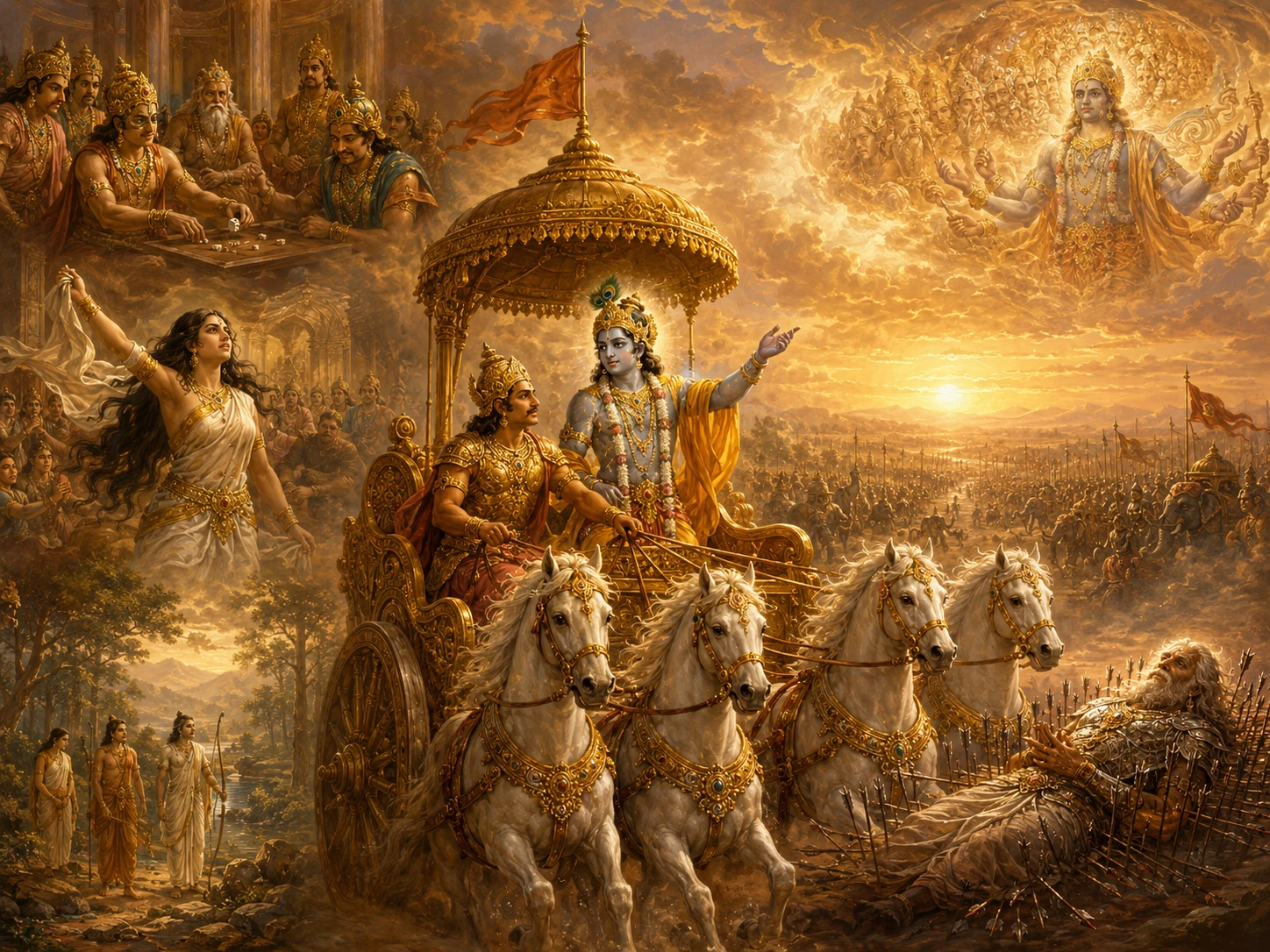
Draupadi in the Sabha -- The Trial That Started the War
सभा में द्रौपदी -- वो अपमान जिसने महायुद्ध जन्माया
The game of dice in the Sabha Parva (Mahabharata, Book 2) is not about gambling. It is about power, humiliation, and the catastrophic failure of every institution designed to protect the vulnerable. Yudhishthira, the eldest Pandava, is invited to a dice game by Dhritarashtra. He cannot refuse -- refusing a royal invitation to a public game would be a breach of Kshatriya dharma. The game itself is rigged: Shakuni, Duryodhana's maternal uncle, plays with loaded dice.
Yudhishthira loses everything. His wealth. His kingdom. His brothers. Himself. Then, goaded by Duryodhana, he stakes Draupadi. And loses her too.
The moment Draupadi is declared 'won,' Duryodhana sends Pratikami (a messenger) to summon her to the court. Draupadi, who is in her menstrual period and wearing a single garment, sends back a question that freezes the entire assembly: 'If Yudhishthira had already lost himself, how could he stake me? A man who has lost his own freedom has no legal standing to wager another person.'
This is not a plea for mercy. It is a point of law. Draupadi is asking the Kuru court to adjudicate a contractual question: did the wager have legal validity given the staker's own prior forfeiture? The question is addressed to Bhishma, the patriarch. To Drona, the teacher. To Vidura, the wise minister. To Dhritarashtra, the blind king. To every Kshatriya elder who has sworn to protect dharma.
None of them answers.
Bhishma's silence is the loudest sound in the Mahabharata. He later admits to Yudhishthira: 'The ways of dharma are subtle. I cannot determine the answer to Draupadi's question.' This is the man who gave up a throne, a dynasty, and a lifetime of love for dharma. And when dharma needed him most -- when a woman was being dragged by her hair into a room full of men -- he sat.
Dushasana drags Draupadi into the sabha. Duryodhana orders her disrobed. What follows -- the attempted vastra-haran (disrobing) -- is the Mahabharata's Rubicon. After this, peace becomes impossible. Every diplomatic mission that follows (Sanjayas, Krishna's peace attempt in the Udyoga Parva) is essentially a formality. The war was declared in the Sabha, not at Kurukshetra.
Draupadi's response to the disrobing attempt has two registers. In the devotional reading (emphasized by later texts and popular tradition), she raises her hands and cries out to Krishna, who miraculously makes her sari infinite -- Dushasana pulls and pulls but the cloth never ends. In the critical Mahabharata text (BORI Critical Edition), the divine intervention is less theatrical. What is consistent across all versions is that Draupadi survives the attempt -- and she remembers.
She remembers everyone who sat.
Draupadi's vow -- that she will not tie her hair until it is washed in Dushasana's blood -- is not hyperbole in the Mahabharata's moral universe. It is a legal oath with cosmic consequences. Bhima takes the corresponding vow: he will tear open Dushasana's chest and drink his blood. Both vows are fulfilled during the Kurukshetra war. The Mahabharata does not flinch from showing the fulfillment. Bhima literally tears Dushasana apart on the battlefield and smears blood in Draupadi's hair.
Modern readers recoil from the violence. But the text demands attention to context: the violence of the vow's fulfillment is presented as proportional to the violence of the Sabha. Draupadi was not just humiliated -- she was subjected to what any modern legal framework would classify as sexual assault in a judicial setting, witnessed by the highest authorities in the land, none of whom intervened. The Mahabharata is saying: when the system fails this completely, the consequences will be exactly this extreme.
For women in India today, the Sabha episode is not a dusty mythological reference. It is a structural mirror. The woman who files a sexual harassment complaint with the Internal Complaints Committee only to watch the accused get a transfer instead of termination -- she is living the Sabha. The girl who is assaulted on a bus in Delhi and watches the news cycle move on within a week -- she knows what it means when Bhishma sits. The female IAS officer whose male colleagues sabotage her district postings and then express confusion when she pushes back with force -- she understands Draupadi's vow.
Draupadi's legal question remains one of the most analyzed passages in Indian jurisprudence and political philosophy. Professor Upendra Baxi of Delhi University's law faculty has written about it in the context of rights theory -- Draupadi is effectively arguing that personhood cannot be wagered, that there are inalienable rights that survive even voluntary submission. Mahatma Gandhi invoked Draupadi's humiliation as a metaphor for India under colonial rule. B.R. Ambedkar cited the caste dynamics of the Sabha (Draupadi's Kshatriya status should have protected her, but power trumped caste) as evidence that even the varna system's supposed protections were hollow.
Vidura is the only voice in the Sabha who speaks. He tells Dhritarashtra that the dice game is adharma, that Draupadi's question is legally valid, that the kingdom is heading for destruction. Dhritarashtra ignores him. Vidura is the classic example of the ethical advisor whose counsel is heard by no one -- the compliance officer whose reports gather dust, the whistleblower whose testimony is filed and forgotten. The Mahabharata honors Vidura's integrity but is ruthlessly honest about its futility.
Duryodhana's behavior in the Sabha reveals the psychology of institutional abuse. He does not just want Draupadi humiliated. He wants it to be public. He wants the court to witness it. He wants everyone to be complicit. When he slaps his thigh and invites Draupadi to sit on it -- a sexual taunt in front of the assembled Kshatriya order -- he is not acting alone. He is creating collective guilt. If everyone watches and no one stops it, everyone is responsible and therefore no one is.
This is the dynamics of workplace harassment, stadium racism, and political mob violence reduced to their essential mechanism. The perpetrator is not just the person who acts. It is every person in the room who does not.
Karna's role in the Sabha adds another dimension. He calls Draupadi a 'woman of loose character' for having five husbands and suggests she be treated as a servant. Karna -- the outsider who knows what humiliation feels like -- humiliates another vulnerable person when given the chance. The Mahabharata understands something that modern psychology has documented extensively: the abused do not always become protectors. Sometimes they become abusers. Karna's behavior in the Sabha is the single largest stain on his otherwise sympathetic character, and the text does not let him escape it.
The aftermath of the Sabha game includes a second dice game (the Pandavas, freshly restored by Dhritarashtra's guilty conscience, are challenged again and lose again) and the twelve-year exile plus one year of incognito living. But the real aftermath is simpler: Draupadi remembers. Every year of exile, every night in the forest, every moment of hiding during the Virata year -- she remembers who sat in that Sabha and said nothing.
किमेकं धर्मतः शुद्धं सर्वलोकेषु भारत। भीष्मो द्रोणः कृपो विदुर गान्धारी मम प्रश्नं उत्तरं किम्॥
kimekaṃ dharmataḥ śuddhaṃ sarvalokeṣu bhārata | bhīṣmo droṇaḥ kṛpo vidura gāndhārī mama praśnaṃ uttaraṃ kim ||
What is pure according to dharma in this assembly, O Bharatas? Let Bhishma, Drona, Kripa, Vidura, and Gandhari answer my question.
— Mahabharata, Sabha Parva, Dyuta Parva section (Draupadi's challenge to the court; paraphrased from Ganguli, Section 67)
Who Was Present in the Sabha -- And What They Did
| Person | Role | Response to Draupadi's Humiliation | Why It Matters |
|---|---|---|---|
| Bhishma | Patriarch, grandsire | Silent. Later admitted he could not answer her question. | The most powerful man did nothing -- institutional failure at the top |
| Drona | Royal guru, teacher of all princes | Silent. | Education system failed to protect its own student's wife |
| Vidura | Minister, voice of dharma | Spoke against the game. Was overruled. | Ethical counsel without authority is futile |
| Dhritarashtra | Blind king, legal authority | Listened. Did nothing. Later reversed the game out of guilt. | Political authority that acts only after the damage |
| Karna | Warrior, outsider turned insider | Insulted Draupadi verbally. Called her unchaste. | The oppressed can become oppressors when given power |
| Duryodhana | Crown prince, orchestrator | Ordered the disrobing. Taunted her sexually. | Perpetrator who used institutions to weaponize humiliation |
| Yudhishthira | Draupadi's husband, gambler | Sat in silence, bound by the dice game's rules. | Complicity through passivity -- even victims can fail other victims |
The Mahabharata assigns different shades of culpability to each figure. No one is fully innocent. This moral complexity is the text's enduring power.
In 2013, after the Nirbhaya gang rape case shook India, protestors at India Gate in Delhi held placards reading 'Where are our Bhishmas now?' and 'Draupadi is still asking her question.' The Mahabharata's Sabha episode was cited in parliamentary debates on the Criminal Law (Amendment) Act 2013, which strengthened sexual assault laws. The connection between mythological silence and modern institutional failure was explicitly drawn by multiple MPs across party lines.
Find the Sabha Parva in the Mahabharata
The Sabha Parva runs from Maya Danava's palace to the dice game and Draupadi's question. The Mahabharata text is not yet on Eternal Raga; the overview article maps all eighteen parvas so you know where to look in a full translation.
Tags
Eternal Raga · शाश्वत राग
Institutional voice — scholarly articles on Sanatan Dharma
Deepen Your Understanding
अपनी समझ और गहरी करें
scriptural exegesis
Karna's Tragedy -- The Sun's Forgotten Son
Born with divine armor, abandoned at birth, raised by a charioteer, humiliated for his caste, cursed by his teacher, and killed while defenseless -- Karna's story is not the Mahabharata's subplot. It is the Mahabharata's conscience. Every system that failed him is a system that still fails people today.
scriptural exegesis
Bhishma's Terrible Vow
A crown prince gave up the throne, love, marriage, and children -- forever -- so his father could marry a fisherwoman. That single vow made Bhishma immortal in name and set the entire Mahabharata into motion. Was it the noblest sacrifice in literature, or the most catastrophic?
scriptural exegesis
Yaksha Prashna -- Questions at the Lake
Four brothers lie dead beside an enchanted lake. One brother remains. A voice from the water asks 124 questions about dharma, death, happiness, and the self. Yudhishthira's answers in Vana Parva remain the most sophisticated ethical examination in all of Sanskrit literature.
scriptural exegesis
Sita and Draupadi -- The Two Women Who Triggered Two Great Wars
Every Indian knows that the Ramayana happened because Sita was abducted and the Mahabharata happened because Draupadi was disrobed. But here is the question nobody asks: were these women the cause of war, or the consequence of systems that had already failed? The answer reframes both epics.
scriptural exegesis
Women Power in Ancient India -- Scholars, Warriors, and Queens the Textbooks Erased
Gargi debated the greatest philosopher of her age and he could not defeat her. Maitreyi rejected a fortune for the pursuit of knowledge. Vishpala lost a leg in battle, got an iron prosthetic, and went back to fight. Kaikeyi drove Dasharatha's chariot in war and saved his life. These are not feminist reimaginings. These are the primary texts. And they tell a very different story from the one you were taught.
scriptural exegesis
Mahabharata -- History or Myth? What the Evidence Actually Says
Submerged cities off Gujarat. 35+ archaeological sites matching the epic's geography. 200+ astronomical events verified by planetarium software. A river that vanished exactly as the text describes. Five categories of evidence that do not 'prove' the Mahabharata -- but make dismissing it as pure fiction increasingly difficult.
In 2013, after the Nirbhaya gang rape case shook India, protestors at India Gate in Delhi held placards reading 'Where are our Bhishmas now?' and 'Draupadi is still asking her question.' The Mahabharata's Sabha episode w…
More in Scriptural Exegesis
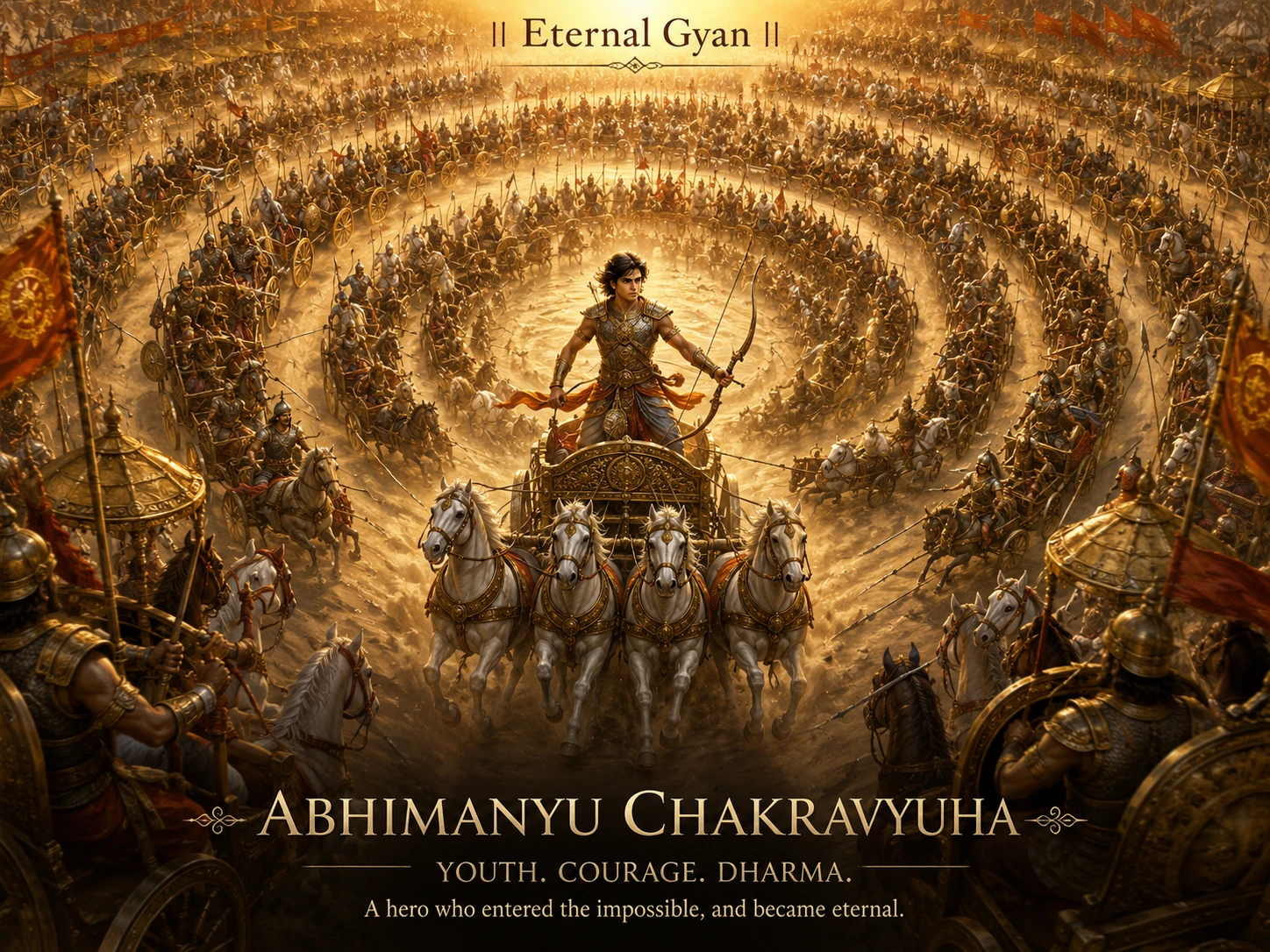
Abhimanyu and the Chakravyuha -- The Boy Who Knew How to Enter but Not How to Leave
14 min read
Adbhuta Ramayana -- The Ramayana Where Sita Becomes Kali
9 min read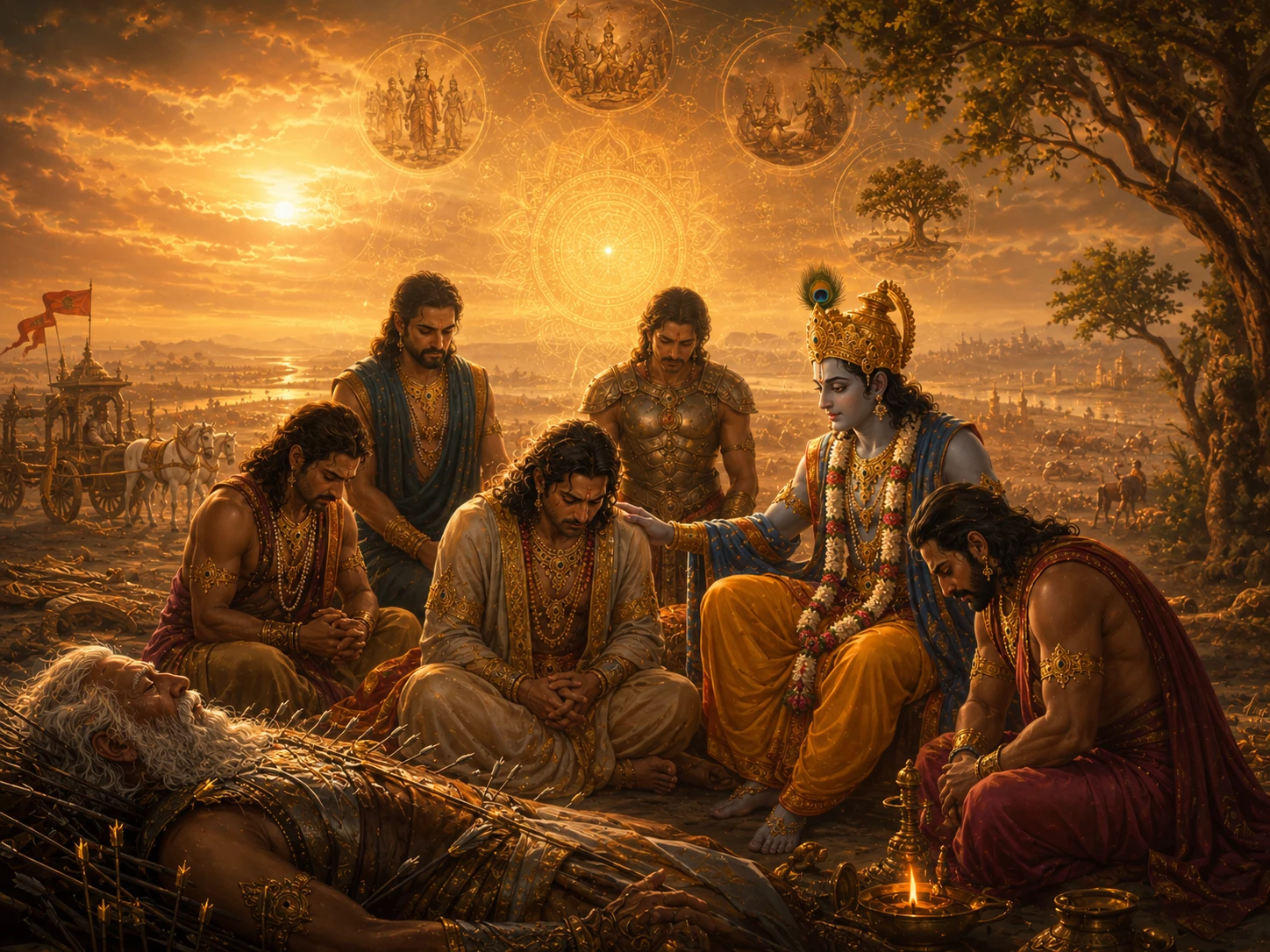
After Kurukshetra -- What Happened Next
14 min readThe same translation error that turned '33 Koti' into '33 crore' in Hinduism also happened in Buddhism. The Chinese translation of Buddhist texts rendered 'Sapta Koti Buddha' (7 Supreme Buddhas) as '7 Crore Buddhas.' The…
Deities AvatarsCommunity Reflections
🕉️
Be the first to share your reflection.